Manufacturing of pharmaceutical tablets
 Call Kai
 Learn
 Practice Test
 Spaced Repetition
 Match
 Flashcards
 Knowt Play
1/26

There's no tags or description
Looks like no tags are added yet.
27 Terms
Manufacturing methods for tablets
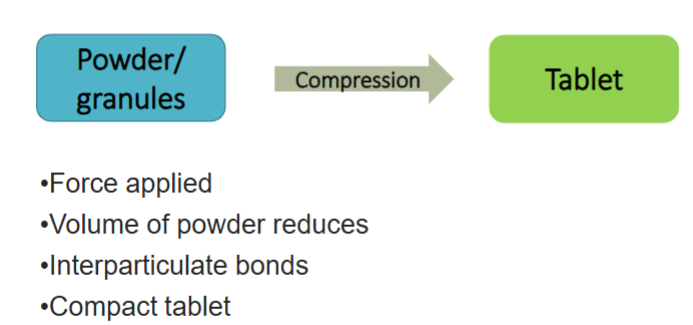
Compression: Tablets are formed by compressing a powder or granule blend into a solid dose using high pressure
Extrusion/Melt granulation: This technique uses heat or mechanical energy to melt and extrude materials, forming granules that are later compressed into tablets
Moulding: Powder mixtures are moistened and shaped in moulds, then dried to form tablets
Freeze-drying: A liquid or semi-solid mixture is frozen and dried under vacuum to yield a porous, fast-dissolving tablet
3D printing: Layer-by-layer deposition of materials allows fabrication of tablets with precise geometry and tailored release profiles
Tablet production stages
Die filling - powder flows from hopper to die closed at base by lower punch
Powder compaction - upper punch lowers into die and applies compression force until tablet is formed
Tablet ejection - lower punch rises, and tablet is ejected
Compression and compaction
Compressibility
Tendency to reduce in volume when force is applied
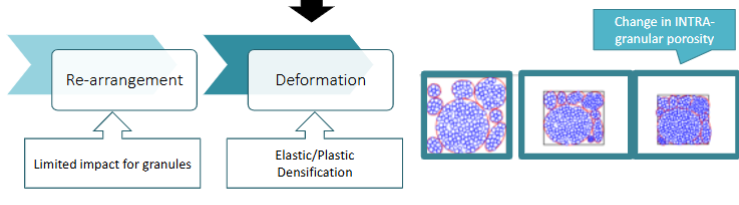
For powders, compression can lead to changes in the physical properties of the primary powder particles
Elastic deformation:
Revisible
Cohesive forced will be lost
Plastic deformation:
Irreversible
Cohesive forces will be retained

Compression and compaction - factors that affect yield point
Polymorphism
Salf form
Moisture content
Partcile size
Compression force

What can compression lead to for granules?
Changes in the physical properties of the primary powder particles
Changes in the physical properties of the granules
Why is it important for powders to cohere when forming tablets?
Form tablets highly resistant to:
Fractures
Capping: partial or total fracture of the top or bottom layer in a tablet
Lamination: separation of tablets into layers

What may go wrong during tablet manufacture?
High weight and dose variation
Low mechanical strength
Capping and lamination
Adhesion of powder to punch tips and surface
High friction during tablet ejection
Excipients and tablet manufacturing considerations - die filling
Die is filled by volume not weight
Poor powder flow = lack of reproducibility in die filling
Different volumes = different weight
Weight/content uniformity
Glidants - improve powder flow be decreasing cohesive forces
Particularly important for direct compression
Added just before compression
Excipients and tablet manufacturing considerations - powder/granule compaction
Compression force and inter-particle bond
Binders – adhesive
Fillers – good technical properties (compactability)
Promote inter-particle bond formation
Granulation
Direct compression
Excipients and tablet manufacturing considerations - tablet ejection
Friction between tablet and die wall will obstruct ejection
May lead to tablet fracture
Lubricants reduce friction
Anti-adherent: prevent sticking to punches and die wall
Excipients and tablet manufacturing considerations - direct compression
Filler: good compactability, good flow
Binder: ductile material (plastic deformation)
Disintegrant: to promote disintegration after administration
Glidant: increase powder flow in the hopper shoe and die
Antiadherent: prevent sticking to punches and die wall
Lubricant: decrease friction during tablet ejection
What are the three main methods used to manufacture pharmaceutical tablets?
Direct compression – powders are blended and compressed directly into tablets without granulation
Wet granulation – powders are mixed with a liquid binder to form granules, which are dried and compressed
Dry granulation – powders are compacted into larger masses or slugs, which are milled into granules before compression
What is direct compression?
API and excipients are blended together and compressed directly into tablets without undergoing a granulation process
The powder blend must have suitable flow and compression properties
Suitable for:
Heat sensitive APIs
Good flow, not prone to segregation
Compactability
Drugs with adequate solubility
Highly potent drugs

Advantages and disadvantages of direct compression
Advantages:
Production cost - no additional process
Product stability - API present in original form
Drug dissolution - disintegration to primary particles
Disadvantages:
Powder flowability and bulk density required
More expensive dry binders and required
Why granulate before tabletting?
Powder flow properties – weight/content uniformity
Mixing homogeneity
• Die filling
Compactability
Dissolution of poorly soluble drugs
Storage
What is wet granulation?
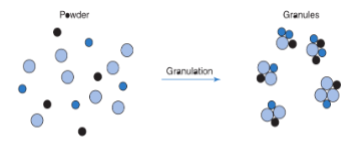
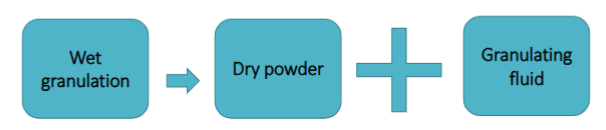
Powders are mixed with a granulating liquid, usually containing a binder, to form larger aggregates called granules
The granules are then dried, sized and compressed into tablets
Liquid content - 20%-50% of the dry powder weight
Binder added as dry powder before granulating fluid
Dry binder dissolved in granulating fluid
What are the main steps involved in wet granulation?
Weighing: Measure the API and excipients
Sieving: Remove lumps and break up aggregates
Dry mixing: Mix the API with suitable excipients, such as diluents
Binder preparation: Prepare a binder solution or dispersion
Wet massing: Add the granulating liquid to the powder blend to form a wet mass
Granulation: Pass the wet mass through a sieve or use a granulator to produce granules
Drying: Remove excess moisture from the granules
Sizing: Pass dried granules through a sieve to obtain a suitable particle size distribution
Final blending: Add external excipients, such as disintegrants and lubricants
Compression: Compress the final blend into tablets

What is dry granulation?
Powders are compacted together without adding a liquid binder
The compacted material is then broken down into granules, which are blended with additional excipients and compressed into tablets
Liquid not required
Primary powder particles aggregated under high pressure
Slugging - large tablet
Rolling - sheet or flakes
Milling
Sieving - to achieve desired granule size
Suitable for moisture sensitive materials
What are the main steps involved in dry granulation?
Weigh and measure the API and excipients
Sieve ingredients if necessary
Blend the powders together
Compact the powder using a roller compactor or slugging machine
Break down the compacted material into granules
Mill and sieve the granules to obtain a suitable size
Blend with additional excipients, such as lubricants and disintegrants
Compress the final blend into tablets

Tablet presses
Single-punch press
Research and development
Low output (130-200 tablet per minute)
Rotary press
Large scale production
Up to 10,000 tablets per minute
Compaction simulator
Used for optimisation of compression settings
Predict potential compression issues
Mimic production process
Melt granulation
Moisture sensitive

Moulded tablets
Drug mixed with diluent – water soluble e.g., lactose, sucrose, mannitol
Liquid added to allow moulding – alcohol/water mixture
Tablet generated after evaporation under vacuum
Advantage:
Disintegrate quickly
Disadvantage
Small size limits use to drugs active at low doses
Freeze-dried tablets
Process:
Mixing of drug with gelatine and sugars
Filling of blister
Freezing
Freeze-drying and sealing

Freeze-dried tablets - advantages and disadvantages
Advantages:
Fast disintegration – ODTs are typically produced by freeze drying
Suitable for patients with difficulty swallowing
Useful for thermo-labile materials
Disadvantages
Taste and feel may be an issue
Tablets are soft and will break if forced through the blister
3D printed tablets
Emerging field in pharmaceutical manufacturing
Materials deposited layer by layer to form dosage form entity – e.g. API, binder
Deposition – solidification
Laser-based writing systems
Printing-based inkjet systems
Nozzle-based deposition systems
3D printed tablets - advantages
Dimensions and designs unachievable by traditional methods
Personalised medicine
Polypills – multiple drugs in one tablet with individual dose and release profile
Controlled drug release
Patient compliance
3D printed tablets examples
Spritam – levetiracetam
Anti-epileptic - partial-onset seizures
First FDA approved 3D printed medicine
Binder jetting technology