spinal cord & nerves
 Call Kai
 Learn
 Practice Test
 Spaced Repetition
 Match
 Flashcards
 Knowt Play
1/39

There's no tags or description
Looks like no tags are added yet.
40 Terms
What are the functions of the spinal cord?
Conduction: information from body → brain & vice versa
Locomotion: continuation of walking
Reflexes: involuntary responses to stimuli
What are the regions of the spinal cord?
Cervical region
Thoracic region
Lumbar region
Sacral region
Coccygeal region
What is different between the cervical and lumbar regions and why?
Cervical Enlargement: nerves for upper extremities
Lumbar Enlargement: nerves for lower extremities
What are the structures of the spinal cord that are important for this chapter?
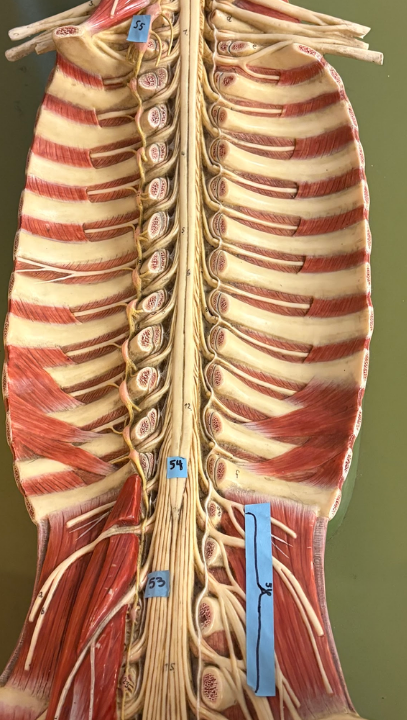
Conus medullaris (54)
Cauda equina (53)
Terminal filum
Anterior median fissure / Ventral median fissure
Posterior median sulcus / Dorsal median sulcus
Functions of Meninges in Spinal Cord
Meninges: fibrous connective tissue that surrounds the CNS
❑ Epidural space: between vertebra and dura mater; contains blood vessels, adipose tissue, and areolar connective tissue (location where anesthetics are introduced)
– Dura mater: outermost layer for stability
❑ Subdural space: potential space between the dura mater and the arachnoid mater
– Arachnoid mater: simple squamous epithelium + mesh of collagenous and elastic fibers
❑ Subarachnoid space: filled with CSF
– Pia mater: innermost layer that is on the surface of the spinal cord made of elastic and collagen fibers
• Terminal filum: extension of the pia mater
What are the different parts of gray matter in the spinal cord?
Posterior horns / Dorsal horns
Anterior horns / Ventral horns
Lateral horns
Gray commissure
What is the space within the spinal cord called? How is it different from adults vs children?
Central canal
contains CSF that has ependymal cells in children
What are the different parts of white matter in the spine?
Posterior column / Posterior funiculus / Dorsal column / Dorsal funiculus
Lateral column / Lateral funiculi
Anterior column / Anterior funiculus / Ventral column / Ventral funicul
What information do ascending vs descending tracts carry?
Ascending tracts: carries sensory information up the spinal cord
Descending tracts: carry motor information down the spinal cord
What are decussation, ipsilateral, contralateral?
Decussation: crossing over from left to right side of the body (vice versa)
Ipsilateral: no decussation occurs so tracts are on the same side
Contralateral: decussation occurs and tracts crosses over to other side of the body
How many spinal nerves do we have?
31 Pairs
Where does the first spinal nerve go through?
First pair between skull and C1
How many spinal nerves for each region of the spinal cord
– 8 Cervical (C1-8)
– 12 Thoracic (T1-12)
– 5 Lumbar (L1-5)
– 5 Sacral (S1-5)
– 1 Coccygeal (Co)
What type of information goes through the spinal nerve proper?
sensory and motor information
If it is sensory information what are the structures it’ll go to next from the spinal nerve proper?
Dorsal horn → Dorsal root → Dorsal root ganglion
If it is motor information, what are all the structures that motor information comes from that goes to the spinal nerve proper?
Ventral horn → Ventral root
What type of information is carried in the posterior ramus and where does it go to?
carries all sensory, motor, and visceral
innervates the muscles and joints in spine (ie: erector spinae) and back skin
What type of information is carried in the anterior ramus and where does it go to?
carries all sensory, motor, and visceral
innervates the anterior and lateral skin and muscles of the trunks and nerves of limbs
What structures comes off of/goes through the anterior/posterior ramus and what do they do?
Communicating rami: connects to sympathetic chain ganglia
Gray Communicating Ramus
White Communicating Ramus
Intercostal nerve: thoracic region innervating skin and intercostal muscles, and abdominal muscles
Nerve plexuses: group of spinal nerves coming and dispersing

What is a dermatome?
area of skin where each spinal nerve innervates
What is referred visceral pain?
pain from an organ that is referred to a dermatome
What are the different nerve plexuses?
Cervical plexus
Brachial plexus
Lumbar plexus
Sacral plexus
Coccygeal plexus
What nerve comes off of the cervical plexus and its function?
Phrenic nerve
Which spinal nerves make up this Phrenic nerve?
C3 - C5
What divisions come off of the brachial plexus?
Posterior and Anterior division
What nerves come from each division off of the brachial plexus?
Posterior division
Axillary nerve: sensory information from shoulder and arm; muscular innervation for deltoid and teres minor muscles
Radial nerve: sensory information from the posterior arm and forearm; muscular innervation for the extensor muscles of arm and forearm
Anterior division
Musculocutaneous nerve: sensory information of the lateral forearm; muscular innervation for anterior arm muscles
Median nerve: sensory information of from hand, digits; innervates muscles of the forearm flexors
Ulnar nerve: sensory information of the medial part of the hand and digits; innervates muscles of the forearm flexors

What nerve comes off the lumbar plexus and what does it do?
Femoral nerve
What nerves come off the sacral plexus and its functions.
Sciatic nerve: largest and longest nerve; innervates hamstring muscles
What nerves does the sciatic nerve become and its functions?
Tibial nerve: Supplies sensory information from posterior leg and sole of the foot
Common fibular nerve
What are reflexes and its properties?
quick, involuntary, stereotyped reactions of glands or muscles
Stimulation: reflexes respond to some stimulus
Quick: contain little to no interneurons
Involuntary: reflexes occur without higher brain centers involved
What are the components of a reflex arc and its order? (7 steps)
Stimulus
Receptor
Afferent neuron / Sensory neuron
Integrating center
Efferent neuron / Motor neuron
Effector
Response
What are the different proprioceptors and its function and locations they are found?
Muscle spindles
Golgi tendon organs
Joint kinesthetic receptors
Name a specific type of stretch reflex?
Patellar/knee-jerk reflex
What type of reflex is the Patellar/knee-jerk reflex?
Tendon reflex
What is a monosynaptic vs polysynaptic reflex arc?
Monosynaptic reflex arc: primary afferent neuron synapses directly on the motor neurons
Polysynaptic reflex arc: involves multiple synapses
Is the monosynaptic reflex or the polysynaptic reflex arc faster?
Monosynaptic, because it connects with only one synapse
What is a withdrawal/flexor reflex?
contracts flexor muscles to withdraw limb from injury also causing reciprocal inhibition
What type of reflex is the withdrawal/flexor reflex?
Polysynaptic reflex arc
Name all the structures sensory information will go through from receptor to CNS (8)
Sensory Receptor
Peripheral Sensory Neuron
Dorsal Root Ganglion
Dorsal Root
Dorsal Gray Horn
Ascending Tract
Brainstem
Primary Sensory Cortex
Name all the structures motor information will go through from CNS to effector (8)
Cerebral Motor Cortex
Upper Motor Neuron
Brainstem
Spinal Cord
Lower Motor Neuron
Ventral Root
Neuromuscular Junction
Effector