[3A] The Scientific Study of Nutrition
 Call Kai
 Learn
 Practice Test
 Spaced Repetition
 Match
 Flashcards
 Knowt Play
1/23

There's no tags or description
Looks like no tags are added yet.
24 Terms
one of the first to link nutrition (diet) with the incidence of chronic disease (CVD)
Farmington Heart Study
How old is nutrition as a form and evidence-based scientific discipline
Relatively very young (last 100 years)
The scientific method emphasizes creating a _________ hypothesis and then?
Falsifiable (the more the better, whatever is left must be true)
then gathering evidence to support or not support that hypothesis.
order of scientific method
observation and question > hypothesis > experiment > theory (when hypothesis supported) OR new observations and questions (hypothesis not supported)
theories are very reliable (they just don’t have final confirmation to make it a law)
Pellagra
disease characterized by dermatitis (“sunburn-like” damage in exposed areas), diarrhea, and dementia
What 3 observations did scientists observe about pellagra?
More common amongst poor and institutionalized (hospital patients, orphans in state homes, prisoners).
Staff who worked in hospitals, orphanages, and prisons did not suffer pellagra, even if the residents did.
Most common in SE USA, which economically and nutritionally depended on cotton and corn.
Based on these observations for pellagra, what hypothesis was proposed? Why?
pellagra was due to a dietary deficiency in the affected populations
More common amongst poor and institutionalized (could be diet, access to HC, racial disparities?)
Staff who worked in hospitals, orphanages, and prisons did not suffer pellagra, even if the residents did (suggests non infectious)
Most common in SE USA, which economically and nutritionally depended on corn and cotton (could imply something wrong with corn, working outside all the time)
How did they test the pellagra hypothesis? What were the results?
nutritious foods such as milk, fresh meats, and vegetables were added to the diets of children in two orphanages.
RESULTS: Symptoms disappeared with supplementation, supporting the hypothesis that pellagra is due to a deficiency of something in the diet > theory that pellagra is caused by a dietary deficiency of niacin (vit B3)
What indicates that treatment has an effect?
A difference between treatment and control
Control groups should be what to treatment group
similar (i.e. age, sex, diet) to remove confounding effects
What is the purpose of placebo
Anticipation can lead to physiological effects, prevents participants from knowing which group they are assigned to
2 main types of study design in nutrition science
observational (epidemiological)
experimental (interventional)
Observational studies
do not attempt to affect outcomes (e.g., provide a treatment).
Often large pop, look for correlation, can suggest mechanism but doesn’t give you the mechanism
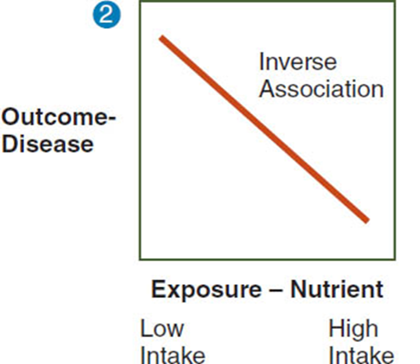
Difference between no association, inverse association, direct association
Inverse association: as one variable increases the other decreases
Direct association: as one variable increases the other also increases


cross-sectional study
researchers analyze a population at a single, specific point in time ("snapshot“) to identify factors that make that population unique.
e.g., People in the Mediterranean region drink lots of wine, eat plenty of fat from olive oil, and have a lower incidence of heart disease compared to North America and Europe.
cohort study
researchers follow a group of people who do not have an outcome at baseline to estimate the incidence of the outcome over time
e.g., How many people born in 1995 in China developed iodine deficiency by 2015?
case-control study
researchers compare people with and without an outcome (e.g., diabetes) to find factors associated with an outcome
(end of cohort study)
Experimental (interventional) studies
Find causation and relationship
Attempt to uncover a direct, causal relationship between two variables by comparing groups with (treatment) and without (control-control, placebo) an intervention applied to them.
Generally more powerful than observational studies, but they are also much more difficult to conduct (costs, ethical considerations, and approval processes)
Gold standard of human interventional studies
double-blind randomized control trial (RCT)
Data dredging “p-hacking”
abuse of data mining where large compilations of data are examined to find any correlation, without any pre-defined hypothesis (e.g., to explain the mechanism of the correlation).
What is the “File drawer” problem
Papers that have more significant results get more attention – someone will do a good study with larger P, data gets put into “file drawer”, if a study doesn’t have a huge stat significance why do we need to publish it?
Fabricated trends on graph - line
If you put a line through it that suggests a significant trend which can sometimes be misleading (drawing trendlines through uncorrelated P > 0.05)
What are the best measurements for effect size and relationship
R² [scatter] or Fstat
NOT P
What does each part of CRAAP stand for
C - currency: timeliness of information
R - relevancy: importance of info for your needs
A - authority: source of information
A - accuracy: reliability, truthfulness, correctness of content
P - purpose: reason information exists