CSA abdomen- me + erin
 Call Kai
 Learn
 Practice Test
 Spaced Repetition
 Match
 Flashcards
 Knowt Play
1/277

There's no tags or description
Looks like no tags are added yet.
278 Terms
lumbar spine
forms the posterior border of the abdominal cavity & is made of 5 vertebrae
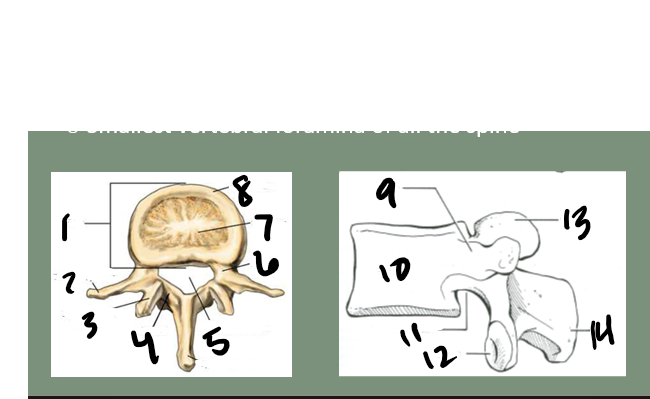
what has the smallest vertebral foramina of the spine and do NOT contain transverse foramina?
lumbar spine
what originates from the sternal process, costal cartilages, bone of ribs 7-12, & forms a septum between thoracic & abdominal cavities?
diaphragm
what is the muscular parts of the diaphragm that originates from the lumbar vertebrae & travel to central tendon on right & left sides of the vertebrae
crura (crus)
what is smooth serous membrane divided into PARIETAL AND VISCERAL & has the purpose of secreting lubricating fluid to reduce friction between organs & supports organs holding them in place?
peritoneum
lines the abdominal cavity
parietal peritoneum
lines the outside of the organs
visceral peritoneum
space between the visceral & parietal peritoneum
peritoneal cavity
what is the double folded layer of peritoneum in posterior abdomen that attaches the intestines to the posterior abdominal wall?
mesentery
mesentery contains
arteries, veins, & nerves for intestine
what is the primary site for fat storage in the body?
mesentery
space behind the peritoneal cavity that is ADJACENT TO POSTERIOR ABDOMINAL WALL
retroperitoneal space
what does the retroperitoneal space contain?
kidneys
pancreas
distal duodenum
ascending colon
descending colon
3 parts of stomach
fundus
body
pylorus
what is the site of major part of digestion
small intestine
duodenum length
10” (smallest)
jejunum length
9 feet
ileum length
11 feet (longest)
duodenum overview
“C” shaped around head of pancreas
only the superior part lies within the peritoneum (remaining parts are fixed within the retroperitoneal)
where does the jejunum usually lie?
umbilical region
where does the ileum usually lie?
lower abdomen/pelvis (terminates at LRQ)
what extends from the terminal ileum to the anus?
large intestine
large intestine lengths)
5-6 feet (1.5 meter
2 parts of large intestine
cecum- posterior to peritoneum (location of appendix)
colon- ascending & descending
ascending colon
upper part lies anterior to R kidney
located retroperitoneal
transverse colon
lies adjacent to anterior abdominal wall
does the hepatic or splenic flexure lie lower?
hepatic (due to liver)
what goes from splenic flexure to pelvic inlet, joins the sigmoid colon, retroperitoneal, and fixed in position
descending colon
largest gland in the body
liver
liver has 4 lobes which are:
right
left
quadrate
caudate
place where portal vein, hepatic artery, lymphatics, & nerves enter the liver (“hilum” of the liver)
porta hepatis
porta hepatis location
slit on inferior surface of the right lobe
what separates the left lobe from the right lobe & connects the liver to the umbilicus?
ligamentum teres
left lobe of the liver lies ___ to the body of the stomach
anterior
right lobe of the liver lies___ to the gallbladder
lateral
what is the attachment of the liver to anterior wall of abdomen called?
falciform ligament
what is the small posterior lobe of the liver that extends IVC to porta hepatis
caudate lobe
what lobe of the liver is small & anterior & situated between the gallbladder & ligamentum teres
quadrate lobe
what exits the liver at the porta hepatis & joins to form the common hepatic duct
left & right hepatic ducts
what is located beneath the liver & is a reservoir for bile produced by the liver
gallbladder
the cystic duct carries bile from ___ to ___
gallbladder to common hepatic duct
what is posterior to the superior duodenum & beside the head of the pancreas & formed by the union of the common hepatic duct & cystic duct?
common bile duct
what transports bile from the gallbladder (via cystic duct) & the liver (via hepatic duct) to the duodenum?
common bile duct
soft lymphatic organ located in the upper left abdomen & acts primarily as a filter for blood & plays a role with the immune system & RBCs
spleen
what is posterior to the stomach & lies transversely & is a collection of glandular tissue
pancreas
endocrine function of the pancreas
insulin/glucagon
exocrine function of pancreas
digestive enzymes
pancreas head lies
with curvature of the duodenum
pancreas body lies
posterior to stomach, anterior to left kidney
pancreas tail lies
toward surface of spleen
what runs along the inside of the pancreas & joins with the common bile duct
pancreatic duct
the pancreatic duct enters the duodenum at___
sphincter of oddi
where are kidneys centered around
L1
what organ has the function of filtering fluid & waste products from the blood for form urine?
kidneys
how kidney works
urine collects in renal pelvis & drains into the ureters
many anomalies may occur in what organ
kidney
what originates from renal pelvis of the kidney & extends down the psoas muscle & is located retroperitoneal
ureters
what produce epinephrine & norepinephrine?
endocrine glands (in adrenal gland atop of kidneys)
arterial vs venous blood flow
arterial- oxygenated
veinous- deoxygenated
what part of the aorta travels from the diaphragm to the pelvis, is on the left side of the vertebral bodies, and terminates at left & right common iliac arteries (L4)
descending aorta
what originates from abdominal aorta extending down & supplies blood to the small intestine & first half of the large intestine
superior mesenteric artery
what originates from the aorta in the mid lumbar region & supplies blood to the left half of large intestine
inferior mesenteric artery
just below SMA (superior mesenteric artery) & supplies blood to the kidneys
renal arteries
which renal artery is longer & travels behind the IVC to the kidney?
right renal artery
bilateral arteries arising from the abdominal aorta (L4)
common iliac arteries
common iliac arteries bifurfate into
left & right internal & external arteries
what arises at the juncture of left & right internal & external iliac veins, is anterior to L5-S1 joint space (extending a short distance to joint around L4) & is more posterior & inferior than iliac arteries
common iliac veins
common iliac veins purpose
drain venous blood from LOWER limbs & pelvis into IVC
which renal vein is longer?
left
what crosses in front of the aorta to IVC & drains blood from the kidneys & into IVC
renal veins
what is anterior to esophagus & descending aorta, right side of heart, formed by union of right & left common iliac veins (L5)
inferior vena cava
what drains most of lower half of body & empties into RIGHT ATRIUM
inferior vena cava
where does psoas muscles originate?
transverse processes of L1-L5
what is useful for finding ureters?
psoas muscles
muscles lining either side of the anterior abdominal wall & originates at symph & crest & inserts cartilage of 5th-7th ribs & xiphoid process
rectus abdominus
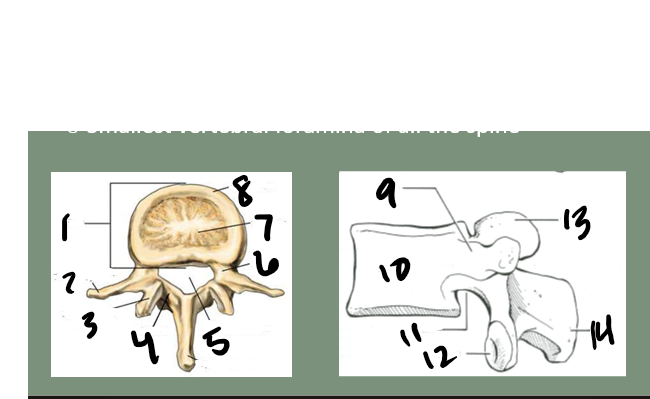
what is 1?
body

what is 2?
transverse process

what is 3?
superior articular process

what is 4?
lamina

what is 5?
vertebral foramen
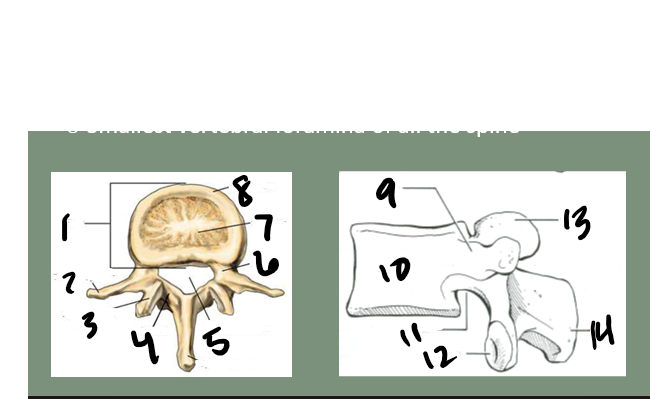
what is 6?
pedicle
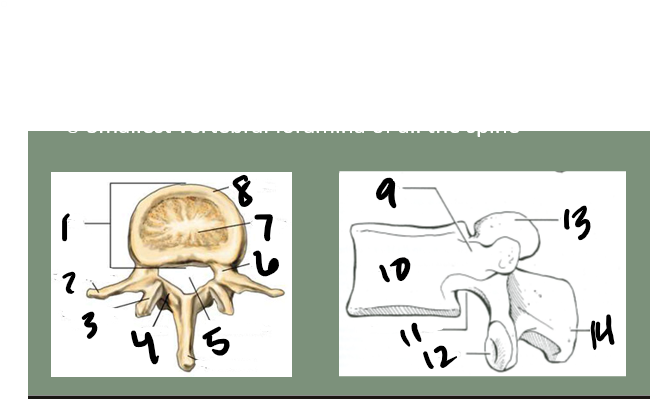
what is 7?
cancellous

what is 8?
cortical rim

what is 9?
pedicle
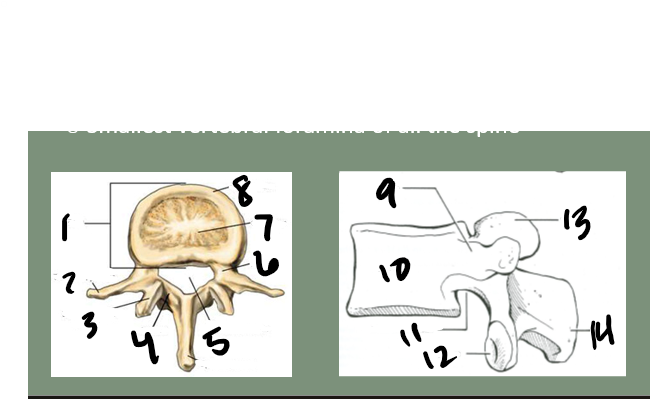
what is 10?
body

what is 11?
inferior vertebral arch

what is 12?
inferior articular process
what is 13?
superior articular process
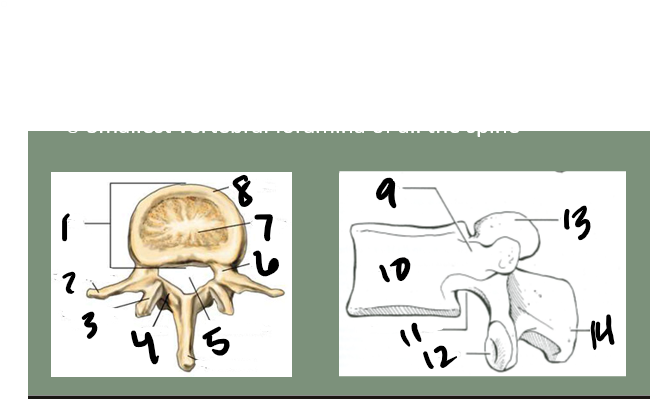
what is 14?
spinous process

what is A?
diaphragm (right side)

what is B?
diaphragm (left side)

what is 1?
right crus

what is 2?
left crus

what is 1?
left hemidiaphragm

what is A?
left hemidiaphragm

what is pink?
right crus of diaphragm

what is red?
parietal peritoneum

what is yellow?
peritoneal cavity

what is blue?
visceral peritoneum

what is blue?
intraperitoneal organ