Glycogen
 Call Kai
 Learn
 Practice Test
 Spaced Repetition
 Match
 Flashcards
 Knowt Play
1/60

There's no tags or description
Looks like no tags are added yet.
61 Terms
what is the storage form of glucose
glycogen
Role of glycogen in muscle
muscle contraction
Role of glycogen in liver
reservoir to maintain homeostasis of blood glucose
Glycogen tiered components small →large
Branched glucose chains →B glycogen granule →A glycogen granule
glycogen B granules are ___ granules
cytosolic
glycogen A granules are __ granules composed of _ B granules
protein-rich
composed of 20-40
Which releases glycogen faster: A or B granules?
B granules
What do A granules associate with
tubules of smooth ER
B granule structure
glycogenin dimer = primer
tiers of glucose residues + branches
Benefits of tiered branched glucose
many free nonreducing ends
Draw glucose a1→4 linkage
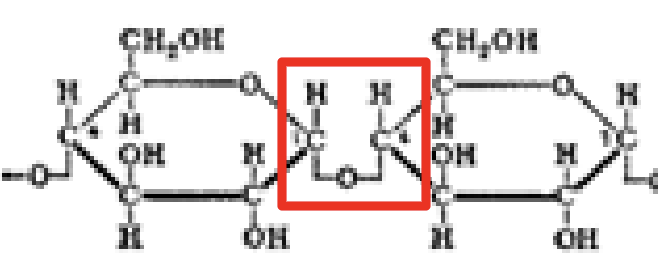
Draw glucose a1→6 linkage

What enzymes are involved with glycogenolysis
Glycogen phosphatase
Branching enzyme
Phosphoglucomutase
Glycogen phosphorylase
Catalyzes phosphorolytic cleavage at nonreducing ends
requires pyridoxyl phosphate cofactor
acts repeatedly until 4 glucose away from branch point
Draw glycogen phosphorylase steps

phosphorylates, removes glucose until 4 away from branch
Debranching enzyme
Transfers branch onto main chain (transferase activity)
releases residue at the a1→6 branch as free glucose (glucosidase)
Draw what the debranching enzyme does

transfers branch to main chain
removes branch point glucose
What happens to glucose 1 phosphate after glycogenolysis?
Is converted to glucose 6P for glycolysis (muscle) or converted to glucose in ER to replenish blood glucose (liver)
Phosphoglucomutase
Converts glucose 1 P ←> glucose 6P
Draw phosphoglucomutase steps
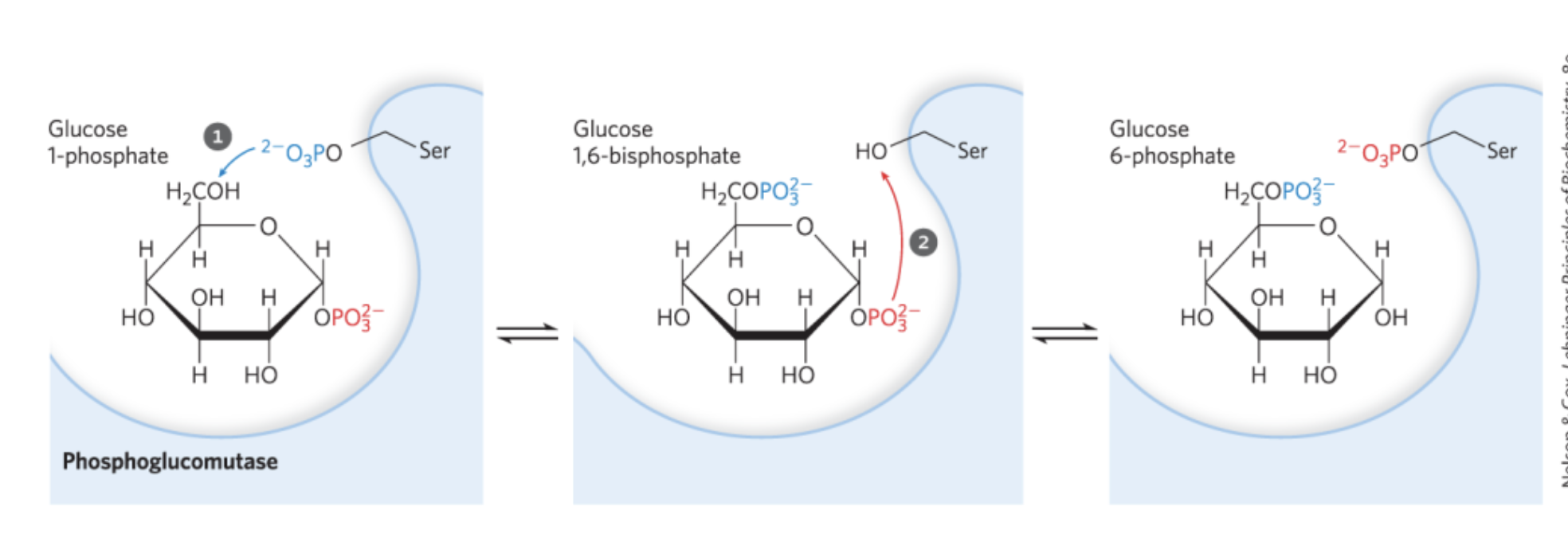
Ser-O-P transfers P to C6
Glucose 6-P transfers P to Ser-OH
What are the fates of glucose 6P
Muscle: enters glycolysis
liver: glucose 6 phosphatase converts it to glucose in ER for transport to replenish blood glucose
Glucose 6 phosphatase
glucose 6P →glucose
What are sources of glycogen 6P for glycogenesis
Hexokinase isozymes catalyze glucose + ATP ←> glucose 6P + ADP
Lactate taken up by the liver converted to glucose 6P by gluconeogenesis
What is the first step of glycogenesis
glucose 6P ←> glucose 1P
catalyzed by phosphoglucomutase
What is the 2nd step of glycogenesis
Glucose 1P + UTP → UDP-glucose + PPi
What enzyme converts glucose 1P to UTP glucose?
UTP glucose pyrophosphorylase
What is a sugar nucleotide
anomeric carbon is activated by attachment of a nucleotide
Draw UDP
= glucose w PPi attached at C1, linked to ribose-uridine

Why are sugar nucleotides suitable for biosynthetic reactions
formation metabolically irreversible
nucleotide moiety has many groups that can undergo noncovalent int w enzymes
nucleotidyl group (UDP, ADP) = excellent leaving group, facilitates nucleophilic attack
“tagging” w nucleotidyl groups distinguishes hexoses destined for other purposes
How is a sugar nucleotide made?
sugar phospahte attacks alpha P on NTP
—> NDP sugar + PPi
What makes the formation of a sugar nucleotide irreversible
Hydrolysis of PPi to 2 Pi
How is the glycogen chain elongated?
glycogen nonreducing end attacks UDP-sugar, transfering glucose to chain, releasing UDP
Draw how glycogen chain is extended

What enzyme catalyzes glycogen chain elongation
glycogen synthase
What enzyme catalyzes the formation of (a1→6) bonds
glycogen branching enzyme
What is the role of glycogenin
The primer on which new chains are assembled and the enzyme that catalyzes their activity
How does glycogenin make a primer?
OH on glycogenin’s tyrosine residue attacks UDP at anomeric carbon
Repeats 7 more times (8 total times)
How many times does the OH end on glycogenin attack UDP’s anomeric carbon
8x
Glycogen phosphorylase a vs. glycogen phosphorylase b
glycogen phosphorylase a=active (is phosphorylated)
glycogen phosphorylase b= less active (dephosphorylated)
Where is epinephrine located
muscle
Where is glucagon located
liver
What enzyme catalyzes glycogen phosphorylase b → a?
phosphorylase b kinase
What activates phosphorylase b kinase
glucagon (liver), epinephrine (muscle)= inc Ca2+, AMP
How is glycogen breakdown regulated?
Epinephrine + glucagon activate adenyl cyclase: ATP → cAMP
increased cAMP activates PKA
PKA + Ca2+ activate phosphorylase b kinase
phosphorylase b kinase phosphorylates glycogen phosphorylase b →a
glycogen phosphorylase a (active) + AMP: glycogen →glucose 1P
Role of Ca2+ in regulation
Signal for muscle contraction
binds to and activates phosphorylase b kinase
Role of AMP in regulation
accumulates in vigorously contracting muscle
binds to and activates glycogen phosphorylase a to speed up glucose 1P release
Role of ATP in regulation
Blocks allosteric site, inactivates glycogen phosphorylase
What is PP1 (phosphoprotein phosphatase 1), what does it do
Catalyzes glycogen phosphorylase a (active) → b (less active)
removes phosphate
How is glycogen phosphorylase a a glucose sensor
Glucose binds to allosteric site on phosphorylase a, makes it more susceptible to dephosphorylation by PP1

phosphorylase a (allosteric empty) + 2 glu → exposes P groups →phosphorylase b
What enzyme in glycogenesis is regulated
glycogen synthase
Glycogen synthase a vs. glycogen synthase b
—>how does it differ from glycogen phosphorylase
Glycogen synthase b: phosphorylated—inactive unless glucose 6P
glycogen synthase a: dephosphorylated-active
What enzyme catalyzes glycogen synthase b→a
PP1
What enzyme catalyzes glycogen synthase a→b
GSK3—catalyzes phosphorylation
GSK3
catalyzes phosphorylation of glycogen synthase a → b
What does insulin do for regulation?
Insulin (liver): inactivates GSK3
Activates PP1
→activates glycogen synthase = makes glycogen
What does glucose 6P do for regulation
Acts allosterically to make glycogen synthase b a better substrate for PP1
How is GSK3 regulated
GSK3 can’t phosphorylate glycogen synthase a until CKII has phosphorylated the glycogen synthase on a neighboring residue
= a priming event
glycogen targeting protein
regulatory subunit of PP1, serves as scaffold
binds glycogen, phosphorylase kinase, glycogen phosphorylase, glycogen synthase
Summary of regulation in the liver vs. muscle
Liver:
glucagon: leads to glycogen breakdown by activating glycogen phosphorylase
stim glycogen breakdown and gluconeogenesis, block glycolysis
insulin: activates glycogen synthase by inhibiting GSK3 and activating PP1
Muscle:
epinephrine: provides ATP by stimulating glycogen breakdown and glycolysis
How is carbohydrate metabolism regulated in liver?
High blood glucose:
increase insulin = activate PP1= inactivate phosphorylase a, activate synthase
= synth hexokinase II, pyruvate kinase, PFK1
= decrease glycogen breakdown
=increase glycogen synth
=increase glycolysis
Low blood glucose
increase glucagon= increase cAMP = activate PKA = activate glycogen synthase
=increase phosphorylase kinase, inc glycogen phosphorylase
=increase FBP-2, decrease PFK2 = decrease F26BP= decrease PFK-1
=increase glycogen breakdown
=decrease glycogen synth
=decrease glycolysis
How is glycogen regulated in skeletal muscle
uses stored glycogen only for own needs
undergoes very large changes in demand for ATP
lacks enzymatic machinery for gluconeogenesis