Aztecs
 Call Kai
 Learn
 Practice Test
 Spaced Repetition
 Match
 Flashcards
 Knowt Play
1/59

There's no tags or description
Looks like no tags are added yet.
60 Terms
Strategies of Aztecs/Mexica to consolidate or expand powe
Royal marriage alliances with older, established elites (early on)
Burn books and rewrite myth/history (Itzcoatl, first to rule after empire established)
Offer social mobility through distinguished military service (Motecuhzoma I)
All Aztec kings had to be effective military leaders.
Annexation of Tlatelolco (Axayacatl) What kind of place was Tlatelolco and what did annexation do?
Conquer and establish buffer zones with Tarascan enemy (Axayacatl)
Establish Mexica dominance officially in the Triple Alliance, become “supreme king” aka “huehuetlatoani (Ahuitzotl)
Swift military reprisals for subject territories not complying
Move toward more absolute monarchy (Motecuhzoma II)
Huitzilihuitl
hummingbird feather” 1391-1415 (pre-Imperial): royal marriage alliances, growth of Tenochtitlan,
increased military prowess, vassals of Tepanecs
Chimalpopoca
“smoking shield” 1415-1426 (pre-Imperial), Key role in warfare between Acolhua and Tepanec
states
Itzcoatl
obsidian serpent” 1428-1440 (Imperial, as for successors), Triple Alliance, Mexica glorification, divine
destiny, book burning
Motecuhzoma I
(Ilhuicamina) 1440-1468 “he frowns like a lord, shoots a bolt into the sky” consolidated empire
in Basin of Mexico, expanded to Oaxaca, presided over Famine 1 Rabbit, imperial administrative strengths, legal codes, social mobility for military
Axayacat
“water mask, water face” 1468-1481, consolidated subject provinces, key battles, annexed Tlatelolco,
incorporated Toluca (buffer zone to north), lost to Tarascans in 1479 with great military losses
Ahuitzotl
mythical water creature) 1486-1502, substantial conquests, including to southern Pacific Mexico,
under him the Mexica came to dominate Triple Alliance, first Huehuetlatoani, prosperous imperial regin
Motecuhzoma Ii
(Xoyocotzin) 1502-1520: “he frowns like a lord, honored young one,” consolidated imperial
domain, purged Ahuitzotl’s officials, superstitious, fearful court politics, eliminated social mobility incentives to military
Mexica omens… during migration
patron god “Huitzilopochtli” advises them to separate from other tribes (lightning hits a tree), …. Founding Tenochtitlan, later, he prophesizes the sign as an eagle with snake on a cactus.
Chapultepec
was important place in Mexica struggles to get established pre-Tenochtitlan. For a while they settled at Tizaapan (a rocky area of hardened lava flow). Diverse diet linked to marginal environmental adaptations…
Xipe Totec
our lord, the flayed one” and the Culhua princess incident just prior to founding Tenochtitlan
Tenochtitlan, founded
1325
Triple Alliance empire, founded
1428
Triple Alliance Composed of
Tenochtitlan (Mexica), Texcoco (Acolhua), Tlacopan (Tepanecs)
What was the population of Aztec central Mexico, according to historical documents
Handout 10
2-6million
What factors were responsible for population growth from the Early (pre-imperial) to Late (imperial) Aztec periods?
Handout 10
What is an “altepetl” and what was it composed of? (slides 16, 17)
The key social, political, and economic unit of the Aztec empire
- city states/or kingdoms
- each with a capital center, subject settlements, and territorial
domains
What does the title “tlatoani” mean?
King
Who were the Tetecuhtin nobles?
Who was the Cihuacoatl (office)?
second-highest political office, functioning effectively as the prime minister or co-ruler
What were the calpolli?
the fundamental social, territorial, and economic units of pre-Columbian Aztec society
Name of lake of island of Tenochtitlan? ()
Lake Texcoco
When was the Famine of 1 Rabbit, and which emperor was it under? What were its consequences, and short and long term effects? Did the empire recover?
Handout 10
1450-1484
Under metecuhcomal
Response - distribution of food from the royal granary, selling oneself since you would get fed onto slavery migration out

Match the portraits below of Aztec kings
Chimapopoca smoking shield 1415- 1426

Match the portraits below of Aztec kings
Itzcoatl ’obsidian serpent 1428-1440s

Match the portraits below of Aztec kings
Motecuhzoma iihuicaamina 1440s-1468 he frown lika a lord,shoots a bolt into the sky

Match the portraits below of Aztec kings
Huitzilihuitl humming bird feather 1391-1415

Match the portraits below of Aztec kings
ahuitzotl (mythical water creature) 1486-1502

Match the portraits below of Aztec kings
axayacatl water mask, water face 1468-1481

Match the portraits below of Aztec kings (ho10)
motecuhzoma 11 xoyocotzin 1502-1520
Foodways
• lake and dessert resources in addition to typical cultigens – what are some examples?
(amaranth, algae, mushrooms “huitlacoche”, crayfish “acociles”, CHAPULINES, fermented maguey drink “pulque”, cultivation on terraces, irrigated lands, and chinampas water garden planting beds

Label ho11
What two animals were domesticated?
• What products were traded between Central Mexico and the American Southwest?
Name some well-known Aztec craft industries
All women engaged in what craft industry?
Two luxury good production industries
feather workingand metallurgy
What was Otumba known for?
What kind of fiber provided the thread for ordinary Aztec clothing?
Was Aztec textile wearing (fiber, plain, dyed or embroidered) governed by law according to social or political status?
• What is a spindle whorl?
Who were the pochteca and what was their unusual status?
• Difference between the calmecac and tepochcalli schools?
Rigid aspects of expected conduct for men, women, children
Sweeping
Concepts of filth/sin, and cleanliness (sweeping especially)
Who engaged in ritual sweeping, besides women of house space? Links of sweeping to maintaining order, keeping chaos at bay
Market system
Well-developed
• Tlatelolco (linked by causeway to Tenochtitlan and ultimately annexed by it, had the largest Aztec market (perhaps 20,000 persons/day)
• Markets held everywhere, all towns, some large and diverse, small minor and less often.
• Some markets had specialized products

Label
Feather working
____ Carving stone (lapidary work)
____ Woodworking
____ Painting
____ Casting metal (metallurgy) |

Label end of ho11
Why did Aztecs believe sacrifice was necessary? Why did the Spaniards exaggerate the scale (large though it may have been)?
Ho13
Which categories of deaths sent people to special otherworld places?

What ceremony is depicted in this image from an Aztec codex?

Which god (shown at right) presides over this era, the “Fifth Sun”? (Quetzalcoatl, Xipe Totec, Huitzilopochtli, Tezcatlipoca, or Tonatiuh)

Which god is this (on left)? (Choose from: A) Quetzalcoat/Ehecatl, B) Huitzilopochtli, C) Teccitztecatl, D) Tonatiuh, E) Tlatecuhtli)?
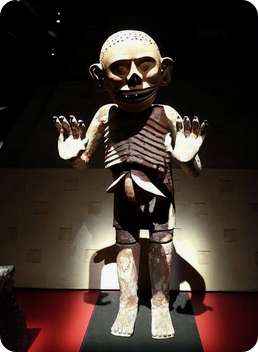
Name the gods shown

Name the gods shown
Takeaways from Aztec-Spanish encounters:
• Context of harsh rule of Motecuhzoma II, its perception, his overconfidence
• Contingencies of history – Cortes defiance of Spanish law
• Role of Tlaxcallans in taking Tenochtitlan and survival of Cortes/Euros
• Role of smallpox in weakening Tenochtitlan
Final century – Aztec at contact:
Demographic, political, and economic expansion, Prosperity and cultural florescence
Growing hardship/pressure on commoner class
Hernando Cortés – 1519
Spanish colonies in Caribbean, based in Cuba
Feb 1519 – Cortés & 11 ships, 500 men explore Mexican coast, Defied governor of Cuba (withdrawn permission)
Recovered Aguilar (shipwreck survivor, Maya coast, spoke Maya), acquired Malintzin, gift from Gulf coast Maya, spoke Maya/Nahuatl
Greeted by Motecuhzoma’s messengers in Veracruz
Motecuhzoma hesitated upon learning of encounter/display of arms
Cortés made allies , some peacefully, some violently en route
November 1519 entered the city feigned friendship, imprisoned emperor
Cortés departed in April 1520 and Alvarado made some bad decisions
Cortés besieged, fled in June “noche triste” slaughter, battles
Returned months later, 700 Spaniards, 70,000 native troops, Tenochtitlan meanwhile
Devastated by disease, emperor Cuitlahuac died of smallpox, siege cut off water, food
August 1521 new emperor Cuauhtemoc captured, Spaniard victory declared
Vengeful Tlaxcallans went on to massacre many more
Valley of Mexico –end of ho13
– 1.6 million in 1519 to 900,000 by 1521 – smallpox
1531 – measles, 1532 unidentified disease, 1538, smallpox again
1545-48 – typhus wiped out 60% or more of Valley of Mexico reducing it to 200,000 people