Shapes & IMFs
 Call Kai
 Learn
 Practice Test
 Spaced Repetition
 Match
 Flashcards
 Knowt Play
1/13

There's no tags or description
Looks like no tags are added yet.
14 Terms
Explain electron pair repulsion theory
shapes of molecules are determined by areas of electron density repelling each other in 3D space

Describe the shape and bond angle of linear shapes

Describe the shape and bond angle of trigonal planar shapes

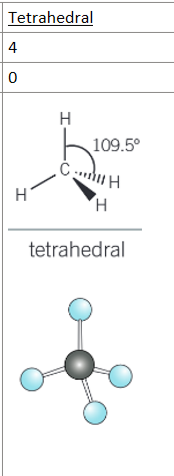
Describe the shape and bond angle of tetrahedral shapes
Describe the shape and bond angle of octahedral shapes

Describe the shape and bond angle of non-linear shapes

Describe the shape and bond angle of pyramidal shapes

Define electronegativity
A measure of the attraction of a bonded atom for the pair of electrons in a covalent bond

explain what a polar bond is and whether a molecule will be polar in terms of permanent dipoles and shape
a polar bond is a type of covalent bond where the bonding electrons are shared unequally between two atoms due to differences in electronegativity. A molecule is polar it is asymmetrical because its individual dipoles do not cancel out resulting in a net dipole movement or if the molecule is completely symmetrical the dipoles cancel out making it non-polar.

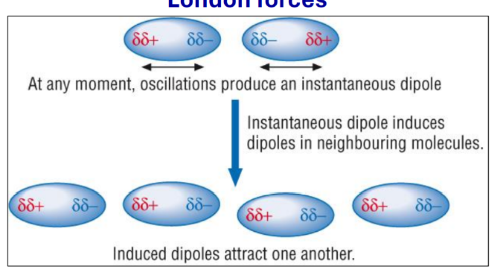
Describe how the London force (instantaneous-induced dipole-dipole) arises
the constant, random movement of electrons within an electron cloud creates a temporary, short lived instantaneous dipole in an atom or molecule
The instantaneous dipole repels electrons in a neighbouring molecule causing it to form an induced dipole
The temporary opposite partial charges between the instantaneous and induced dipoles electrostatically attract each other
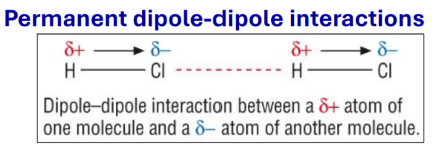
Describe how the permanent dipole-dipole force arises
In polar molecules differences in electronegativity and an asymmetrical shape create a permanent dipole (a fixed separation of partial charges across the molecule)
when separate polar molecules align, the permanent slightly positive region of one molecule electrostatically attracts the slightly negative region of the neighbouring molecule
Describe how hydrogen bonding arises between molecules containing N, O and F and the H atom of NH, OH or FH
N, O, F are highly electronegative creating a strong permanent dipole that leaves the bonded H atom heavily electron deficient with a large partial-positive charge
The strongly positive hydrogen atom on one molecule forms a powerful electrostatic attraction with a lone pair of electrons on the highly electronegative atom (N, O or F) of an adjacent molecule

A labelled diagram of two water molecules hydrogen bonding

What are the anomalous properties of water
ice is less dense than water as the molecules are held apart by hydrogen bonds/ice has an open lattice structure because the molecules are spaced further apart the ice has a lower density than liquid water allowing it to float
Ice has a relatively high melting point hydrogen bonds are relatively strong (stronger than permanent dipole-dipole and definitely London forces), more energy is needed to overcome hydrogen bonding