Aquatic VPH (Foor Borne Parasites & Other Food Safety Risks)
 Call Kai
 Learn
 Practice Test
 Spaced Repetition
 Match
 Flashcards
 Knowt Play
1/22

There's no tags or description
Looks like no tags are added yet.
23 Terms
What fish produce a majority of the food poisoning?
Finfish - low risk
Main risk is fro raw or lightly processed fish
Poisoning from shellfish is more common
No evidence of any difference between wild or farmed
Are there meat inspectors for fish?
No - EHOs inspect
What are the main causes of fish spoilage?
• Autolysis
Enzymes in fish lissue break down muscle after death.
Leads to softening and off-flavours.
• Bacterial Growth
Environmental flora (Pscudomonas, Acromonas, Vibrio) multiply quickly.
Produce slime, odours, and discoloration.
• Storage Conditions
Warm temperatures accelerate both autolysis and bacterial growth.
Poor handling (delayed chilling, dirty water) worsens spoilage.
• High Water Content of Fish Flesh
Creates ideal conditions for bacterial activity.
• Rapid chilling essential to reduce spoilage
Common bacterial flora of the fish include…?
• Reflects the aquatic environment
• Common genera: Aeromonas, Flavobacterium, Pseudomonas, Vibrio, Serratia, Photobacterium, Clostridium, Bacillus
Some act as spoilage organisms
Others can be opportunistic human pathogens
• "Natural" contaminants (environmentalbacteria)
Clostridium, Aeromonas
• "Unnatural" contaminants (hygiene failures)
Staphylococcus aureus
E. Coli
Salmonella
Does cold-smoking, curing and other light processing eliminate bacteria?
No
What are some ways we can reduce bacterial contamination in fish?
Pre-harvest fasting to reduce gut content
Temperature influences metabolism
Hygienic slaughter & handling
Rapid chilling using potable, chlorinated water
HACCP: high-risk vs low-risk separation
Removal of biofilms by effective disinfection
Environmental & product microbiological monitoring
What are the main features of Vibrio bacteria?

What are the main features of Listeria?

What are the main features of Clostridium?

What are the main features of salmonella?

What are the main features of Anisakis simplex (Herring worm)?
Humans are accidental host, fish are a secondary host
Cooking, freezing and immediate gutting control

What are the main features of Diphyllobotrium latum?
Cestoda
• Cysts: white, visible on fish intestines; heavy infection → viscera may fuse. • Inactivation: killed by normal cooking & freezing; cysts disappear if fish moved to seawater.
Transmission: humans infected by eating raw/undercooked fish. Development in humans:
Plerocercoids attach to intestine. Adults can exceed 10 m, with >3,000 proglottids.
Each worm can release up to 1 million eggs/day. Eggs appear in faeces 5-6 weeks post-infection.
What are the main features of Fasciola hepatica and Opisthorchis?
Trematode
• One other important species is Fasciola hepatica - man may also be infected by F. hepatica through the ingestion of contaminated vegetation such as watercress.
Watercress beds and other aquatic plants that are commonly consumed raw can become contaminated with faeces containing the eggs of liver flukes.

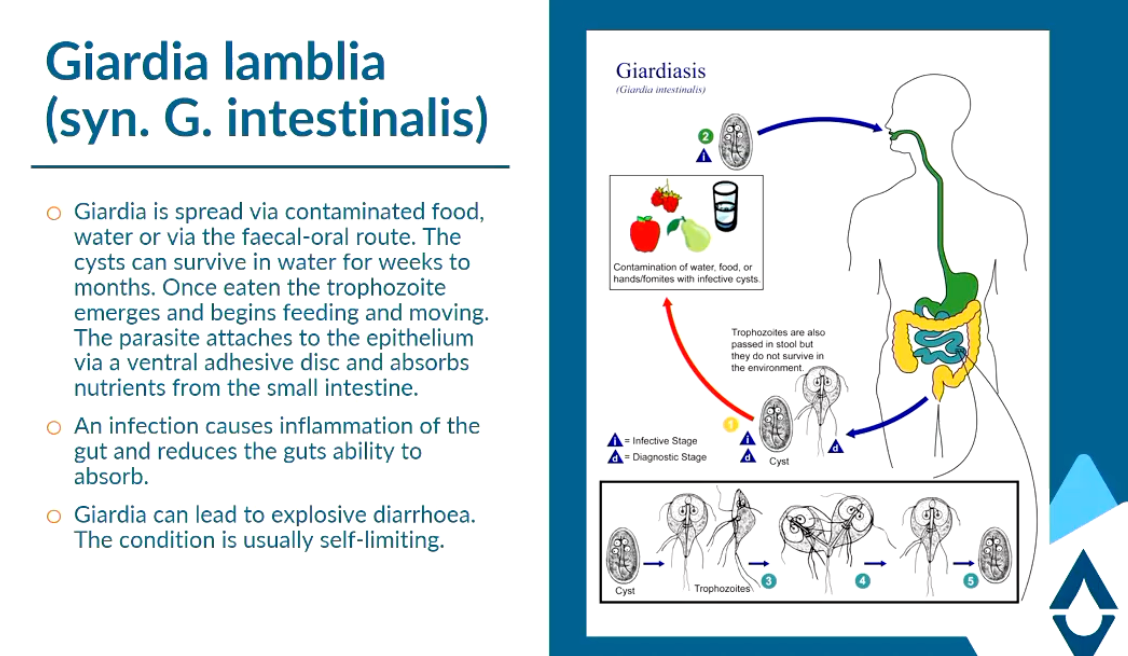
Describe the main features of Giardia lamblia.
Describe the main features of Norovirus in shellfish.
Infection - which is why it takes a bit to develop (Inclubation)
Poisoning - immediate due to toxins

Describe the main features of Hepatitis A in shellfish.

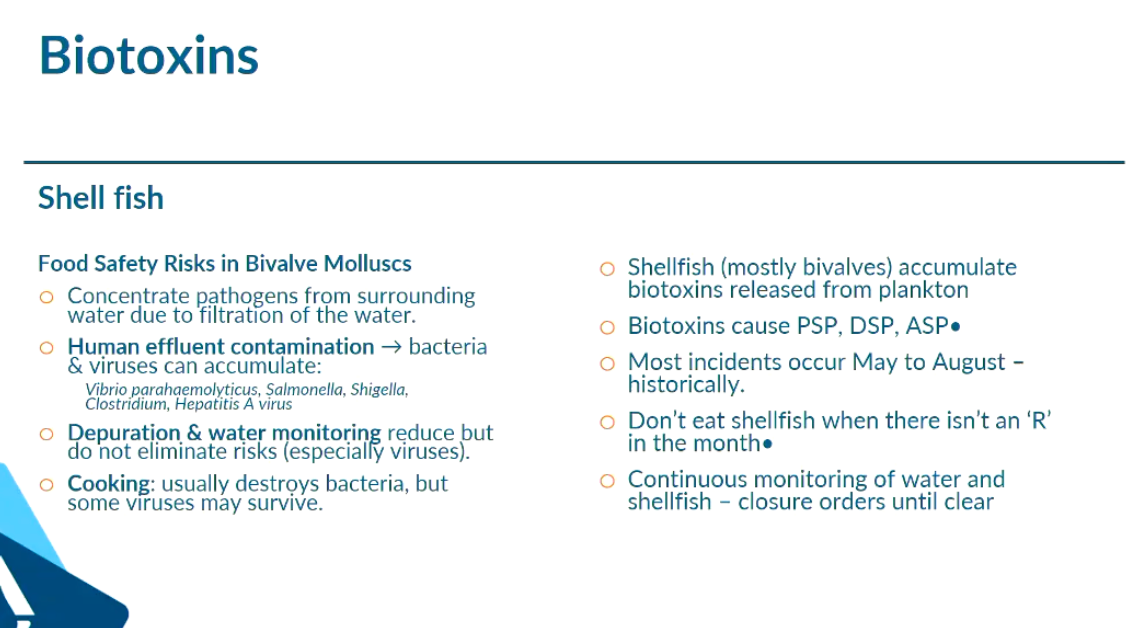
What are the main biotoxins produced in shellfish?
Diarrhoeic food poisoning (DSP)
• Phytoplankton Dinophysis, Prorocentrum Bivalves concentrate the toxins produced by the plankton
Range of heat-stable toxins - Okadaic acid, lactones, yessotoxins
1 hour after ingestion - diarrhoea, nausea, vomiting abdo pain. Recover in 3 days
Paralytic shellfish poisoning (PSP)
• Dinoflagellate Alexandrium
Bivalves accumulate saxitoxins (many forms) - neurotoxins
Numbness, paralysis, inco-ordination.
Recovery within a few hours
Amnesic shellfish poisoning (ASP)
• Also known as domoic acid poisoning (amnesia not always a symptom)
• Bivalves - especially scallops
Potent neurotoxin caused by diatom
Pseudo-nitzschia pungens forma multiseries
Destroys nerve cells causing cramps, disorientation, vomiting and memory loss
What are the risks of heavy metals in aquatic foods?
Industrial discharge, mining, agricultural runoff, natural sediments
• Key metals of concern
Mercury (Hg) - bioaccumulates in predatory fish (e.g. tuna, swordfish)
Cadmium (Cd), Lead (Pb), Arsenic (As) → can contaminate shellfish and benthic feeders
Health risks
Mercury → neurotoxicity, risk to foetal development
Cadmium/Lead → kidney damage, bone toxicity
Arsenic (inorganic forms) → carcinogenic potential
Trends
Farmed fish generally have lower levels due to controlled diets and shorter grow-out periods
Wild, long-lived predators have highest concentrationsControlsMaximum residue limits (MRLs) set by legislationMonitoring of seafood supply chains
Dolphins - big concern is heavy metal, specifically methylmercury, high levels recorded
What are important considerations for drug resides in aquaculture?
• Risks
Allergic reactions in sensitive consumers
Contribution to antimicrobial resistance (AMR)
• Controls
Maximum Residue Limits (MRLs) set by legislation (EU, FDA, etc.)
Withdrawal periods ensure fish are free of residues before harvest
Routine monitoring of aquaculture products
• Trends
Residues are rare in regulated aquaculture if guidelines are followed
Greater risk in regions with less strict regulation or oversight
What is taint in fish?
Unwanted flavour or odour in fish flesh.
Unnatural causes
Chemical pollutants (e.g. petroleum from oil spills)
Agricultural or industrial contaminants
Natural causes
Bacterial or algal metabolites
"Earthy" flavours in trout & catfish from cyanobacteria and phytoplankton (e.g. geosmin, MIB)
Some produced by bacteria
Why do farmed fish have lower parasite burdens and contaminant levels?
Low Parasite Burdens
Controlled environment
biosecurity, water treatment, and feed management reduce exposure.
No access to intermediate hosts (e.g. copepods, snails) that are common in natural food webs.
• Commercial feed (pellets) replaces raw prey items, breaking parasite life cycles.
• Regular health monitoring and veterinary oversight detect issues early.
• Stocking density may increase bacterial disease risk, but generally lowers exposure toparasites compared to wild fish.
• Geographical control
Farms are located away from high parasite transmission zones when possible.
Low Contamination Levels
Controlled feed → formulated diets are screened for contaminants (e.g. mercury, PCBs, dioxins).
• Shorter food chains - farmed fish do not accumulate toxins via predation like wild carnivorous fish.
Faster growth & younger harvest age → less time to bioaccumulate pollutants.
Monitored environments → water quality and contaminant levels are checked regularly.
Regulawal persise forced in aquaculue remits (MRLs) and
Wild fish may bioaccumulate heavy metals & persistent organic pollutants from polluted ecosystems.
How does the parasite burden and contamination levels change across production systems?
Parasite Burden
• Cage culture (open water)
High exposure to wild hosts: risk of sea lice, trematodes, Anisakis (marine fish).
• Pond systems
Risk of digenean trematodes if snails present.
Higher burden in regions using sewage fertilisation.
Recirculating Aquaculture Systems (RAS)
• Minimal parasite exposure (closed loop, filtered water).
Risk if biosecurity fails, but easier to eradicate.
Shellfish farming
Filter-feeding: high risk of protozoan parasites (Giardia, Cryptosporidium) if effluent contamination.
Contamination levels
Cage culture
Similar contaminant exposure to wild fish.
Accumulate pollutants present in local environment.
• Pond culture
Possible agricultural runoff (pesticides, fertilisers, heavy metals).
• RAS
Lowest contaminant risk (water treated, feeds controlled).
Monitoring of inputs is essential.
• Shellfish farming
Accumulate heavy metals, toxins, and human pathogens from polluted water.
Contaminant levels highly dependent on site location.
What are the general trends of farmed vs. wild caught fish?
