Exam 4: ID 2241

0.0(0)
Studied by 0 people
call kaiCall Kai
learnLearn
examPractice Test
spaced repetitionSpaced Repetition
heart puzzleMatch
flashcardsFlashcards
GameKnowt Play
Card Sorting

1/77

encourage image

There's no tags or description

Looks like no tags are added yet.

78 Terms

1
New cards

EARLY CHRISTIAN ART

1st to 5th centuries

Western Empire

* religion of salvation: teaching ritual practice

* religion of afterlife: funerary body/soul doctrine

Period of Persecution: 1st - 3rd

  • secret codes, images for teaching, practice

  • catacombs: funerary

Period of Proliferation: 4th - 5th

  • churches

Italy; Rome; Ravenna

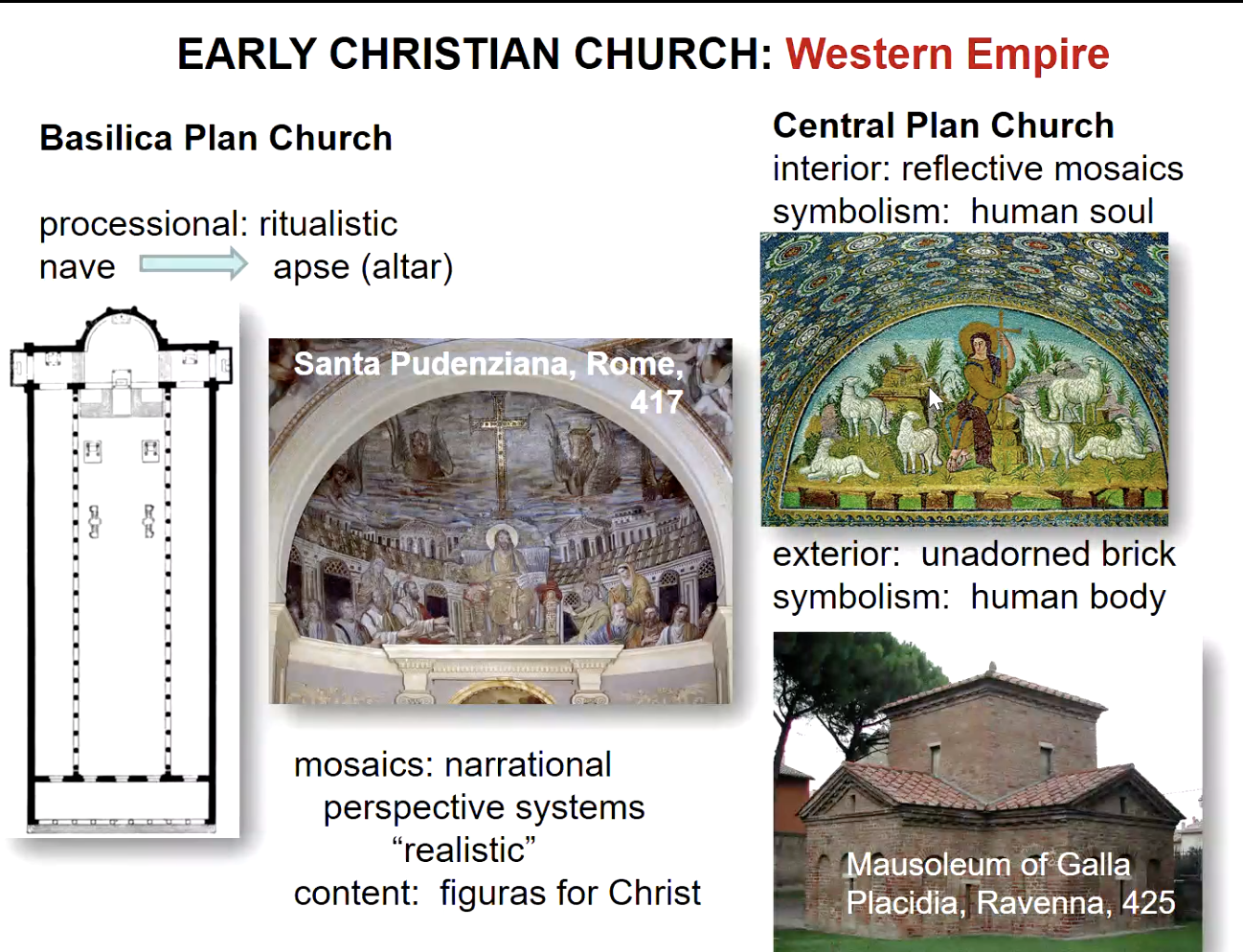
Basillica Plan and Central Plan (specialized focus toward center) Churches


2
New cards

Introduction: Arch of Constantine, 315 AD (Imperial Roman Art)

Constantine converts to Christianity: makes it the state religion of the ROman Empire

from Imperial Art period

schemata for representing human form: short, flat bodies

  • “Christian body” deemphasized

large heads

“Christian soul”

emphasized

Christian symbols: three: Trinity (Father, Son, Holy Spirit)


3
New cards

Catacombs, Rome, 3rd –4th c.: loculi

Period of Persecution: 1st to 3rd c.


funerary and sacred

  • 60 miles of subterranean tunnels in tufa beneath the city of Rome

  • reserved column


funerary making use of Loculi: “shelves” in which Christian bodies were entombed

Estimated 4 million bodies entombed


<p>Period of Persecution: 1st to 3rd c.</p><p></p><p>funerary and sacred</p><ul><li><p>60 miles of subterranean tunnels in tufa beneath the city of Rome</p></li><li><p>reserved column</p></li></ul><p></p><p>funerary making use of Loculi: “shelves” in which Christian bodies were entombed</p><p>Estimated 4 million bodies entombed</p><img src="https://assets.knowt.com/user-attachments/7bf28058-f4eb-4e1c-aff1-84dc8f86ac14.png" data-width="50%" data-align="center" style="display: block; width: 50%; margin-left: auto; margin-right: auto;"><p></p><p></p>
4
New cards

“Orant figure’; “Good Shepherd”

prayerful pose

Catacombs, Rome

period of Persecution

Christ, cruxifiction
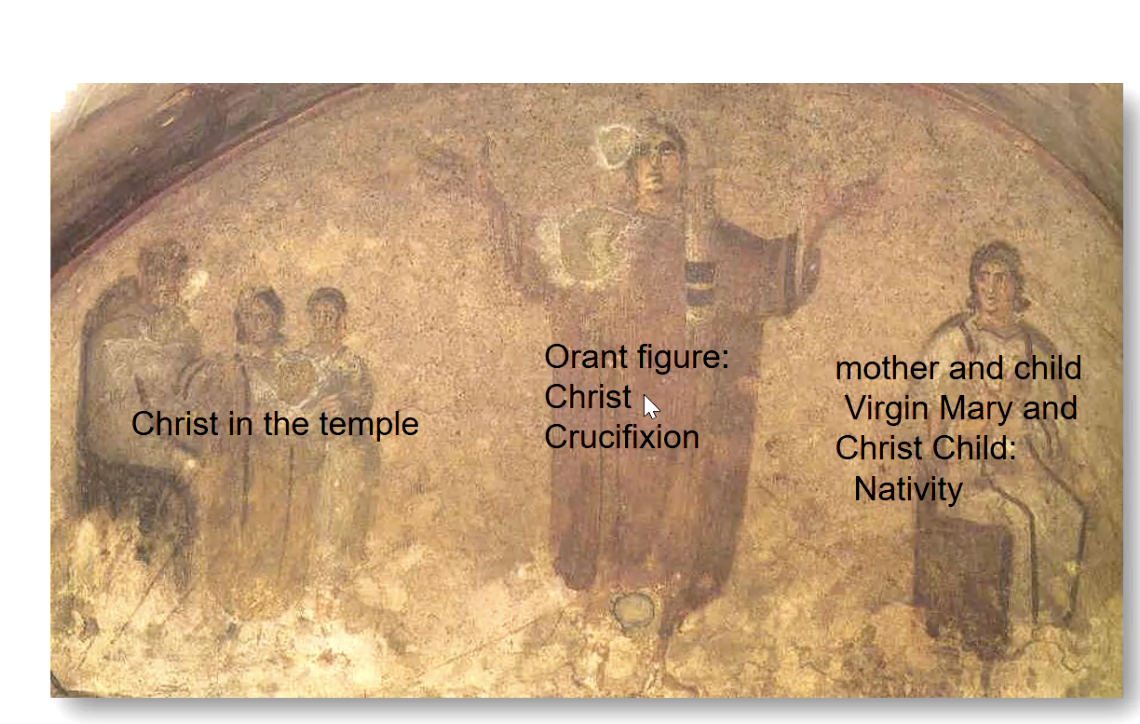

<p>prayerful pose</p><p>Catacombs, Rome</p><p>period of Persecution</p><img src="https://assets.knowt.com/user-attachments/f5a78819-101a-4283-886c-2c1c7948af87.png" data-width="50%" data-align="center" style="display: block; width: 50%; margin-left: auto; margin-right: auto;"><p>Christ, cruxifiction</p><img src="https://assets.knowt.com/user-attachments/8c5a5209-8a18-4b9e-a223-e657cec3f9e7.png" data-width="50%" data-align="center" style="display: block; width: 50%; margin-left: auto; margin-right: auto;"><p></p>
5
New cards

Old St. Peter’s, Rome, begun 320

*painting of what this looked like

Early Christian Art
Period of Proliferation (Constantine orders the construction of a Christian church in Rome)

built over believed site of St. Peter’s burial

demolished 1605


Early Christian Church; Basilica Plan Church

  • provide large public space for worship

    • 3,000 to 4,000 worshippers

  • teach rituals of Christian practice

    • earthly - sacred

  • avoid similiarity to “pagan” temples (Pantheon, Temple of Fortuna) to avoid confusion in religious message (no orders used)

    • Pagan —> Christian


125 feet wide


6
New cards

Santa Pudenziana, Rome, 410: “Christ Enthroned” apse mosaic

Early Christian Art

A Basilica Plan Church with an apse mosaic (mosaic is the focus here)
dedicated to Pudenziana

christian girl who refused to worship Pagan gods

apse mosiac featured here “_____ ______”

mosaic: glass, stone applied to surface

tesserae: individual sections

Christ as ruler seated on throne:

new figura: Emperor, teacher

holds book: “The Lord is the preserver of the church of Pudenziana”

Christian symbolism: symbolizes the holy, or divine

halo: a ring of light that radiates from or around the head (Christ has one in the mosaic)

influence: Second Style of Roman Wall painting: “architectural”

  • overlapping

  • planimetric seperation

Altar:

“Eucharist” christian ritual

*commemoration of “Last Supper”

*miraculous transformation of bread/wine into Christ

lined up perfectly with where Christ is
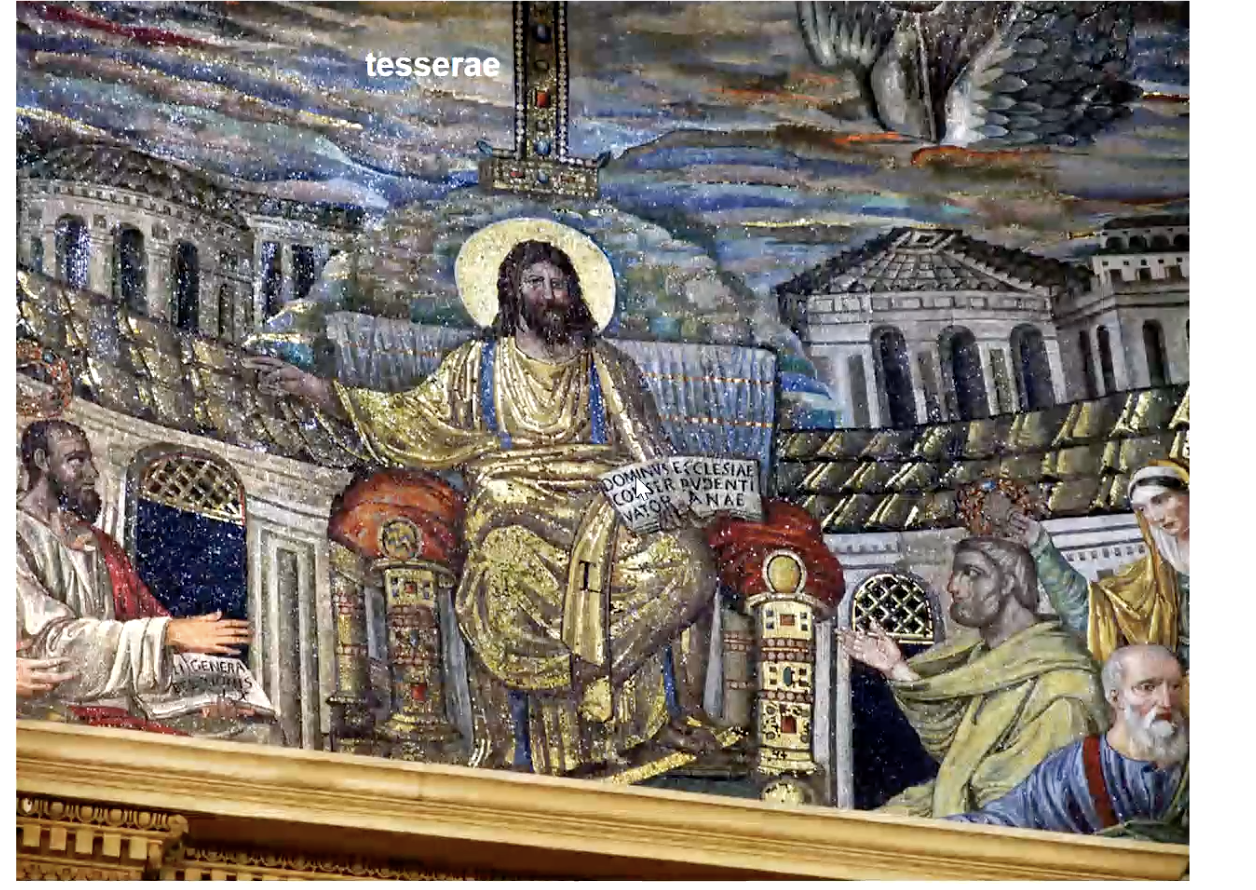

<p>Early Christian Art</p><p>A Basilica Plan Church with an apse mosaic (mosaic is the focus here)<br>dedicated to Pudenziana</p><p>christian girl who refused to worship Pagan gods</p><img src="https://assets.knowt.com/user-attachments/21c0cda6-96ce-4c7c-baf5-38048fff84eb.png" data-width="50%" data-align="center" style="display: block; width: 50%; margin-left: auto; margin-right: auto;"><p>apse mosiac featured here “_____ ______”</p><p>mosaic: glass, stone applied to surface</p><p>tesserae: individual sections</p><img src="https://assets.knowt.com/user-attachments/f19e9dca-7807-464a-8803-4038cea62a88.png" data-width="50%" data-align="center" style="display: block; width: 50%; margin-left: auto; margin-right: auto;"><p>Christ as ruler seated on throne:</p><p>new figura: Emperor, teacher</p><p>holds book: “The Lord is the preserver of the church of Pudenziana”</p><p>Christian symbolism: symbolizes the holy, or divine</p><p>halo: a ring of light that radiates from or around the head (Christ has one in the mosaic)</p><p>influence: Second Style of Roman Wall painting: “architectural”</p><ul><li><p>overlapping</p></li><li><p>planimetric seperation</p></li></ul><img src="https://assets.knowt.com/user-attachments/384a8ebb-c025-4aba-92ef-138a1c14814a.png" data-width="50%" data-align="center" style="display: block; width: 50%; margin-left: auto; margin-right: auto;"><p>Altar:</p><p>“Eucharist” christian ritual</p><p>*commemoration of “Last Supper”</p><p>*miraculous transformation of bread/wine into Christ</p><p>lined up perfectly with where Christ is</p><p></p>
7
New cards

Visigoths invade Rome: 410 AD

Rome fell to invasions (King Alaric) in 410

  • Germanic people (Visigoths led by King Alaric)

  • used the network of “Imperial Roman” roads to invade

  • resulted in relocation of capital of Western Empire from Rome to Ravenna

  • surrounded by swamps (defensible)

  • on Adriatic Sea (protected by shoreline)


<p>Rome fell to invasions (King Alaric) in 410</p><ul><li><p>Germanic people (Visigoths led by King Alaric)</p></li><li><p>used the network of “Imperial Roman” roads to invade</p></li><li><p>resulted in relocation of capital of Western Empire from Rome to Ravenna</p></li><li><p>surrounded by swamps (defensible)</p></li><li><p>on Adriatic Sea (protected by shoreline)</p></li></ul><p></p>
8
New cards

Mausoleum of Galla Placidia, Ravenna, 425: “Good Shepherd” mosaic

a building housing tombs

Cruciform shape: shaped like a cross

NOT basicilla plan layout, but Central Plan layout:

  • focused towards center

  • makes use of ambulatory (walking path around interior)

exterior of Mausoleum: brick

  • brick: symbol of the human body

  • “soil”: “ashes to ashes”

  • unadorned

  • avoids Greco/Roman Orders


interior:

  • mosaic: reflected light

  • immaterial: symbolic of the soul or spirit
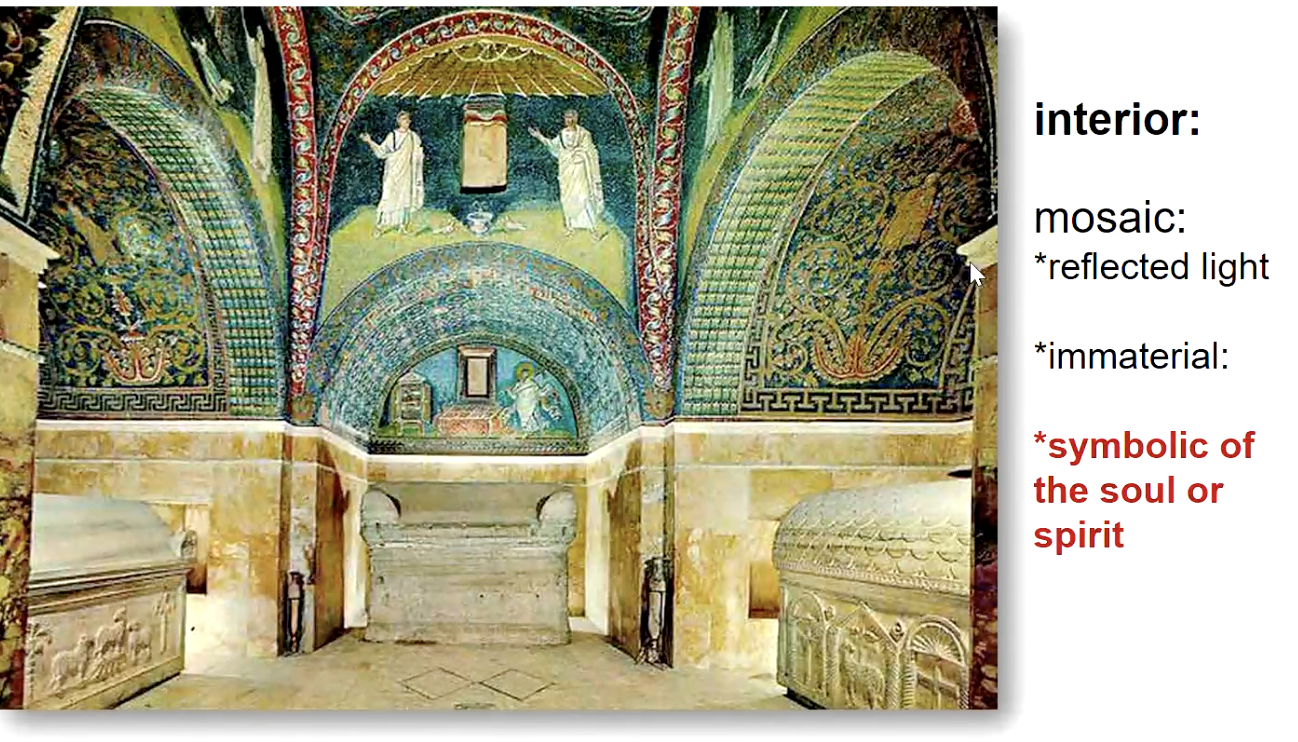
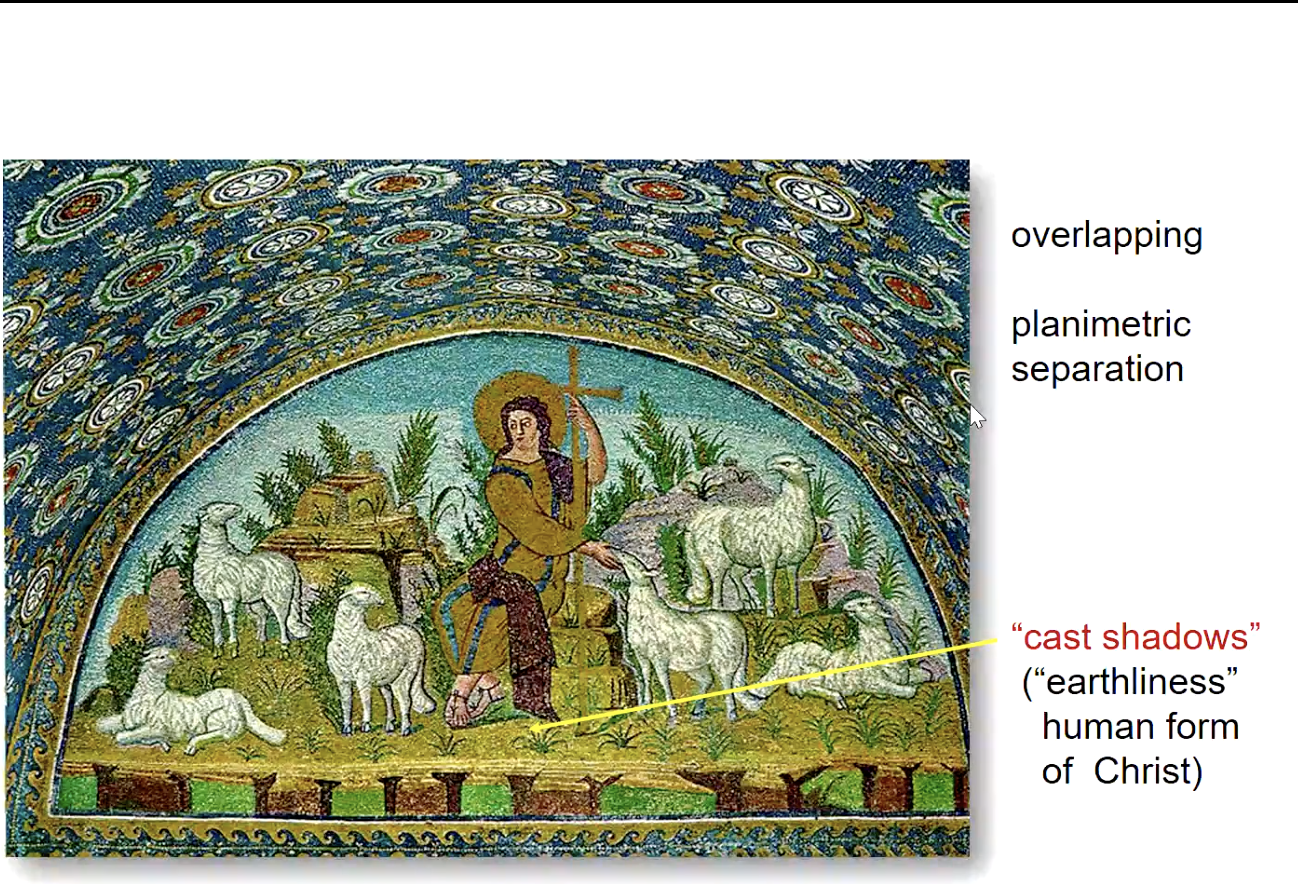
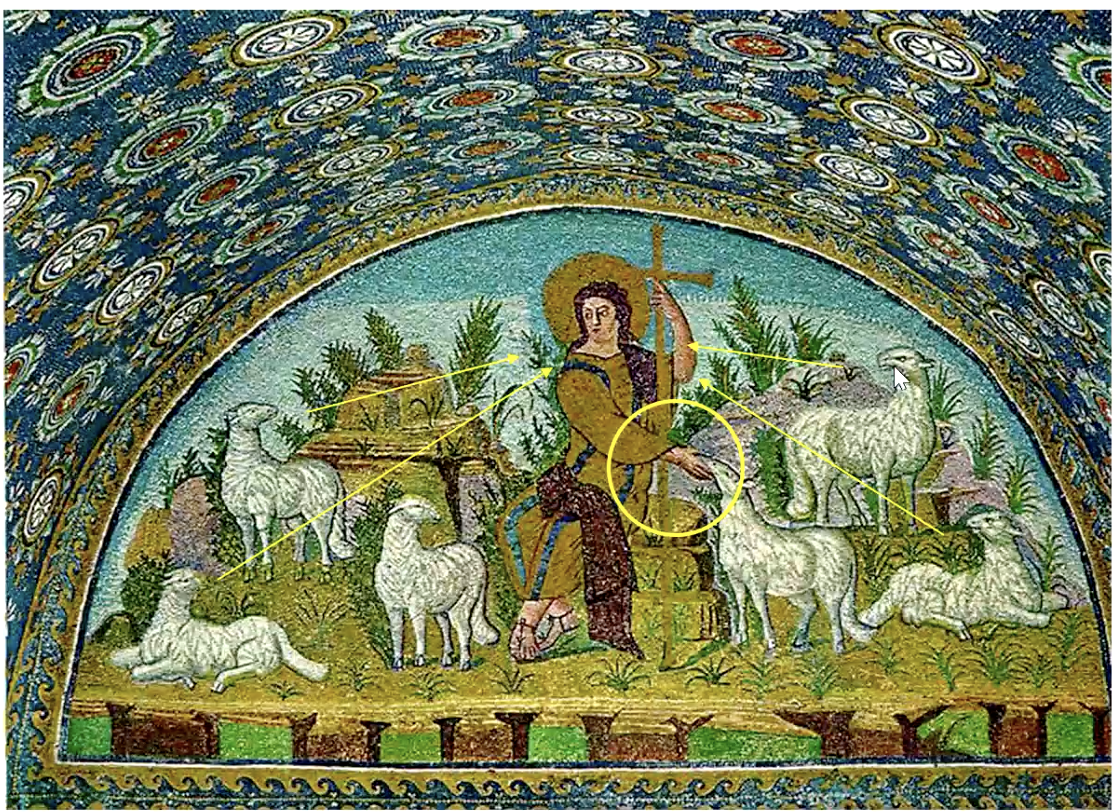
The mosaic we are focusing on is titled _____ _____:


  • narrative focus on action

  • Christian symbolism: Trinity (father, son, holy spirit); three sheep on both sides

  • perspective systems: Architectural Style of Roman Wall Painting

  • planimetric separation

  • earthly space (landscape)

  • blue sky: earthly sky

  • “cast shadows”

    • (“earthliness” human form of Christ)


<p>a building housing tombs</p><img src="https://assets.knowt.com/user-attachments/e985d954-3ecf-42ed-af79-b4314ce328aa.png" data-width="50%" data-align="center" style="display: block; width: 50%; margin-left: auto; margin-right: auto;"><p>Cruciform shape: shaped like a cross</p><img src="https://assets.knowt.com/user-attachments/517de016-b0ba-4369-836a-78fb0fd01006.png" data-width="50%" data-align="center" style="display: block; width: 50%; margin-left: auto; margin-right: auto;"><p>NOT basicilla plan layout, but Central Plan layout:</p><ul><li><p>focused towards center</p></li><li><p>makes use of ambulatory (walking path around interior)</p></li></ul><p>exterior of Mausoleum: brick</p><ul><li><p>brick: symbol of the human body</p></li><li><p>“soil”: “ashes to ashes”</p></li></ul><ul><li><p>unadorned</p></li><li><p>avoids Greco/Roman Orders</p></li></ul><p></p><p>interior:</p><ul><li><p>mosaic: reflected light</p></li><li><p>immaterial: symbolic of the soul or spirit</p></li></ul><img src="https://assets.knowt.com/user-attachments/be90eb94-5437-43f6-bc67-65c06fdec6ac.png" data-width="50%" data-align="center" style="display: block; width: 50%; margin-left: auto; margin-right: auto;"><p>The mosaic we are focusing on is titled _____ _____:</p><img src="https://assets.knowt.com/user-attachments/0d9062d6-d290-4764-96b8-faf8129f3462.png" data-width="50%" data-align="center" style="display: block; width: 50%; margin-left: auto; margin-right: auto;"><p></p><ul><li><p>narrative focus on action</p></li><li><p>Christian symbolism: Trinity (father, son, holy spirit); three sheep on both sides</p></li><li><p>perspective systems: Architectural Style of Roman Wall Painting </p></li><li><p>planimetric separation</p></li><li><p>earthly space (landscape)</p></li><li><p>blue sky: earthly sky</p></li><li><p>“cast shadows”</p><ul><li><p>(“earthliness” human form of Christ)</p></li></ul></li></ul><img src="https://assets.knowt.com/user-attachments/cb91b2ef-e827-4df6-af3d-77c0bd59412f.png" data-width="50%" data-align="center" style="display: block; width: 50%; margin-left: auto; margin-right: auto;"><p></p>
9
New cards

BYZANTINE ART

Eastern Roman Empire (Constaninople)

constantine renamed Byzantium “Constantinople”


Justinian the Great

  • Emperor of the Eastern Roman Empire, Byzantine

  • the last emperor to speak Latin as a first language

  • the rewriting of Roman law, the Corpus Juris Civilis, the basis of civil law

  • reconquest of the Western Roman Empire including Rome

  • in reconquering the Eastern Empire lands lost to the Barbarian invasions, he builds a church in Ravenna to signify the integration of West and East

Byzantine Style:

  • Justinian period: integrates Western Empire: Ravenna; Eastern : Constantinople

  • Early Christian symbolism of materials:

    • brick: body

    • mosaic: soul

    • hieratic imagery: symbolic not “realistic” imagery

San Vitale, Ravenna, 526-547; apse mosaic: “Second Coming” (Christ between two angels,

St. Vitalis and Bishop Ecclesius)

“Justinian,” Theodora” mosaics

Sant’Apollinare in Classe, 549:

“St. Apollinaris amid Sheep” (“Hand of God the Creator”)

Hagia Sophia, (Isidore of Miletus), Constantinople, 532-537

10
New cards

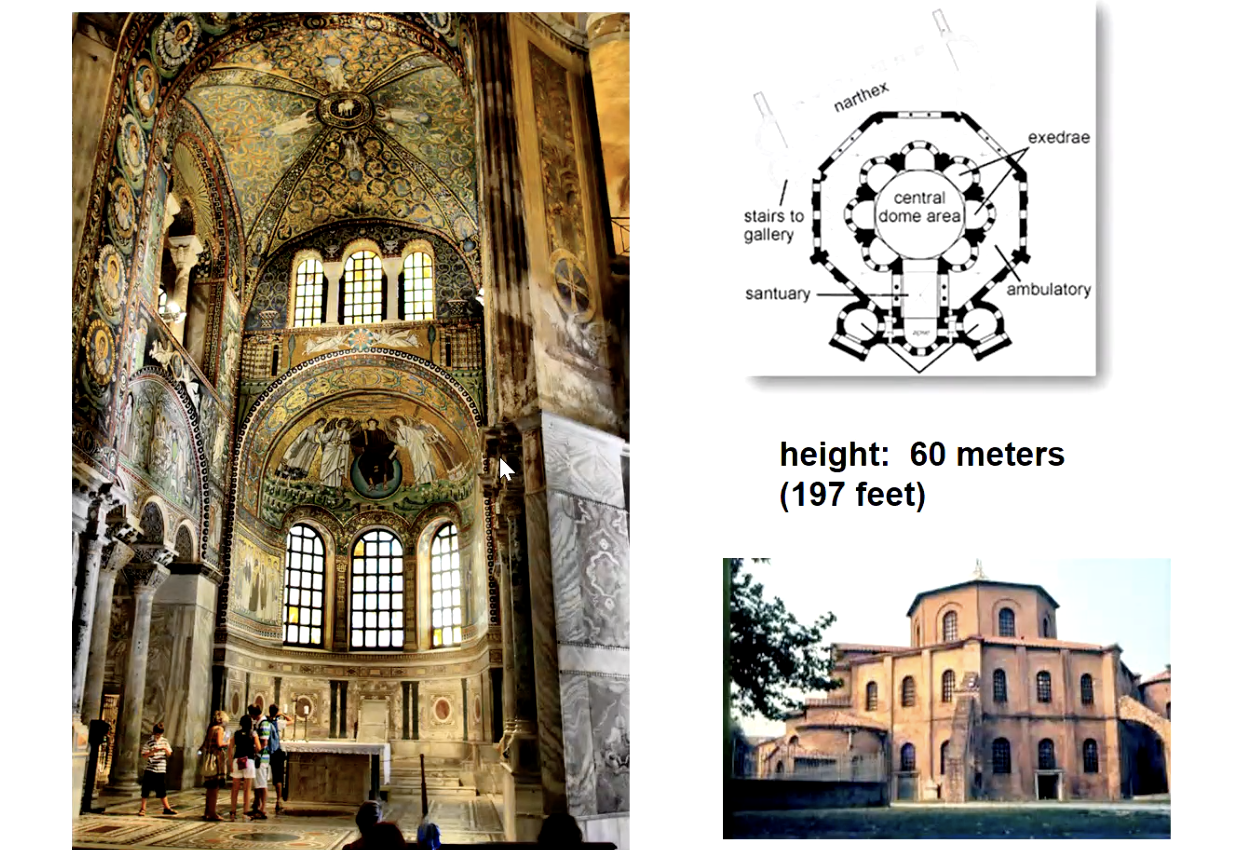
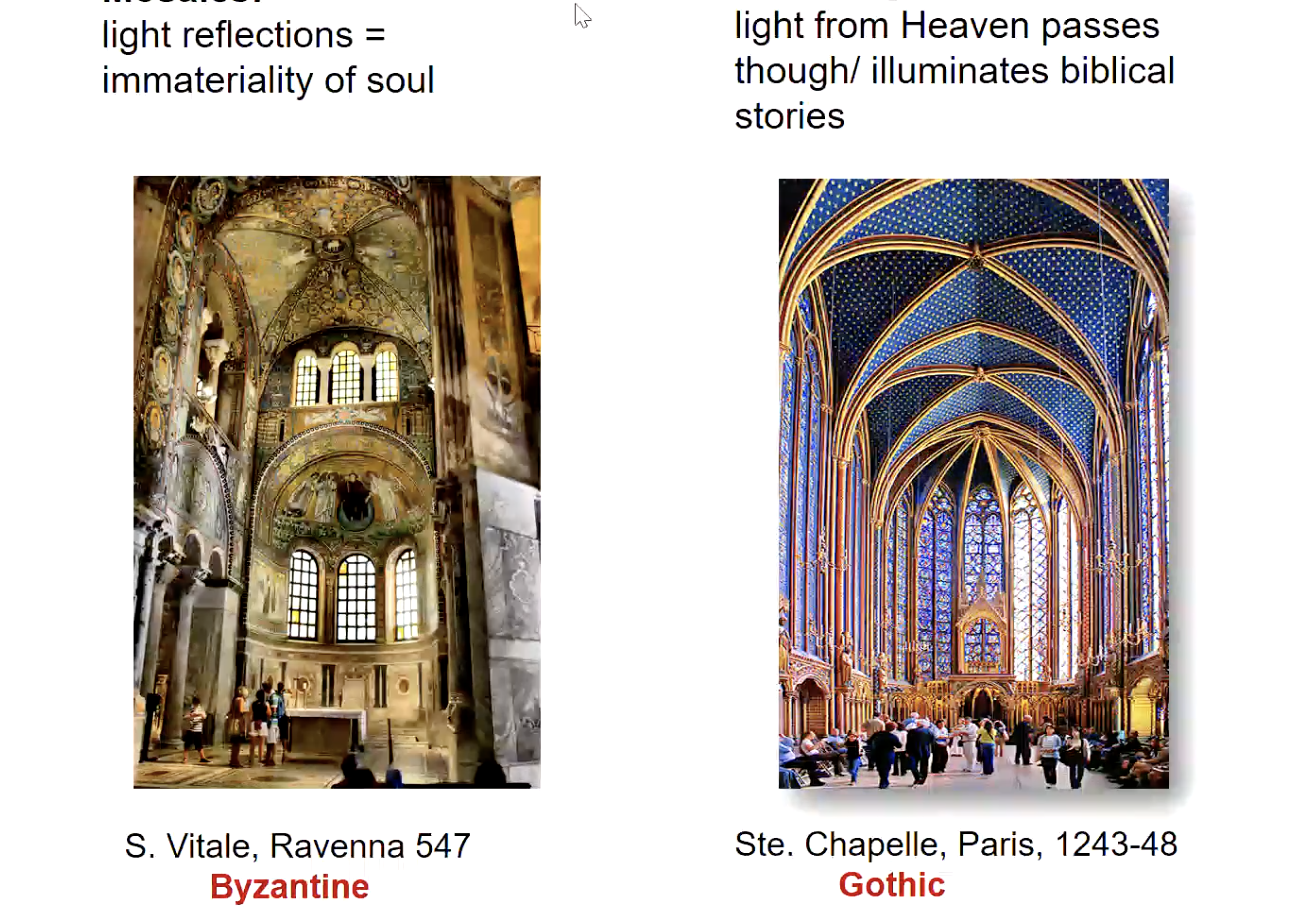
San Vitale, Ravenna, 526-547

Byzantine Art; located in Ravenna

  • a church in Ravenna to signify the integration of West and East by Justinian the Great

  • exterior: body; brick (symbolic of the body)

  • interior: spirit/soul: mosiac


Central Plan Church

interior: central dome (197 feet; 60 meters)

mosaics: light reflections as immaterial: symbolic of the Christian soul


<p>Byzantine Art; located in Ravenna </p><ul><li><p>a church in Ravenna to signify the integration of West and East by Justinian the Great</p></li><li><p>exterior: body; brick (symbolic of the body)</p></li><li><p>interior: spirit/soul: mosiac</p></li></ul><p></p><p>Central Plan Church</p><img src="https://assets.knowt.com/user-attachments/18d91d88-412c-4738-9289-cc229811e5c2.png" data-width="50%" data-align="center" style="display: block; width: 50%; margin-left: auto; margin-right: auto;"><img src="https://assets.knowt.com/user-attachments/a40a51bd-e20e-483b-a642-d4b23a0666ff.png" data-width="50%" data-align="center" style="display: block; width: 50%; margin-left: auto; margin-right: auto;"><p>interior: central dome (197 feet; 60 meters)</p><img src="https://assets.knowt.com/user-attachments/79c96c7d-8fa9-42a6-add6-468bd22057d6.png" data-width="50%" data-align="center" style="display: block; width: 50%; margin-left: auto; margin-right: auto;"><p>mosaics: light reflections as immaterial: symbolic of the Christian soul</p><p></p>
11
New cards

San Vitale: apse mosaic: “Second Coming” (Christ between two angels, St. Vitalis and Bishop Ecclesius)

in San Vitale (Byzantine Art)

Christ returns to judge and to rule

crown: earthly rule

book: New Testament: doctrine

orb: the earth as a circular planet “round earth belief”

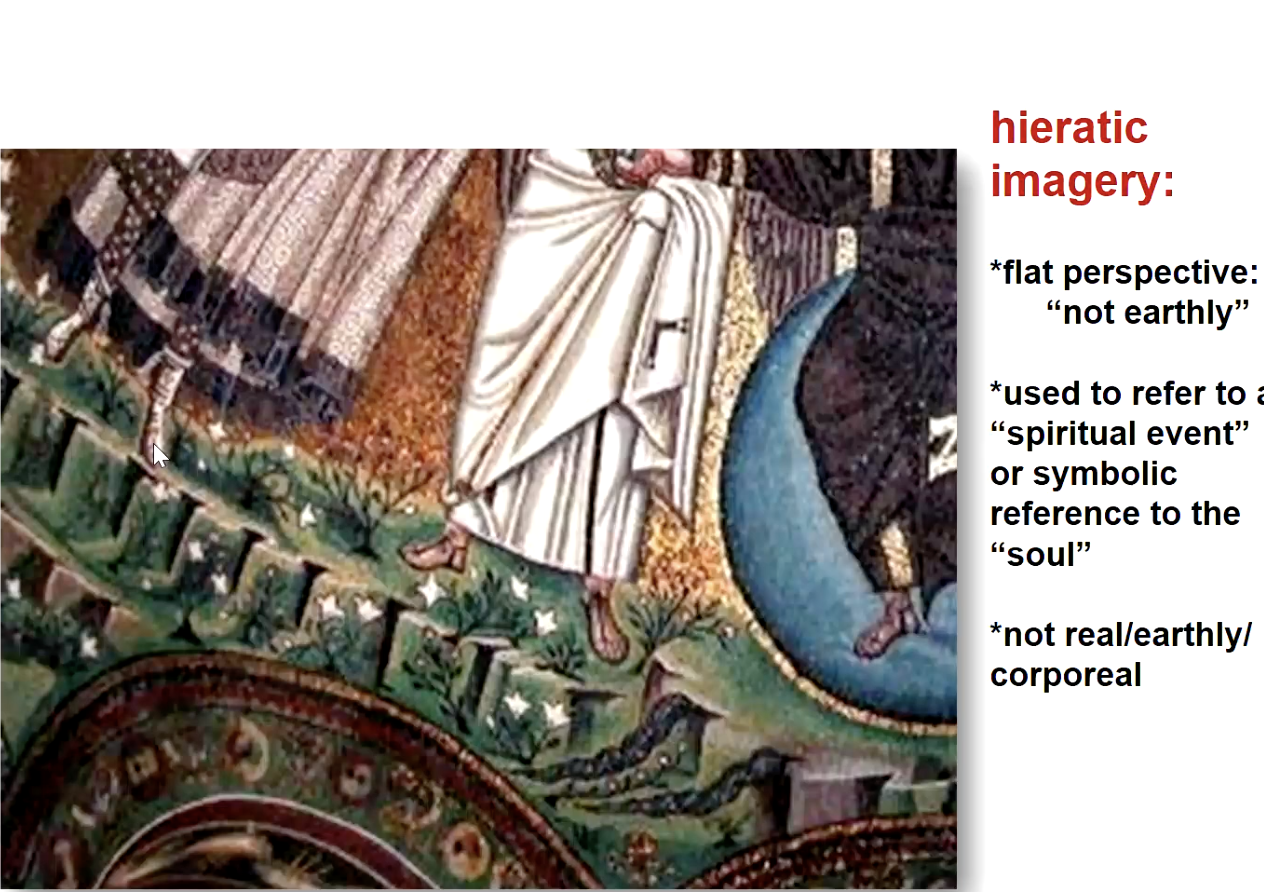
hieratic imagery: imagery that is NOT realistic in terms of representing space or figures

  • symbolism emphasized

*imagery whose primary purpose it to convey religious meaning and religious symbolism; used to refer to a spiritual event or symbolic reference to the soul; not real/earthly; corporeal

  • a spiritual event

  • flat perspective: “not earthly”

  • golden sky: symbolic of heaven

  • no shadows: symbolic of souls/spirits

  • slanted feet: floating, non-corporeal


<p>in San Vitale (Byzantine Art)</p><p>Christ returns to judge and to rule</p><p>crown: earthly rule</p><p>book: New Testament: doctrine</p><p>orb: the earth as a circular planet “round earth belief”</p><img src="https://assets.knowt.com/user-attachments/20b3e88c-1ca7-41ec-b9fe-5b743d086781.png" data-width="50%" data-align="center" style="display: block; width: 50%; margin-left: auto; margin-right: auto;"><p>hieratic imagery: imagery that is NOT realistic in terms of representing space or figures</p><ul><li><p>symbolism emphasized </p></li></ul><p>*imagery whose primary purpose it to convey religious meaning and religious symbolism; used to refer to a spiritual event or symbolic reference to the soul; not real/earthly; corporeal</p><ul><li><p>a spiritual event</p></li><li><p>flat perspective: “not earthly”</p></li><li><p>golden sky: symbolic of heaven</p></li><li><p>no shadows: symbolic of souls/spirits</p></li><li><p>slanted feet: floating, non-corporeal</p></li></ul><img src="https://assets.knowt.com/user-attachments/a2f40dcf-9df9-4a60-98c8-48eab21e84de.png" data-width="50%" data-align="center" style="display: block; width: 50%; margin-left: auto; margin-right: auto;"><p></p>
12
New cards

“Justinian,” Theodora” mosaics

in San Vitale (Central Plan, Byzantine) church

Eucharist: presentation of the bread

hieratic imagery: golden sky, slanted feet, no shadows, symbolism focused

Other side: presentation of wine

tesserae

<p>in San Vitale (Central Plan, Byzantine) church</p><p>Eucharist: presentation of the bread</p><p>hieratic imagery: golden sky, slanted feet, no shadows, symbolism focused</p><p>Other side: presentation of wine</p><img src="https://assets.knowt.com/user-attachments/a7cecda7-6a63-470a-a27e-d97673e84885.png" data-width="50%" data-align="center" style="display: block; width: 50%; margin-left: auto; margin-right: auto;"><img src="https://assets.knowt.com/user-attachments/12ef4947-27a8-40be-af63-d9d8b47e2931.png" data-width="50%" data-align="center" style="display: block; width: 50%; margin-left: auto; margin-right: auto;"><p>tesserae</p>
13
New cards

Sant’Apollinare in Classe, 549: “St. Apollinaris amid Sheep” (“Hand of God the Creator”)

Byzantine Period but Basillica Plan church

knowt flashcard image
  • exterior: brick: Christian symbol of earthly body

apse mosiac (main focus)

orant figure

twelve sheep = twelve disciples of christ

flat perspective, no shadows, slanted feet

hand of God the creator


<p>Byzantine Period but Basillica Plan church</p><img src="https://assets.knowt.com/user-attachments/31be447c-2aa5-4fdd-bf3d-d0817134749b.png" data-width="50%" data-align="center" alt="knowt flashcard image" style="display: block; width: 50%; margin-left: auto; margin-right: auto;"><ul><li><p>exterior: brick: Christian symbol of earthly body</p></li></ul><p>apse mosiac (main focus)</p><img src="https://assets.knowt.com/user-attachments/7e06b881-5b61-473b-ae7a-c077100a2f35.png" data-width="50%" data-align="center" style="display: block; width: 50%; margin-left: auto; margin-right: auto;"><p>orant figure</p><p>twelve sheep = twelve disciples of christ</p><img src="https://assets.knowt.com/user-attachments/ba4eca2e-eb15-4935-a9c9-cd7958a9c861.png" data-width="50%" data-align="center" style="display: block; width: 50%; margin-left: auto; margin-right: auto;"><p>flat perspective, no shadows, slanted feet</p><p>hand of God the creator</p><img src="https://assets.knowt.com/user-attachments/530588e0-532b-42d8-9261-29ef144782bf.png" data-width="50%" data-align="center" style="display: block; width: 50%; margin-left: auto; margin-right: auto;"><p></p>
14
New cards

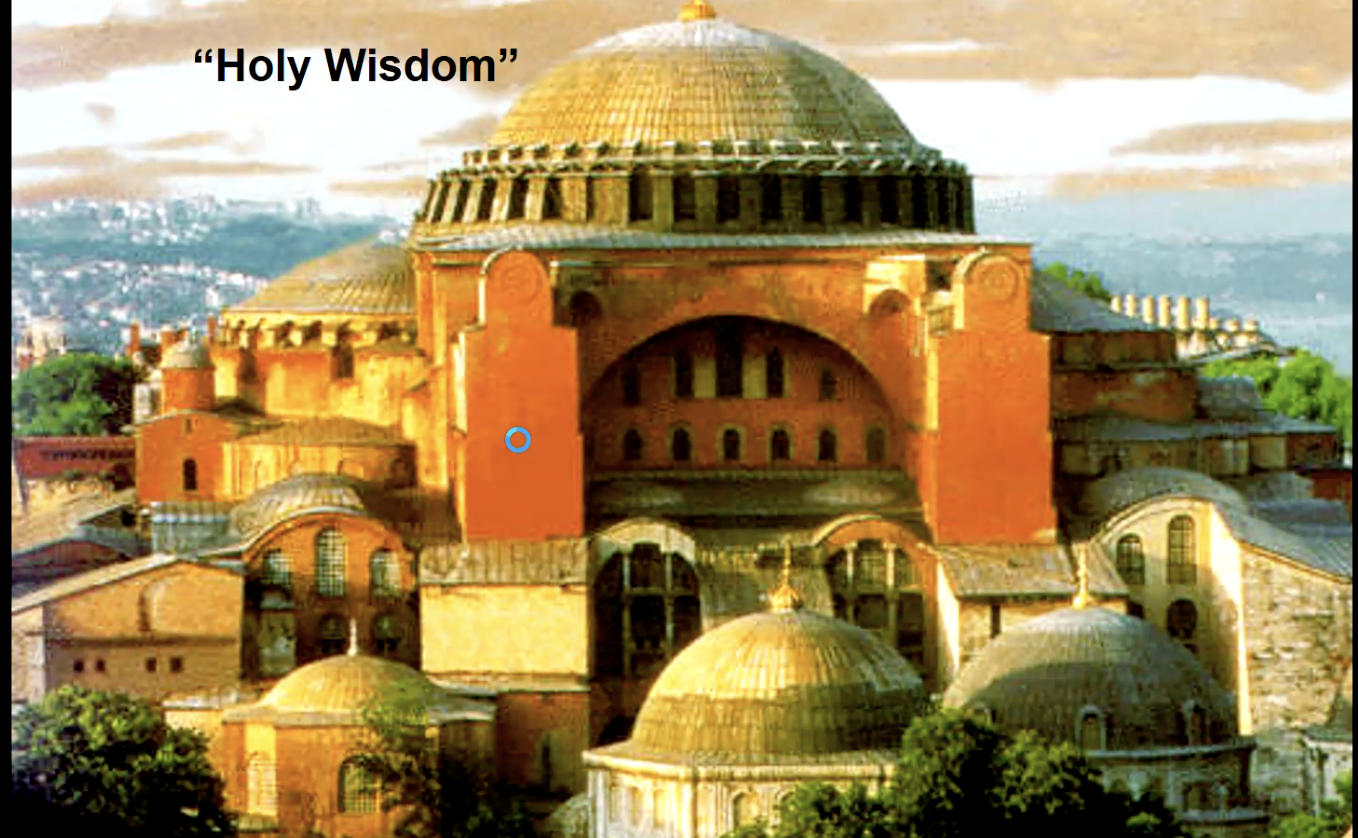
Hagia Sophia, (Isidore of Miletus), Constantinople, 532-537

Byzantine Justinian Period Church

means “Holy Wisdom”

1453 converted to islamic mosque
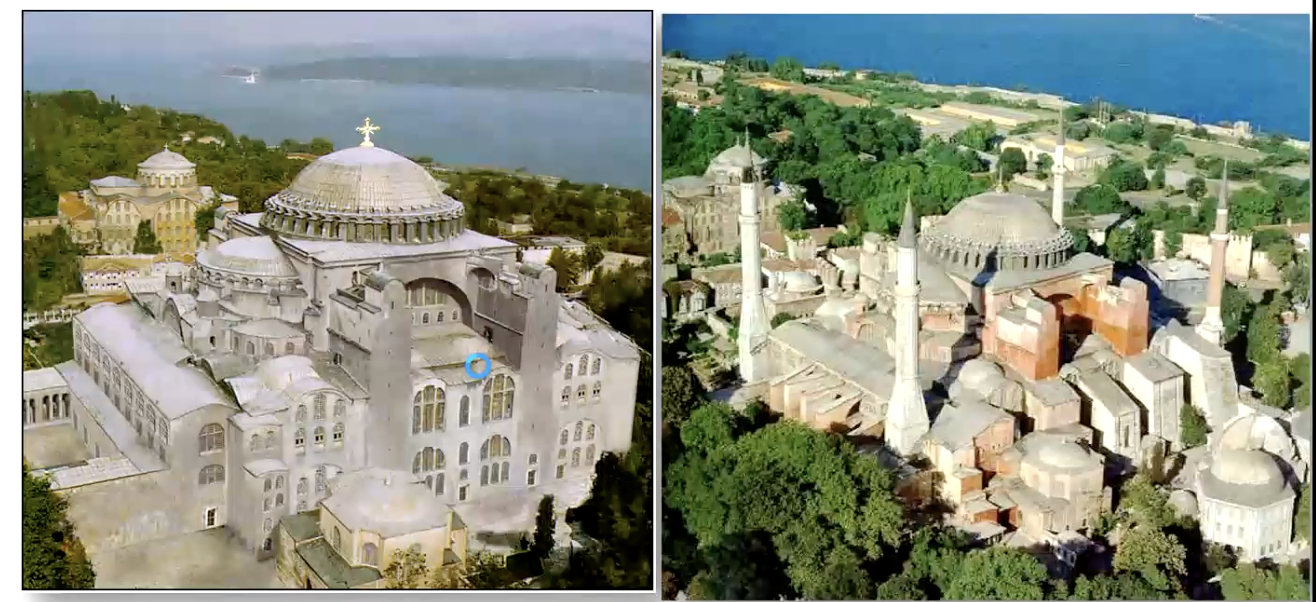
byzantine vs. current look

1935 became a museum

COMBINED: Central Plan Church and Basilica Plan church reconciled and integrated (combined features); circle within a square

Justinian chose as architects: Isidore of Miletus, physicist and Anthemius of Tralles, mathematician (dies during 532)

circle within square

very large, took 10,000 artitechs and almost 6 years to complete (because it is so large)

HEMISPHERIC DOME (100+ feet tall)


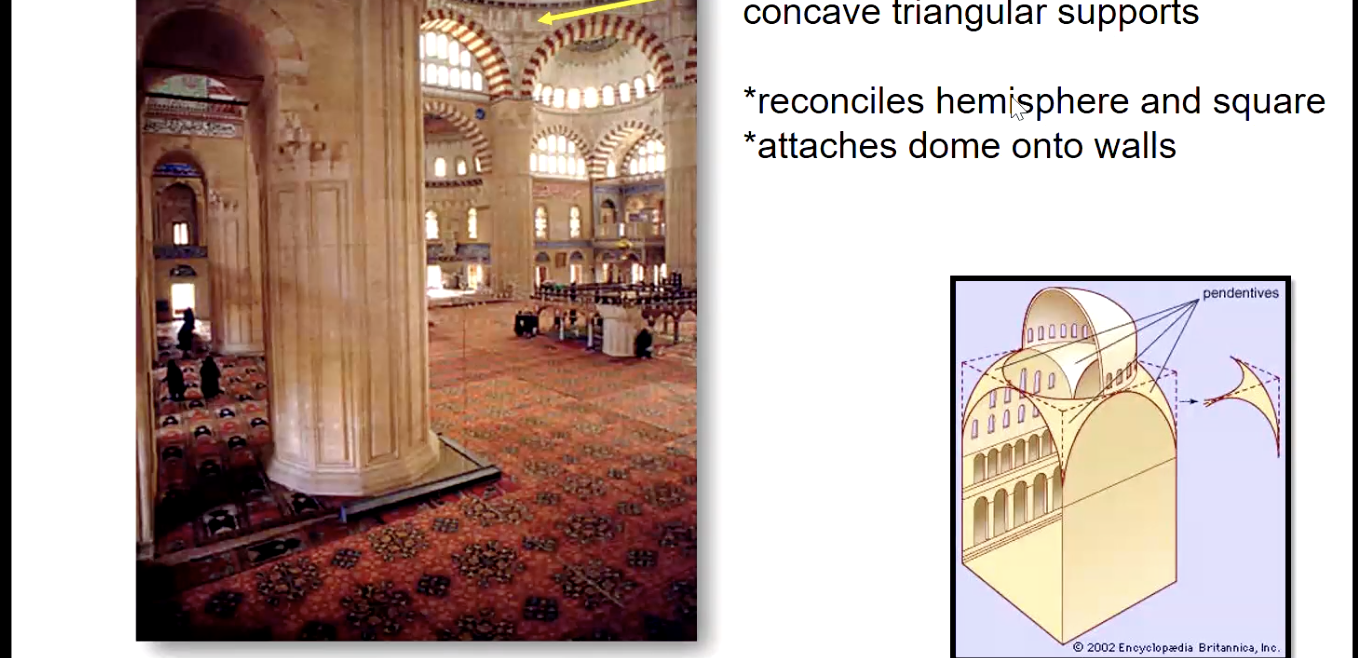
How to Join a Circle on a Square?

introduced pendentives (concave triangular supports)

  • reconciles hemisphere and square

  • attaches dome onto walls


wall pier: wall section supporting pendentive


earthquake caused collapse of original dome; new dome after 558 by nephew of Isidore: Isidore the Younger


lighter materials

30 ft taller

184 feet tall

40 windows (clerestory)

  • allows light into interior

  • created “floating” effect

church was covered with mosaics

  • mosaics covered with WHITE PLASTER


materials imported from all over the Empire:

  • Hellenistic columns from the Greek Temple of Artemis at Ephesus

  • prophyry from Egypt

  • green marble from Thessaly

  • yellow stone from Syria


<p>Byzantine Justinian Period Church</p><p>means “Holy Wisdom”</p><p>1453 converted to islamic mosque</p><img src="https://assets.knowt.com/user-attachments/634e77ae-259d-4ed4-abd2-2abd8530f96d.png" data-width="50%" data-align="center" alt="byzantine vs. current look" style="display: block; width: 50%; margin-left: auto; margin-right: auto;"><p>1935 became a museum</p><p>COMBINED: Central Plan Church and Basilica Plan church reconciled and integrated (combined features); circle within a square</p><img src="https://assets.knowt.com/user-attachments/0f12b298-e766-4181-9791-2b2d675c02d7.png" data-width="50%" data-align="center" style="display: block; width: 50%; margin-left: auto; margin-right: auto;"><p>Justinian chose as architects: Isidore of Miletus, physicist and Anthemius of Tralles, mathematician (dies during 532)</p><p>circle within square</p><img src="https://assets.knowt.com/user-attachments/2eb2649a-35ee-4761-9d00-bc5df31e3113.png" data-width="50%" data-align="center" style="display: block; width: 50%; margin-left: auto; margin-right: auto;"><p>very large, took 10,000 artitechs and almost 6 years to complete (because it is so large)</p><p>HEMISPHERIC DOME (100+ feet tall)</p><p></p><p>How to Join a Circle on a Square?</p><p>introduced pendentives (concave triangular supports)</p><ul><li><p>reconciles hemisphere and square</p></li><li><p>attaches dome onto walls</p></li></ul><p></p><p>wall pier: wall section supporting pendentive</p><p></p><p>earthquake caused collapse of original dome; new dome after 558 by nephew of Isidore: Isidore the Younger</p><p></p><p>lighter materials</p><p>30 ft taller</p><p>184 feet tall</p><img src="https://assets.knowt.com/user-attachments/662208b0-56cb-446e-a9ae-394b7626a427.png" data-width="50%" data-align="center" style="display: block; width: 50%; margin-left: auto; margin-right: auto;"><p>40 windows (clerestory)</p><ul><li><p>allows light into interior</p></li><li><p>created “floating” effect</p></li></ul><img src="https://assets.knowt.com/user-attachments/902f8fcd-4704-4a5c-a365-c0abb503ec1f.png" data-width="50%" data-align="center" style="display: block; width: 50%; margin-left: auto; margin-right: auto;"><p>church was covered with mosaics</p><ul><li><p>mosaics covered with WHITE PLASTER</p></li></ul><p></p><p>materials imported from all over the Empire:</p><ul><li><p>Hellenistic columns from the Greek Temple of Artemis at Ephesus</p></li><li><p>prophyry from Egypt</p></li><li><p>green marble from Thessaly</p></li><li><p>yellow stone from Syria</p></li></ul><img src="https://assets.knowt.com/user-attachments/a975e9e4-259d-4f9b-b2c7-02d1085efb4f.png" data-width="50%" data-align="center" style="display: block; width: 50%; margin-left: auto; margin-right: auto;"><p></p>
15
New cards

figuras

character types

Example:

_____ of Christ: “Good Shepherd” from Early Christian Era

New Testament book of John: “I am the good shepherd and the good shepherd gives his life for the sheep”


  • youthful : large head, de-emphasized body

  • rescues (salvation)


16
New cards

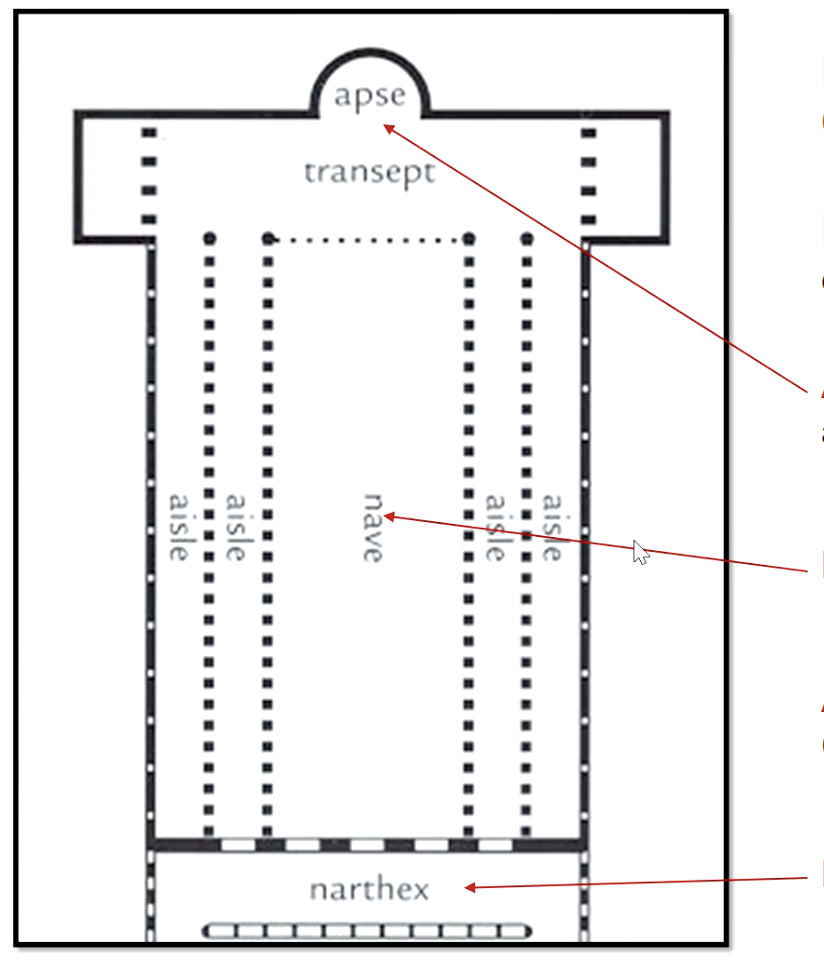
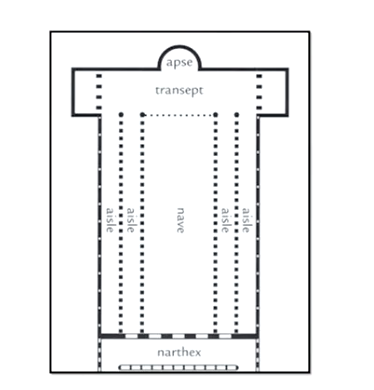
Basilica plan: {cruciform}: narthex, nave, apse (altar), transept, aisle

Apse: where sacred altar is located

  • ritualized; where sacred rituals happen (altar); circular = sacred

Nave: processional way

  • longitudinal axis

aisle: three-part division (symbol of Trinity)

Narthex: antechamber (entrance into the church)

  • transition from earthly/secular space


Cruciform (cross like shape): cross shape (symbol of Crucifixion)

  • transept/crossing of nave


17
New cards

mosaic; tesserae

____: glass, stone applied to surface

the individual sections are called ____


18
New cards

halo

a ring of light that radiates from or around the head


19
New cards

Central plan: ambulatory, gallery

specialized purpose focus toward center

  • makes use of _______ (walking path around interior). Upper walkway is called a _____


20
New cards

Western Roman Empire; Eastern Roman Empire: 285 AD

285 AD, Emperor Diocletian: division of the Roman Empire (bc it was massive):

____ : (Rome - 410, Ravenna)

____: (Constantinople)


21
New cards

hieratic imagery

imagery that is not realistic in terms of representing space or figures

*imagery whose primary purpose it to convey religious meaning and religious symbolism

  • a spiritual event


22
New cards

dome (hemispheric)

featured in Hagia Sophia Church
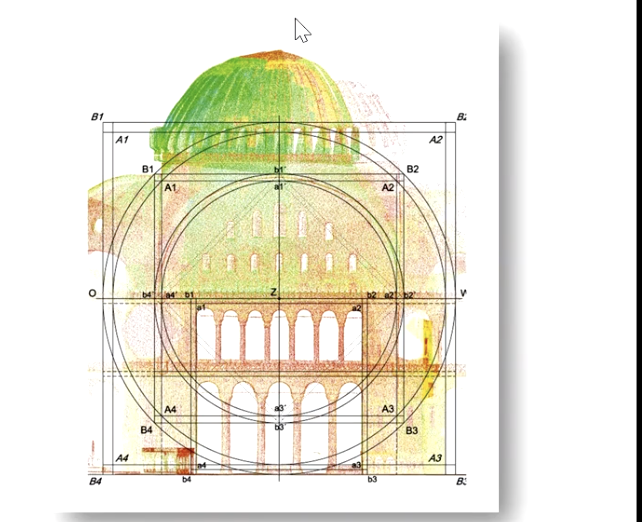
102 ft diameter; 154 feet tall

originally designed by Isidore of Miletus

earthquake caused collapse

23
New cards

clerestory

windows in Hagia Sophia

  • allows light into interior

  • created “floating” effect


24
New cards

pendentives


25
New cards

wall piers

wall section supporting pendentive


26
New cards

Figura of Christ

“Good Shepherd”

*youthful (“human”

schema: large head

de-emphasized body

*rescues (salvation)

*Crucifixion story

*avoids confusion of Christ with pagan Gods (Apollo, Jupiter, etc.)

*allows for teaching of Christian narratives


<p> “Good Shepherd”</p><p>*youthful (“human”</p><p>schema: large head</p><p>de-emphasized body</p><p>*rescues (salvation)</p><p>*Crucifixion story </p><p>*avoids confusion of Christ with pagan Gods (Apollo, Jupiter, etc.)</p><p>*allows for teaching of Christian narratives</p><p></p>
27
New cards

Sutton Hoo Treasure: Anglo-Saxon purse lid, 625

Medieval Art Period

Anglo-Saxan

burial site in England

Suffolk, England

14 burial mounds (one of which is an Anglo-Saxan period ship burial)

Sutton Hoo ship burial: 89 feet long; 14 feet wide; no wood survives, bronze rivets

One body found: Raedwald, the King of the Anglo Saxans

Anglo-Saxon burial of ships and transportable artifacts (migratory art)
Helmet found and recreated (from story of Beowulf: epic poem, interlace patterning, cloisonne)

  • Oldest English poem: hero travels to Denmark to slay demon Grendel

  • Warrior Code
    Purse lid (pictured, cloisonne, interlace patterning, heraldic composition)


cloisonne (wire twisted and filled with enamel which is ground glass paste)

  • eagle/duck configuration

Cloisonne: when you take wire, tiwst it around; fill it in with enamel paste (ground glass paste)

<p>Medieval Art Period<br><br>Anglo-Saxan</p><p>burial site in England</p><p>Suffolk, England</p><p>14 burial mounds (one of which is an Anglo-Saxan period ship burial)</p><p>Sutton Hoo ship burial: 89 feet long; 14 feet wide; no wood survives, bronze rivets</p><p>One body found: Raedwald, the King of the Anglo Saxans</p><p>Anglo-Saxon burial of ships and transportable artifacts (migratory art)<br>Helmet found and recreated (from story of Beowulf: epic poem, interlace patterning, cloisonne)</p><ul><li><p>Oldest English poem: hero travels to Denmark to slay demon Grendel</p></li><li><p>Warrior Code<br>Purse lid (pictured, cloisonne, interlace patterning, heraldic composition)</p></li></ul><p><br>cloisonne (wire twisted and filled with enamel which is ground glass paste)</p><ul><li><p>eagle/duck configuration</p></li></ul><img src="https://assets.knowt.com/user-attachments/ef442432-45a7-4726-96c0-316801599948.png" data-width="50%" data-align="center" style="display: block; width: 50%; margin-left: auto; margin-right: auto;"><img src="https://assets.knowt.com/user-attachments/a9e85de8-6c74-4cca-94c9-eee8d38a3900.png" data-width="50%" data-align="center" style="display: block; width: 50%; margin-left: auto; margin-right: auto;"><img src="https://assets.knowt.com/user-attachments/61cd5675-c35b-49c8-8263-227709e72287.png" data-width="50%" data-align="center" style="display: block; width: 50%; margin-left: auto; margin-right: auto;"><p>Cloisonne: when you take wire, tiwst it around; fill it in with enamel paste (ground glass paste)</p>
28
New cards

Oseberg ship burial, Norway (Viking), 825

825 AD in Norway (Viking), installed in Viking Ship Museum in Oslo
interlace patterning with animals (dragons)

animal head mast/posts (around 5), 825

believed to be references for dogs

<p>825 AD in Norway (Viking), installed in Viking Ship Museum in Oslo<br>interlace patterning with animals (dragons)</p><p>animal head mast/posts (around 5), 825 </p><img src="https://assets.knowt.com/user-attachments/296f18a5-0e7b-4913-b34a-139295dc2813.png" data-width="50%" data-align="center" style="display: block; width: 50%; margin-left: auto; margin-right: auto;"><img src="https://assets.knowt.com/user-attachments/79b06c45-ec04-4d66-96e3-b6626bc94e39.png" data-width="50%" data-align="center" style="display: block; width: 50%; margin-left: auto; margin-right: auto;"><p>believed to be references for dogs</p>
29
New cards

Lindisfarne Gospel, frontispiece, “carpet page”

example of Manuscript Illumination from Hiberno-Saxon area (late 7th century):
the picture depicts the _____ (cover, cloisonne, cruciform (cross like) shape, interlace patterning)


this image is of the ____ _____ (looks like woven textile, cruciform shape, interlace patterning)

<p>example of Manuscript Illumination from Hiberno-Saxon area (late 7th century):<br>the picture depicts the _____ (cover, cloisonne, cruciform (cross like) shape, interlace patterning)</p><img src="https://assets.knowt.com/user-attachments/6d57e4ca-6546-4110-a72b-5da7f8a6aab3.png" data-width="50%" data-align="center" style="display: block; width: 50%; margin-left: auto; margin-right: auto;"><p><br>this image is of the ____ _____ (looks like woven textile, cruciform shape, interlace patterning)</p>
30
New cards

cloisonné: wire, enamel paste

when you take wire, tiwst it around; fill it in with enamel paste (ground glass paste)

31
New cards

interlace patterning

32
New cards

manuscript illumination: scriptoria; prototypes; “making clear” carpet page; frontispiece

Scriptoria (location where monks copied stories)
prototypes ("making clear", think of as template)

  • master templates they would be copying from

    used pricking tools to copy from prototype
    frontispiece (cover)
    carpet page

  • cloisonne, cruciform shape, interlace patterning


<p>Scriptoria (location where monks copied stories)<br>prototypes ("making clear", think of as template)</p><ul><li><p>master templates they would be copying from<br><br>used pricking tools to copy from prototype<br>frontispiece (cover)<br>carpet page</p></li><li><p>cloisonne, cruciform shape, interlace patterning</p></li></ul><p></p>
33
New cards

Medieval Art

migratory cultures

ship burials

migratory art: transportable

Cloisonne technique

interlace patterning

Manuscript Illumination - book decorating; (transfers to Romansque culture as well)


34
New cards

Romanesque Art and Architecture

The Crusades

military campaigns sanctioned by the catholic church to gain access to the Holy Land and Jerusalem

were organized in part to bring back artifacts from the Holy Land that were connected to the Life of Christ, the Virgin Mary and other saints (like wood from the cross and thorn from crown of thorns)

-new materials

-new purpose

-triadic symbolism

-basilica plan

-stone(no concrete)

-unadorned

-christian body

-sculptors’ names known

-hieratic imagery

-manu

35
New cards

Reliquaries; Pilgrimage

cases for relics brought back from the Crusades
distributed throughout European Catholic churches to be displayed
churches housing reliquaries were organized for "pilgrims" to visit church to view relic ("pilgrimage churches")
churches were designed to resemble reliquaries to "protect" artifacts

-the pilgrimage churches were distributed thought out europe

-workshops were opened at each church to provide construction and sculpture

-Pilgrimage were established by the catholic church for he faithful to visit the various churches

-”guidebooks” were prepared to map the pilgrimage routes

-the pilgrimage to visit these churches was decreed by the church as a christian ritual

-Pilgrimage churches were consistently designed along pilgrimage road or route by workshops run by

guilds which controlled the quality of the workmanship and los the consistency of the style

  • designed to resemble reliquaries

-Churches were designed to resemble reliquaries, boxes to “protect the artifacts”

-Pilgrimage churches were consistently designed along a pilgrimade road or route by workshops run by guilds

-They were in the style known as The Romanesque


<p>cases for relics brought back from the Crusades<br>distributed throughout European Catholic churches to be displayed<br>churches housing reliquaries were organized for "pilgrims" to visit church to view relic ("pilgrimage churches")<br>churches were designed to resemble reliquaries to "protect" artifacts</p><p>-the pilgrimage churches were distributed thought out europe</p><p>-workshops were opened at each church to provide construction and sculpture</p><p>-Pilgrimage were established by the catholic church for he faithful to visit the various churches</p><p>-”guidebooks” were prepared to map the pilgrimage routes</p><p>-the pilgrimage to visit these churches was decreed by the church as a christian ritual</p><p>-Pilgrimage churches were consistently designed along pilgrimage road or route by workshops run by</p><p>guilds<span style="background-color: unset; line-height: unset; font-size: unset; color: transparent;"> </span>which controlled the quality of the workmanship<span style="background-color: unset; line-height: unset; font-size: unset; color: transparent;"> </span>and los the consistency of the style</p><ul><li><p>designed to resemble reliquaries</p></li></ul><p>-Churches were designed to resemble reliquaries, boxes to “protect the artifacts”</p><p>-Pilgrimage churches were consistently designed along a pilgrimade road or route by workshops run by guilds</p><p>-They were in the style known as The Romanesque</p><img src="https://assets.knowt.com/user-attachments/15b20140-4280-4b59-9b71-1bf80b392b46.png" data-width="50%" data-align="center" style="display: block; width: 50%; margin-left: auto; margin-right: auto;"><img src="https://assets.knowt.com/user-attachments/24e48bb2-f520-4014-b008-1fd6579a95c2.png" data-width="50%" data-align="center" style="display: block; width: 50%; margin-left: auto; margin-right: auto;"><p></p>
36
New cards

Romanesque Churches; stonemasonry

-large, monumental to house large numbers of pilgrims

-constructed out of stone/______:symbolizes “stone box”

-no concrete(Imperial Roman) formula is lost

-stone:sturdy, solid, protective

-stonemasonry

-cruciform: symbolizes cross

-triadic: symbolizes trinity

-triadic:navel/2 aisles

-triforium: three part stacking

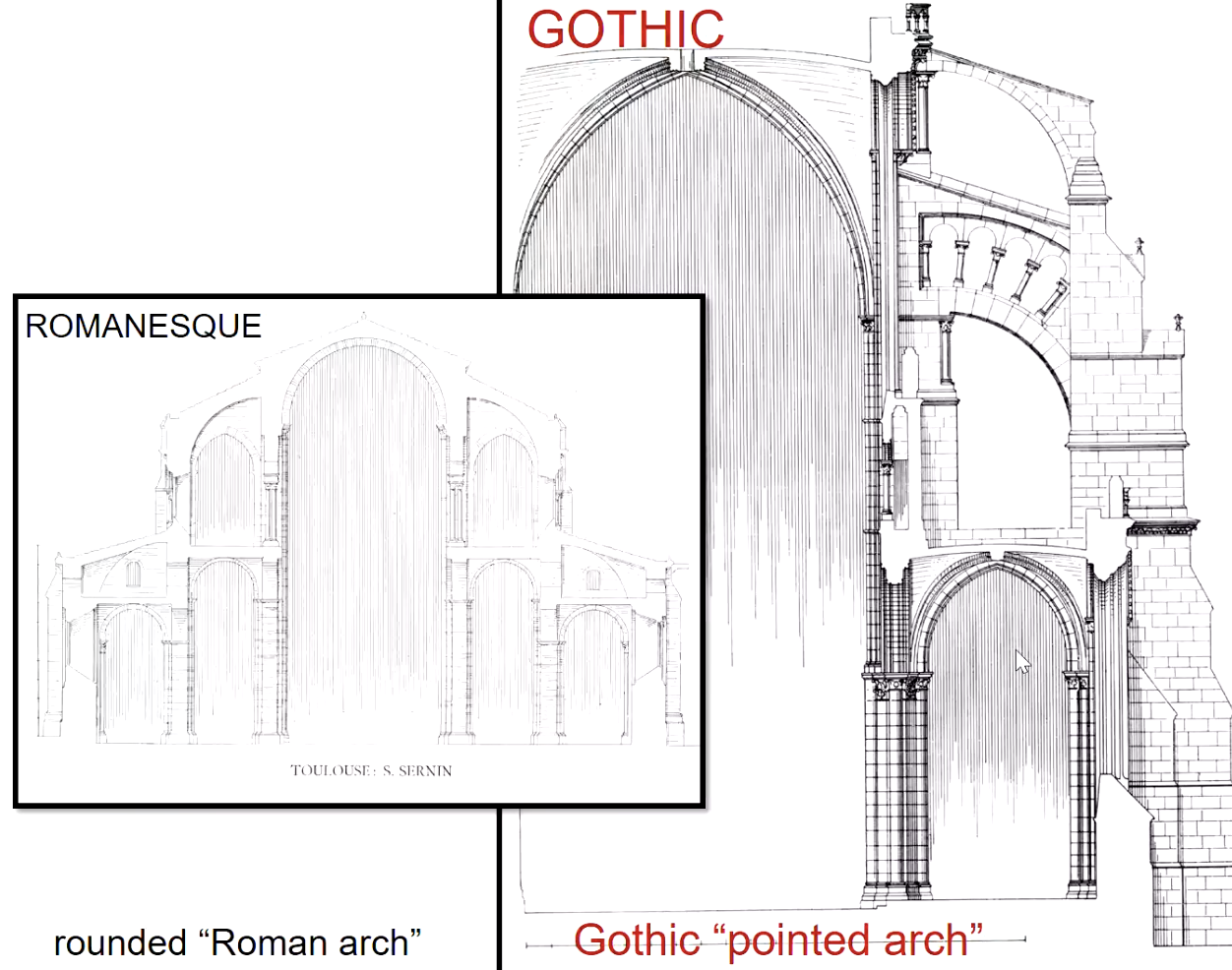
-use of arch: “Roman Arch”(Romanesque) rounded

-NO CONCRETE (don’t have the material for it); stone masonry instead

-basilica plan

Radiating chapel: relics

Ambulatory: pilgrimage route

Bay unit: unit of measurement: multiplie, stacker, lined up

Portal

Narthex: beginning of pilgrimage

-cruciform

-triadic

-Roman arch=vaulting

But not with concrete (Ex, Coliseum, Rome)

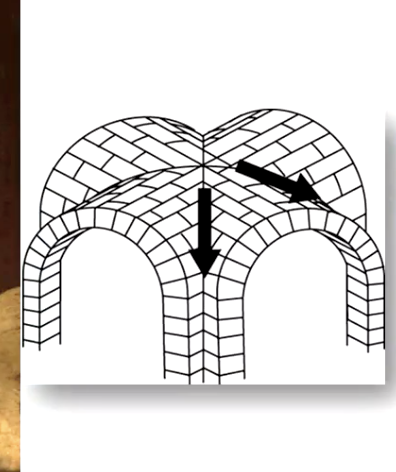
Barrel vault: horizontal stretch of arches

Groin vault: int
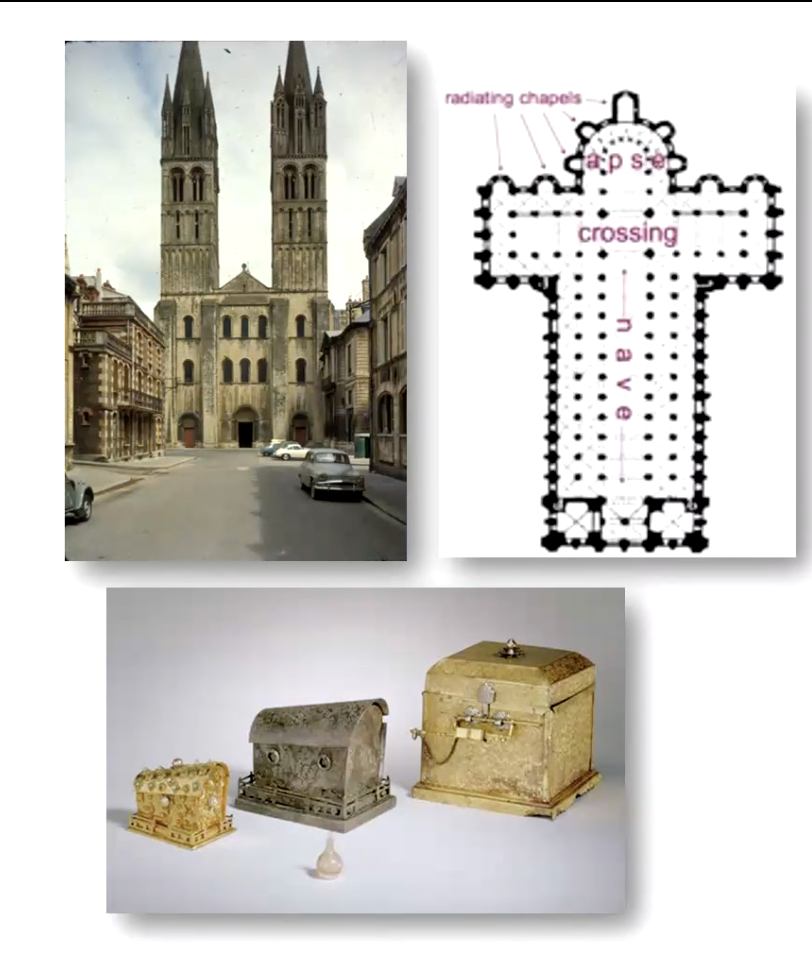
<p>-large, monumental to house large numbers of pilgrims</p><p>-constructed out of stone/______:symbolizes “stone box”</p><p>-no concrete(Imperial Roman) formula is lost</p><p>-stone:sturdy, solid, protective</p><p>-stonemasonry</p><p>-cruciform: symbolizes cross</p><p>-triadic: symbolizes trinity</p><p>-triadic:navel/2 aisles</p><p>-triforium: three part stacking</p><p>-use of arch: “Roman Arch”(Romanesque) rounded</p><p>-NO CONCRETE (don’t have the material for it); stone masonry instead </p><p>-basilica plan</p><p>Radiating chapel: relics</p><p>Ambulatory: pilgrimage route</p><p>Bay unit: unit of measurement: multiplie, stacker, lined up</p><p>Portal</p><p>Narthex: beginning of pilgrimage</p><p>-cruciform</p><p>-triadic</p><p>-Roman arch=vaulting</p><p>But not with concrete (Ex, Coliseum, Rome)</p><p>Barrel vault: horizontal stretch of arches</p><p>Groin vault: int</p>
37
New cards

Romanesque basilica

nave, apse, transept, crossing, aisle, ambulatory,

radiating chapel, vaulting (barrel, groin, ribbed), triforium, narthex
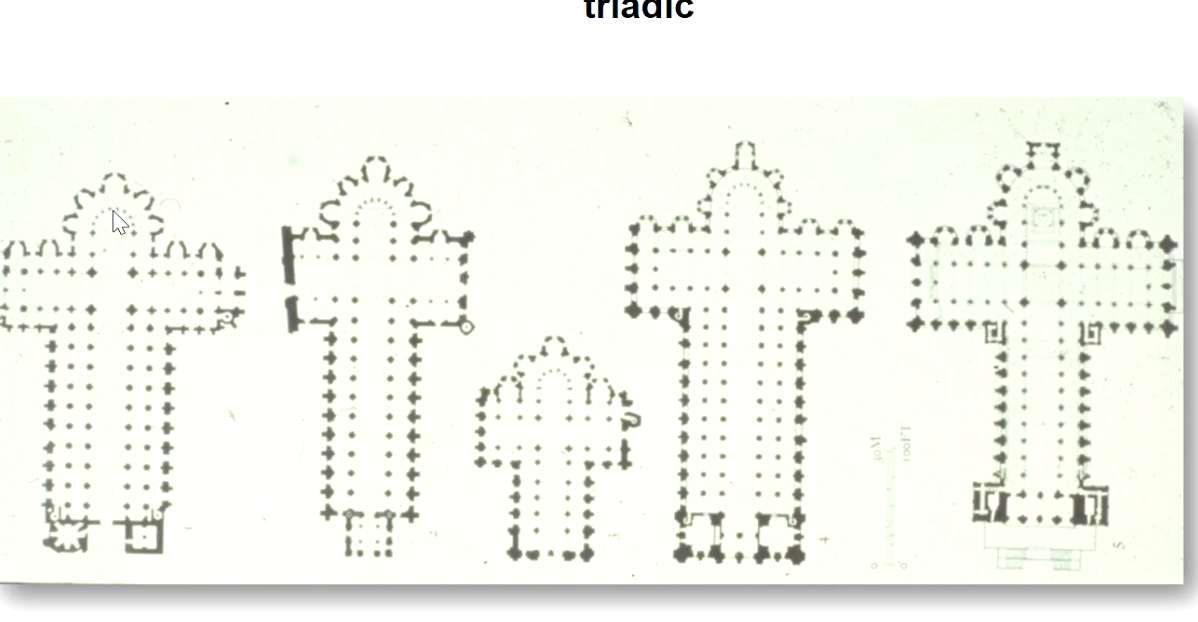
-basilica plan

Radiating chapel: relics

Ambulatory: pilgrimage route

Bay unit: unit of measurement: multiplie, stacker, lined up

Portal

Narthex: beginning of pilgrimage

-cruciform

-triadic

-Roman arch=vaulting

But not with concrete (Ex, Coliseum, Rome)

Barrel vault: horizontal stretch of arches

Groin vault: intersection at right angles of two barrel vaults


-subdivides weight of materials

-transfers weight into 4-8 sections

Ribbed groin vault: groin vault (2-3 intersecting barrel vaults) edged with stone ribs

38
New cards

S. Sernin, Toulouse, France, 1070-1120

from Romansque Period: large stone church to protect the relics

-cruciform

-stone masonry

-ribbed barrel vaulting (100 feet tall)
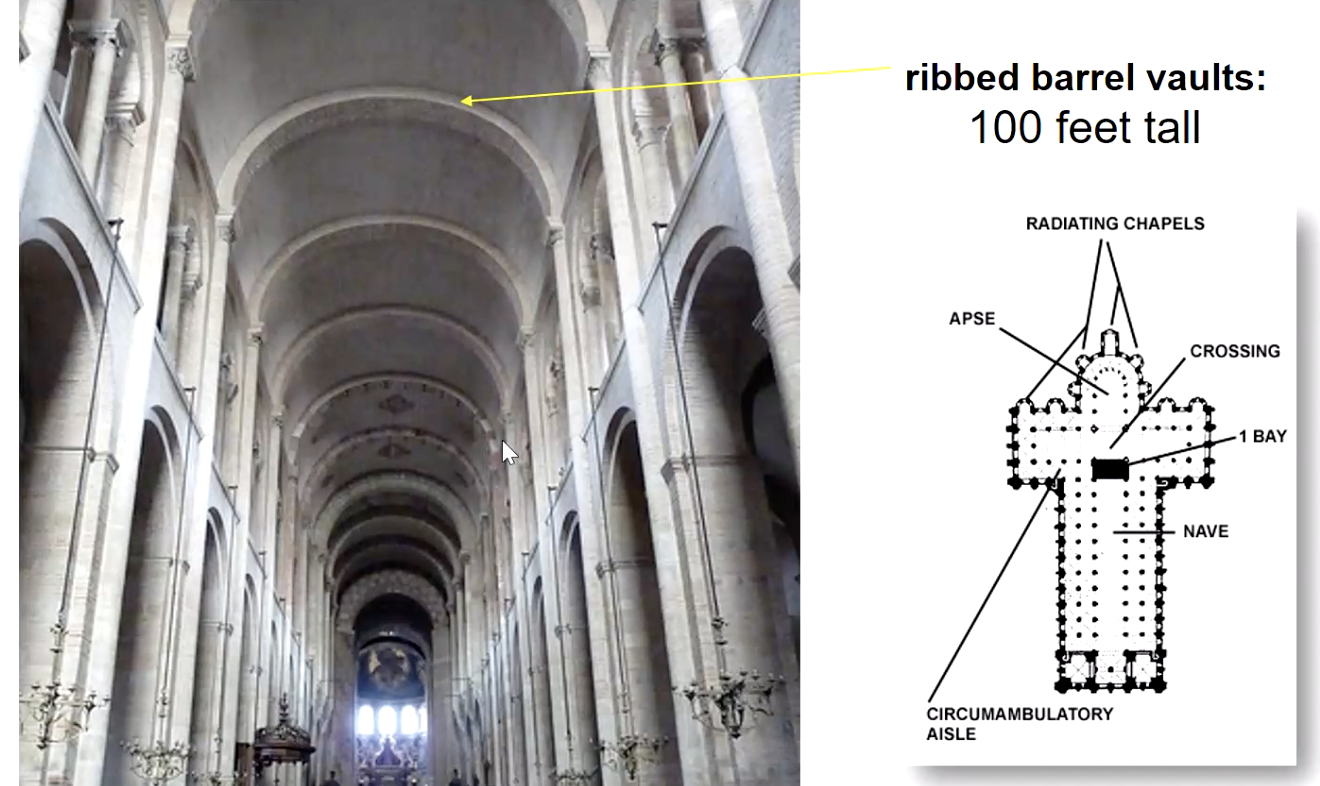
-round “Roman arch”

-TRIFORIUM wall: interior support wall

Weight of stone in vaulted ceiling is transferred down through the triforium wall into the foundation


-apse

-ribbed groin vault

-radiating chapel: where relics would be displayed

-capital:

Interlace patterning

Medieval influence


39
New cards

triforium

Weight of stone in vaulted ceiling is transferred down through the _____ wall into the foundation

<p>Weight of stone in vaulted ceiling is transferred down through the _____ wall into the foundation</p>
40
New cards

Eadwine the Scribe, Eadwine Psalter, 1160-1170

Romanesque manuscript illumination example

Book of Psalms

Romanesque Rounded “Roman arch”

Romanesque triforium wall

interlace patterning

<p>Romanesque manuscript illumination example</p><p>Book of Psalms</p><p>Romanesque Rounded “Roman arch”</p><p>Romanesque triforium wall</p><p>interlace patterning</p>
41
New cards

Gothic Art and Architecture

First crusade is Romanesque (pilgrimage and reliquaries)

“Migrating goths” from eastern germany and Gotland(southern sweden)

  • different gothic tribes

Not part of “Roman empire”

No roman influences

Shift away from Romanesque

-from round roman arch

-to gothic “pointed arch” / groin vaulting

buttressing

stone masonry = weightless

stained glass = transparency

Rose Window


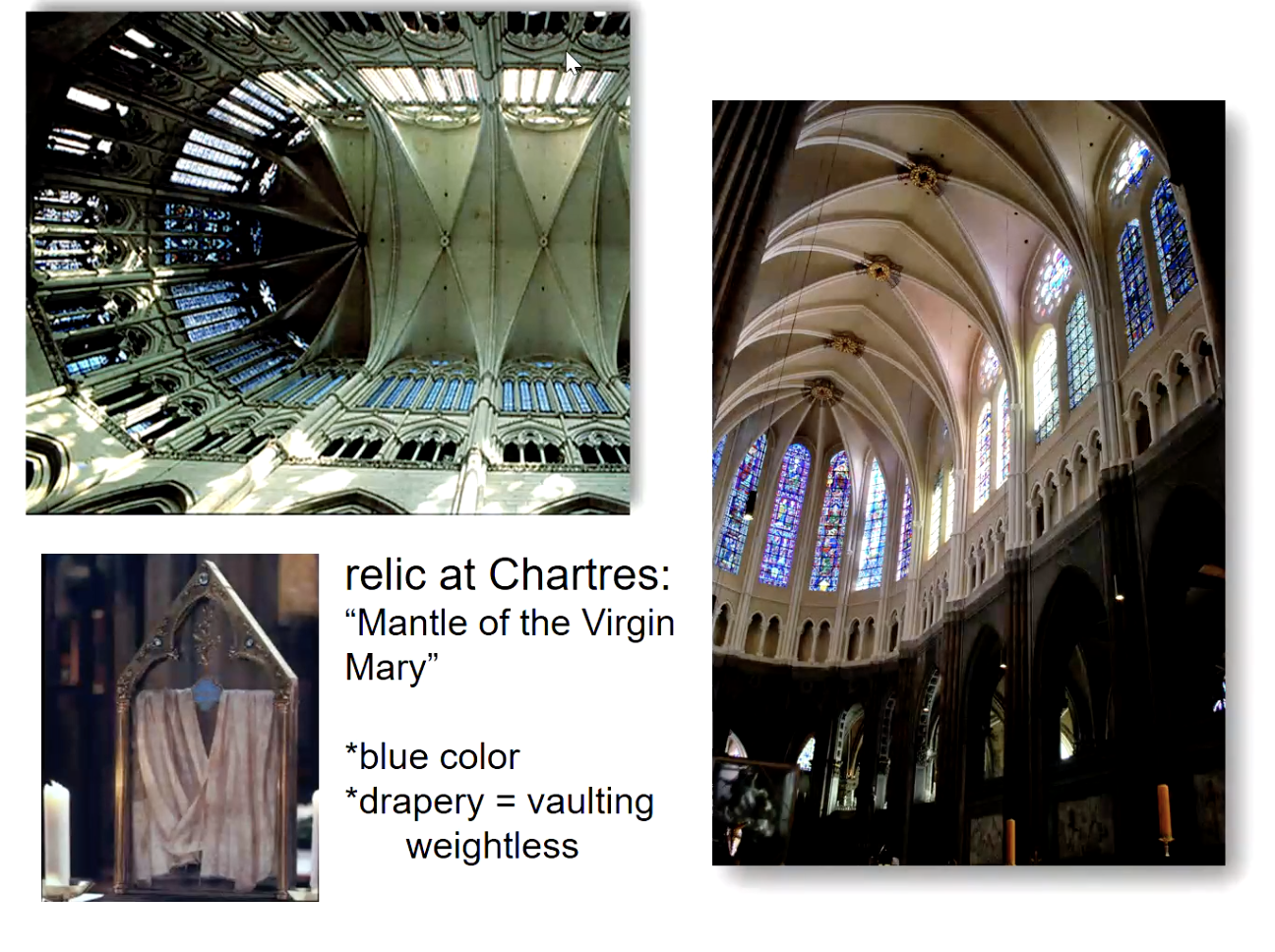
important relic brought back: “Mantle of the Virgin Mary” (mantle = veil)

“Assumption of Mary”: no physical body

Silk cloth “worn at the birth of Christ”
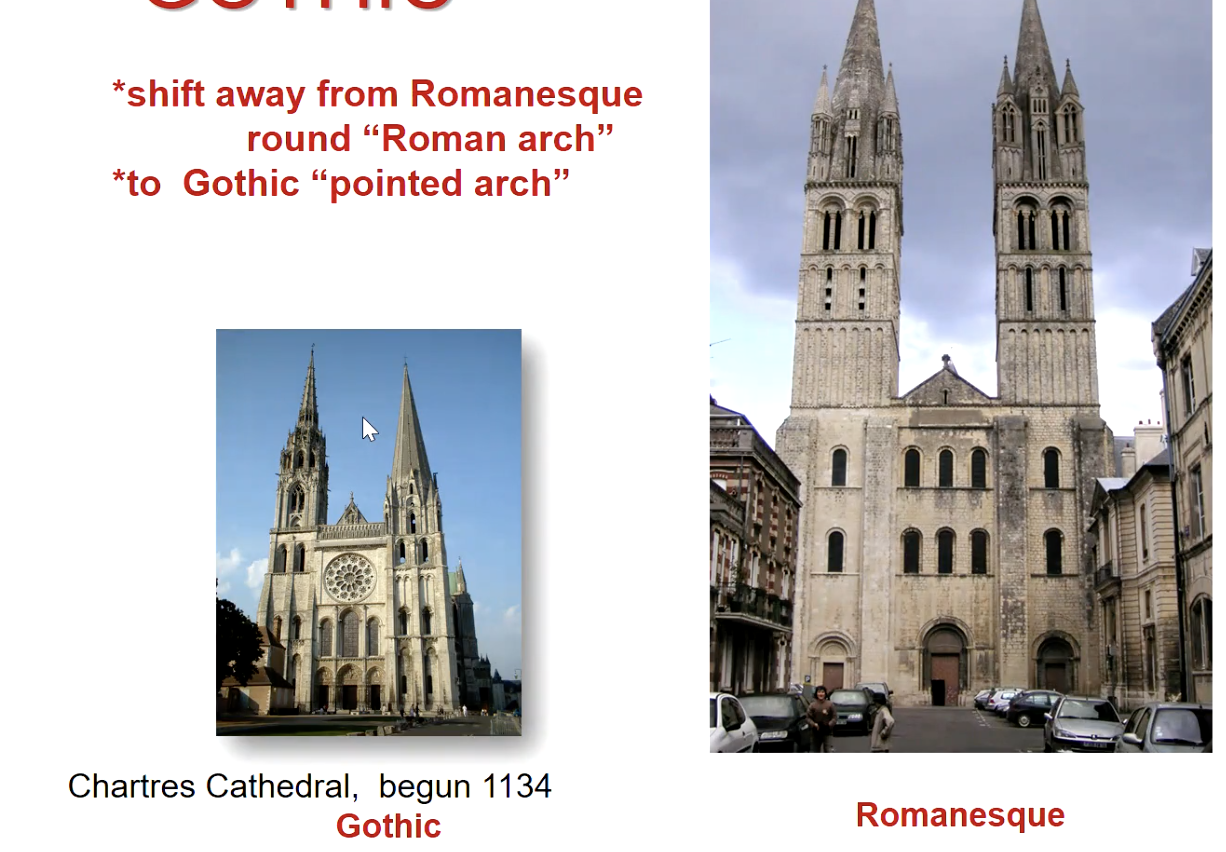


42
New cards

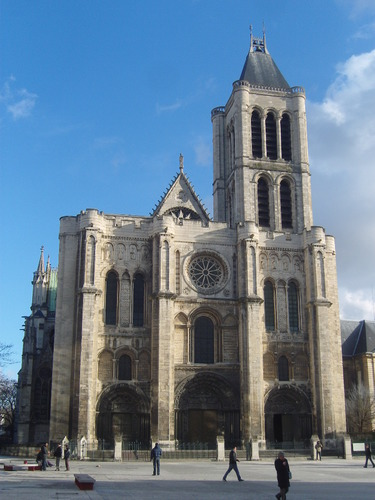
Abbot Suger, abbey church of St. Denis, 1140-1144

“gothic additions” made to a Romanesque church (addition to church 12th.c. Gothic, earlier church, 10thc. Romanesque)

-Abbot Suger:” the whole church should shine with the wonderful and uninterrupted light of

most luminous windows”

  • STONE, GLASS

-Abbot Suger: redesign of that church

-open, not compartmentalized

-stained glass windows: light filled and radiant by adding the glass


-”pointed gothic” arch instead of ribbed barrel vault or groin vault from Romanesque period

20

-groin vault with pointed Gothic arch

-canopy like vaulting: open, floating, weightless

-ribbed groin vaults

-Gothic:

Transparency

Addition of glass

Pointed Gothic arch

<p>“gothic additions” made to a Romanesque church (addition to church 12th.c. Gothic, earlier church, 10thc. Romanesque)</p><p>-Abbot Suger:” the whole church should shine with the wonderful and uninterrupted light of</p><p>most luminous windows”</p><ul><li><p>STONE, GLASS</p></li></ul><p>-Abbot Suger: redesign of that church</p><p>-open, not compartmentalized</p><p>-stained glass windows: light filled and radiant by adding the glass </p><img src="https://assets.knowt.com/user-attachments/ed461bfb-7d05-4090-843e-f80a62fea448.png" data-width="50%" data-align="center" style="display: block; width: 50%; margin-left: auto; margin-right: auto;"><p></p><p>-”pointed gothic” arch instead of ribbed barrel vault or groin vault from Romanesque period</p><p>20</p><p>-groin vault with pointed Gothic arch</p><p>-canopy like vaulting: open, floating, weightless </p><p>-ribbed groin vaults</p><img src="https://assets.knowt.com/user-attachments/f9a60da0-04c4-4e88-8246-0053b5944461.png" data-width="50%" data-align="center" style="display: block; width: 50%; margin-left: auto; margin-right: auto;"><p>-Gothic:</p><p>Transparency</p><p>Addition of glass</p><p>Pointed Gothic arch</p>
43
New cards

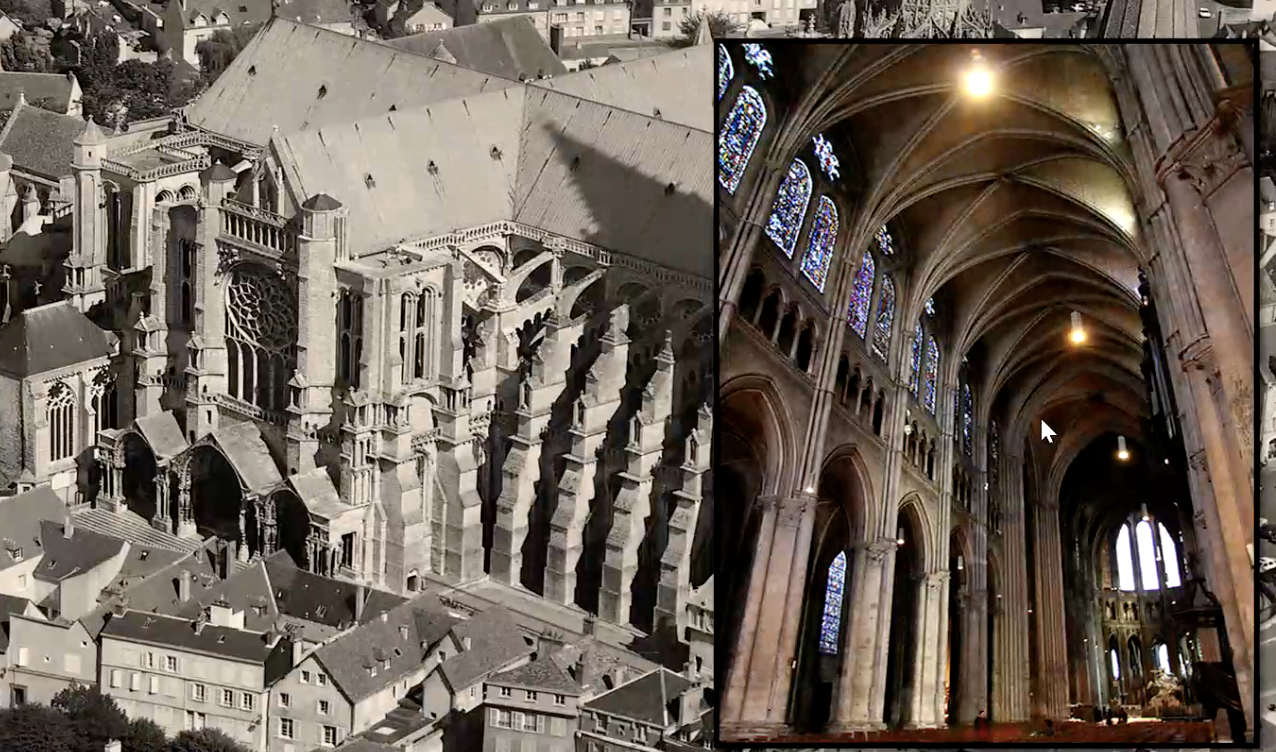
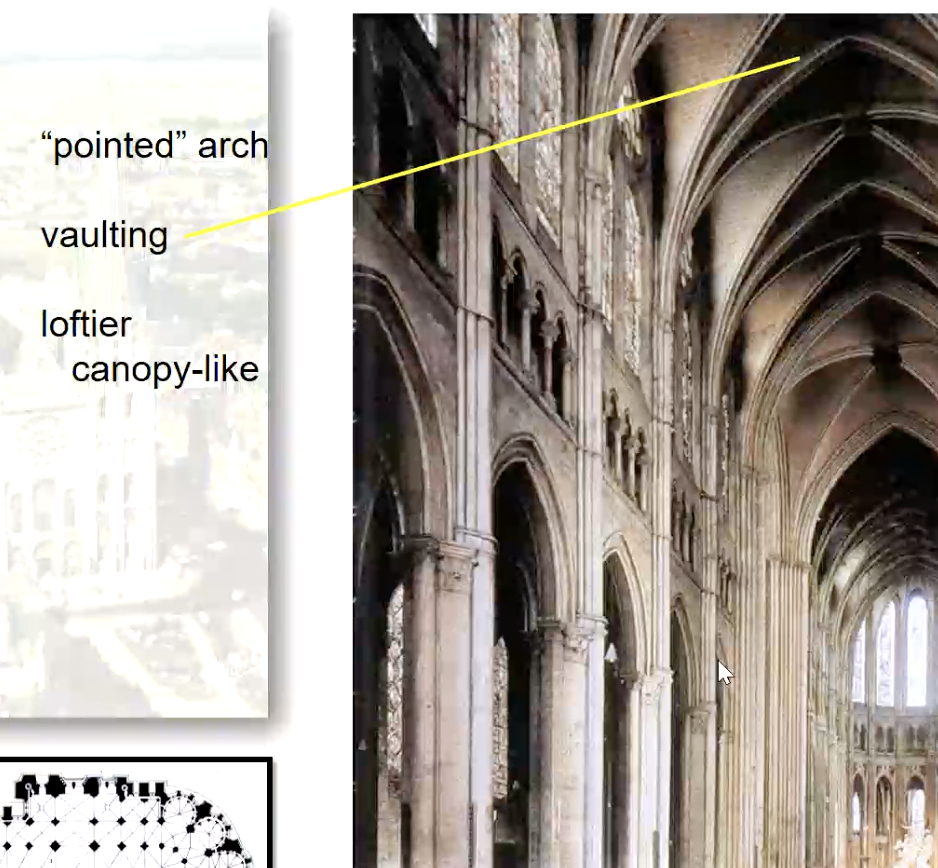
Chartres Cathedral, France, begun 1134,

Gothic Church (pointed architecture)

influences from the romanesque style: large buildings, stone masonry, triadic symbolism

changes from the romanesque style:

taller structures

MORE complex

ribbed vaulting (ribbed groin vault, instead of ribbed barrel vault like S. Sernin Toulouse


“Gothic” pointed arch

larger apse

more integration from the nave to apse

more glass than stone introduced in gothic church

“pointed” arch

weightless

canopy-like

buttressing

<p>Gothic Church (pointed architecture)</p><img src="https://assets.knowt.com/user-attachments/106344af-412c-4e42-b7ea-b201816fc37c.png" data-width="50%" data-align="center" style="display: block; width: 50%; margin-left: auto; margin-right: auto;"><img src="https://assets.knowt.com/user-attachments/74e1b096-ac43-498a-95e6-069e9e1c7991.png" data-width="50%" data-align="center" style="display: block; width: 50%; margin-left: auto; margin-right: auto;"><p>influences from the romanesque style: large buildings, stone masonry, triadic symbolism</p><p>changes from the romanesque style:</p><p>taller structures</p><p>MORE complex</p><p>ribbed vaulting (ribbed groin vault, instead of ribbed barrel vault like S. Sernin Toulouse</p><p></p><p>“Gothic” pointed arch</p><img src="https://assets.knowt.com/user-attachments/2734b604-bd85-498e-a3f6-ad4b90170f97.png" data-width="50%" data-align="center" style="display: block; width: 50%; margin-left: auto; margin-right: auto;"><p>larger apse</p><p>more integration from the nave to apse</p><p>more glass than stone introduced in gothic church</p><img src="https://assets.knowt.com/user-attachments/935db1aa-d28a-4e8f-ba8f-23c0f0203baa.png" data-width="50%" data-align="center" style="display: block; width: 50%; margin-left: auto; margin-right: auto;"><p>“pointed” arch</p><p>weightless</p><p>canopy-like</p><img src="https://assets.knowt.com/user-attachments/2eb33f46-a007-4e7c-8ff1-a3e64c18cef2.png" data-width="50%" data-align="center" style="display: block; width: 50%; margin-left: auto; margin-right: auto;"><p>buttressing</p>
44
New cards

buttress

Gothic period technique

structure which shifts transference of weight to a “propping” function

flying buttress: open, attach to buttress pier (or wall)

rose window


45
New cards

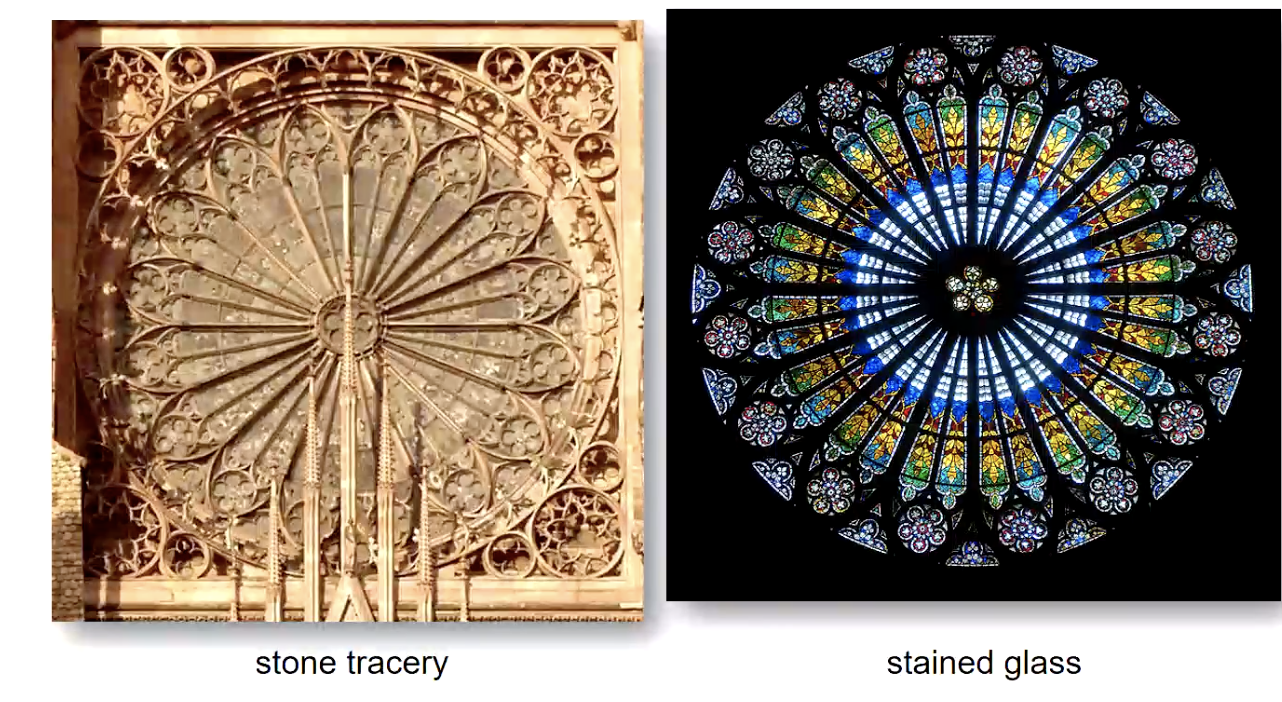
Chartes Cathedral: Rose window, 1220

from Gothic period

Hugh Of St.Victor: “stained glass windows are the holy scriptures and their

brilliance lets the LIGHT of heaven pass into the church to enlighten those inside”

Stone tracery

Stained glass

knowt flashcard image


-Rose windows… constellation of stars….petals of a rose….unfolding the perfection of the

christian world”

-relic: reliquary holding textile fragment believed to be from mantle/turic/cloak of the virgin

mary

Blue

-The rose windows are 50 feet in diameter

-relic at Chartres:

Mantle of the Virgin mary (most important relic)

  • Blue color of glass

drapery = vaulting weightless

look at how the blue color of the drapery is in this stained glass


also incorporates cloisonne

<p>from Gothic period </p><p>Hugh Of St.Victor: “stained glass windows are the holy scriptures and their</p><p>brilliance lets the <strong>LIGHT</strong> of heaven pass into the church to <strong>enlighten</strong> those inside”</p><p>Stone tracery</p><p>Stained glass</p><img src="https://assets.knowt.com/user-attachments/0eec86ca-5653-4e7f-a8ff-e67859d2fe9e.png" data-width="50%" data-align="center" alt="knowt flashcard image" style="display: block; width: 50%; margin-left: auto; margin-right: auto;"><p></p><p>-Rose windows… constellation of stars….petals of a rose….unfolding the perfection of the</p><p>christian world”</p><p>-relic: reliquary holding textile fragment believed to be from mantle/turic/cloak of the virgin</p><p>mary</p><p>Blue</p><p>-The rose windows are 50 feet in diameter</p><p>-relic at Chartres:</p><p>Mantle of the Virgin mary (most important relic)</p><ul><li><p>Blue color of glass</p></li></ul><p>drapery = vaulting weightless</p><img src="https://assets.knowt.com/user-attachments/5e21ec5b-d331-467e-9421-708f089faa3e.png" data-width="50%" data-align="center" style="display: block; width: 50%; margin-left: auto; margin-right: auto;"><img src="https://assets.knowt.com/user-attachments/7acfb2cd-26b0-4dfe-a018-25bda5168eca.png" data-width="50%" data-align="center" style="display: block; width: 50%; margin-left: auto; margin-right: auto;"><p>look at how the blue color of the drapery is in this stained glass</p><p></p><p>also incorporates cloisonne </p>
46
New cards

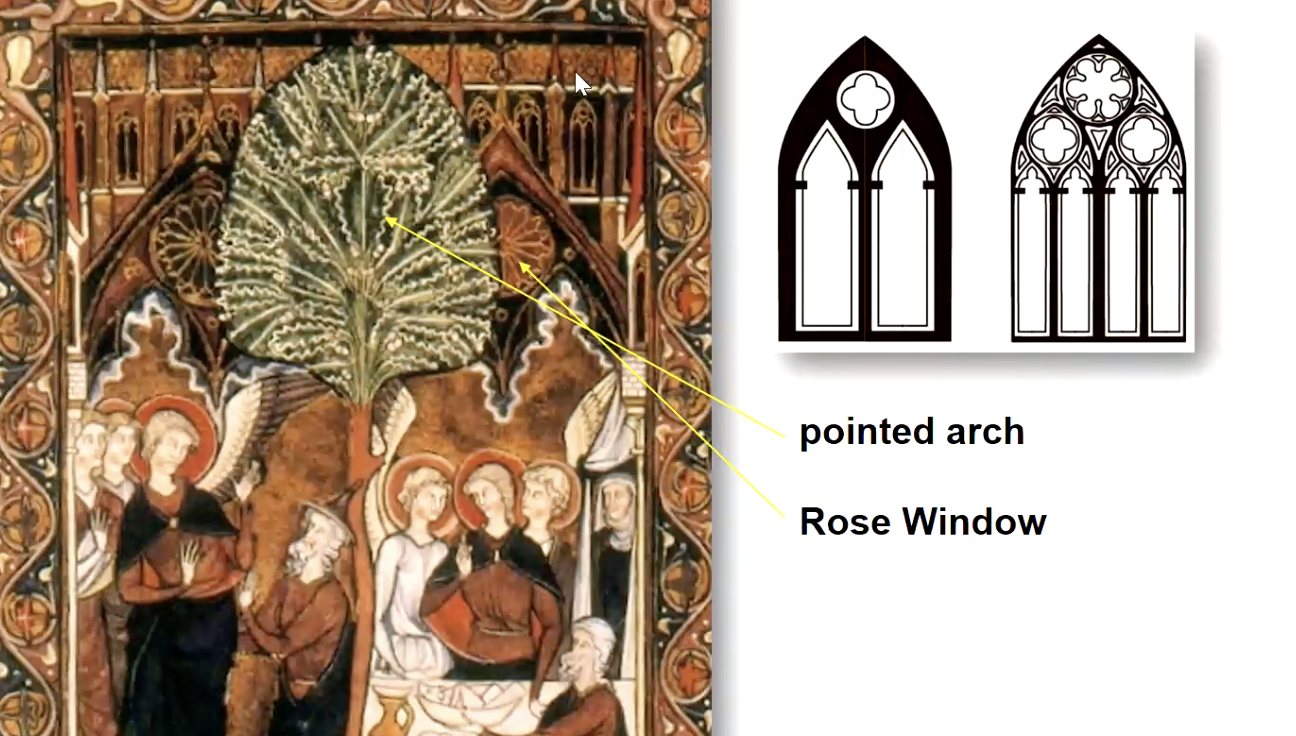
Psalter of St. Louis, “Abraham and the angels,” 1270

Gothic Manuscript Illumination

-Genesis 18: Abraham received three visitors and prv ADD

-Abraham with visitors

Pointed arch

Rose Window

interlace patterning


<p>Gothic Manuscript Illumination</p><p>-Genesis 18: Abraham received three visitors and prv ADD</p><p>-Abraham with visitors</p><p>Pointed arch</p><p>Rose Window</p><img src="https://assets.knowt.com/user-attachments/ec4e3a5f-c2b4-42b2-9c4b-6324cb7a6e22.png" data-width="50%" data-align="center" style="display: block; width: 50%; margin-left: auto; margin-right: auto;"><p>interlace patterning</p><img src="https://assets.knowt.com/user-attachments/aae13c21-1953-4fe4-acdd-03c991775141.png" data-width="50%" data-align="center" style="display: block; width: 50%; margin-left: auto; margin-right: auto;"><p></p>
47
New cards

Giotto di Bondone, Madonna Enthroned, 1310

Madonna, the Virgin Mary was a Jewish woman of Nazareth in Galilee.


The New Testament begins its account of Mary’s life with the Annunciation when the angel Gabriel appeared to her and announced her divine selection to be mother of Jesus.

Apocryphal writing tell of her subsequent death and bodily assumption into heaven where she is symbolically represented as Enthroned.


Demonstrates realism


“earthly form”; overlapping

3-dimensional

“earthly space”


human drama (human mother with a body, human-like qualities)


<p>Madonna, the Virgin Mary was a Jewish woman of Nazareth in Galilee.</p><p></p><p>The New Testament begins its account of Mary’s life with the Annunciation when the angel Gabriel appeared to her and announced her divine selection to be mother of Jesus.</p><p>Apocryphal writing tell of her subsequent death and bodily assumption into heaven where she is symbolically represented as Enthroned.</p><p></p><p>Demonstrates realism</p><p></p><p>“earthly form”; overlapping</p><p>3-dimensional</p><p>“earthly space”</p><p></p><p>human drama (human mother with a body, human-like qualities)</p><img src="https://assets.knowt.com/user-attachments/56d9fc65-72ae-469d-adb4-e3ae43686d88.png" data-width="50%" data-align="center" style="display: block; width: 50%; margin-left: auto; margin-right: auto;"><p></p>
48
New cards

Cimabue, Madonna Enthroned with Angels and Prophets , 1290

flattened out image of madonna (symbolism focused)

hieratic image

“divine form”; stacked

flat/floating

“spiritual space”

divine symbol


<p>flattened out image of madonna (symbolism focused)</p><p>hieratic image</p><p>“divine form”; stacked</p><p>flat/floating</p><p>“spiritual space”</p><p>divine symbol</p><p></p>
49
New cards

Proto-Renaissance

75-200 million people die from the Black Death (bubonic plague)

25 million in Europe (one third of the population of Europe)

one-half of the artistic population


“missing generation” in art guild/workshop system


painting

painting masters,

painting workshops

Giotto Realism vs. Cimabue Symbolism


<p>75-200 million people die from the Black Death (bubonic plague)</p><p>25 million in Europe (one third of the population of Europe)</p><p>one-half of the artistic population</p><p></p><p>“missing generation” in art guild/workshop system</p><p></p><p>painting</p><p>painting masters,</p><p>painting workshops</p><img src="https://assets.knowt.com/user-attachments/37a19867-1d01-4dbe-b0bb-9f579cbaa20a.png" data-width="50%" data-align="center" style="display: block; width: 50%; margin-left: auto; margin-right: auto;"><p>Giotto Realism vs. Cimabue Symbolism</p><img src="https://assets.knowt.com/user-attachments/c171bf37-a2f7-4830-8307-21d3834c1bfc.png" data-width="50%" data-align="center" style="display: block; width: 50%; margin-left: auto; margin-right: auto;"><img src="https://assets.knowt.com/user-attachments/c50f6de5-fbfb-43e2-8a05-360c8d904331.png" data-width="50%" data-align="center" style="display: block; width: 50%; margin-left: auto; margin-right: auto;"><p></p>
50
New cards

Giotto, Arena Chapel, Padua, Italy, 1305-1306:

interior made/painted by painter described as the most sovereign master of painting in his time, who drew all his figures and their postures according to nature

38 panels: Life of Christ and Life of Virgin Mary

Entry of Christ into Jerusalem

Lamentation

Meeting of Joachim and Anna

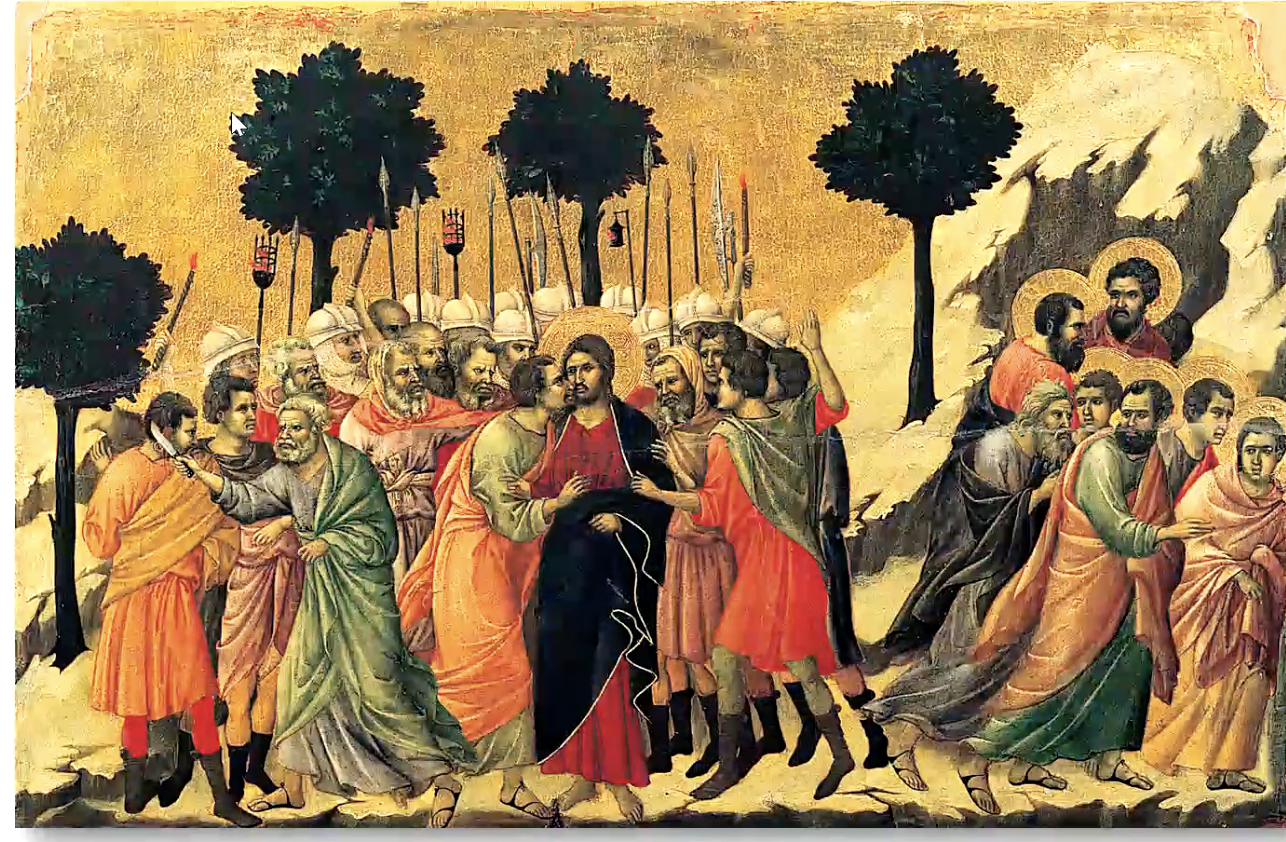
Betrayal


<p>interior made/painted by painter described as the most sovereign master of painting in his time, who drew all his figures and their postures according to nature</p><p>38 panels: Life of Christ and Life of Virgin Mary</p><p>Entry of Christ into Jerusalem</p><p>Lamentation</p><p>Meeting of Joachim and Anna</p><p>Betrayal</p><img src="https://assets.knowt.com/user-attachments/a7b3a16d-548a-4f39-9aad-af4ffee170f5.png" data-width="50%" data-align="center" style="display: block; width: 50%; margin-left: auto; margin-right: auto;"><p></p>
51
New cards

Arena Chapel: Entry of Christ into Jerusalem

According to Gospel writers, Jesus rode a donkey into Jerusalem, and the celebrating people laid down their cloaks in front of him, and also small branches of trees.

Upon entering Jerusalem, the events leading up to his betrayal and subsequent crucifixion unfold

(he is at the crossroads here, dramatic narrative)

Realism

narrate the story: character, action, setting

describe it: make it real: perspective systems

dramatic moment in story: suspended time

  • planimetric seperation (background, middle ground, foreground): narrate the story with the space)

    • foreground: christ and disciples in route

    • middle: gate, arrival sets into motion the arrest, crucifixion

    • background: blue-sky (earthliness)

  • overlapping

    • connecting the images in the different “planes” by having them appear to block or obscure images in another “plane”

  • linear perspective

  • implied lines: lines of direction, motion


52
New cards

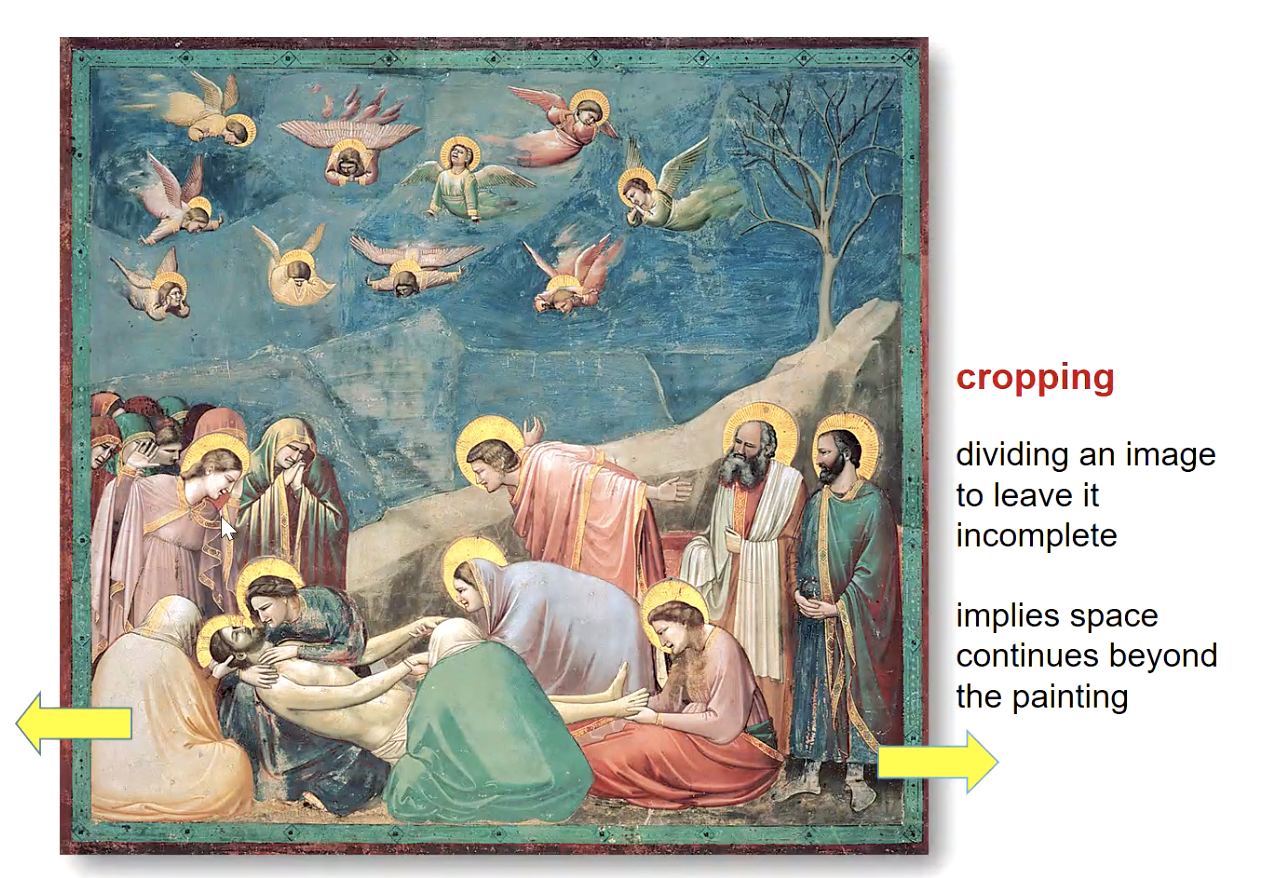
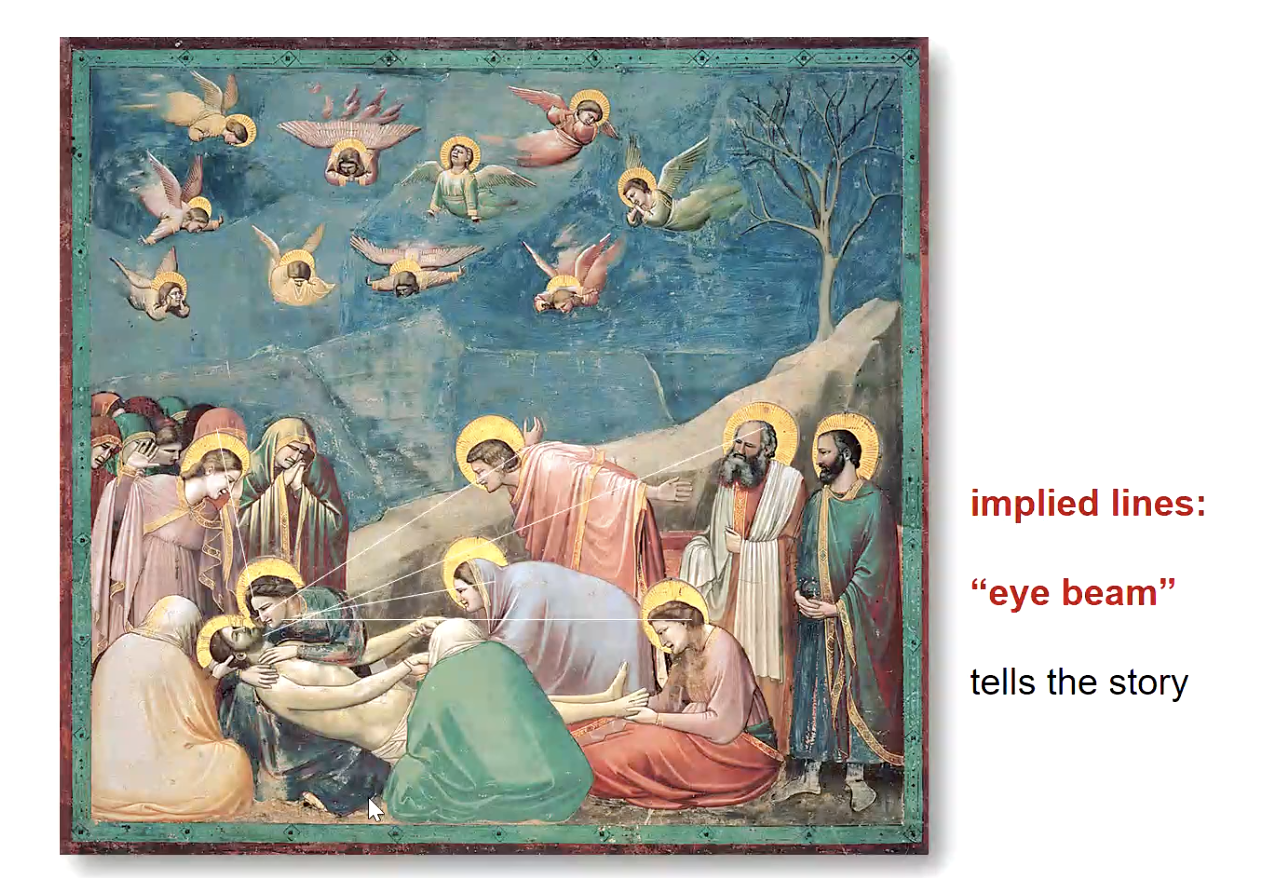
Arena Chapel: Lamentation


The _____ refers to the lament (weeping) over his crucified body

Realism

narrate the story: character, action, setting

describe it: make it real: perspective systems


planemetric seperation

  • foreground: Christ and witnesses (Virgin Mary, Mary Magdalen)

  • middle-ground: tree

  • background: angels

mediation: connections between one plane (foreground) and another (middle ground)


foreground to middle ground

  • tree in the garden of Eden

  • tree: wood of crucifix

  • connections in time (Adam: Christ)

  • connections in Christian symbolism (original sin to crucifixion)


horizon line

  • ground line

  • divine space (above) vs. earthly space (below)

horizontal position of Christ

(earthly death)

overlapping: connecting the images in the different planes by having them appear to block or obscure images in another plane (concave space)

linear perspective (orthogonals) (concave space)

cropping

modeling: manipulation of colors from light to darker to create the illusion of being convex (three-dimensional); convex figures


concave space - real 3d space

convex figures - real 3d figures existing in the 3d space


foreshortening

continuous plane: with the viewer’s space; often leaves an empty space for the viewers poisiton; includes viewer in the action


implied lines: ‘eye beam”

tells the story


53
New cards

overlapping

connecting the images in the different planes

by having them appear to block or obscure images in another plane

<p>connecting the images in the different planes</p><p> by having them appear to block or obscure images in another plane</p>
54
New cards

linear perspective

the manipulation of lines to produce the effect of recessional space

i.e, orthogonals (diagonal lines that appear to converge at a distance point)

  • done through linear configurations


<img src="https://assets.knowt.com/user-attachments/be8472ca-3784-464d-88dd-68faeb344375.png" data-width="50%" data-align="center" style="display: block; width: 50%; margin-left: auto; margin-right: auto;"><p>the manipulation of lines to produce the effect of recessional space</p><p>i.e, orthogonals (diagonal lines that appear to converge at a distance point)</p><ul><li><p>done through linear configurations</p></li></ul><p></p>
55
New cards

cropping

dividing an image to leave it incomplete

implies space continues beyond the painting

56
New cards

modeling

manipulation of colors from light to darker to create the illusion of being convex (three-dimensional)

57
New cards

foreshortening

is a technique used in perspective to create the illusion of an object receding strongly into the distance or background

58
New cards

Arena Chapel: Meeting of Joachim and Anna

planemetric seperation

  • foreground: Anna and Joachim

  • middle ground: golden gate

  • mediation: connections between planes: bridge

  • overlapping: embrace

lowered horizon line

cropping

engaged eye: a figure in the painting appears to look into the viewer’s space

59
New cards

Arena Chapel: Betrayal

Judas Iscariot betrays Jesus

lowered horizon line

continuous plane with the viewer’s space

in the action, but unable to prevent the outcome

overlapping

implied line

“eye beam”

modeling: light to dark, convexity

60
New cards

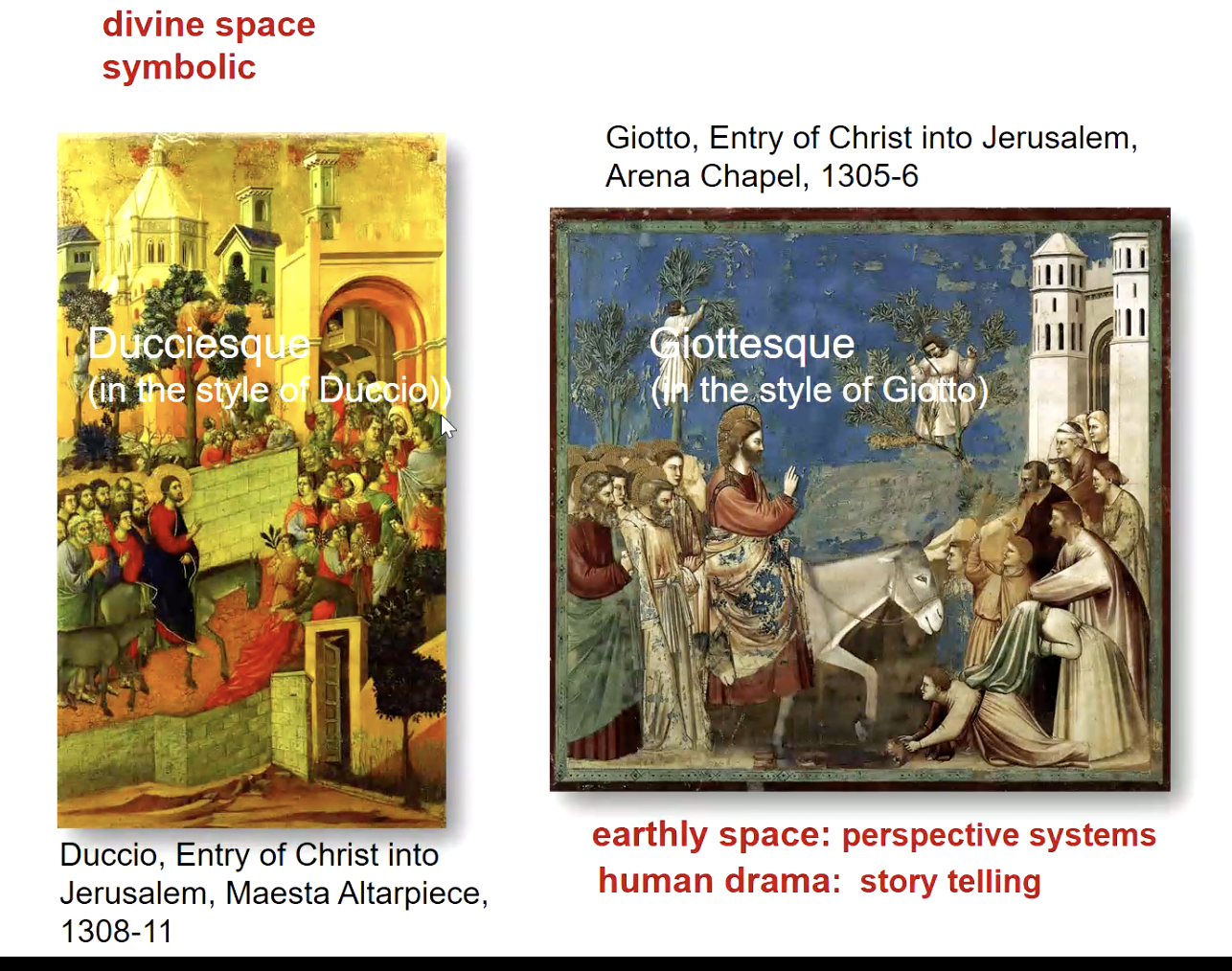
Duccio di Buoninsegna, Maesta Altarpiece, 1308-1311:

Entry of Christ into Jerusalem

Betrayal of Jesus

61
New cards

Maesta Altapiece: Entry of Christ into Jerusalem

by Duccio


opposing style from Giotto

hieratic imagery

floating

divine sky (instead of earthly sky like Giotto)

“tilted plane”: stacked space to show details; not recessional space (unlike Giotto, with ‘earthly space” and perspective systems); all about symbolic space

“reverse perspective": size diminishment is reversed from small to large (to show details)

divine space, symbolic

<p>by Duccio</p><p></p><p>opposing style from Giotto</p><p>hieratic imagery</p><p>floating</p><p>divine sky (instead of earthly sky like Giotto)</p><p>“tilted plane”: stacked space to show details; not recessional space (unlike Giotto, with ‘earthly space” and perspective systems); all about symbolic space</p><p>“reverse perspective": size diminishment is reversed from small to large (to show details)</p><img src="https://assets.knowt.com/user-attachments/e980bcac-bc51-4bde-9d55-be129f33a9c9.png" data-width="50%" data-align="center" style="display: block; width: 50%; margin-left: auto; margin-right: auto;"><p>divine space, symbolic</p>
62
New cards

Maesta Altapiece: Betrayal of Jesus

hieratic imagery: floating

tilted plane


<p>hieratic imagery: floating</p><p>tilted plane</p><p></p>
63
New cards

Giottesque vs. Ducciesque:

differing styles: realism (earthly) from Giotto vs. divine (hieratic imagery) from Duccio


64
New cards

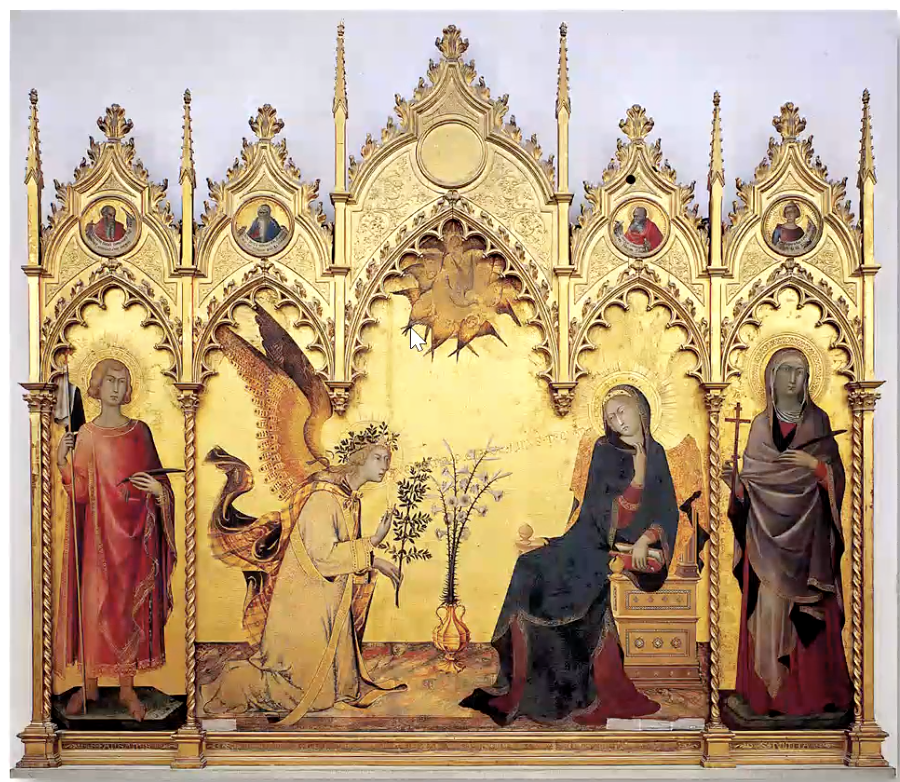
Simone Martini and Lippo Memmi, The Annunciation, 1333

from the life of Virgin Mary: when the angel Gabriel appeared to Mary and announced her divine selection to be mother of Jesus

Ducciesque:

  • gold: divine space

  • absence of overlapping: divine space

no eye beam between madonna and angel

symbol: easter lily


<p>from the life of Virgin Mary: when the angel Gabriel appeared to Mary and announced her divine selection to be mother of Jesus</p><p>Ducciesque: </p><ul><li><p>gold: divine space</p></li><li><p>absence of overlapping: divine space</p></li></ul><p>no eye beam between madonna and angel</p><p>symbol: easter lily </p><p></p>
65
New cards

Andrea Pisano, south door, Florence Cathedral, “Baptism of Christ,” 1336

john the baptist baptized christ in the Jordan river and recognized christ as the son of God

Giotto realism

  • Giottesque

  • perspective systems: earthly space

  • dramatic moment; human drama

  • overlapping: christ body seen thrugh water

  • linear perspective: orthogonals


<p>john the baptist baptized christ in the Jordan river and recognized christ as the son of God</p><p>Giotto realism </p><ul><li><p>Giottesque</p></li><li><p>perspective systems: earthly space </p></li><li><p>dramatic moment; human drama</p></li><li><p>overlapping: christ body seen thrugh water</p></li><li><p>linear perspective: orthogonals</p></li></ul><p></p>
66
New cards

Basillica Plan: apse

where sacred altar is located;

ritualized where sacred rituals happen (altar)

circular: sacred

<p>where sacred altar is located;</p><p>ritualized where sacred rituals happen (altar)</p><p>circular: sacred</p>
67
New cards

Basillica plan: nave

processional way


longitudinal axis

<p>processional way</p><p></p><p>longitudinal axis</p>
68
New cards

Basilica Plan: aisle

three part division (symbol of trinity)

<p>three part division (symbol of trinity)</p>
69
New cards

Basilica Plan: Narthex

antechamber


transition from earthly/secular space to nave

<p>antechamber</p><p></p><p>transition from earthly/secular space to nave</p>
70
New cards

transept

Cruciform: cross-shape (symbol of Crucifixion)

____ / crossing of nave


71
New cards

Hagia Sophia

dome (hemispheric)

clerestory (40 windows allowing light into interior and created floating effect

pendentives

wall piers


all featured by ____ _____ from Byzantine, the church combining elements of Basillica Plan and Central Plan outlines


72
New cards

vaulting; barrel

From Romanesque Period


“Roman arch” == _____;

____ vault: horizontal stretch of arches


73
New cards

groin vault

From Romanesque Period


intersection at right angles of two barrel vaults

  • subdivides weight of materials

  • transfers weight into 4-8 sections


74
New cards

ribbed groin vault

from Romanesque period

groin vault (2-3 intersecting barrel vaults) edged with stone ribs


75
New cards

“mantle of the Virgin” relic

from Gothic period

important relic brought back: (mantle = veil)

“Assumption of Mary”: no physical body

Silk cloth “worn at the birth of Christ”


76
New cards

S. Sernin, France vs. apse of Abbey church of St. Denis

Romanesque (sernin - rounded architecture) vs. Gothic (abbey - pointed architecture)

gothic taller

<p>Romanesque (sernin - rounded architecture) vs. Gothic (abbey - pointed architecture)</p><img src="https://assets.knowt.com/user-attachments/2bc03128-199b-455c-8ef5-c6120f8815ee.png" data-width="50%" data-align="center" style="display: block; width: 50%; margin-left: auto; margin-right: auto;"><p>gothic taller</p>
77
New cards

Gothic triforium


78
New cards

Mosaics vs. Stained Glass