Organic chemistry exam 4
 Call Kai
 Learn
 Practice Test
 Spaced Repetition
 Match
 Flashcards
 Knowt Play
1/87

There's no tags or description
Looks like no tags are added yet.
88 Terms

What is the correct reagent for the following compound?
c. I and IV

The reactivity of carboxylic acid derivatives from highest reactivity to lowest reactivity is_____
b. acid chloride > acid anhydride > ester > amide >

What is the product of the following reaction?
d. IV

What is the product of the following reaction?
a. I

What is the product of the following reaction?
b. II

What is the correct order of the reagents to achieve the following synthesis?
c. 1) NaOH, H2O, 2)TBAF/ THF 3)H3O+/ heat

What is the correct order of reagents to achieve the following synthesis?
b. 1) H3O+/heat, 2) KMnO4, 3) H3O+, 4) heat

What is the product of the following reaction?
C. III

What is the product of the following reaction?
C. III

What is the product of the following reaction?
b. II

This compound (shown below) can exist at equilibrium in solution in a number of keto-enol tautomers. Which of the following structures are possible tautomers of the following compound?
b.

Give the major product of the reaction-
d.

Give the major organic product(s) of the following reaction-
a.

In which of the following compounds would an α-hydrogen be most acidic?
c.

A compound, C5H10O, reacts with phenylhydrazine and gives a positive iodoform test. The compound could be which of these?
d.

Which of these amines is/are used with aldehydes and ketones to form enamines?
e. Both I and II

What would be the major product of the following reaction sequence?
I.

What would be the major product of the following reaction?
c. III

What would be the major product of the following reaction?
c. III

Simple enols are less stable than the tautomeric keto forms because:
d. the C-C p bond is weaker than the C-O p
Draw the structure of Acyl chloride-

Draw the structure of acid anhydride-

Draw the structure of Ester-

Draw the structure of Nitrile-

Draw the structure of Amides-

Name the following:
4-methylhexanoic acid

Name the following:
(E) -hept-3-enoic acid

Name the following:
Pthalic acid

Name the following:
Oxalic acid
Name the following:
Ethyl acetate

Name the following:
Tert-butyl-propanoate

Name the following:
Vinyl acetate

Name the following:
Methyl-4-chlorobenzoate

Name the following:
Diethyl malonate

Name the following:
3-methyl butyl ethanoate

Name the following:
Isopentyl pentanoate

Name the following:
Ethanoic anhydride
Name the following:
Succinc anhydride

Name the following:
Phthalic anhydride

Name the following:
Maldives anhydride

Name the following:
Ethanoyl chloride

Name the following:
Propanol chloride

Name the following:
Benzoyl chloride

Name the following:
N-phenyl-n-propylethanamide

Name the following:
Benzamide

Name the following:
Ethanenitrile

Name the following:
Prop-2-eneitrile

How to convert water insoluble carboxylic acid to soluble carboxylic acid-
Deprotonate it by reacting it with a suitable base to form a water-soluble ionic carboxylate salt
Write them down in the decreasing order of acidity and explain why

Which one is more acidic and why.
Because the pka is 2.85 and the other pka is 4.50 the lower pka the more acidic it is

Write down the methods for synthesis of carboxylic acid
Oxidation of primary alcohols and aldehydes
Oxidation of alkylbenzenes
Hydrolysis of nitriles and amides
Carboxylation of Grignard reagents
Hydrolysis of carboxylic acid derivatives
Write down the general mechanism of acyl substitution (nucleophilic addition elimination)-
What is the product of hydrolysis of all the carboxylic derivatives?
Acid chlorides, acid anhydrides, esters, amides, nitriles
Write down the order of the reactivity of the carboxylic acid derivative?
acyl chloride, acid anhydride, thioester, ester/carboxylic acid, amide, carboxylate ion
Write down the synthesis of acyl chloride from their reactive compound-

Write down the synthesis of acid anhydride from their reactive compound-
Write down the synthesis of thioester from their reactive compound-

Write down the synthesis of ester from their reactive compound-

Write down the synthesis of carboxylic acid from their reactive compound-

Write down the synthesis of amide from their reactive compound-

Write down the synthesis of carboxylate ion from their reactive compound-

Explain fisher esterification?
chemical reaction that converts a carboxylic acid and an alcohol into an ester and water using an acid catalyst
Explain saponification?
a chemical reaction where fats and oil mix with a strong base to produce soap and glycerol
What are lactones?
a cyclic ester, an organic molecule containing a ring structure made of carbon atoms and a single oxygen atom with a carbonyl group (C=O) adjacent to that ring group
Does lactone on hydrolysis give carboxylic acids?
yes, because lactones are cyclic esters
Complete the reaction and label the compound-
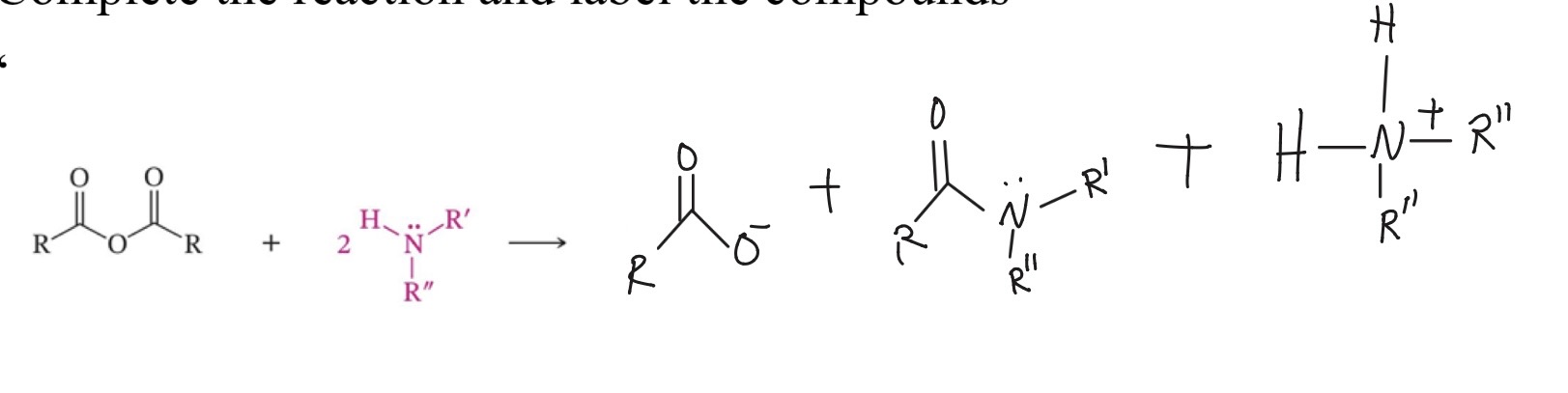
Complete the reaction and label the compound-

Complete the reaction and label the compound-
Complete the reaction and label the compound-

Complete the reaction and label the compound-

Complete the reaction and label the compound-
Complete the reaction and label the compound-

Complete the reaction and label the compound-

Complete the reaction and label the compound-

Write down the reaction for polyester synthesis-

Write down the reaction for polyamides synthesis-

Arrange the following in the increasing order of the acidity-
19-20 (higher), 25, 44, 50 (lower)
Draw the resonating structure of the enolates-

Draw the keto and enol forms of enolate-

What are tautomer’s?
constitutional isomers of a chemical compound that readily and reversibly interconvert with one another in a dynamic chemical equilibrium
For simple monocarbonyl compounds, such as acetone and acetaldehyde, the amount of the enol form present at equilibrium ______
extremely small, less than 1%
In compounds whose molecules have two carbonyl groups separated by one carbon atom (called B-Dicarbonyl compounds) the amount of enol present at equilibrium______
is higher 75-76%
The______ reaction is one of the rare instances in which a carbanion acts as a leaving group
haloform
Complete the reaction-

name the reaction-
hell-volhard-zelinski reaction

Complete the reaction-

Complete the reaction-

name and complete the reaction-
stork enamine reaction
