Exam 3 Biochem
 Call Kai
 Learn
 Practice Test
 Spaced Repetition
 Match
 Flashcards
 Knowt Play
1/68

There's no tags or description
Looks like no tags are added yet.
69 Terms
Oxidoreductases
Catalyzes oxidation-reduction reactions
Transferases
Catalyzes transfer of functional groups
Hydrolases
Catalyzes Hydrolysis reactions
Lyases
Catalyzes group elimination by breaking a covalent bond without water or oxidation (often to form double bonds)
Isomerases
Catalyzes isomerization reactions
Ligases
Catalyzes bond formation couples with ATP hydrolysis
Translocases
Catalyzes solute transport through membranes

What kind of enzyme catalyzes this reaction?
Transferase

What kind of enzyme catalyzes this reaction?
Lyase
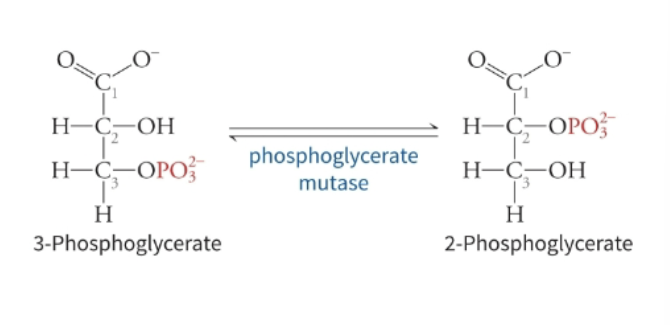
What kind of enzyme catalyzes this reaction?
Isomerase

What kind of enzyme catalyzes this reaction?
Oxidoreductase
Activation Energy
Energy barrier to achieve the transition state
Transition State
The highest point of free energy that a reaction needs in order to form products
What does a reaction require in order to overcome repulsions to come together to make products?
Free Energy (x-axis)

Is this a spontaneous reaction?
Yup

Is this a spontaneous reaction?
Nah
Cofactors
Needed to catalyze reactions that functional groups in Aas cant catalyze by themselves (redox reactions)
Coenzymes
Organic Cofactors
Cosubstrates
Coenzymes that are loosely bound and transiently interact with enzyme and substrate
Prosthetic Group
Coenzyme that is a permanently bound group that interacts with substrate
Acid-Base Catalysis
Reaction mechanism where a catalyst donates/accepts a proton during the reaction (facilitating proton transfer)
What Amino Acid side chains can participate in acid-base catalysis?
Histidine, Aspartate, Glutamate, Lysine, Arginine, Cysteine, and Tyrosine
What do all the Amino Acid side chains that can participate in acid-base catalysis have in common?
they all contain ionizable functional groups
ionizable function groups
functional groups (on amino acids) that can gain or lose a proton based on the pH levels
Covalent Catalysis
Where a covalent bond forms between the catalyst and the substrate during formation of the transition state; uses nucleophiles and electrophiles to form new bonds
What Amino Acid side chains can participate in covalent catalysis?
Serine, Tyrosine, Cysteine, Lysine, and Histidine
What do all the Amino Acid side chains that can participate in acid-base catalysis have in common?
They can all act as nucleophiles
Nucleophile
Chemical molecule that donates an electron pair to form a chemical bond with an electrophile
Electrophile
Chemical molecule that forms bonds with nucleophiles by accepting an electron pair
What is the catalytic triad of chymotrypsin?
His 57, Ser 195, and Asp 102
What is the role of His 57 in the catalytic triad?
being a base catalyst that takes a proton (H+) from Ser 195
What is the role of Ser 195 in the catalytic triad?
being a covalent catalyst that attacks peptide bonds of substrates
What is the role of Asp 102 in the catalytic triad?
stabilizes positively charged His 57 after it takes H+ from Ser 195
Catalytic triad
Interacts through H-bonding in active site
Oxyanion Hole
Negative oxyanion in chymotrypsin active site that is stabilized by two hydrogen bonds with chymotrypsin peptide backbone; H-bond only form with transition states
Velocity (v)
Progress of the reaction that’s measured by the appearance of product/disappearance of substrate over time (usually in mM/s)
Initial velocity (v0)
When [S] is low, v is linear. more [S] = faster rate
Maximal Velocity (Vmax)
When [S] is high, V plateaus. more [S] = same rate. Enzyme becomes saturated
Non-molecular (0th order) kinetics
When a reaction has a velocity (rate) independent of [S]
Unimolecular (1st order) kinetics
When a reaction has velocity (rate) dependent on concentration of a single substrate
Bimolecular (2nd order) kinetics
When a reaction has velocity (rate) dependent on concentration of two substrates
When does Michaelis-Menten Equation Apply?
When [S] is much greater than [E]
Km
Constant that combines the three rate constants; A measure of an enzyme’s affinity for a substrate
What does a small Km signify?
Enzyme has high substrate affinity; more effective at lower substrate concentrations
What does a large Km signify?
Enzyme has a lower substrate affinity; less effective at lower substrate concentrations
What is Kcat?
The turnover number; the rate constant of the reaction when the enzyme is saturated with substrate; is the number of catalytic cycles that each enzyme undergoes per unit of time
What are the three types of Reversible Inhibitors?
Competitive, Non-competitive, and Uncompetitive
Competitive Inhibitor
Compete with substrate to bind to active site

What effect do Competitive Inhibitors have on Km and Vmax?
Increases Km and has no effect on Vmax
Uncompetitive Inhibition
Inhibitor does not interfere with substrate binding, but prevents reaction from completing and forming product

What effect do Uncompetitive Inhibitors have on Km and Vmax?
Km and Vmax both decrease proportionately
Noncompetitive Inhibition
Binds to a site other than the active site before or after the substrate binds
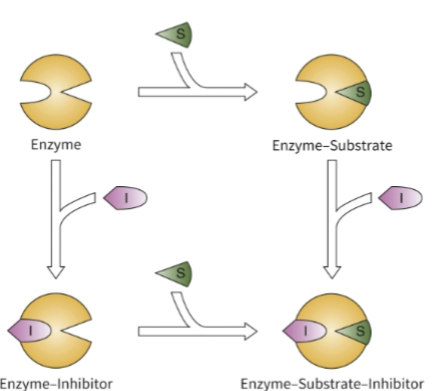
What effect do Noncompetitive Inhibitors have on Km and Vmax?
Km stays the same, and Vmax decreases

What type of Inhibition does this graph belong to? (Blue = normal Red = w/ Inhibitor)?
Noncompetitive

What type of Inhibition does this graph belong to? (Blue = normal Red = w/ Inhibitor)?
Competitive

What type of Inhibition does this graph belong to? (Blue = normal Red = w/ Inhibitor)?
Uncompetitive
What’s the difference between Saturated and Unsaturated Fatty Acids?
Saturated Fatty Acids have all C single bonds, while Unsaturated Fatty Acids have at least one C double bond
What’s the system for naming fatty acids (that we use)?
Counting carbons starting at the carboxylic acid, and then counting which carbon the double bond started at (# carbons : # double bonds (Delta) carbon position)


Name this Fatty Acid
18:0

Name this Fatty Acid
18:1 (Delta)^9

Name this Fatty Acid
18:2 (Delta)^9,12
How to identify a Omega-3 Fatty Acid?
If the last double bond is 3 carbons away (counting the start) from the end of the fatty acid
How to identify an Omega-6 Fatty Acid?
If the last double bond is 6 carbons away (counting the start) from the end of the fatty acid