Overview of Innate Immunity
 Call Kai
 Learn
Learn Practice Test
 Spaced Repetition
 Match
Match Flashcards
 Knowt Play
1/30

There's no tags or description
Looks like no tags are added yet.
Name | Mastery | Learn | Test | Matching | Spaced | Call with Kai | Chat |
|---|
No analytics yet
Send a link to your students to track their progress
31 Terms
What are the first lines of defense against pathogens?
Physical barriers such as skin, oral mucosal, respiratory epithelium, intestine, cornea and conjungtiva
Barriers can be ____, ____, or ____.
mechanical, chemical, microbiological (normal microbiota)
After anatomic barriers, the next layer of protection is?
Complement/antimicrobial proteins →preformed soluble effectors. These are preformed and available all the time ciruclating in body
Preformed soluble effectors include?
Complement, Defensins
How does the complement system defeat pathogens?
A multiprotein proteolytic cascade
Assembles a pore of multiple complement protein 9 (C9) on the bacterial surface
Causes osmotic lysis of the pathogen
How do Defensins defeat pathogens?
Similar to complement, but is an individual protein. Assembles a pore on bacterial surface, causes osmotic lysis
How are Defensins and C9 able to create pores?
They are able to associate with bacterial membranes because they are cationic (positively charged and lipid membranes are negatively charged), and amphipathic (have hydrophobic and hydrophilic sides)

Complement and Defensins are specific or not specific?
No specificity
What is the 3rd layer of host protection (after preformed soluble effectors?)
Innate immune cells (macrophages, neutrophils, eosinophils, basophils, mast cells, natural killer (NK) cells)

Identify this immune cell
Neutrophil

Identify this immune cell
Eosinophil

Identify this immune cell
Basophil

Identify this immune cell
Mast Cell
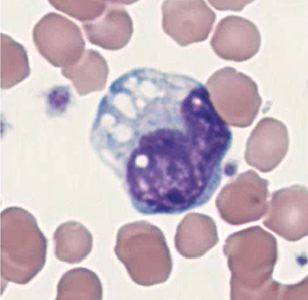
Identify this immune cell
Monocyte
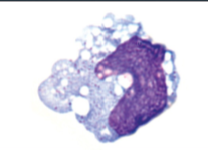
Identify this immune cell
Macrophage
What role do macrophages have in the innate immune response?
The initiators/ the first recognizers
How do macrophages respond to pathogens?
Express innate immune receptors (pattern recognition receptors) to detect microbes, phagocytoses them, presents the microbe antigen on its surface and secretes inflammatory cytokines thus initiating inflammation
What inflammatory cytokines do macrophages secrete?
Tumor Necrosing Factor (TNF), Interleukin 1 (IL1), Interleukin 6 (IL6)
Macrophages can also respond to environmental cues to do what?
They can undergo polarization to differentiae into multiple functional states such as tissue repair

Immune cell direct communication
Direct cell to cell binding and signaling such as T cell binding to APC, cytotoxic T cells, regulatory T cell inhibition
Immune cell indirect communication
Indirect communication through soluble effectors (cytokines) that bind to receptors (specific receptors for specific cytokines). Binding to receptor triggers a signal cascade to activate cell transcription
Autocrine
Cell secretes a cytokine that stimulates itself
Paracrine
Cell secretes a cytokine that stimulates nearby cells
What is the role of neutrophils in the innate immune system?
They are the eliminators, the first responders
How do neutrophils eliminate pathogens?
Highly phagocytic, contain granules containing preformed mediators that kill pathogens
How are neutrophils stimulated?
They are very plentiful circulating in the blood. TNF, IL-1, IL-6 stimulate the bone marrow to release more neutrophils.
What are the 4 steps of neutrophil recruitment?
Rolling
Firm adhesion
Transmigration
Chemotaxis

What molecule is responsible for the recruitment signaling to neutrophils to a site?
Interleukin 8 (IL-8), a chemokine

What immune cell connects the innate immune system to the adaptive immune system?
Dendritic Cells
A naive T cell can only be activated by what?
a professional APC (dendritic cell)
Compare and Contrast Immature and Mature Dendritic Cells
Immature: Highly endocytic (eats a lot), in tissues, poor T cell interactions, poor antigen presentation (low surface MHC II, low costimulatory molecules)
Mature: Poorly endocytic (not eating anymore), moves to lymph nodes, strong T cell interactions, highly antigen presenting (high surface MHC II, high costimulatory molecules)