chp. 12: anabolism
 Call Kai
 Learn
 Practice Test
 Spaced Repetition
 Match
 Flashcards
 Knowt Play
1/140

There's no tags or description
Looks like no tags are added yet.
141 Terms
anabolism
uses the energy from catabolism for biosynthetic pathways (building)
lots of energy needed
carbon source and inorganic molecules → new organelles and cells
macromolecules made from monomers
what is the cofactor for anabolism?
NADPH (for catabolism it was NADH)
can the same enzymes be in catabolism and anabolism?
yes, alot do double duty (forward + reverse) but the pathways themselves r not identical
are rxns separated in anabolism?
YES in eukaryotes for instance B-oxidation is the catabolism breaking down fatty acids, and in anabolism they r making lipids but it happens somewhere else. in prokaryotes anabolism can happen in the periplasmic space to separate
what builds new cells?
carbon source + inorganic molecules

what does catabolism make thats necessary in anabolism?
precursor metabolites like the 12 carbon skeletons (most r used for a.a)
ex: peptidoglycan is made of sugars and a.a, RNA is made of nucleotides, ATP is a ribonucleotide

nucleoside vs nucleotide
a nucleoside contains only a nitrogenous base and a five-carbon sugar, whereas a nucleotide is a nucleoside with one or more phosphate groups attached

what elements do the carbon skeletons have associated w them?
CHOPS but do not have N!!! acetyl-CoA and Succinyl-CoA has S

what r most of the carbon skeletons used to make?
amino acids
oxaloacetate makes a lot of a.a
ribose-5-P used for RNA + DNA
Erythrose-4-P used to make aromatic a.a
acetyl-coA can make fatty acids
alpha-ketoglutarate important in nitrogen assimilation to make glutamate

what is the carbon source of autotrophs?
CO2 so they need a CO2 fixaiton pathway like Calvin Benson cycle or reductive TCA cycle
what r the CO2 fixation pathways?
Calvin-Benson cycle
Reductive TCA cycle
Archaea has some that we wont study. Both of these input CO2 as starting rxn
what is another name for calvin-benson cycle?
reductive pentose phospate cycle (starts w 5C, ends w 6C)
Calvin-Benson cycle
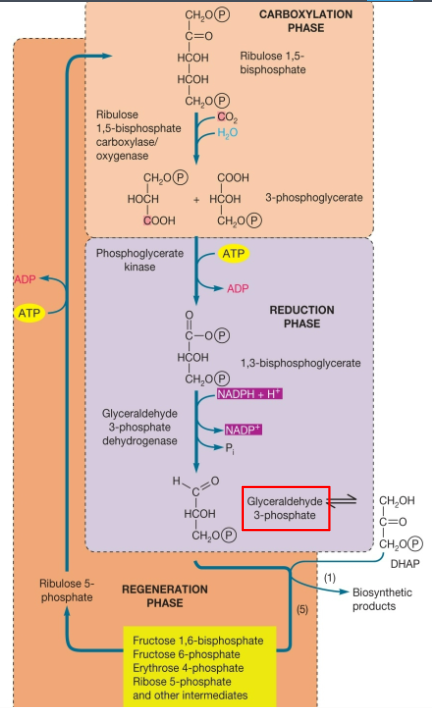
a CO2 fixation pathway whose main goal is to make glyceraldehyde-3-P from 3 CO2.
it starts w 5C and ends w 6C
has 3 phases:
1) carboxylation phase
2) reduction phase
3) regeneration phase
3 ATPs and 2 NADPHs used per 1 CO2

where does the calvin cycle happen in eukaryotes?
in the stroma of chloroplasts

where does calvin cycle happen in prokaryotes?
occurs in carboxysomes (not an organelle, but a specialized location w/in cytoplasm like a storage inclusion)
in cyanobacteria and some nitrifying bacteria, and thiobacilli

in the calvin cycle, how many ATPs and NADPH r used per one CO2?
3 ATPs and 2 NADPHs
carboxylation phase of Calvin cycle
the 1st step! Takes 5C sugar (ribulose 1,5-bisphosphate (RuBP)) and 1 CO2 and puts it together, then splits it in half
catalyzed by the enzyme ribulose bisphosphate carboxylase/oxygenase (RuBisCo)
CO2 + ribulose-1,5-bisphosphate (RuBP) → 2 3-phosphoglycerate
intermediate of EMP
what is the starting 5C sugar of Calvin cycle?
ribulose-1,5-bisphosphate (RuBP)
ribulose-1,5-bisphosphate (RuBP)
the starting 5C sugar in the Calvin cycle. It combines with 1 CO2 to become 2 3-phosphoglycerate
catalyzed by RuBisCo

ribulose bisphosphate carboxylase/oxygenase (RuBisCo)
the enzyme that catalyzes the carboxylation phase in Calvin cycle
1 CO2 + RuBP → 2 3-phosphoglycerate

what is the product of the carboxylation phase in Calvin cycle thats also an EMP intermediate?
2 3-phosphoglycerate (3 carbons)

reduction phase of Calvin cycle
3-phosphoglycerate → Glyceraldehyde 3-P
can do biosynthesis w/ it or can regenerate 5C sugar at top (RuBP)

regeneration phase of Calvin cycle
RuBP (rubulose-1,5-bisphosphate) is regenerated from G3P
frucose and glucose are produced (reverse of PPP)

what is used up in Calvin cycle?
6CO2, 18 ATP, 12 NADPH
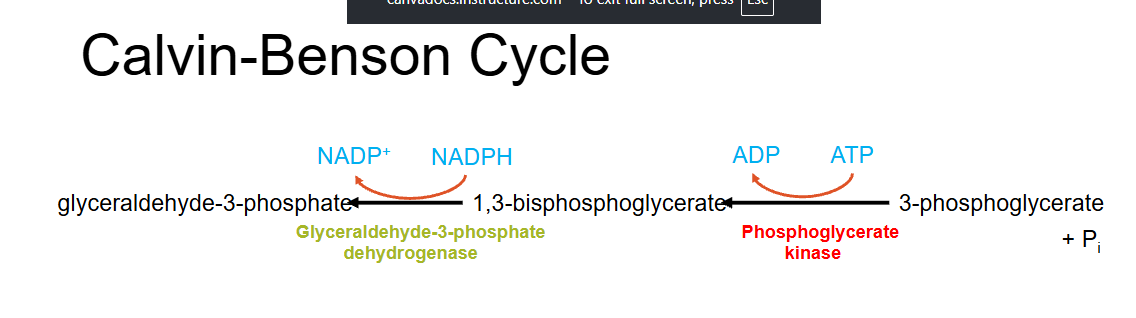
in the calvin cycle, what enzyme turns 3-phosphoglycerate → 1,3-bisphosphoglycerate?
phosphoglycerate kinase it uses 1 ATP

phosphoglycerate kinase
this is a reversible enzyme that functions in Calvin cycle and EMP
In Calvin cycle, it turns 3-phosphoglycerate → 1,3-bisphosphoglycerate using 1 ATP
in EMP, it turns 1,3-bisphosphoglycerate → 3-phosphoglycerate making 1 ATP
can use SLP

in EMP, what molecule turns 1,3-bisphosphoglycerate → 3-phosphoglycerate?
phosphoglycerate kinase, it generates 1 ATP

in Calvin cycle, what turns 1,3-bisphosphoglycerate → glyceraldehyde-3-phosphate?
glyceraldehyde-3-phosphate dehydrogenase, it uses 1 NADPH

in EMP, what enzyme turns G3P → 1,3-bisphosphoglycerate?
glyceraldehyde-3-phosphate dehydrogenase, it makes 1 NADH

glyceraldehyde-3-phosphate dehydrogenase
a reversible enzyme that catalyzes rxns btwn G3P and 1,3-bisphosphoglycerate using NAD(P)H
in Calvin cycle: turns 1,3-bisphosphoglycerate → G3P using 1 NADHP
in EMP: turns G3P → 1,3-bisphosphoglycerate making 1 NADH

when the Calvin cycle goes in reverse what is the flow of products and enzymes?
G3P ← 1,3-bisphosphoglycerate ← 3-phosphoglycerate
1) G3P dehydrogenase catalyzes 1st step and uses NADPH
2) phosphoglycerate kinase catalyzes 2nd step and uses ATP
Reductive TCA cycle
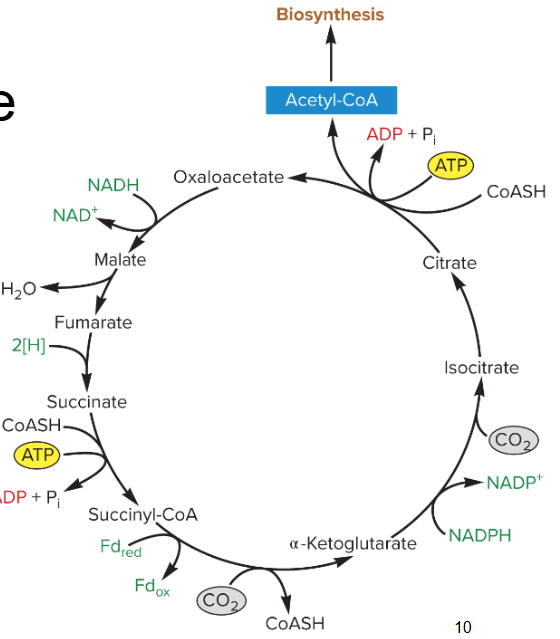
a CO2 fixation pathway that is the reverse of oxidative TCA cycle. It uses energy!
used by some chemolithoautotrophs
depends on ferredoxin, limited to anaerobes
Needs:
fumarate reductase
alpha-ketoglutarate synthase
ATP-dependent citrate lyase
Overall: 4 CO2 → oxaloacetate
to PEP w the help of pyruvate and PEP synthases
who is the reductive TCA cycle used by?
some chemolithoautotrophs and more common in anaerobes
what nonreversible things does the reductive TCA cycle need?
fumarate reductase
alpha-ketoglutarate synthase
ATP-dependent citrate lyase
what is the net rxn of reductive TCA cycle?
4 CO2 → oxaloacetate
to PEP w the help of pyruvate and PEP synthases
uses ATP and NADH

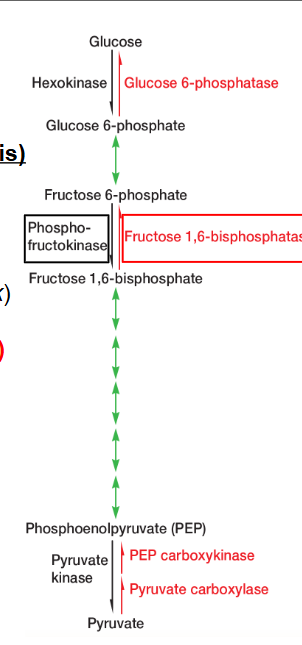
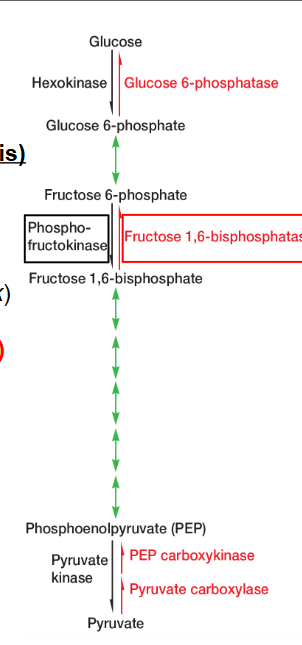
gluconeogenesis
makes glucose from pyruvate (reversal of glycolysis) but the 2 pathways r not identical! Uses ATP and NADH
pacemaker is fructose 1,6-bisphosphatase

what is the pacemaker for glycolysis?
phosphofructokinase

what is the pacemaker for gluconeogenesis?
fructose 1,6-bisphosphatase

what are some of the enzymes unique to gluconeogenesis?
glucose 6-phosphatase
PEP carboxykinase
pyruvate carboxylase
fructose 1,6-bisphosphatase

pyruvate carboxylase
one of the enzymes unique to gluconeogenesis. It uses CO2 and ATP to convert pyruvate → oxaloacetate

PEP carboxykinase
one of the enzymes unique to gluconeogenesis. It uses GTP and CO2 to convert oxaloacetate → PEP

glucose 6-phosphatase
one of the enzymes unique to gluconeogenesis. It converts glucose 6-phosphate → glucose

fructose 1,6-bisphosphatase
the PACEMAKER enzyme for gluconeogenesis. It turns fructose 1,6-bisphosphate → fructose 6-phosphate using H2O to cleave the P

what r some enzymes unique to glycolysis?
hexokinase
phosphofructokinase
pyruvate kinase

hexokinase
an enzyme unique to glycolysis. It turns glucose → glucose 6-phosphate
phosphofructokinase
the PACEMAKER for glycolysis!! It turns fructose 6-phosphate → fructose 1,6-bisphosphate by using ATP

pyruvate kinase
an enzyme unique to glycolysis. it turns PEP → pyruvate and generates an ATP
when is phosphofructokinase activated (glycolysis)?
when high lvls of AMP and ADP (low energy signals)
lots of fructose 6-P
if theres accummulation, means enzmye isnt going fast enough so we need to do glycolysis
fructose-2,6-bisphosphate (euk)

when is phosphofructokinase inactivated?
with high energy signals
high ATP
high citrate

when is fructose 1,6-bisphosphatase activated (gluconeogenesis)?
high energy signals → too much energy, store it
high ATP
high citrate
when is fructose 1,6-bisphosphatase inactivated? (gluconeogenesis)
w/ low energy signals
increased AMP and ADP
increased fructose 1,6-bisphosphate
increased fructose 2,6-bisphosphate (euk)

what energy is used to synthesize sugars?
Uridine diphosphate glucose (UDP-G)
glycogen
UDP-NAM-pentapeptide and UDP-NAG

what is the precursor to NAG?
fructose 6-phosphate

what is Uridine diphosphate glucose used for? (UDP-G)
for synthesis of sugars! It activates glucose. We put glucose together as glycogen so u have to activate it w/ this
found in peptidoglycan

in order to make amino acids from the 12 carbon skeletons, what do u need to add?
amino group and sometimes sulfur
nitrogen assimilation
sulfur assimilation
what r the methods of synthesizing amino acids from carbon skeletons?
nitrogen assimilation (add amino group)
sulfur assimilation (some have S)
amino acid biosynthetic pathways
anaplerotic rxns
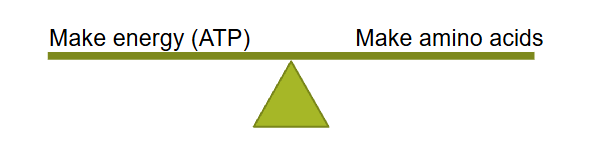
balanced rxns. have to be balanced. if we make a.a we also need energy, we cant spend all of our 12 carbon skeletons
assimilatory pathways
inorganic nitrogen and sulfur are INCORPORATED into organic materials
protein, nucleic acids, coenzymes
dissimilatory pathways
inorganic compounds are USED instead of oxygen as electron acceptors
such as in anaerobic respiration
product (NO3, NO2) is excreted into environment → cant keep iside of cell cuz pH drops → denaturation
nitrogen assimilation
we don’t have N in our 12 carbon skeletons but need it to survive (CHONPS). So we take inorganic N and incorporate it into organic molecules like a.a and nucleic acids
what r some potential sources of nitrogen for nitrogen assimilation?
ammonia (NH3, more reduced) what we want!
nitrogen (N2) lots in atmosphere but we cant use it
nitrate (NO3, more oxidized) cant assimilate
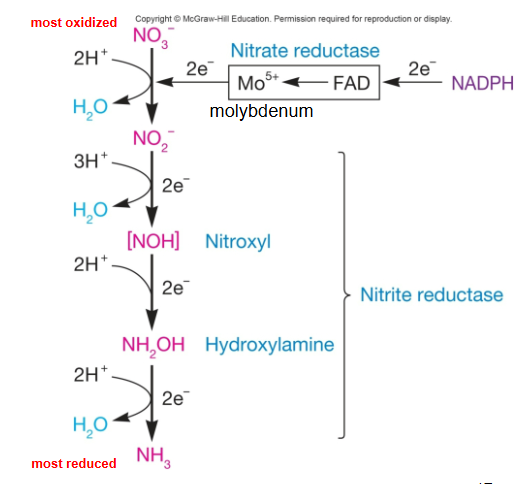
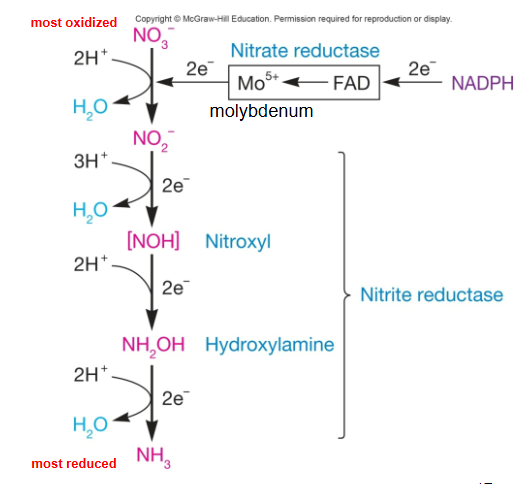
assimilatory nitrate reduction
take somethig other than ammonia and turn it into ammonia. Used by bacteria to reduce nitrate → ammonia
done by bacteria, fungi, and ohotosynthetic protists (euk)
how microbes take NO3 from non usable form to usable NH3
NO3 → NO2 = nitrate reductase
NO2 → NH3 = nitrite reductase
where does assimilatory nitrate reduction happen in bacteria?
in cytoplasm
nitrate reductase
the enzyme that reduces nitrate → nitrite
NO3 → NO2

nitrite reductase
the enzyme that reduces nitrite → ammonia
NO2 → NH3
produces water
nitrogen fixation
takes N2 gas and reduces it to NH3. (N2 → NH3)
catalyzed by the enzyme nitrogenase
it is highly sensitive to O2 so if its present it wont function. Cells w nitrogenase will bind to O2 and get rid of it, not necessarily strict anaerobes
only carried out by a few prokaryotes → diazotrophs
exergonic process! needs 8 electrons and 16 ATP
nitrogen fixing bacteria can use 20% (1/5) of ATP made by host plant

what enzyme catalyzes nitrogen fixation?
nitrogenase
nitrogenase
the enzyme that catalyzes nitrogen fixation.
it is super sensitive to O2 so it wont function if its present. the cells w nitrogenase will bind to O2 and get rid of it. not necessarily strict anaerobes tho
diazotrophs
the few prokaryotes that carry out nitrogen fixation
chemotrophic bacteria and archaea (Klebsiella)
plant symbionts (Rhizobium)
cyanobacteria
what type of prokaryotes do nitrogen fixation?
diazotrophs!
chemotrophic bacteria and archaea (Klebsiella)
plant symbionts (Rhizobium)
cyanobacteria
is nitrogen fixation endergonic or exergonic?
exergonic! requirs 8 electrons and 16 ATP

what r the 2 ways to incorporate ammonia?
reductive amination
used when NH3 is high, no ATP needed
done by bacteria and fungi
alpha-ketoglutarate → glutamate by glutamate dehydrogenase (GDH)
glutamine synthetase-glutamate synthase (GS-GOGAT)
done w bacteria ONLY
used when NH3 low, uses ATP
2 steps
glutamate → glutamine by glutamine synthetase
alpha-ketoglutarate + glutamine → glutamate by glutamate synthase

reductive amination
a method to incorporate ammonia.
used when NH3 is high, no ATP needed! but needs reducing power (NADPH)
done by bacteria and fungi, acellular microbes
alpha-ketoglutarate → glutamate by glutamate dehydrogenase (GDH)

who is reductive amination to incorporate ammonia used by?
bacteria, fungi, acellular microbes (viruses)
when NH3 is high what ammonia incorporation tactic is used?
reductive amination (requires no ATP)
glutamate dehydrogenase (GDH)
in reductive amination, it is the enzyme that turns alpha-ketoglutarate → glutamate by adding amino group

glutamate
the amino acid that is made when alpha-ketoglutarate gains an amino group either through reductive amination or GS-GOGAT
when it donates its amino group again, it becomes alpha-ketoglutarate again

transaminases
donate amino group to make a.a or nitrogenous bases
it takes the amino group from glutamate to turn it back into alpha-ketoglutarate
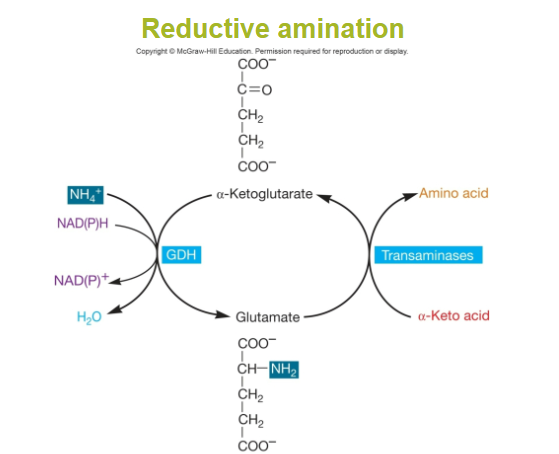
alpha-ketoglutarate → glutamate when NH3 is high and no ATP used is?
reductive amination, catalyzed by GDH

glutamine synthetase-glutamate synthase (GS-GOGAT)
a 2 step method for ammonia incorporation
done in bacteria only!!
happens when NH3 is low, uses ATP
1) glutamate → glutamine by glutamine synthetase
gives another amino group, requires ATP
2) alpha-ketoglutarate + glutamine → glutamate by glutamate synthase
donates amino group

GS-GOGAT ammonia incorporation is done by who?
bacteria only!
which ammonia incorporation method is used when NH3 is low?
GS-GOGAT
glutamate → glutamine
this is the 1st step in GS-GOGAT. it is catalyzed by glutamine synthetase which adds another amino group to glutamate
uses ATP
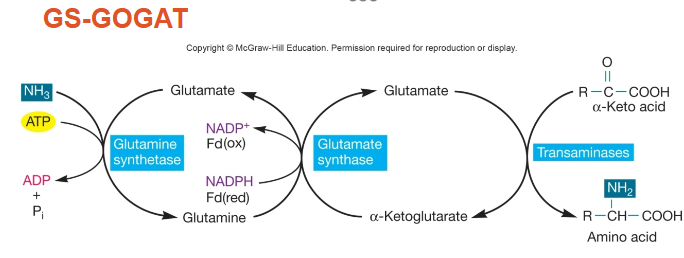
glutamine synthetase
the enzyme that catalyzes the 1st step in GS-GOGAT. This enzyme adds another amino group to glutamate which turns it into glutamine.
uses ATP!
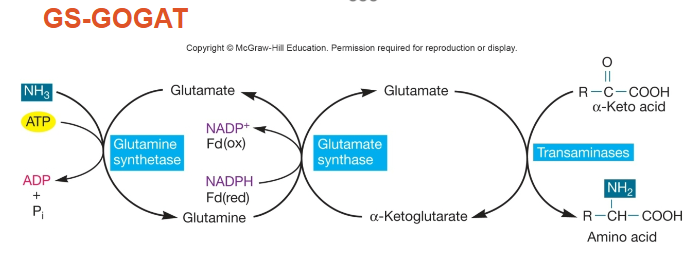
alpha-ketoglutarate + glutamine → glutamate
the 2nd step in GS-GOGAT. It is catalyzed by glutamate synthase which donates amino group from glutamine to alpha-ketoglutarate so that we have 2 glutamates.

glutamate synthase
the enzyme catalyzing the 2nd step in GS-GOGAT which donates the 2nd amino group from glutamine to alpha-ketoglutarate so that we make a 2nd glutamate
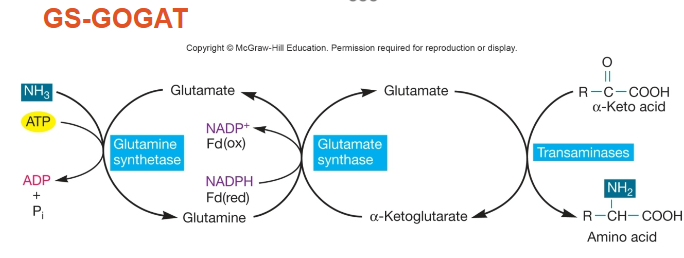
what do we need sulfur for?
synthesis of amino acids
cysteine → creates covalent disulfide bridges in tertiary and quaternary protein structure
methionine → start codon AUG
synthesis of coenzymes (Co-A)
sulfur in thioester bond
what does cysteine do?
it donates reduced sulfur cuz u need sulfur assimilation to make cysteine (H2S)
sulfur assimilation
we can obtain sulfur from external sources and intracellular amino acid reserves
sulfate (SO4, inorganic) more oxidized form
phosphoadenosine 5’-phosphosulfate (PAPS)
sulfate reduced to H2S → cysteine (will take S and donate it where needed)

sulfate (SO4)
the more oxidized inorganic form of sulfur, we want to reduce it to sulfide

phosphoadenosine 5’-phosphosulfate (PAPS)
While cysteine donates reduced sulfur (like thiol groups or persulfides) for things like iron-sulfur clusters, PAPS donates oxidized sulfur (sulfate, SO₄²⁻, or sulfonate, -SO₃⁻)
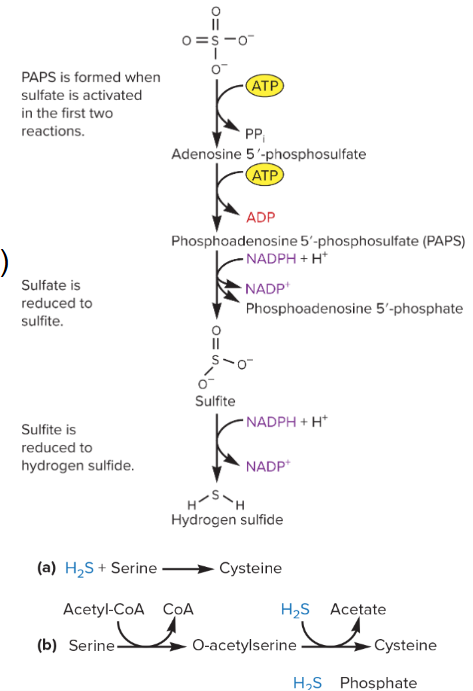
u need sulfur asimmilation to make what?
cysteine
sulfate reduced to H2S → cysteine
amino acid biosynthesis
regulated by feedback mechanisms
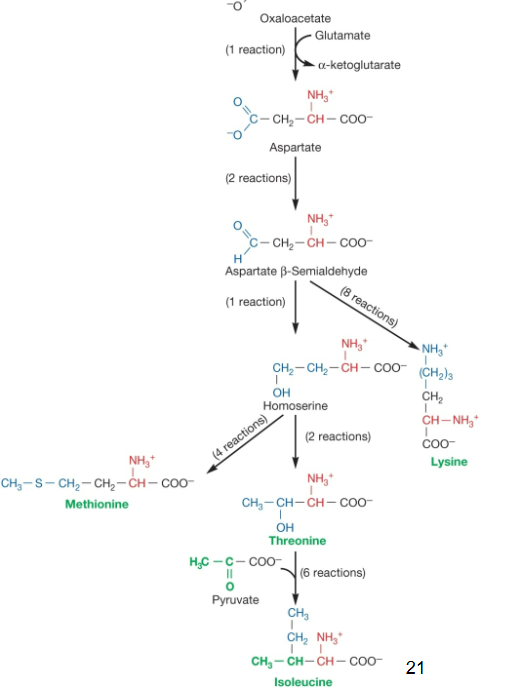
single precursor → several a.a
branching pathways
oxaloacetate → lysine, threonine, isoleucine, and methionine

in making a.a, what is the 1st thing oxaloacetate does?
accept amino group from glutamate which turns it into alpha-ketoglutamate

what element do we tag proteins with?
sulfur (we tag DNA w P)
the a.a acid L-Lysine is special in peptidoglycan cuz?
in gram (+) bacteria, it is the 3rd a.a and has 2 amino groups so can make 3 peptide bonds
there is feedback inhibition btwn which 2 amino acids?
threonine and isoleucine. (-) feedback to threonine to stop making isoleucine so we can have all 20 a.a

what amino acids does oxaloacetate make?
lysine, threonine, isoleucine, methionine
what r the aromatic amino acids?
phenylalanine, tryptophan, tyrosine

how r aromatic a.a made?
using the Shikimate pathway with starting products PEP + Erythrose-4-P
not present in animals, only used by bacteria, fungi, and some protozoa (euk)
need to make Chorismate intermediate
