Gustave Courbet, The Stonebreakers, 1849–50 (Salon of 1850–51)
 Call Kai
 Learn
 Practice Test
 Spaced Repetition
 Match
 Flashcards
 Knowt Play
1/20

Earn XP
Description and Tags
Much larger scale painting than Millet's, showing a real subject on a large scale not typically done Ordinary subject based on Courbet's real experience Only was interested in painting things you could actually see and observe and should be making art about the present Thought very highly of himself, grew up in a rural village, and rejected academic teaching Depicts unpleasant but necessary labor, breaking stones on the side of the road
21 Terms

Gustave Courbet, The Stonebreakers, 1849–50 (Salon of 1850–51)
Showing a real subject on a large scale was not typically done
Ordinary subject based on Courbet's real experience
Only interested in painting things you could actually see and observe, and should be making art about the present
Thought very highly of himself, signed his signature large on all of his works
Grew up in a rural village and rejected academic teaching
Depicts unpleasant but necessary labor, breaking stones on the side of the road
Not a social commentary

Alexandre Cabanel, The Death of Moses, 1851 (Salon of 1852)
Painted on a very large scale
Depicts a grand narrative from the torah/old testament
Painted in finely rendered brushstrokes
This painting fits all the expectations of the history painting concept, while Courbet's doesn't
Moses is in green at the bottom, and Jesus is in the blue cloak
Color is used to differentiate figures but isn't representative of thematic ideas
God has been depicted as an older man in past depictions by Michelangelo and Raphael
Rooted in classicism
Shallow space, all subjects in the foreground

John Everett Millais, Christ in the House of His Parents, 1849–50 (R.A. 1850)
Pre-Raphaelites interested in depictions of god and Shakespeare
British interpretation of the story, not trying to look like the era of the story but a modern interpretation
Resonates with modern audiences
Jesus palm injury alludes to crucifixion
Triangle on wall alludes to the Holy Trinity
Cousin is coming with a bowl of water, alluding to his future role baptiizing jesus
Used real people as models because accuracy of appearances was a way to get to moral truths vrs generic depictions of people
Didn't use professional models; used real people
Charles Dickens wrote this painting, saying it was extremely ugly, was used to seeing classicized art
Pre-Raphaelites worked on white and not brown surfaces, which made them look more intense and saturated
Royal Academy taught to paint subjects first, but Pre-Raphaelites painted backgrounds first and then added subjects

Édouard Manet, Olympia, 1863 (Salon of 1865)
Manet withheld this painting from the Salon of 1863 because other works of his were rejected
In 1863, 2,783 paintings were rejected out of 5000 submissions, causing an outcry, so Napoleon III sponsored a Salon des Refusés for people who were initially rejected; it was only a one-time thing
Manet wasn't interested in this
Manet's paintings go towards heavy lights and darks without much in between
Olympia represents a prostitute; the model was a favorite of Manet, but wasn't actually a prostitute
Having a bracelet and shoes and necklaces emphasizes her nudity
Better brothers had prostitutes with names from Greek mythology
Prostitution in France was officially governed; it was generally tolerated in France but not usually a subject of art
Painting also features a dark-skinned woman whom Laura posed with; she comes in with a bouquet, which is a gift from a client
Black cat on the edge of the bed, represents sexuality
References a painting from 1529 called Venus of Urbino, which shows a reclining woman wth an animal at the end of the bed, which didn't represent a prostitute but was thought to have been
Direct gaze; audience is a client
Assertive, owning her situation; audiences weren't accustomed to this

Claude Monet, Woman with a Parasol—Madame Monet and Her Son, 1875
Wanted brush strokes to be visible; didn't try to hide them
Most Impressionists were primarily interested in the human figure; Monet specifically was more focused on landscapes
Depicts his son and wife
Plein air painting from one session
Fluidly rendered painting helps show motion and movement vrs the other solid, detail-oriented paintings feel more stagnant
Instead of using straightforward colors, he used a wide variety of colors to depict light and shadow; didn't just use neutrals; used blues and yellows and reds

Berthe Morisot, The Cradle, 1872
Morisot painted outdoor and indoor views; the only woman to exhibit in the first Impressionist shows; showed in all but one Impressionist exhibition
Was limited by the social status she was born into (upper middle class); art, science, and all of these cultural things were seen as for men
Could do small arts but was not encouraged to pursue a career as a painter
Was not allowed to paint portraits of her male colleagues due to her status; only allowed to paint her husband (Manet’s brother)
Had ot have her husband chaperone meetings with fellow artists
Focused on the public and private lives of women because she was excluded from other subject matter
Depicts her sister and her child; nurseries were seen as a female space
Critics singled her out because of her gender in comparison to her contemporaries; women are simple, and so they can limit themself to doing these loose brushstrokes and not doing detailed paintings because they can't, can be easily distracted
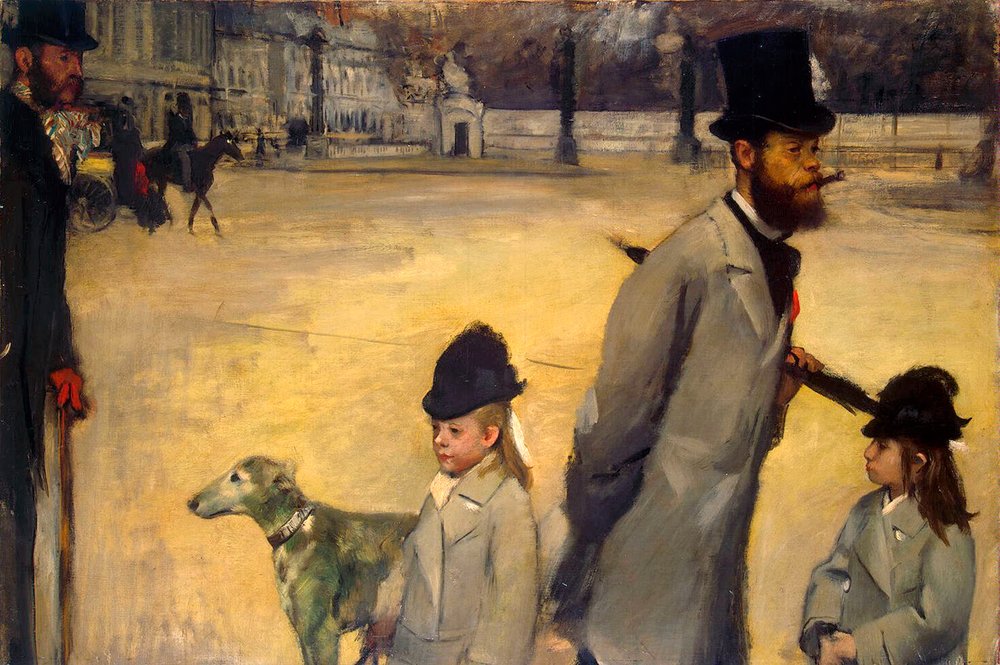
Edgar Degas, Place de la Concorde (Viscount Lepic and His Daughters), 1873
Started painting outdoors but finished them inside
Like capturing moving moments that changed rapidly
Lepic was a wealthy man
Credited Japanese artists with how he learned to draw, dramatic cropping, flattened perspective, and unusual angles
Inspired by color woodblock prints, which made their way to Europe around this time

James McNeill Whistler, Nocturne in Blue and Gold: Old Battersea Bridge, c. 1872–75
Aestheticism (Aesthetic Movement): “Art for Art’s Sake,” art that is intended to exist for its own purpose on its own terms, not expected to do other things, doesn't care about heavy symbolic meaning
Influenced by Impressionists and their technique, but Whistler was interested in color
Deeper meanings were not important to Whistler, instead wanting pleasing depictions of modern subjects
Sued critic John Ruskin for claiming Whistler was cheating the audience
Used music as an analogy or metaphor to underscore that his work is aesthetic and not symbolic
Clearly influenced by Japanese color woodblock prints
Composition is very similar to Bamboo Yards by Ando Hiroshige

Walter Crane, Illustration from Little Red Riding Hood, Walter Crane’s Toy Books (George Routledge & Sons, 1875)
A toy book is an illustrated children's book
Illustrations for books in general didn't take up a whole page or a large portion of it; encouraged to focus on the picture and not the text
A color woodblock print with one block for each color used to produce; part of the process of Japanese color woodblock prints
Pristinely rendered outcome of this process
Had a black outline like Japanese woodblock prints
Crane also made wallpaper and other goods
Founder of the arts and crafts exhibition society

Paul Cézanne, The Bay of Marseille, Seen from L’Estaque, c. 1885
Exhibited with the Impressionists but pushed the ideas further
Made flat depth-of-field paintings inspired by other artists
Internalizing what we saw, rendered it in a way that was aware of the fact that it was a painting and not trying to look like real life, capturing the qualities of the world
He left Paris for his hometown and began making landscape paintings to try to find his own way of representing form
Seeing textures and patterns, not trying to depict as real life
Brushstrokes define all subjects in the painting in a similar way (texture and stuff)
Wasn't until the early 20th century that people began to appreciate his work after it emerged
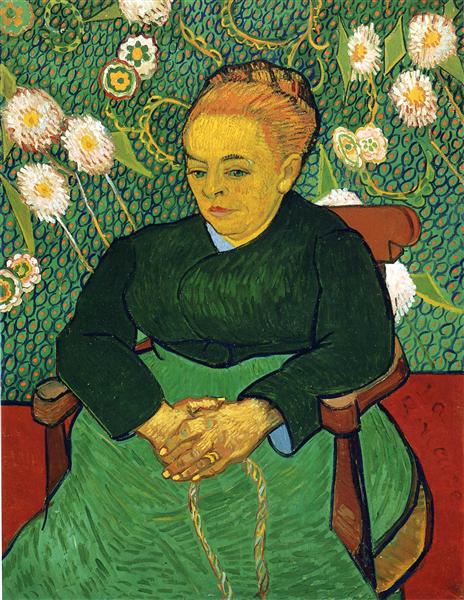
Vincent van Gogh, Lullaby (Madame Roulin Rocking a Cradle), 1889
Shows a view of a local postman rocking a cradle with a rope, but we don't see the actual cradle
Face is yellow while hands are tan and floor is red; it isn't how it would've actually looked
The wallpaper is rendered in a way that aligns with the other colors
Wanted harmonious feelings in his work by using complementary colors

Paul Gauguin, Aha oe feii? (Are You Jealous?), 1892
Traveled to Tahiti because France colonized it
“Savage” primitive or uncivilized, used in a derogatory way, but Gauguin thought it was a positive attribute, as these people weren't corrupted by modern life
Thought going to Tahiti would help him make better, more pure work
Discovered Tahiti was transformed by the infiltration of French culture
This painting is Gauguin's conception of Tahiti; people thought they were lifelike portrayals, but it was largely made up, portrayed as the tropical island he wanted to find, but it wasn't like this when he went
The color of the water is colorful to improve composition
Represents two sisters after swimming; the women are talking about past and future amorous relationships; the title refers to one sister experiencing more erotic pleasure than the other
Represented as a place where nudity is accepted and traditional, even if it wasn't really like that when he went
Shows figures lost in thought, creates questions
He had a Tahitian-French dictionary to translate the title, but the grammar is wrong
The painting mainly consists of unnatural colors

Auguste Rodin, Monument to Balzac, 1893
Sculpture in memory of Balzac, a writer
Depicts him in a monk's robe to show his intellect
Instead of showing him with a book to represent him, he gave him a tall figure with just his head poking out to show his power and intellect
Didn't show him in a typical way; has eyes shadowed over, showing he's looking inward
The proposed figure was rejected by the people commissioning it because it was an obese monstrosity
Everybody hated on this shit

Gustave Moreau, The Apparition, 1876
Symbolism/Symbolists: Offshoot of Romanticism, growing interest in the supernatural and decadence (rejecting material progress and spiritual progress), looking at emotional and psychological states, imagination as key components
Wanted to look inward, interested in their feelings; their inner experience was the starting point rather than the external world
Moreau was partially inspired by indian paintings from the 1400s
Used symbols/motifs placed in an unexpected context to generate new reactions
Depicts a woman who seduces the king to get whatever she wants; she asked for the head of John the Baptist
Inspired by biblical stories
The symbol of John the Baptist's head was well known and would've been recognized, but unlike the biblical story, the other figures aren't specifically identified
Instead of the woman receiving the head on a platter, it's shown as his head floating in a supernatural way
Doesn't accurately represent the story; takes an idea and uses it to create an imaginative interpretation
Salome is characteristic of the femme fatale, “dangerous woman.” Symbolists used femme fetale to understand debasement, predatory sexuality, and perversion
Thought of art existing alongside the real world instead of in the real world
Allows the viewer to have different interpretations based on their own experiences; in the past, it had a specific message universal to all

James Ensor, Self-Portrait with Masks, 1899
Painter and printmaker known for his mask like subjects
Masks are associated with carnival, the celebration before lent in the spring, parents owned a shop that sold these masks and souvenirs
All of the masks surrounding him reveal his inner character
Not good sense of space
Lost in crow dof masks, shows loneliness or isolation
Mask is not to hide a persons appearance but instead revels inner character
Though his self portrait he was linking himself to peter paul reubens, styled in a similar way
Paints himself disregarding the masks, ignores them but they are still there
Pessimistic view on humanity

Kolo Moser, Fromme’s Calendar, designed 1899, printed 1903
Poster for a calendar
Designed lots of things such as jewelry and furniture
Large size of figure and bold silhouette not common for the time
Poster is flat with outlined forms
References Norn, ancient goddess of fate from scandinavian mythology
Accompanied my sand time and a snake eating its own time, sign of infinity
Motifs inspired by the end of the century, also symbolism refers to time which is what the calendar is selling
Poster was rendered in different color schemes

Gustav Klimt, Judith and Holofernes, 1901
Inspired by art nouveau and its decorative tendencies, also some pre raphaelite influence
This work is similar to The Sin and also features a Femme Fatale
Judith is from an ancient Hebrew scripture story, decapitated a general of an army
Is depicted holding her head
Gold motifs placed throughout the painting
Name of subject is embossed on the top of the composition in gold frame
Uniting flatness and illusions of two-dimensionality
Inspired by Byzantine mosaics, which influenced him to apply gold leaf to his paintings

Henri Matisse, The Red Studio, 1911
“Color for color's sake”
Color red is applied uniformly over most of the painting, creating no sense of depth, light, or shadow
Reserve line: creating line and shape by using negative space when applying a lot of color
Painting acknowledges the existence of the picture plane
It's very flat; you don't look through the paintings
Challenging the Renaissance perspective of art

Käthe Kollwitz, Memorial Sheet to Karl Liebknecht, 1919–20
Made from a woodcut print
Liebknecht was assassinated; political members far left
Didn't directly support him but respected him and appreciated his contribution and the significance of his death
expressionism: Distortion present in a piece of art to reflect a subjective/emotional point of view
Expressionism: Northern European
German Expressionism: specific to a couple of groups
She was not interested in oil painting, focused on drawing and printmaking, part of German tradition from the 1500s
Was made through the process of etching
Focused on human vulnerability and death in her work

Ernst Ludwig Kirchner, Berlin Street Scene, 1913–14
Made paintings of the alienation he experienced living in the urban environment
Elongated, angular figures with long and feathery brushwork
Prostitutes are present in the composition
Kirchner understood the city as a devourer of the human soul, physically close to each other by psychologically distant
Tilted pink sidewalk inspired by japanese printmaking
Takes place in Berlin, actually had very wide streets but chose to depict them as narrow and claustrophobic to portray emotion
The faces in this painting are not lifelike and are inspired by African objects and artwork

Vasily Kandinsky, Autumn Landscape, 1911
Representational describes art showing something recognizable and it mimics the way things look, was the norm for this time
Kandinsky made non-representational art
Abstract art is the distillation of a subject you are depicting, still might be recognizable but isn't fully representational;
Abstraction
Mountains and buildings are still recognizable, but it isn't depicted how it would actually look
Listened to arnold schonberg, musician who didn't follow typical musicality or melodies, was inspired
Eludes to ideas of spirituality