VCE Physics Unit 3/4 Exam Revision
 Call Kai
 Learn
 Practice Test
 Spaced Repetition
 Match
 Flashcards
 Knowt Play
1/141

There's no tags or description
Looks like no tags are added yet.
142 Terms
Longitudinal wave
A wave in which the vibration of the medium is parallel to the direction the wave travels
Transverse wave
a wave that causes the medium to vibrate at right angles to the direction in which the wave travels
How does amplitude apply to wave motions such as sound, light or mexican waves?
Sound: loudness
Light: brightness
Mexicain: energy and height
Amplitude
For a wave or vibration, the maximum displacement on either side of the equilibrium (midpoint) position.
Diffraction
The bending of a wave as it moves around an obstacle or passes through a narrow opening. Phone reception in a valley.
Refraction
The bending of a wave as it passes at an angle from one medium to another. Placing a straw in a glass of water and seeing the piece in the water in a different place to the piece sticking out.
Reflection
The bouncing back of a wave when it hits a surface through which it cannot pass. Seeing an image of the mountains behind a lake reflected in the lake.
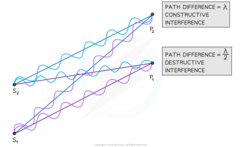
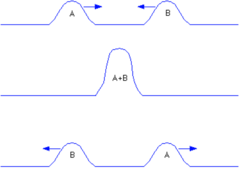
Constructive interference
When two waves combine to make a wave with a larger amplitude
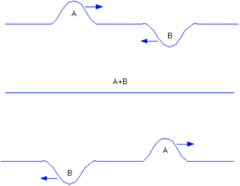
Destructive interference
Occurs when two or more waves combine to produce a wave with a smaller displacement
Resonance
A phenomenon that occurs when two objects naturally vibrate at the same frequency
Wavelength
Horizontal distance between the crests or between the troughs of two adjacent waves (λ)
Frequency
The number of complete wavelengths that pass a point in a given time (Hz)
Destructive interference occurring in sound energy...
No sound can be heard
Destructive interference occurring in light energy...
No light can be seen
Destructive interference occurring in water...
Still water with no disturbance
Nodes
Points of zero amplitude on a standing wave
Antinodes
The positions on a standing wave where the largest amplitudes occur.
Standing waves
A pattern of vibration that simulates a wave standing still
Explain resonance
A process where an object is made to vibrate at its natural frequency by absorbing the energy of another object that is vibrating at the same frequency
Dampening
A reduction of amplitude over time resulting from friction
Why is the sky blue during the day?
Air molecules preferentially and repeatedly scatter blue (short) wavelengths out of the direct beam to the viewer's eyes.
Why is the sky red at sunset?
The light is traveling through a thicker part of the atmosphere. Because red light scatters less than blue, it is more likely to reach our eyes before being scattered (all the blue light is scattered before it can reach out eyes)
Intensity of a sound wave
The amount of energy the wave carries per second through a unit of area
Wave motion
Transmits energy without the physical transport of material
Particle motion
Displacement, speed, velocity and acceleration of a particle
Wave-particle duality
The concept that all matter and energy exhibit both wave-like and particle-like properties
DC motor
Electrical machines which convert electrical power into mechanical power (kinetic energy)
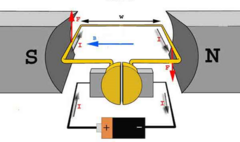
Commutator
A device that controls the direction of the flow of current through an electric motor
Torque
A force that causes rotation
Right hand rule for magnetic force
Thumb - current
Fingers - field lines --> Palm - force on + charge

F=nIlB
Force of magnetic field on a current formula
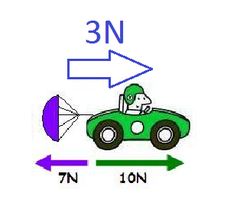
Normal Force (Fn)
The perpendicular force exerted by a surface on an object in contact with it (apparent weight)

Fnet=
ma (or Fn+Fg)
Satellite
An object that is in a stable orbit around a larger central mass

Natural satellite
A planet or moon that orbits around another celestial body

Artificial satellite
Any human-made object placed in orbit around a body in space

Geostationary satellite
A satellite that remains in the same position relative to a spot on the Earth's surface, by orbiting in the direction of the Earth's rotation over the equator with a period of 24 hours and orbital radius of 35700km

Uniform Circular Motion (UCM)
The movement of an object at a constant speed around a circle with a fixed radius. velocity is tangential to the circumference and acceleration is due to the changing velocity.

Centripetal acceleration formula
a = 4π^2r/T^2 = mv^2/r = MG/r^2 = g
Centripetal force formula
Fg = m4π^2r/T^2 = mv^2/r = MGm/r^2 = mg
Gravitational constant (G)
6.67 x 10^-11 Nm^2/kg^2
Kepler's Third Law
For every planet, the ratio of the cube of its average orbital radius, r, to the square of its period of revolution, T, is the same, i.e. r^3/T^2 is constant.

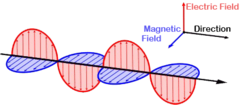
Electric field
A field of force surrounding a charged particle

Magnetic field
The region around a magnet where the magnetic force is exerted

Electron current flow
Current flow from negative to positive

Conventional Theory
Electrons flow from positive to negative

Gravitation
A force of attraction between two masses

Magnetism
The force of attraction or repulsion of magnetic materials

Electricity
A form of energy caused by the movement of electrons.

Gravitational field
A force field that exists in the space around every mass or group of masses

Dipoles
Created by equal but opposite charges that are separated by a short distance
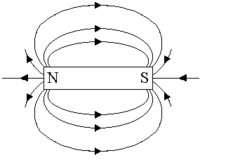
Monopoles
The existence of 1 side of polar opposites without the existence of another.

Point charges in Magnetic field
Point charges undergo uniform circular motion in a uniform magnetic field wherein the centripetal force is the magnetic force acting on the point charge.

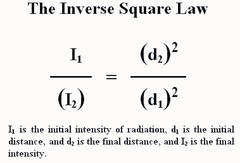
Inverse square law
The intensity of radiation is inversely proportional to the square of the distance from the source of radiation
Static fields
Constant fields, which do not change in intensity or direction over time

Changing fields
Fields that change intensity or direction over time
Uniform fields
Vector fields with evenly spaced field lines and a constant magnitude throughout space

Non-uniform fields
Fields with unevenly spaced field lines and a changing magnitude
Electromagnetic induction
The process of generating a current by moving an electrical conductor relative to a magnetic field
EMF (electromotive force)
The total work done when a unit charge moves around a complete circuit
Unit: J/C or Volt (V)
Magnetic flux
A measure of the strength of a magnetic field over a given area - scalar
Magnetic flux formula
Φ = BA
Magnetic flux formula (not perpendicular to magnetic field)
Φ=BAcosθ
Induced EMF
A change in magnetic field when a magnet is moved closer to a conductor
EMF formula
E = W/Q
Faraday's Law
An electric field is induced in any region of space in which a magnetic field is changing with time.
Lenz's Law
An induced EMF will always give rise to a current who's magnetic field will oppose the original change in flux.
Alternator
A generator that produces an alternating current
Armature
The rotating part of an electrical generator.
AC generator
A coil of wire is rotated in a magnetic field. As the coil cuts through the magnetic field, the relative motion causes a current to be generated in the coil.
Slip rings and brushes
Components on generator that make an alternating currrent possible
DC generator
A generator that produces direct current
split ring commutator
Metal contacts on the coil of a direct current motor that connects the rotating coil continuously to its electrical power supply.
Australia mains power
50Hz
Australian peak voltage
360V
transformer
A device that increases or decreases the voltage of alternating current
Power distribution
Voltage step-down and wires used to distribute power to end users (residences and businesses)
Power loss equation
Power loss= Current^2 * resistance
superposition principle
when two or more waves overlap, the resulting wave is the sum of the individual waves
constructive interference
The interference that occurs when two waves combine to make a wave with a larger amplitude
destructive interference
The interference that occurs when two waves combine to make a wave with a smaller amplitude
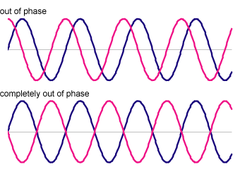
waves in phase
Trough meets trough, peak meets peak

waves out of phase
cancel each other out
Resonance
The dramatic increase in amplitude that occurs when the frequency of forced vibrations on an object match with the object's natural frequency
what something needs in order for it to resonate
a force to pull it back into it's starting position and enough energy to keep it vibrating
items that resonate
stringed instruments - violins, guitars, cellos
standing waves
when two waves of the same amplitude and frequency are travelling in opposite directions (towards each other) in the same string. usually one wave is a reflection of the other.
Antinode
A point of maximum amplitude on a standing wave

Node
A point on a standing wave that has no displacement from the rest position

Harmonic rules for fixed ends
l=n (λn/2)
frequency of waves for harmonics
fn=nv/2l
electromagnetic waves
transverse waves consisting of changing electric fields and changing magnetic fields

electromagnetic radiation
The energy transferred through space by electromagnetic waves.
Wave equation
v=fλ
Wave Equation of Light
C=fλ
Diffraction
The bending of a wave as it moves around an obstacle or passes through a narrow opening
Young's double slit experiment
shows the constructive and destructive interference of waves that occur as light passes through parallel slits, resulting in minima (dark fringes) and maxima (bright fringes) of intensity
Corpuscular theory of light
the theory that describes light as a stream of particles
The double-slit experiment with electrons illustrates the surprising idea that
light travels as a wave

Path difference
difference in the distances two waves must travel from their sources to a given point