Biology Exam 1
 Call Kai
 Learn
 Practice Test
 Spaced Repetition
 Match
 Flashcards
 Knowt Play
1/69

70 Terms
Dmitri Belyaev (1917-1985)
How did we domesticate animals
(e.g. dogs)?
• Believed that genes were selected
in the ancestors of dogs that made
them tame
• Could we duplicate the process by
breeding for tameness?
• He tested his ideas in silver foxesFur farms in russia
Farm Fox experiment
first 2 categories - fearful/aggressive (class 1) & receptive/tolerant (class 2)
Bred only class 2, also control population
Minimum time around humans (make sure its genetic)
6th gen - dramatic changes - some foxes more dog-like (tail wagging, whimpering, licking)
Class 3 - elite foxes → more friendly
Domestication syndrome
Suite of characteristics that accompany domestication (less musk, shorter snout, short/curly tails, spots, floppy ears)
Tameness vs domestication
Tameness - acquired trait learned during lifetime
Domestication - result of breeding for genetically=controlled traits
Darwin experiments
pigeon breeding - artificial selection
Galapagos finches
Selection can occur if:
variation is present
Variation is heritable
Trait influences whether reproduction occurs (/how much)
Mendelian genetics
Genes that control traits exist and can be
passed on to offspring
Lysenkoism/Lamarckianism
Characteristics that are acquired during
one’s lifetime can be passed on to offspring
Lamark inheritance of acquired traits
use & disuse of certain
characters would lead to their
enhancement or loss in a species
Lysenko inheritance
cold treatment of seeds
(vernalization) causes plants to
germinate sooner; believed their
offspring would also
Genetic evidence supports which of the following explanations for the presence of 13 different finch species on the Galápagos islands?
D. Many years ago, a small population of a single finch species migrated to the islands and evolved into the 13 species.
Artificial and natural selection differences
people instead of nature select which organisms reproduce
Natural selection
Survival and offspring production depends on heritable traits, leading to changes in traits among populations
Darwins 4 postulates of natural selection
Variation among individuals
Variation is inherited
More individuals are born than will survive (resources are limited)
Some variants survive and reproduce more than others
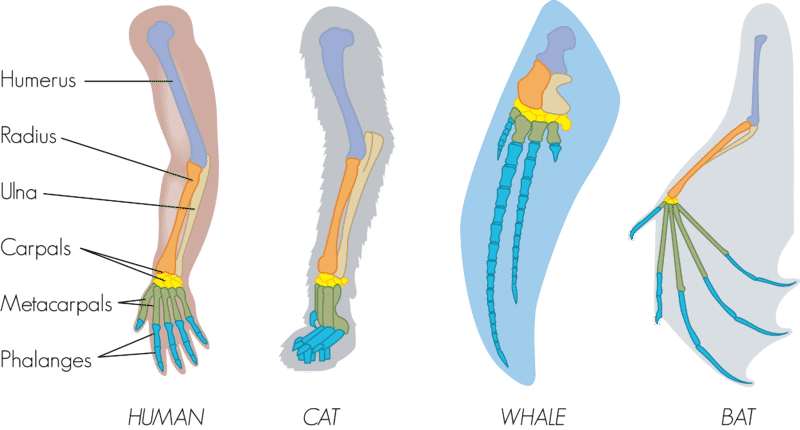
Analogous features share ________ function but not ________ ancestry.
similar; common
The rise of methicillin-resistant Staphylococcus aureus (MRSA) can be considered to be an example of artificial selection because
D. humans synthesize methicillin and create environments in which bacteria frequently come into contact with methicillin.
Convergent evolution
The process where unrelated species develop similar traits in response to similar environmental pressures, leading to similar adaptations.
Homologous structure
Structures in different organisms that have a similar origin but may serve different functions.
Why do we have species?
Dividing organisms into species useful for
understanding biodiversity and for what
processes create new biodiversityA species is the fundamental unit of
biodiversitySpecies are the conceptual bridge
between micro & macroevolution
Microevolution
Microevolution refers to small-scale changes in the genetic makeup of a population over generations. It is driven by factors such as genetic variation, natural selection, mutation, and gene flow. These changes can lead to adaptations and the formation of new species.
Macroevolution
The process through which new species arise over long periods of time, involving significant genetic and phenotypic changes. It occurs through mechanisms like natural selection, genetic drift, and mutation. Macroevolution leads to the diversification and branching of lineages, resulting in the formation of new species and higher taxonomic groups.
Genetic drift
Random changes in allele frequencies due to chance events, leading to the loss or fixation of alleles within a population. It is more pronounced in small populations and can have significant effects on genetic diversity.
Biological species concept
Ernst Mayr 1990
Species = group of individuals that can interbreed in
nature and produce fertile offspringThey either do not interbreed, or
They fail to produce viable, fertile offspring
How species arise under BSC
Reproductive isolation
Shortcomings of BSC
Many distinct species can produce fertile offspring (dogs/wolves, grolar bears)
self-reproducing bacteria
Fossil organisms
Fungi
Morphological species concept
different phenotype
Pro: widely applicable
Con: subjective, misidentifies polymorphic species, misses cryptic species
Phylogenetic species concept
Distinct group in a cladogram (DNA)
Pro: widely applicable, based on testable criteria
Con: relatively few well-estimated phylogenies are currently available
Ecological species concept
Distinct role in ecosystem
Unified species concept
UNIFIED SPECIES CONCEPT = apply multiple concepts and accept consensus
Central problem of species concepts
• There is a continuum of
diversity in life (from
individuals to populations, to
metapopulations, to species,
to families, etc.)
• Looking beyond evolutionary
history and combining it with
molecular, ecological,
behavioral and biological
data.
Necessities for speciation
interbreeding population
Geographic subdivision leading to 2 pops
evolutionary change over time
Formation of reproductive barriers (isolation)
Isolating barrier types
Geographic: extrinsic properties of landscape that prevent gene flow (allopatric speciation)
Reproductive: features of organisms prevent interbreeding (sympatric speciation)
Allopatric speciation
Vicariance - geographic barrier arises to divide one pop into 2 smaller ones
Dispersal (founder events) - individuals leave original pop and find a new one
Sympatric speciation
based on behavioral differences (non-random mating), resource usage, or temporal differences
Controversial
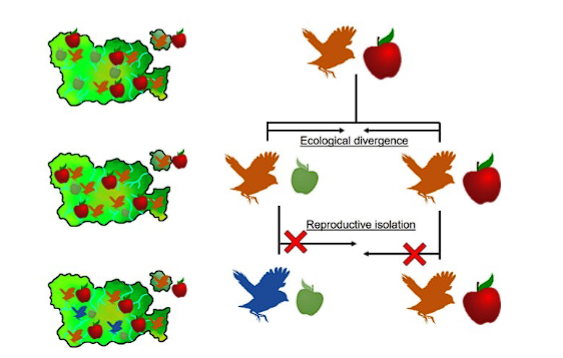
Mechanisms of speciation in daughter populations
Genetic drift - random changes in allele frequencies
Natural selection - daughter populations will adapt to changes
in their environment INDEPENDENT of what is occurring in the
other population (again, as long as no genes are exchanged)
Reproductive isolation types
• Prezygotic barriers
– act before fertilization
• Postzygotic barriers
– act after fertilization
Prezygotic reproductive barriers
Premating:
habitat isolation (ecological)
temporal isolation (ecological)
behavioral isolation (lack of attraction)
Mechanical isolation (genitalia, pollination structures incompatible)
Post-mating:
Gametic incompatibility (no fertilization)
Conspecific sperm precedence
Copulatory behavioral isolation
Postzygotic reproductive barriers
reduced hybrid viability - hybrids dont survive as well
Hybrid sterility
Hybrid breakdown - F1 hybrids fertile, but F2 gen doesn’t develop property
Evolutionary convergence
When unrelated species independently evolve similar traits or characteristics due to similar environmental pressures.
Autoploidy
Type of polyploidy where an individual has multiple sets of chromosomes from the same species. Can occur due to errors in cell division or fusion of gametes.
A. fertile tetraploid offspring produced by self-pollination of the new species
Polyploidy
Polyploidy is a genetic condition where an organism has more than two complete sets of chromosomes. It can occur naturally or be induced artificially. Polyploidy often leads to increased genetic diversity and can result in larger, more robust organisms.
Tetraploidy
A condition where an organism has four sets of chromosomes instead of the usual two sets. It can result in increased genetic variation and can be caused by errors in cell division or hybridization.
Scala naturae
A concept in medieval and Renaissance philosophy that describes a hierarchical ladder of life forms, with humans at the top and minerals at the bottom. It suggests a fixed and unchanging order of beings, with each level being more complex and perfect than the one below it.
Robber mouse

Algerian mouse

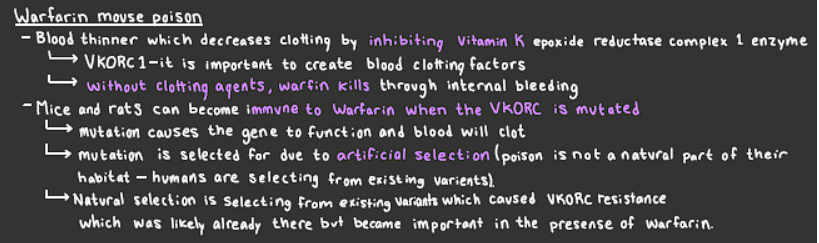
Warfarin mouse poison
Descent with modification
"Process where species evolve over time through genetic variation, natural selection, and reproductive success. Leads to the formation of new species and adaptation to different environments."
Adaptive radiation
The process by which a single species evolves into diverse forms to exploit different ecological niches. It leads to the emergence of new species with distinct adaptations. Example: Darwin's finches in the Galapagos Islands.
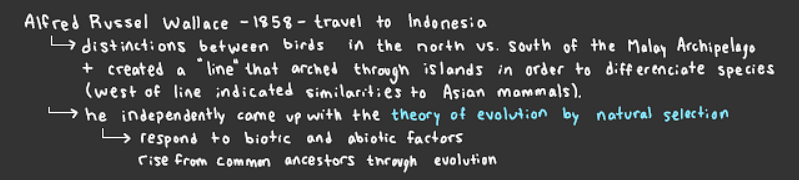
Alfred Russel Wallace
Extinction rate
number of species extinct/length of time
Speciation rate
number of nodes/length of time
Necessities of adaptive radiation
common ancestry (recent ancestors)
Key adaptations (association between environments and morphological and physiological traits used to exploit new environment)
Trait utility (performance/fitness advantage of trait values in environment)
Rapid speciation (presence of 1+ emergence of new species when ecological or morphological divergence)
Phylogenies can be use to infer:
• Which CHARACTERISTICS are older or younger
• Which CHARACTERISTICS are ancestral versus derived
(better terms than ‘primitive’ versus ‘advanced’)
• Which trait evolved first
• What might the common ancestor have looked like?
• We can use methods of ancestral state reconstruction to
analyze traits one character at a time
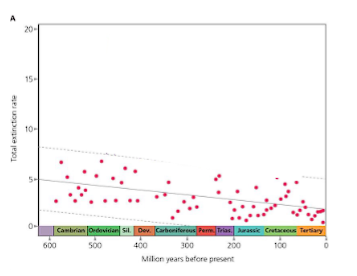
Background extinction
he normal rate of
extinction for a taxon or biota
Mass extinction
a statistically significant
increase above background extinction rate
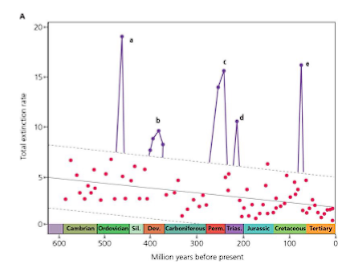
Main 5 extinctions
Ordovician 86%
Devonian 75%
Permian 96%
Triassic 80%
Cretaceous 76%
Causes of mass extinctions
• Physical causes
• Sea-level regressions
• Sea-level transgressions
• Ocean chemistry
• Global Climate changes
• Biological Causes
• Competition for niche
• Extraterrestrial causes
• Iridium from comets
Speciation and extinction effects on diversity
Species diversity of an
evolutionary lineage will
increase when new
member species originate
than are lost to extinction
• These changes are
influenced by plate
tectonics, mass extinctions
and adaptive radiations
Radiometric dating
Method used to determine the age of rocks or fossils by measuring the decay of radioactive isotopes.
• A “parent” isotope decays to a “daughter”
isotope at a constant rate
• Each isotope has a known half-life, the
time required for half of the parent
isotope to decay (disappear)
Principle of faunal succession
The Principle of Faunal Succession states that fossilized organisms in rock layers follow a specific order. Older layers contain fossils of simpler organisms, while younger layers have fossils of more complex organisms. This principle helps scientists determine the relative age of rock layers and establish a timeline of Earth's history.
Earth’s early atmosphere
• Nitrogen, carbon dioxide, methane and ammonia.
• Volcanoes spewed water vapor, carbon monoxide, and even
more nitrogen and carbon dioxide into the air.
• Comets also contributed water vapor, but no free oxygen.
where did the abundant oxygen that has made life as we
know it come from?
From Cyanobacteria and early photosynthetic organisms
The Miller and Urey experiments - 1953
Abiotic production of organic molecules
End of week 1: 10-15% of carbon now in
ORGANIC compounds
Later experiments: formation of sugars,
some amino acids, lipids and
nitrogenous bases within amino acids
Proved this hypothesis is POSSIBLE
RNA World Hypothesis
Earliest living cells were liposomes containing RNA
RNA can store information (like DNA) and catalyze reactions (like proteins)
RNA also capable of self replication (due to base pairing)
Ribozymes
RNA with protein-like enzyme activity
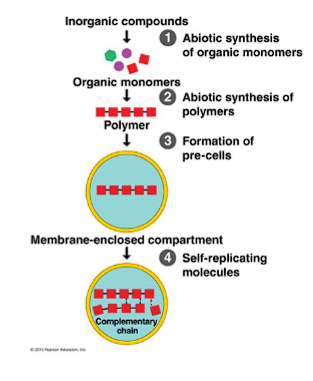
Four Stages leading up to
formation of life:
1. Abiotic synthesis of organic monomers
2. Abiotic synthesis of polymers
3. Formation of pre-cells
4. Self-replicating molecules
Protobiont (prelife) features
Boundary (membrane) separating interior/exterior
Polymers within had enzymatic function
Polymers within contained info
Ability to self replicate
First single celled organisms
Oldest fossils (3.5 billion years ago) = stromatolites
• Accumulation of sediment on bacterial mats
• Only Prokaryotes (single cell, no nucleus, no organelles)
from 3.5 to about 2.1 billion years ago
Stanley Miller's experiment simulated early Earth by exposing:
salt water, hydrogen, and to electricity and found that amino acids could be formed from these starting compounds in just a single week.
Types of variation
age group differences
Genetic differences (ex. sexual dimorphism)
Environmental differences (ex. polymorphism)
Chance (random effect of cell division, random changes in genetic code)