ADVANCED NUTRITION: LIPOPROTEINS
 Call Kai
 Learn
 Practice Test
 Spaced Repetition
 Match
 Flashcards
 Knowt Play
1/47

There's no tags or description
Looks like no tags are added yet.
48 Terms
Lipoproteins
Transporting hydrophobic compounds (lipids) in an aqueous environment (blood)
Cholesterol esters and triglycerides along with some integral apoproteins
What is the core of lipoproteins mainly composed of?
Can be sent to extrahepatic tissues as fatty acids
Glycerols
Remnants
HDL
How are plasma chylomicrons cleared?
Lipoprotein lipase
capillary endothelial cells of heart, muscle and adipose – not in liver
Becomes Cholesterol and Fatty acid
What happens to the chylomicron remnants in the liver?
LRP and ApoB100 E receptors
The two types of receptors that chylomicrons remnants can go under?
Nascent Chylomicron
When dietary TG enters the small intestine, what comes into the bloodstream?
apoCII
activates LPL (speeds chylo/VLDL clearance)
apoCIII & Angiopoietin-like 4 (ANGPTL4)
inhibits LPL (slows chylo/VLDL clearance)
has lower Km (= higher affinity) for TG and oxidizes
In LPL regulation, what is unique about muscle
– has higher Km (= lower affinity) for TG
– Upregulated by insulin
In LPL regulation, what is unique about adipose
ApoE
hepatic uptake of chylomicron remnants and LDL clearance
ApoE3
allele most common (60% E3/E3; 35% heterozygous E3)
E2/E2
(Arg158 → Cys) have elevated blood lipids (TG, cholesterol), atherosclerosis. (E2 allele frequency 7%) because of poor binding of E2 to the hepatic remnant receptor
E4/ E4
Cys112 → Arg) is also associated with atherosclerosis, and with Alzheimer’s disease (not causative for AD). (E4 allele frequency 14%)
VLDL
Precursor particles contain PL shell with Apo B-100 and a core of CE
• TG is added via MTP (microsomal TG transfer protein)
• If TG content in ER is low, then ApoB100 is degraded
• TG cleared by LPL, similar to CM clearance
• ~90 mins half-life
Apo B-100
PL shell and a core of CE
MTP (microsomal TG transfer protein)
Have TF added to this
ApoB100
If TG content in ER is low, then what is degraded?
Lomitapide
treatment of hyperlipidemia acts as an inhibitor for MTP
Fatty Acids in lipoprotein lipases
Glycerol
IDL (VLDL remnant)
HDL broken down by Apo C
How are VLDLs cleared? (seperate into?)
LDL receptor and LRP
Two transporters of VLDL?
ApoC
Broken down VLDL to HDL
ApoA and ApoC
Broken down Chylomicron to HDL
LDL and Liver
Where can VLDL remnants and IDL go to?
lipoprotein lipase)
TG hydrolysis by LPL rom VLDL → IDL
endothelial lipase & hepatic TG lipase
TG hydrolysis by HTGL from IDL → LDL
LCAT & CETP
in plasma and bound to HDL → activated by ApoAI on HDL with Exchange of TG from VLDL and IDL for CE from HDL
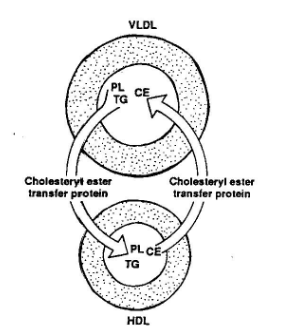
ACAT
adds a FA onto cholesterol to produce CE
High-density lipoprotein- HDL
Picks up free cholesterol from liver,
macrophages, intestine – removes cytotoxic free
cholesterol from cells – reverse cholesterol transport
(can also be the reverse). Contributes apoCII and apoE to TG-rich
lipoproteins (i.e. CMs and VLDL and IDL) Smallest of the lipoproteins
• Highest density (high ratio of protein:lipid)
ApoAl
What is the main Apoprotein of HDL?
no
Is LDL the same as LDL-C?
Apo B100

Apo B-48

Apo E

Apo A-I

Apo AII

Apo C-I

Apo- CII

Apo C-III

5 minutes
How long does it take for chylomicrons to be cleared?
90 min
How long does it take for VLDLs to be cleared?
15 hrs
How long did it take for LDL to be cleared?
Conversion of HDL2 to pre beta HDL
1st step of HDL cycle?

Pre beta-HDL
Lipid poor Apo A-1
Pre beta-HDL enters in the capillary endothelium to spread to the peripheral cells and converts to Discodial HDL and pass by lymph
2nd step of the HDL cycle
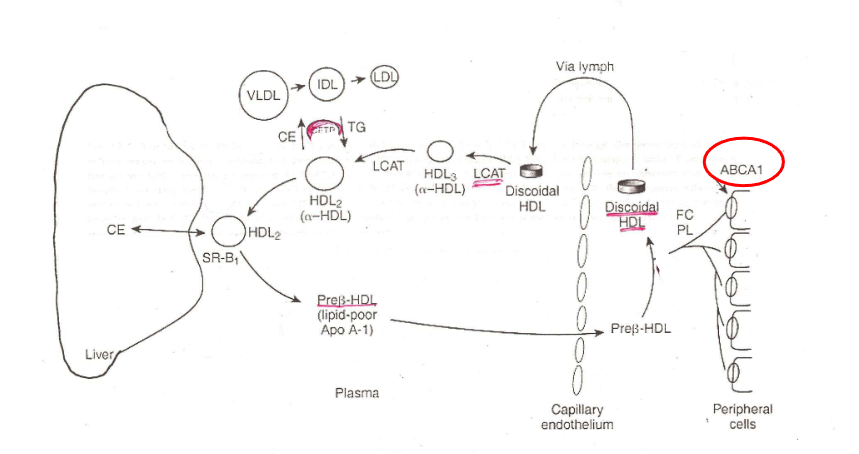
When Discoidal HDL is converted to HDL3 by LCAT
3rd step to The HDL cycle

CETP and cholesterol ester converts HDL2 to VLDL (CETP rxn)
4th step of the HDL cycle
