Tissue Organization​ I

0.0(0)
Studied by 0 people
call kaiCall Kai
learnLearn
examPractice Test
spaced repetitionSpaced Repetition
heart puzzleMatch
flashcardsFlashcards
GameKnowt Play
Card Sorting

1/67

flashcard set

Earn XP

Description and Tags

Week 4-5

Last updated 10:27 PM on 9/23/26
Name
Mastery
Learn
Test
Matching
Spaced
Call with Kai
Chat

No analytics yet

Send a link to your students to track their progress

68 Terms

1
New cards

Name the 4 types of tissues

  1. Epithelial

  2. Connective

  3. Muscle

  4. Nervous


2
New cards

What is a tissue?

Groups of similar cells that perform a common function​

3
New cards

What are the 6 characteristics of Epithelial Tissue?

  1. Cellularity

  2. Polarity

  3. Attachment to a Basement Membrane

  4. Avascular

  5. Extensive Innervation

  6. High Regeneration Capacity


4
New cards

What does it mean for Epithelial Tissue to have Cellularity?

It’s composed of tightly packed cells ​

5
New cards

What does it mean for Epithelial Tissue to have Polarity?

It has an apical and basal surface

6
New cards

What is a Apical Surface? Basal Surface?

Apical Surface → exposed to ​external environment or internal body space​


Basal Surface → fixed or deep attachment site​

<p>Apical Surface <span>→</span> <span>exposed to </span><span style="line-height: 0px;">​</span><span>external environment or internal body space</span><span style="line-height: 0px;">​</span></p><p></p><p>Basal Surface <span>→  fixed or deep attachment site</span><span style="line-height: 0px;">​</span></p>
7
New cards

What is the Basement Membrane?

Layers that act like “glue” that attach to underlying connective tissue​

8
New cards

What is the Basement Membrane attached to?

Basal Surface

9
New cards

Avascular

Lack of blood vessels

10
New cards

Extensive Innervation​

Supplied by many nerves to detect stimuli ​

11
New cards

What function or ability of Epithelial Tissue shows high regeneration capacity?

Frequent cell division​

12
New cards

Why is high regeneration capacity important for Epithelial Tissue?

Allows for continuous repair and replacing of cells lost to daily wear, tear, and environmental damage

13
New cards

What are the 4 functions of Epithelial Tissue?

  1. Physical Protection

  2. Selective Permeability

  3. Secretions

  4. Sensations


14
New cards

Why is it important for Epithelial Tissue to provide physical protection?

Prevents it’s internal and external surfaces from dehydration, abrasion, and destruction​

15
New cards

What do epithelial cells form?

Glands

16
New cards

How is Epithelial Tissue classified?

  1. Number of Cell Layers

  2. Cell Shape


17
New cards

What are the 3 categories of numbered cell layers when classifying Epithelial Tissue?

  1. Simple

  2. Stratified

  3. Pseudostratified


18
New cards

Simple Epithelium

One cell layer → all cells in direct contact with basement membrane​

<p class="Paragraph WhiteSpaceCollapse SCXP233817019 BCX0" style="text-align: left;">One cell layer → all cells in direct contact with basement membrane<span style="line-height: 0px;">​</span></p>
19
New cards

Provide an overview of Simple Epithelium (what, environment, function)

  • One cell layer, all cells in direct contact with basement membrane​

  • Found in areas where stress is minimal​

  • Filtration, absorption, or secretion​


20
New cards

Stratified Epithelium

Multiple cell layers​

<p class="Paragraph WhiteSpaceCollapse SCXP14155042 BCX0" style="text-align: left;"><span>Multiple cell layers</span><span style="line-height: 0px;">​</span></p>
21
New cards

Provide an overview of Stratified Epithelium (what, function)

  • Multiple cell layers​

  • More structural support and protection​

  • Basal cells regenerate continuously​


22
New cards

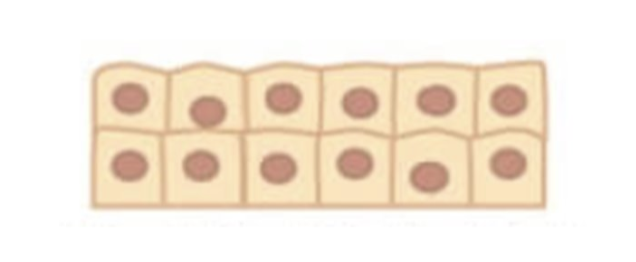
Pseudostratified Epithelium​

One cell layer (Simple Epithelium)

  • Appears stratified because nuclei are at different levels​

  • All attached to base, but not all reach surface​


<p class="Paragraph WhiteSpaceCollapse SCXP192451603 BCX0" style="text-align: left;">One cell layer (<span style="background-color: rgba(0, 0, 0, 0);">Simple Epithelium</span>)</p><ul><li><p class="Paragraph WhiteSpaceCollapse SCXP192451603 BCX0" style="text-align: left;"><span>Appears stratified because nuclei are at different levels</span><span style="line-height: 0px;">​</span></p></li><li><p class="Paragraph WhiteSpaceCollapse SCXP177506866 BCX0" style="text-align: left;"><span>All attached to base, but not all reach surface</span><span style="line-height: 0px;">​</span></p></li></ul><p></p>
23
New cards

What are the 4 categories of cell shape (at apical surface when classifying Epithelial Tissue?

  1. Squamous

  2. Cuboidal

  3. Columnar

  4. Transitional


24
New cards

Squamous (Cell Shape)

  • Flat, wide, irregular shape​

  • “Floor tiles,” flattened nucleus​


<ul><li><p class="Paragraph WhiteSpaceCollapse SCXP46107301 BCX0" style="text-align: left;"><span>Flat, wide, irregular shape</span><span style="line-height: 0px;">​</span></p></li><li><p class="Paragraph WhiteSpaceCollapse SCXP46107301 BCX0" style="text-align: left;"><span>“Floor tiles,” flattened nucleus</span><span style="line-height: 0px;">​</span></p></li></ul><p></p>
25
New cards

Cuboidal (Cell Shape)

  • As tall as they are wide, ​

  • Cubes with rounded edges, spherical nucleus​


<ul><li><p class="Paragraph WhiteSpaceCollapse SCXP207987155 BCX0" style="text-align: left;"><span>As tall as they are wide, </span><span style="line-height: 0px;">​</span></p></li><li><p class="Paragraph WhiteSpaceCollapse SCXP207987155 BCX0" style="text-align: left;"><span>Cubes with rounded edges, spherical nucleus</span><span style="line-height: 0px;">​</span></p></li></ul><p></p>
26
New cards

Columnar (Cell Shape)

  • Slender and taller than they are wide​

  • Oval nucleus​


<ul><li><p class="Paragraph WhiteSpaceCollapse SCXP188458830 BCX0" style="text-align: left;"><span>Slender and taller than they are wide</span><span style="line-height: 0px;">​</span></p></li><li><p class="Paragraph WhiteSpaceCollapse SCXP188458830 BCX0" style="text-align: left;"><span>Oval nucleus</span><span style="line-height: 0px;">​</span></p></li></ul><p></p>
27
New cards

Transitional (Cell Shape)

  • Change shape when stretched​


<ul><li><p class="Paragraph WhiteSpaceCollapse SCXP154140359 BCX0" style="text-align: left;"><span>Change shape when stretched</span><span style="line-height: 0px;">​</span></p></li></ul><p></p>
28
New cards

What makes the Transitional cell shape in Epithelial Tissue special?

Only urinary system ​

29
New cards

Simple Squamous Epithelium​

  • Delicate​

  • Thinnest possible barrier ​


<ul><li><p class="Paragraph WhiteSpaceCollapse SCXP142652573 BCX0" style="text-align: left;"><span>Delicate</span><span style="line-height: 0px;">​</span></p></li><li><p class="Paragraph WhiteSpaceCollapse SCXP142652573 BCX0" style="text-align: left;"><span>Thinnest possible barrier </span><span style="line-height: 0px;">​</span></p></li></ul><p></p>
30
New cards

Which type of Epithelial Tissue provides the thinnest barrier? Why?

Simple Squamous Epithelium​

  • Allows movement of molecules and ions across layer​


31
New cards

Simple Cuboidal Epithelium​

  • Absorption and Secretion

    • forms secretory tissue of most glands and ducts​

  • Usually arranged in circles (glands and tubes)​


<ul><li><p class="Paragraph WhiteSpaceCollapse SCXP70820081 BCX0" style="text-align: left;"><span>Absorption and Secretion</span></p><ul><li><p class="Paragraph WhiteSpaceCollapse SCXP70820081 BCX0" style="text-align: left;"><span>forms secretory tissue of most glands and ducts</span><span style="line-height: 0px;">​</span></p></li></ul></li><li><p class="Paragraph WhiteSpaceCollapse SCXP70820081 BCX0" style="text-align: left;"><span>Usually arranged in circles (glands and tubes)</span><span style="line-height: 0px;">​</span></p></li></ul><p></p>
32
New cards

Simple Columnar Epithelium​

  • Absorption and secretion​

  • 2 Types:

    • Nonciliated

    • Ciliated


33
New cards

Nonciliated Simple Columnar Epithelium

  • Contains microvilli​

  • May contain goblet cells​

  • Secrete mucus​


<ul><li><p class="Paragraph WhiteSpaceCollapse SCXP111889076 BCX0" style="text-align: left;"><span>Contains microvilli</span><span style="line-height: 0px;">​</span></p></li></ul><ul><li><p class="Paragraph WhiteSpaceCollapse SCXP111889076 BCX0" style="text-align: left;"><span>May contain goblet cells</span><span style="line-height: 0px;">​</span></p></li><li><p class="Paragraph WhiteSpaceCollapse SCXP111889076 BCX0" style="text-align: left;"><span>Secrete mucus</span><span style="line-height: 0px;">​</span></p></li></ul><p></p>
34
New cards

Ciliated Simple Columnar Epithelium

  • Cilia that project from surfaces of cell​

  • Mucus covers the apical surface and is moved along by cilia​

    • Goblet cells​


<ul><li><p>Cilia that project from surfaces of cell​</p></li><li><p>Mucus covers the apical surface and is moved along by cilia​</p><ul><li><p>Goblet cells​</p></li></ul></li></ul><p></p>
35
New cards

Pseudostratified Columnar Epithelium​

  • Protection

  • 2 Types:

    • Ciliated

    • Nonciliated ​


36
New cards

Ciliated vs. Nonciliated Pseudostratified Columnar Epithelium​

  1. Ciliated ​

  • Cilia on apical surface

  • Goblet cells

​

2. Nonciliated

  • Lacks cilia and goblet cells​

  • Rare, lining of male urethra​


<ol><li><p class="Paragraph WhiteSpaceCollapse SCXP23052898 BCX0" style="text-align: left;"><span>Ciliated </span><span style="line-height: 0px;">​</span></p></li></ol><ul><li><p class="Paragraph WhiteSpaceCollapse SCXP23052898 BCX0" style="text-align: left;">Cilia on apical surface</p></li><li><p class="Paragraph WhiteSpaceCollapse SCXP23052898 BCX0" style="text-align: left;"><span>Goblet cells</span></p></li></ul><p class="Paragraph WhiteSpaceCollapse SCXP23052898 BCX0" style="text-align: left;"><span style="line-height: 0px;">​</span></p><p class="Paragraph WhiteSpaceCollapse SCXP23052898 BCX0" style="text-align: left;"><span>2. Nonciliated </span></p><ul><li><p class="Paragraph WhiteSpaceCollapse SCXP23052898 BCX0" style="text-align: left;">Lacks cilia and goblet cells<span style="line-height: 0px;">​</span></p></li></ul><ul><li><p class="Paragraph WhiteSpaceCollapse SCXP23052898 BCX0" style="text-align: left;"><span>Rare, lining of male urethra</span><span style="line-height: 0px;">​</span></p></li></ul><p></p>
37
New cards

Stratified Squamous Epithelium​

  • Protection from abrasion​

  • Adapted to protect from friction​

  • Stem cells continuously divide​

  • Two Types:

    • Keratinized

    • Nonkeratinized​


38
New cards

Keratinized Stratified Squamous Epithelium​ (what and where)

  • Superficial layer composed of cells that are dead

    • Lack nuclei and organelles​

  • Epidermis of skin​


39
New cards

Keratin

Tough, protective protein that strengthens the tissue

40
New cards

Nonkeratinized Stratified Squamous Epithelium​ (what and where)

  • Lack keratin and remain alive at apical layer

    • All layers have nuclei​

  • Kept moist at apical layer with secretions of saliva or mucus​

  • Oral cavity, throat, esophagus, vagina, anus​


41
New cards

Stratified Cuboidal Epithelium​

  • Protection and secretion​

  • Forms walls of exocrine ducts in glands​


<ul><li><p class="Paragraph WhiteSpaceCollapse SCXP122930507 BCX0" style="text-align: left;"><span>Protection and secretion</span><span style="line-height: 0px;">​</span></p></li><li><p class="Paragraph WhiteSpaceCollapse SCXP122930507 BCX0" style="text-align: left;"><span>Forms walls of exocrine ducts in glands</span><span style="line-height: 0px;">​</span></p></li></ul><p></p>
42
New cards

Stratified Columnar Epithelium​

  • Only apical layer is columnar​

  • Protects and secretes​

  • Goblet cells​


<ul><li><p class="Paragraph WhiteSpaceCollapse SCXP207806712 BCX0" style="text-align: left;"><span>Only apical layer is columnar</span><span style="line-height: 0px;">​</span></p></li><li><p class="Paragraph WhiteSpaceCollapse SCXP207806712 BCX0" style="text-align: left;"><span>Protects and secretes</span><span style="line-height: 0px;">​</span></p></li><li><p class="Paragraph WhiteSpaceCollapse SCXP207806712 BCX0" style="text-align: left;"><span>Goblet cells</span><span style="line-height: 0px;">​</span></p></li></ul><p></p>
43
New cards

What type of Epithelium tissue is rare?

Stratified Columnar Epithelium​

44
New cards

Transitional Epithelium​

  • Limited to urinary tract​

  • Bladder, ureters, urethra​

  • Accommodates urine volume changes in bladder​

    • Changes appearance depending on if it is in relaxed or stretched state​


45
New cards

What are the 2 states of Transitional Epithelium​?

  • Relaxed state (collapsed) → when bladder is empty

    • Rounded apical cells​


  • Stretched state (distended) → when bladder is full

    • Flattened apical cells​


<ul><li><p class="Paragraph WhiteSpaceCollapse SCXP17323593 BCX0" style="text-align: left;"><span>Relaxed state (collapsed) </span>→ <span>when bladder is empty</span></p><ul><li><p class="Paragraph WhiteSpaceCollapse SCXP17323593 BCX0" style="text-align: left;"><span>Rounded apical cells</span><span style="line-height: 0px;">​</span></p></li></ul><p class="Paragraph WhiteSpaceCollapse SCXP17323593 BCX0" style="text-align: left;"></p></li></ul><ul><li><p class="Paragraph WhiteSpaceCollapse SCXP17323593 BCX0" style="text-align: left;"><span>Stretched state (distended) </span>→ <span>when bladder is full</span></p><ul><li><p class="Paragraph WhiteSpaceCollapse SCXP17323593 BCX0" style="text-align: left;"><span>Flattened apical cells</span><span style="line-height: 0px;">​</span></p></li></ul></li></ul><p></p>
46
New cards

Gland

Secrete substances either for use elsewhere in the body or for elimination from the body​

47
New cards

What are glands composed of?

Epithelial Tissue

48
New cards


What are the 2 types of glands? What do they do

Endocrine and Exocrine

49
New cards

Endocrine Gland

  • No ducts​

  • Secrete hormones to enter into blood for transport


50
New cards

Exocrine Gland

  • Secretions exit body or organ​

  • Maintain connection with epithelial surface through a duct

  • 2 Types:

    • Unicellular

    • Multicellular​


51
New cards

Multicellular vs. Unicellular Exocrine Gland

Multicellular → uses ducts​

  • Ex. Secrete mucus, sweat, oil, and milk

​

Unicellular → ​no duct​, located close to surface​

  • Ex. Goblet cells​


52
New cards

What are the 2 components of a Multicellular​ Exocrine Gland?

Acinus → produce secretion

​

Duct → tube to transport secretion to epithelial surface​


53
New cards

What qualities of Connective Tissue makes it different from other tissue types?

Most diverse, abundant, and widely distributed of the four tissue types​

54
New cards

What are the 3 functions of Connective Tissue?

  1. Support

  2. Protect

  3. Bind


55
New cards

What are the 3 traits of all Connective Tissue?

  1. Derived from mesenchyme ​

  2. Vascular​

  3. Range of regenerative capacity ​


56
New cards

What are the differences in regenerative capacity ​between bone and cartilage?

Bone → highly regenerative


Cartilage → not regenerative​

57
New cards

What are the 3 components of Connective Tissue structure?

  1. Cells​

  2. Protein fibers​

  3. Ground substance​


58
New cards

Protein Fibers and Ground Substance makes up what structure in Connective Tissue?

Extracellular Matrix

59
New cards

What are the 2 types of cells in Connective Tissue?

-Blast and -Cyte Cells

60
New cards

-Blast Cells (Connective Tissue)

Immature cells that actively build and secrete extracellular matrix

61
New cards

-Cyte Cells (Connective Tissue)

Mature cells that maintain extracellular matrix

62
New cards

What are the 3 types of Protein Fibers in Connective Tissue?

  1. Collagen Fibers

  2. Reticular Fibers ​

  3. Elastic Fibers​


63
New cards

Collagen Fibers​ (what and where)

Strong, flexible, and resistant to stretch

  • Tendons and Ligaments​


64
New cards

Reticular Fibers (what and where)

Forms a branching, interwoven framework (tough but flexible)​

  • Structural support in organs​


65
New cards

Elastic Fibers​

Stretch and recoil easily (elastin)​

  • Abundant in skin, blood vessels, lungs (stretch)​


66
New cards

Ground Substance​

  • Substance material produces by CT cells ​

  • Protein fibers and cells reside here​


67
New cards

What individual component takes up the majority of space in Connective Tissue?

Ground Substance

68
New cards

What are the 3 traits/types Ground Substance can have?

  • Viscous (blood)

  • Semisolid (cartilage)

  • Solid (bone)​