Cells and Tissues - Anatomy
 Call Kai
 Learn
 Practice Test
 Spaced Repetition
 Match
 Flashcards
 Knowt Play
1/123

There's no tags or description
Looks like no tags are added yet.
124 Terms
Cytology
study of cells
3 main parts of cells
membrane, cytoplasm, nucleus
organelles
“little organs” within cell that preforms specific functions
Cell membrane
regulates what enters and leaves the cell and consists of phospholipids and embedded proteins.
Cytoplasm
Contains organelles except nucleus.
Mitochondria
Produces ATP through cellular respiration and is called the “powerhouse" of the cell.
Endoplasmic reticulum
transport system of the cell
Rough ER
Has ribosome on it; involved in protein synthesis and transport.
Smooth ER
Synthesizes lipids, stores calcium ions, and detoxifies drugs and poison
Free ribosome
synthesizes proteins used in the cell
Golgi apparatus
Modifies, packages, and delivers proteins
Lysosome
Contains digestive enzymes to break down waste material.
Centrosome (pair of centrioles)
helps organize microtubules during cell division (mitosis and meiosis)
Chromatin
DNA + Proteins; condenses into chromosomes during cell division.
Chromosomes
Carry genetic information in the form of genes.
Nucleus
directs cell activities and contains DNA; “brain" of the cell
Nucleolus
Synthesizes ribosomal RNA and assembles ribosomes
Nuclear Pores
Regulates movement of molecules between the nucleus and cytoplasm
Cytoskeleton Filaments
A network of protein filaments in the cytoplasm-provide structural support, shape, mechanical strength, cell movement and internal transport
Cilia
Move mucus or particles across the cell surface
Flagella
Enable cell movement in sperm cells
Villi
Increase surface area in the small intestine for nutrients absorption.
3 checkpoints of cell life cycles
Interphase, mitosis, cytokinesis
Interphase
growth phase
mitosis
nuclear division
cytokinesis
cell splits into 2 daughter cells
Cell death
by necrosis or apoptosis
necrosis
unprogrammed cell death
apoptosis
programed cell death
atrophy
less or no cell growth
hypertrophy
increase in size
hyperplasia
increase in number
Dysplasia
change to the size, shape, and organization of cells
neoplasia
change in cell structure
hypoxia
decrease in the amount of oxygen in the blood flow
anoxia
a lack of oxygen flow to cellular structure
Passive transport
when substances move across the cell membrane without the cell needing to expend energy
Active transport
when the cell uses energy to move substances across the cell membrane
Facilitated Diffusion
Moves molecule or ions across a cell membrane with the help membrane proteins
osmosis
natural movement of water through the membrane from low to high solute concentration.
Hypertonic
water moves out of the cell, causing it to shrink
Hypotonic
water moves into the cell, causing it to swell
Isotonic
water moves equally in and out, keeping the cell the same size
Exocytosis
things exit cell
Endocytosis
things enter cell
Histology
study of cell tissue
Tissue
a group of similar cells working together to preform common functions
epithelial tissue
greets/protects you; covers all body surfaces both inside and outside; attached to underlying connective tissue at the basement membrane
Connective tissue
supports you
muscle tissue
gets things done
nervous tissue
coordinating - keeps everything running smoothly
simple
single layer
squamous
flat
cuboidal
square
columnar
column (rectangle)
Pseudostratified
fake layers
transitional
ability to change; stretchable
histology
image evaluation
gland
one or more cells that secretes a particular product
endocrine gland
ductless-secrete product directly into blood or tissue
exocrine gland
empty through ducts to the epithelial surface
connective tissue
most abundant tissue in your body; binds structures together; provides support, protection, framework, fills space, stores fat, produces blood cells, fights infection
Collagen
found in bones, ligaments, tendons, stiff but flexible
Elastic
found in ears, vocal cords
Reticular
very thin; found in bone marrow
Fibronectin
found in blood plasma
Fibrin
insoluble fibrous protein, forms a network to trap cells and sealing blood vessel leak
Loose or Areolar CT
Loosely arranged network of fibers and cells with abundant ground substance.
Adipose Tissue (Fat)
insulation to preserve body heat and stores energy.
Dense-Fibrous CT
Densely packed collagen fibers with few cells
Dense Regular CT
stabilize and support organs
Dense Irregular CT
skin, arterial walls
Elastic dense CT
packed elastic fibers with very little ground substance
Bone Tissue (Osseous)
Densely packed collagen fibers with few cells
Cartilage
firm, flexible connective tissue.
Hyaline Cartilage- Avascular
covers ends of joints, nose and respiratory passages, serves as padding
Hyaline cartilage
providing smooth surfaces for joint movement and structural support
Elastic cartilage
a highly flexible type of connective tissue that can bend repeatedly and return to its original shape
Fibrocartilage
tough, shock absorbing
blood tissue
fluid connective tissue; RBC, WBC, Platelets
Nerve Tissue
Consists of brain, spinal cord, nerves and Carry electrical signals
Neurons
receive, transmit, and process signals
Neuroglia
which support, protect, and nourish neurons
Smooth
involuntary, slow squeeze
Cardiac
involuntary, rhythmic pump
Skeletal
voluntary, fast movement
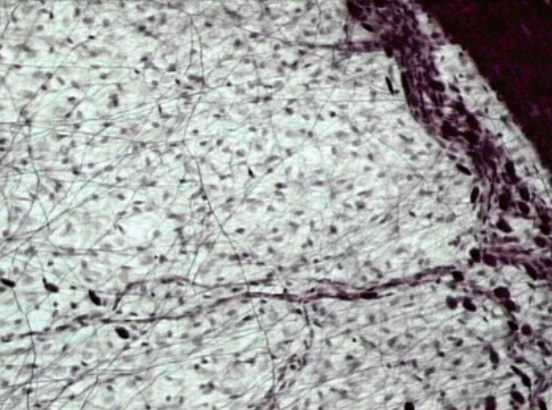
Areolar (Loose connective tissue)
Loose collagen and elastic fibers
Adipose (Loose connective tissue)
Large fat-filled cells
Reticular (Loose connective tissue)
Network of reticular fibers
Regular (Dense Fibrous Connective Tissue)
Parallel collagen fibers
Irregular (Dense Fibrous Connective Tissue)
Randomly arranged collagen fibers
Bone
hard, mineralized matrix
Hyaline cartilage
Smooth, glassy matrix
Fibrocartilage
Dense collagen bundles
Elastic cartilage
Abundant elastic fibers
Plasma (blood)
Liquid extracellular matrix
Erythrocytes (blood)
Biconcave, nucleus-free cells
Leukocytes (blood)
Nucleated immune cells
Thrombocytes (blood)
Small cell fragments
Areolar