Lecture 7 Microbial Growth, Nutrition and Metabolism Fall 2026
 Call Kai
 Learn
 Practice Test
 Spaced Repetition
 Match
 Flashcards
 Knowt Play
1/75

There's no tags or description
Looks like no tags are added yet.
76 Terms
What is water activity (aw)?
A measure of water availability to cells.
How do salts and sugars affect water availability?
They decrease water availability to microbes.
What happens to water activity when solute concentration increases?
Water activity decreases.
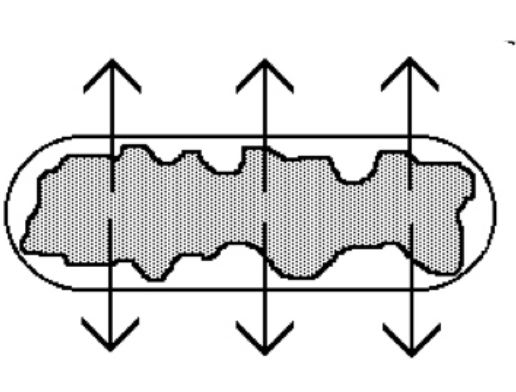
What solution is this bacteria in?

A HYPERTONIC solution causes the plasma membrane to shrink
The solute concentration is higher outside. Water leaves the cell
Why does the bacteria’s internal contents shrivel up while its outer shape remains intact?
The cell wall maintains structural integrity and prevents the entire microbe from collapsing or bursting
What is a halophile?
A microbe that requires high salt concentrations to grow.
What does osmotolerant mean?
Able to grow over a wide range of water activities. aw
Which genus is noted as salt tolerant?
Staphylococcus.
Where is Staphylococcus described as a commensal?
Salt tolerant on the human skin.
What medium is mentioned for selecting salt-tolerant microbes?
Mannitol Salt Agar.
How do microbes survive in highly concentrated environments
They keep the cytoplasmic osmolarity somewhat above that of the environment so that the plasma membrane is always pressed firmly against the cell wall.
Through the usage of compatible solutes
Turgor pressure
What are compatible solutes
Organic molecules that can be kept at high intracellular concentrations without in interfering with metabolism and growth.
What are examples of compatible solutes?
Choline, betaine, certain amino acids, and sugars.
Why do microbes need nutrients?
To obtain energy and construct cellular components.
What are nutrients?
Substances used in biosynthesis and energy release that are required for growth.
What proportion of microbial cell dry weight is made up of a few major elements?
About 95%.
What are macronutrients (macroelements)?
Elements required in large amounts.
Which elements are listed as macronutrients?
C, O, H, N, S, P, and Fe.
What are micronutrients (trace elements)?
Elements required in small amounts.
Which micronutrients are listed in the lecture?
Cobalt, copper, zinc, and manganese.
Water can be added to get these trace elements
What nitrogen sources can many microbes use?
Ammonia (NH3) or nitrate (NO3).
What nitrogen source can a few microbes use?
Atomspheric Nitrogen gas (N2).
What percentage of Earth's atmosphere is nitrogen gas?
About 79%.
What microorganism is shown forming root nodules?
Rhizobium.
Whats the symbiotic relationship between the plant and Rhizobium?
Rhizobium does nitrogen fixation N2 → NH3 and shares it with the plant
Plant provides the bacteria with shelter and carbon/energy from photosynthesis
What is the free-living bacteria in soil
Azotobacter
What challenges do rapidly growing microbes face in nutrient acquisition?
Nutrients must enter rapidly, selectively, across membranes, and often against a concentration gradient.
How is nutrient protein selective?
Proteins are used to determine it
What two broad types of transport systems do microbes use?
Passive transport and active transport.
Does passive transport require energy?
No.
In passive transport, which way do substances move along a concentration gradient?
From higher concentration to lower concentration.
Wht are the 2 main types of Passive Transport
Passive diffusion & Faciliated Diffusion
What is passive diffusion limited to?
Small molecules and certain gases.
What is facilitated diffusion?
Substances move across the plasma membrane with the assistance of transport proteins that are either channels or carriers.

Why is it called facilitated diffusion?
Because the Membrane carrier protein has to recognize the nutrient and undergo a conformational change to
What does facilitated diffusion use?
Membrane carrier proteins.
What powers primary active transport by ABC transporters?
Energy from ATP hydrolysis.
What does ABC stand for?
ATP-binding cassette.
Where are ABC transporters found?
In all domains of life.
What can ABC transporters do?
Move substances into or out of cells.
What is the role of uptake ABC transporters?
They move nutrients into cells.
What is another name for export ABC transporters?
Multidrug efflux pumps.
How can bacterial export pumps contribute to antibiotic resistance?
They move antibiotics out of bacterial cells.
How can export pumps contribute to cancer drug resistance?
They move anticancer drugs out of cancer cells.
What is secondary active transport?
Transport powered by an ion gradient rather than directly by ATP hydrolysis.
What does Lac permease transport?
Lactose into the cell.
What powers Lac permease in the lecture example?
A proton (H+) moving into the cell.
What is group translocation?
A transport process in which the substance is chemically modified as it enters.
What bacterial system is given as an example of group translocation?
The phosphotransferase system (PTS).
Why is iron uptake a challenge for microbes?
All microbes require iron, but little free iron is available and it is often insoluble.
What form of iron is mentioned as often insoluble?
Ferric iron (Fe3+).
What is a siderophore?
A molecule that helps microbes acquire iron.
Which siderophore and organism are shown in the lecture?
Enterobactin from Escherichia coli.
What is metabolism?
All chemical reactions in a cell.
What is catabolism?
Breakdown of complex molecules into smaller ones, releasing energy.
What is anabolism?
Reactions that build cellular components.
What does metabolism require?
A flow of energy and the participation of enzymes.
What is ATP known as in the cell?
The energy currency of cells.
What happens energetically when a phosphate is removed from ATP?
It has a large negative standard free-energy change.
What are enzymes?
Usually proteins that catalyze reactions; some catalytic RNAs are ribozymes.
What are ribozymes?
Catalytic RNA molecules.
What is a substrate?
A molecule on which an enzyme acts.
What is a product in an enzyme-catalyzed reaction?
The molecule formed from the substrate.
What is activation energy?
The energy required to bring reacting molecules to the reactive state.
How do enzymes increase reaction rates?
They lower activation energy.
Give three enzyme-name examples from the lecture.
Phosphatase, kinase, and cellulase.
What happens to electrons in redox reactions?
They move from an electron donor to an electron acceptor.
What can redox reactions release that can be used to form ATP?
Energy.
What do electron carriers do in redox reactions?
They carry electrons, often along with protons.
What is the lecture's example of a redox carrier pair involving electron and proton transfer?
NAD+/NADH.
What does reduction potential (E0) describe in the lecture?
The tendency of a donor to lose electrons.
What are examples of freely diffusible electron carriers?
NAD+ and NADP+.
What are the reduced forms of NAD+ and NADP+?
NADH and NADPH.
What are NADH and NADPH described as providing to the cell?
Reducing power.
What are examples of membrane-bound electron carriers?
Flavoproteins, cytochromes, and quinones.
What are membrane-bound electron carriers important components of?
Electron transport chains.