Grief, Loss & Palliative Care
 Call Kai
 Learn
 Practice Test
 Spaced Repetition
 Match
 Flashcards
 Knowt Play
1/21

There's no tags or description
Looks like no tags are added yet.
22 Terms
Grief
inner emotional response to loss, shown in thoughts, feelings, behaviors.
Bereavement
grief + mourning (outward expression) after death of a significant other.
Palliative/EOL
meet physical, spiritual, psychosocial needs; honor client/family wishes; support decision-making.
medical specialty focused on improving the quality of life for patients with serious illnesses by relieving symptoms like pain, shortness of breath, fatigue, and stress
Advance directives
▪ Living will: client’s treatment wishes
▪ Health care proxy (durable POA): surrogate decision maker when client lacks capacity
▪ Guide EOL decisions; review with client/family.
Kubler Ross Model
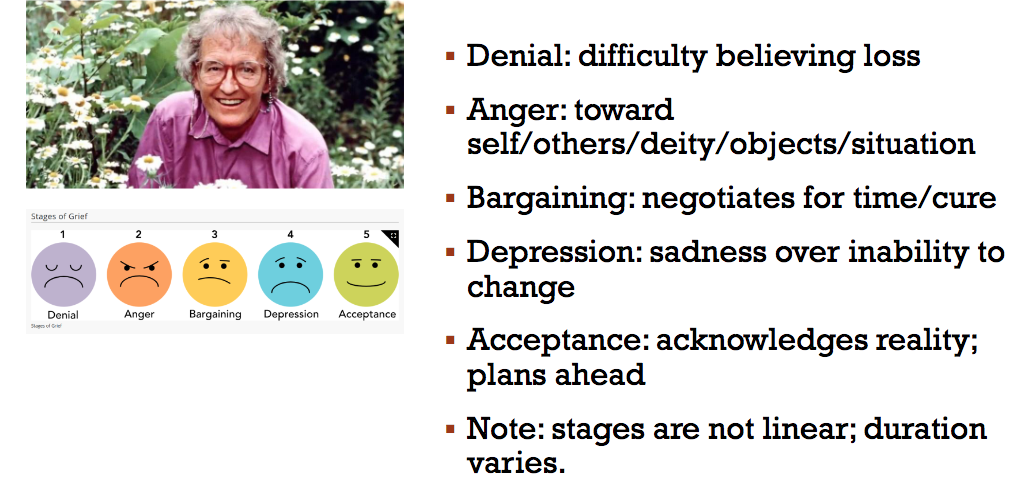
normal
(Grief Reactions)
negative emotions (anger, guilt, hopelessness) → acceptance by ~6 months; somatic complaints possible.
Anticipatory
(Grief Reactions)
grieving before loss (e.g., terminal illness).
complicated
(Grief Reactions)
Chronic/exaggerated/masked/delayed; prolonged/severe; depression, suicidal ideation, guilt, low self-esteem, persistent somatic complaints.
Disenfranchised
(Grief Reactions)
loss not publicly shared/accepted (e.g., incarcerated person, abortion).
Facilitate Mourning
Nursing Interventions
▪ Allow time; identify expected behaviors
▪ Therapeutic communication matched to stage (name the emotion)
▪ Active listening; open-ended questions; paraphrase/clarify/summarize
▪ Use presence/silence; avoid false reassurance/advice/topic changes
▪ Support acceptance and rebuilding relationships
▪ Assess ineffective coping; educate about grief tasks/stages
▪ Avoid clichés; encourage memories; link to community resources
Palliative Care
▪ Goal: live fully with incurable conditions; improve Quality of Life for clients/families at any stage of serious illness.
▪ Focus: relieve physical (e.g., pain), spiritual, emotional, psychosocial distress.
▪ Team: MD/NP, nurses, social work, PT/OT, massage, music/art, touch/energy therapists, spiritual support.
Hospice Care
▪ Comprehensive care when prognosis ≤6 months
▪ Curative treatments stopped; focus on comfort, dignity, peaceful death
▪ Settings: home, facility, extended care
▪ Include family as unit of care
Palliative/Hospice Assessment
▪ Sources of strength/hope; client/family goals
▪ Discomfort: pain, anxiety, restlessness, dyspnea, N/V, dehydration, bowel/urinary changes, ADL limits
Expected manifestations
Approaching Death
▪ ↓ LOC; loss of muscle tone; facial relaxation
▪ Labored breathing, dyspnea, apnea, Cheyne-Stokes; noisy respirations (“death rattle”)
▪ Diminished touch (pressure felt)
▪ Mucus in airways; incontinence (bowel/bladder)
▪ Mottling/cyanosis; cool extremities; perspiration
▪ ↓ BP; weak, slow pulse; pupils non-reactive
▪ ↓, dark urine; inability to swallow
Physical Care Interventions
(For Comfort)
▪ Control manifestations; titrate meds (e.g., morphine for pain/air hunger/anxiety)
▪ Reassess effectiveness/adjust plan; manage side effects
▪ Reposition for airway patency/comfort; protect skin & mucosa
▪ Provide caring touch; clean, odor-free environment; comfortable clothing; grooming
▪ Encourage familiar items; relaxation techniques; client choice in food/activities; encourage ADLs as able
Psychosocial Care
▪ Interprofessional support; volunteers for nonmedical care
▪ Therapeutic communication to align client/family/provider
▪ Clarify disease course/treatment options; support religious/cultural practices
▪ Help clarify values for decisions; encourage effective coping
▪ Treat hearing as last sense—speak respectfully around unconscious clients
▪ Address finances/roles; refer as needed
Prevent Abandonment and
▪ Make presence known; frequent checks; timely responses
▪ Keep client informed of schedules
▪ Allow overnight family; room placement for comfort
▪ Home care: consider central bed location
Support Grieving Family
▪ Plan visits to protect client rest
▪ Keep family updated on plan changes
▪ Provide privacy for family processing; assess desire to provide care & teach as needed
▪ Educate on physical changes near death
▪ Encourage expression of feelings
Postmortem care
Responsibilities
▪ Follow laws on organ/tissue donation, autopsy permissions, death certification/documentation
▪ Provide respectful care per cultural/religious/social practices
▪ After postmortem care, focus on family support
Prepare body for viewing
▪ Ask if family wants to participate; maintain privacy
▪ Remove tubes unless autopsy/donation/ME case
▪ Return belongings to family
▪ Cleanse & align body supine; pillow under head; dentures in; eyes closed; arms at sides palms down
▪ Fresh linens/absorbent pads; clean gown; hair groomed; remove excess equipment/soiled items; dim lights; minimize noise
after viewing and documentation
▪ Identification tags per policy; complete documentation
▪ Be sensitive during transport
▪ Infant considerations: swaddle; carry per protocol; offer mementos (ID bands, footprints, hair lock, photos)
Organ/tissue Donation and autopsy
▪ Requests made by trained personnel; provide private space and support
▪ Maintain cardio-pulmonary support for organ retrieval
▪ Autopsy: provider discusses; nurse supports/answers questions
▪ Many cases require leaving tubes/lines in place
▪ Document: pronouncer/time; donation considerations; tubes/lines; belongings; notifications/decisions; tag locations; departure time/destination