AST101 Midterm 2
 Call Kai
 Learn
 Practice Test
 Spaced Repetition
 Match
 Flashcards
 Knowt Play
1/29

There's no tags or description
Looks like no tags are added yet.
30 Terms
Newton’s 3 Laws
1.An object in motion remains in motion unless acted upon by an outside force
2.Acceleration is proportional to Force and inversely proportional to mass (F = ma)
3, For every force, there is always an equal and opposite reaction force
(Angular) Momentum
Angular Momentum - mass x velocity x distance
Momentum = mass x velocity
Newton’s Universal Law of Gravitation
There is a force between any two objects in the universe that pulls them together
The force is proportional to the product of the masses (mass x mass)
If you double the mass of either object, you double the force
The force is inversely proportional to the square of the distance
If you double the distance, you reduce the force by a factor of 1/2^2 =4 (¼)
Freefall and Orbits

Tidal Locking
Tidal locking occurs when Earth's tidal forces gradually slow the Moon's rotation until it rotates once for every orbit around Earth, causing the same side of the Moon to always face Earth.
Tides in a day
There are two high tides in a day , one a little after the moon is highest in the sky and one around 12 hours later.
Spring Tide and Neap Tide
Spring Tide: tidal forces from the earth and sun ‘add’ to make bigger tides
Neap Tides: tidal forces from the sun partially cancel the moon tides

Fusion in the Sun
The sun converts hydrogen into helium when two two atomic nuclei combine to form a heavier nucleus. Heat, Speed and density allow fusion to happen.
Ideal Gas Law
Higher Temperature means moving faster and higher pressure.
Higher density means more particles and higher pressure.
P = kT(n/V)
Hydrostatic Equilibrium in the Sun
Density of the sun increases -> more fusion -> higher temperature -> pressure increases -> more pressure means it expands -> it expands so density drops -> equilibrium reached and sun is stable
Nuclear Fission
Nuclear fission occurs when uranium-235 absorbs a neutron, becomes unstable, and splits into smaller nuclei (krypton and barium), releasing energy and additional neutrons that can cause a chain reaction. It is used in nuclear power plants and atomic bombs.
Nuclear fission is used in: nuclear power plants and small nuclear bombs
Nuclear Fusion is used in the sun and hydrogen bombs
Parts of the Sun
Core: fusion takes place here, around 10m C
Radioactive Zone: Hot but calm, a few m C (no fusion
Convection Zone: Hot plasma rises, bringing heat to the surface, hundreds and thousands of C

Light Definitions
Emission: where light comes from (e.g. a candle flame)
Reflection: light bounces off something that is reflective and we see it. (eg. mirror reflects cabinets)
Scattering: a light source shines on a rough surface and the light scatters in all directions. It's how we see things. On a red shirt, only red light is scattered from it. The rest of the colours are being absorbed.
Absorption: Black objects absorb all light. Most things we see are not actually black.
Transmission: light goes through a solid. (eg. light going through transparent things such as glass)
Wavelengths
Long wavelength: red, short wavelength blue

3 Scenarios of light from Gas
Thermal Radiation from a hot dense source: Something that is just warm and glowing. It has all the colours of the rainbow from violet and red. No extra chemistry stuff going on. When you put it through a prism, you see all the colours.
Emission line spectrum from hot low density gas (excited gas). Something is causing the electrons to jump up, and when they jump down, they emit light. When you put it through a prism, you see the emission lines.
Absorption Line Spectrum from cool low density gas with a hotter source behind it (light is behind the cloud): the cloud absorbs the colours and you get absorption lines. Absorption lines let us figure out what (gas) is between us and a light source
Doppler Effect Colours
When an object moves away from us, its spectral lines shift toward longer wavelengths (redshift). When an object moves toward us, its spectral lines shift toward shorter wavelengths (blueshift). The faster the object moves, the greater the shift in its spectral lines

Star Formation
Molecular Cloud: Stars form in cold clouds of gas and dust, mostly hydrogen and helium.
Protostar: Gravity pulls gas inward, causing the centre to become hotter, denser, and higher in pressure until fusion begins.
Main-Sequence Star: Hydrogen fuses into helium in the core. Outward gas pressure balances inward gravity, keeping the star stable (hydrostatic equilibrium).
Hydrogen Shell-Burning Red Giant: Core hydrogen runs out, causing the helium core to contract and heat up. Hydrogen fusion begins in a surrounding shell, releasing more energy and expanding the star into a red giant.
Helium Core-Burning Red Giant: The helium core becomes hot enough to fuse helium into carbon and oxygen, while hydrogen shell fusion continues. Eventually, core helium runs out.
Helium Shell-Burning Red Giant: The carbon-oxygen core contracts and heats up, triggering helium fusion in a surrounding shell. Hydrogen fusion continues in an outer shell, producing enormous energy and further expanding the star.
Planetary Nebula: The star expels its outer layers into space, forming a glowing cloud illuminated by the exposed hot core.
White Dwarf: The remaining carbon-oxygen core becomes a hot, dense white dwarf supported by electron degeneracy pressure. Fusion has stopped, so it gradually cools and may eventually become a black dwarf.
Planet Formation
Solar Nebula: The solar system began as a large cloud of gas and dust that started collapsing under gravity.
Rotating Disk: As the cloud collapsed, it spun faster due to conservation of angular momentum and flattened into a rotating disk.
Formation of the Sun: Most material collected in the centre, becoming hot and dense enough for hydrogen fusion to begin, forming the Sun.
Condensation and Frost Line: Close to the Sun, only rocks and metals could remain solid, while beyond the frost line, colder temperatures allowed ice to form.
Accretion and Planet Formation: Small particles collided and stuck together, forming planetesimals that merged into protoplanets. Inside the frost line, rocky materials formed terrestrial planets, while beyond it, larger icy cores attracted gas to form Jovian planets
The Frost Line
The frost line is the distance from the Sun beyond which temperatures are cold enough for substances like water, methane, and ammonia to freeze into ice, allowing larger planetary cores and gas giants to form.
Terrestrial planets: Mercury, Venus, Earth, Mars. (Small, rocky planets with relatively thin or no atmospheres.)
Jovian planets: Jupiter, Saturn, Uranus, Neptune. (Large planets rich in gases and/or ices.)
Heavy Bombardment Period
The Heavy Bombardment Period was a time early in the solar system's history, around 4 billion years ago, when planets and moons were struck by large numbers of asteroids and other space debris, creating many impact craters.
How do we know the solar system’s age?
Scientists estimate the solar system is approximately 4.55 billion years old using radioactive dating, which measures the decay of elements like potassium-40 into argon-40 in ancient rocks.
Where did the moon come from?
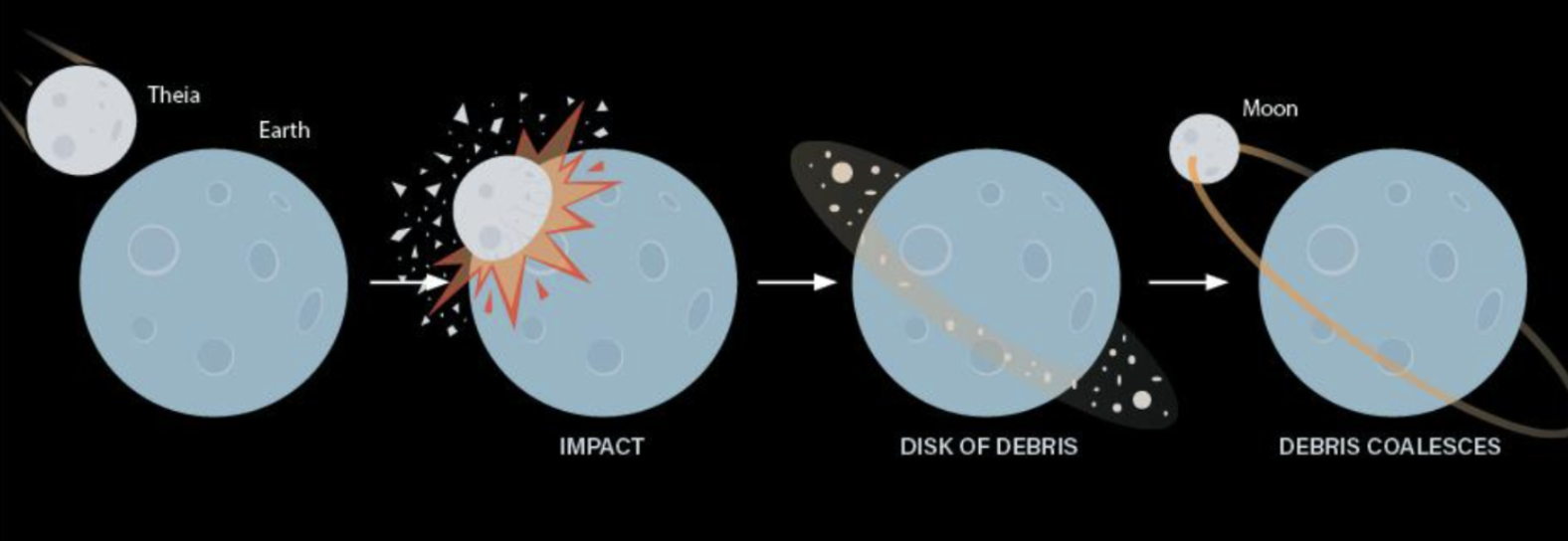
Seismic Waves used to understand planets
- P-waves (Primary waves): Compression waves that push and pull material in the direction they travel. They can travel through solids and liquids.
- S-waves (Secondary waves): Waves that move material side to side, perpendicular to their direction of travel. They can travel through solids but not liquids.
3 Main Layers of Terrestrial Planets
- Crust: The outermost layer, made of relatively low-density rock.
- Mantle: The thick middle layer, made of denser rock.
- Core: The innermost layer, containing the densest materials, primarily iron and nickel.

Differentiation
Differentiation is the process where a planet's interior separates into layers as heavier materials (like iron and nickel) sink toward the core, while lighter materials rise toward the surface.
Why Are Planetary Interiors Hot? (3)
Accretion: constant collisions cause heat.
Differentiation: while the planet is still go, heavy materials sink and lighter materials float. the motion converts into heat
Radioactive Decay: radioactive elements naturally decay over time, releasing energy as heat..
How Do Planets Cool Down?
Step 1: Convection. Hot rock moves up and cools and creates convection cells. Brining heat up.
Step 2: Conduction. Heat from the hot maybe leak through the crust and leaks though the surface.
Step 3: Radiation. more light from the sun hitting the earth vs light leaving
Techtonic Plates Movement
Convergent boundaries: Two tectonic plates move toward each other. In some cases, a denser oceanic plate is pushed beneath a continental plate, a process called subduction. The continental crust can also be pushed upward, forming mountains.
Divergent boundaries: Two tectonic plates move away from each other. Molten material rises from below and creates new crust. Underwater, this process forms long mountain ranges called mid-ocean ridges.
Erosion Causes
Flowing water: Rivers gradually wear away rock and transport sediment. Over millions of years, this can create enormous valleys and canyons, such as the Grand Canyon.
Glaciers: Large masses of moving ice slowly scrape and carve the landscape, forming valleys and other geological features. The lecture uses Yosemite Valley as an example.
Wind: Wind carries particles that gradually wear away exposed rock. It can also transport sand and sediment, creating features such as sand dunes.
4 Ways the Surface is Changed
1.High speed strikes (craters)
2.Volcanism
3. Erosion
4.Internal Stress