Chemistry II - Exam 3
 Call Kai
 Learn
 Practice Test
 Spaced Repetition
 Match
 Flashcards
 Knowt Play
1/21

There's no tags or description
Looks like no tags are added yet.
22 Terms
What is a buffer?
It is a chemical system that resists changes in pH.
What must a buffer contain?
A weak base to react with any added acid or a weak acid to react with any added base.
A titrant has
A known concentration and volume
An analyte has
An unknown concentration and known volume

When a titration involving a strong acid and base reaches the equivalence point,
The pH is = 7
When a titration involves a strong acid and weak base, the equivalence point is
pH < 7
When a titration involves a strong base and weak acid, the equivalence point is
pH > 7
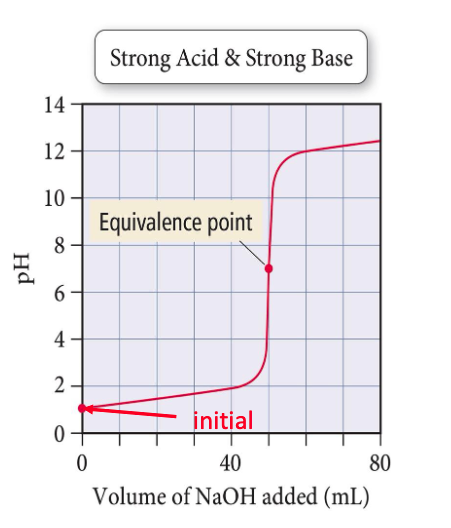
At the initial point the titration curve, how would you calculate the pH?
Since at this point there is only strong acid, just calculate the pH as it is a strong acid.

At the parts BEFORE the equivalence point the titration curve, how would you calculate the pH?
You would calculate the excess strong acid moles, then figure out the concentration by dividing that amount by the volume of the acid and base. Then use the typical pH equation.
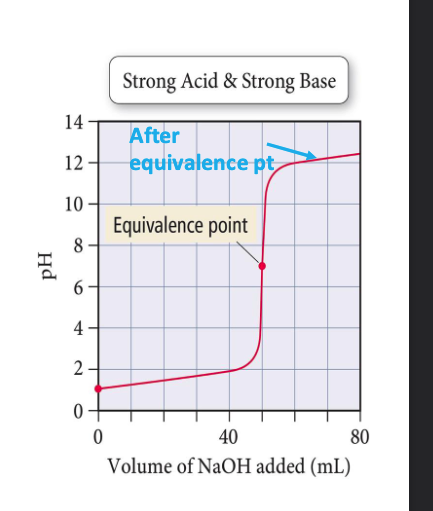
At the parts AFTER the equivalence point the titration curve, how would you calculate the pH?
First calculate the amount of excess moles of base by subtracting the moles of acid from the moles of base. Then, divide that amount by the total volume of the acid and base to get the concentration. Then use the pOH equation and subtract the sum from 14 to get the pH.
When can you not use the Henderson Hasselbach Equation?
When dealing with strong acids or bases.
What is the endpoint of a titration?
When the solution startt to change color.
At the equivalence point of ANY titration,
The moles of the titrant are stoichiometrically equivalent to the moles of the analyte.
You can only use the HH equation when
You are given the initial concentrations of the weak acid/weak base and conjugate base/acid.
When a buffer is described with a single overall molarity without separate concentrations listed,
Assume that the cocnentrations of weak acid and conjuagte base are 1:1.
As the KsP value increases,
A substance’s solubility increases.
How do you determine what has the highest buffer capacity?
First, see if the two species are weak acid/weak base conjugate pairs. Then see which one’s concentrations add up to the most. Lastly, see which ones have the closest 1:1 ratios.
As the Kb value increases, the species becomes
More basic
As the Ka value increases, the species becomes
More acidic
If the Ksp > Qsp
The reaction favors the products (dissolving)
If the Ksp < Qsp
The reaction favors the reatcants (precipate forms)
What is the Common Ion Effect
When an two solutions that are added together that share a similar ion, it’ll shift the reaction towards the products, making a precipitate.