D Generation Diversity 1 - 4 ;)
 Call Kai
 Learn
 Practice Test
 Spaced Repetition
 Match
 Flashcards
 Knowt Play
1/10

There's no tags or description
Looks like no tags are added yet.
11 Terms
What is the “problem” with antibody specificity?
The human body can produce 25 million different antibody specificities (types).
The body contains only 30,000 genes and if each gene produces one type of protein how is this possible?
In what ways can antibodies vary in diversity?
Isotype: Different antibody classes (IgG, IgM, IgA, IgE, IgD).
Allotype: Genetic differences in antibodies between individuals.
Idiotype: Differences in antibody-binding sites.
Allelic exclusion: Only one parental allele is used per antibody chain type, limiting diversity within a B cell.
During the antibody response
Heavy chain: Produced before the light chain.
Isotype switching: Antibody class changes, but the target stays the same.
Affinity increases: Antibodies bind more strongly to antigens with time.
Specificity improves: Antibodies recognise their targets more precisely.
Hypervariability: Most antibody variation occurs at the antigen-binding site (CDRs).
What is isotype, allotype and idiotype ?
Isotype: Different antibody classes (IgG, IgM, IgA, IgE, IgD).
Allotype: Genetic differences in antibodies between individuals.
Idiotype: Differences in antibody-binding sites.

There are also different sub groups of IgG, IdM, IgA, IgE and IgD
What is isotope switching ?
Isotype switching: Antibody class changes, but the target stays the same.

Same antigen exposure → different antibodies both binding to the same antigen. In primary and secondary immune response.
What are the theories for the specificity problem ?
Two theories of antibody diversity
Germline theory: Many different genes produce different antibodies. INCORRECT ❌
Somatic variation theory: A small number of genes rearrange or mutate to produce many different antibodies (correct theory). CORRECT✅
Explain how the gene which code for antibodies (immunoglobulin loci) are structured?
3 loci (3 locations of gene which code for antibodies): Kappa (κ) light chain, lambda (λ) light chain and heavy chain.
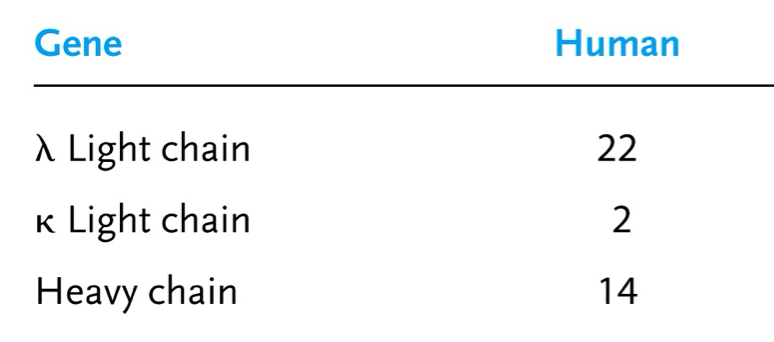
Each locus contains multiple gene segments: V (variable), D (diversity), J (joining) and C (constant).
D segments are only found in the heavy chain locus.

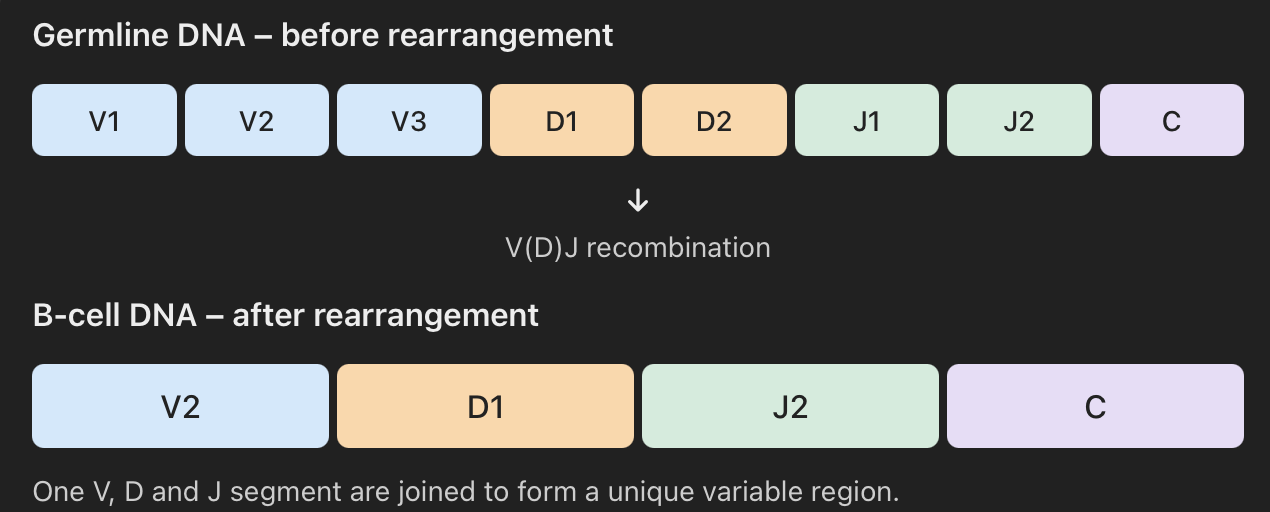
Germline DNA: Gene segments are unrearranged.
B-cell DNA: Gene segments rearrange, and some intervening DNA is removed.
Explain how germline DNA aids in diversity of antibodies
Germline DNA refers to the original DNA inherited from your parents, before antibody gene rearrangement occurs.
It contains multiple copies of V, D and J gene segments.
These segments are separate and have not yet been joined together.
During B-cell development, one of each required segment is selected and joined together.
Some unused DNA is removed during this process.
Explain how B cell DNA aids in diversity
During B-cell development, the original germline DNA is rearranged to produce a unique antibody.
One V, one D and one J segment are randomly selected for the heavy chain.
Enzymes called RAG1 and RAG2 cut the DNA.
Unused DNA between the selected segments is removed.
The selected segments are joined together to form a unique variable region.
This process is called V(D)J recombination.

What are the consequences of recombination within genes ?
Combinatorial diversity: Different combinations of V, D and J segments generate different antibodies.
Diversity comes at a price: DNA rearrangement is not always successful.
Many lymphocytes die: Unsuccessful rearrangements can prevent functional antibody production, leading to apoptosis.
Changes can be pathogenic: Incorrect DNA rearrangements can cause diseases such as lymphoma.
Success prevents further change: Successful rearrangement generally stops further rearrangement of that chain (allelic exclusion). Once a working antibody chain is produced, the B cell stops trying to make a different version of that chain.
Success leads to gene expression: Successfully rearranged genes are expressed to produce functional antibody chains.
T cells face the same problem → they need to bind to million of different antigens.
Explain the factors which contribute to their diversity.
Repertoire: Approximately 25 million different receptor specificities, similar to antibodies.
Two chains: Alpha (α) and beta (β), each encoded by a separate gene locus in the common αβ TCR.
Gene segments:
Alpha chain: V, J, C.
Beta chain: V, D, J, C.
Germline DNA: Gene segments are unrearranged.
T-cell DNA: Gene segments rearrange and some unused DNA is removed.
Combinatorial diversity: Different combinations of gene segments and chain pairings produce different T-cell receptors.
Compare antibody diversity with T cell diversity
