CHEMISTRY ENERGETICS
 Call Kai
 Learn
 Practice Test
 Spaced Repetition
 Match
 Flashcards
 Knowt Play
1/20

Earn XP
Description and Tags
Year 1
21 Terms
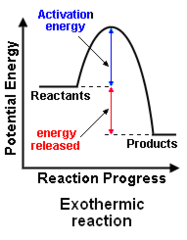
Exothermic reaction
Transfers energy to the surroundings (temperature of the surroundings increases), resulting in a negative enthalpy change.
More energy is released when making new bonds in the products than is needed to break the bonds in the reactants.
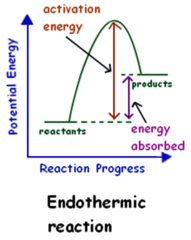
Endothermic reaction
Takes in energy from the surroundings (temperature of surroundings increases), resulting in a positive enthalpy change.
More energy is required to break the bonds in the reactants than is released when new bonds in the products have been made.
Enthalpy, H
A measure of the total thermal energy stored within a chemical system.
Enthalpy change, ΔH
The thermal energy change measured under constant pressure
Standard enthalpy change, ΔH°, occurs...
Under fixed standard conditions with all substances in their standard states.
Standard enthalpy change of reaction
The enthalpy change for a reaction. Measured per mole
Standard enthalpy change of formation
Enthalpy change when one mole of a substance is formed from its constituent elements with all reactants and products in standard states under standard conditions
The standard enthalpy change of formation of an element in its standard state =
0
Standard enthalpy change of combustion
Enthalpy change when one mole of a substance is completely burned in oxygen with all reactants and products in standard states under standard conditions
The standard enthalpy change of combustion of an element is the same as...
The standard enthalpy change of formation of its oxide
Hess's Law
At constant pressure, the enthalpy change for a reaction is independent of the route taken if reactants and products are in their standard states
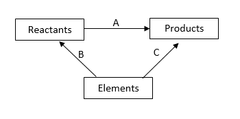
Enthalpies of formation
A = -B + C
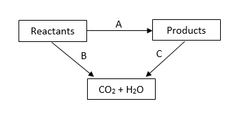
Enthalpies of combustion
A = B - C
In Hess cycles, arrows point away from...
Elements
In Hess cycles, arrows point towards...
Oxides
To find an accurate temperature change for an experiment...
Plot the data on a graph and extrapolate
Specific heat capacity
The energy required to raise the temperature of one gram of a substance by 1K without a change of state
Temperature change =
Initial temperature - final temperature. Negative for exothermic reactions
q =
mc∆T
∆H =
q/n (n of limiting reactant)
∆H values found using calorimetry are never entirely accurate as...
Energy is easily lost from the system to the surroundings through conduction and convection.
Substances may undergo incomplete combustion rather than complete, which gives out less energy.