Lipids
 Call Kai
 Learn
Learn Practice Test
 Spaced Repetition
 Match
Match Flashcards
 Knowt Play
1/4

Earn XP
Name | Mastery | Learn | Test | Matching | Spaced | Call with Kai | Chat |
|---|
No analytics yet
Send a link to your students to track their progress
5 Terms
Functions of lipids
Made up of carbon, hydrogen, and oxygen which are only soluble in organic solvents such a alcohols.
-Used to store energy in adipose tissue in human, which helps to insulate the body and reduce heat loss to the environment.
-Adipose tissue also protects delicate organs
-Phospholipids used in cell membrane
Triglycerides
-Made of one molecule of glycerol and three fatty acids joined by ester bonds from condensation reaction
-Saturated lipids are found in animal fats, doesn’t contain any carbon-carbon double bonds
-Unsaturated lipids are found in plants, they contain carbon-carbon double bond. They are liquid at room temperature because the molecules are able to bend and cannot pack together tightly

Triglycerides structure and properties
-High ratio of energy storing carbon-hydrogen bonds to carbon atoms so they are an excellent energy store
-Low mass to energy ratio so they are a good storage molecule, with a lot of energy being stored in a small volume
-Large and non polar lipids are insoluble in water so their storage does not affect water potential of cells
-High ratio of hydrogen-oxygen atoms means that triglycerides release water when they are oxidised, so it is an important source of water for organisms that lives in dry conditions
Phospholipids
One of the fatty acid in a triglyceride is substituted to a phosphate. Phosphate heads are hydrophilic and the tails are hydrophobic. Phospholipids forms micelles when they are in contact with water. Therefore the molecule is polar
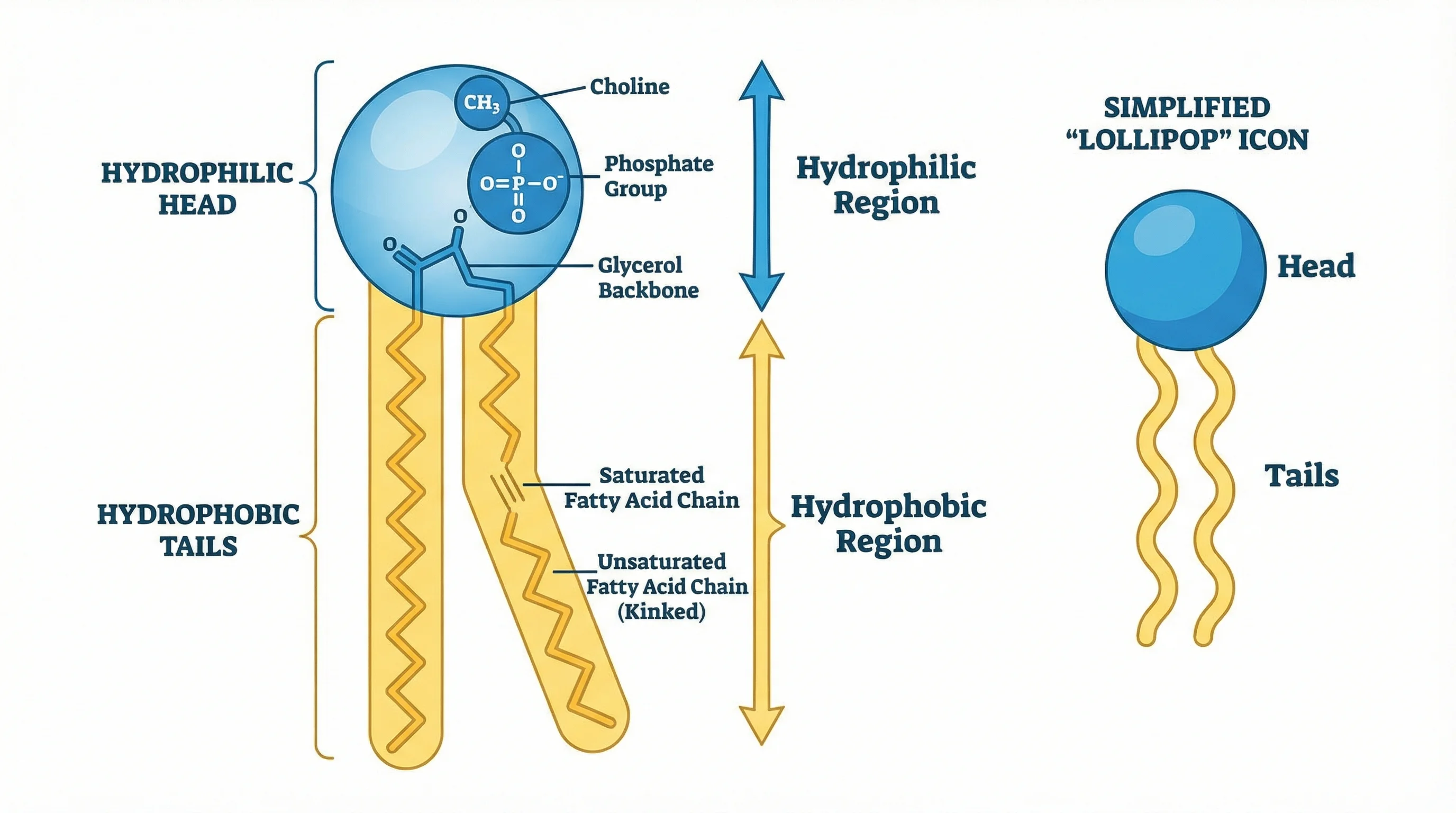
Phospholipids structure and properties
-In aqueos environment being polar means a bilayer can be formed
-Hydrophilic heads of the phospholipids can be used to hold at the surface of the cell surface membrane
-Structure allows them to form glycolipids with carbohydrates which are important on the cell surface membrane for cell recognition