Art from 1780-1880 Midterm
 Call Kai
 Learn
Learn Practice Test
 Spaced Repetition
 Match
Match Flashcards
 Knowt Play
1/28

There's no tags or description
Looks like no tags are added yet.
Name | Mastery | Learn | Test | Matching | Spaced | Call with Kai | Chat |
|---|
No analytics yet
Send a link to your students to track their progress
29 Terms

Benjamin West, The Death of General Wolfe, 1770
History paintings done in classical dress up until this point
Portraying the Battle of Quebec between French and English, English win and decide the colonies
Composition forms a pyramid
General Wolfe positioned like death of Jesus; he’s a martyr
Indigenous warrior looks like The Thinker
Military paintings were always done in the classical style; they are in contemporary dress
Revolutionized history painting

Joseph Wright of Derby, A Philosopher Lecturing on the Orrery, 1776
Mechanical depiction of the movement of the planets
This is a painting depicting the Enlightenment; science is the basis for things
Light is brightest on kids faces as they are the future

Henry Fuseli, The Nightmare, 1781
Imp/incubus sitting on chest is representing how its hard to breathe
The mare represents “nightmare”; evil spirit who suffocates people
Sleep/dreams were big subject for Fuseli
Unrequited love, love lost

Jacques-Louis David, Oath of the Horatii, 1785
His first royal commission, loved by the king
First really big success
Comes from story about Horus (everybody dies)
Men swearing to act on behalf of Rome
Women mourning already, someone is going to be hurt
Diagonal construction of painting gives movement
Roman arches and columns
Loyalty to the state, no matter the cost
Light appears on the swords the most (the oath)
Proposing new ideals of public virtue

Jacques-Louis David, The Death of Marat, 1793
A pamphleteer after French Revolution
Poses Marat like the Pieta by Michelangelo
Stab mark similar to Deposition of Christ by Caravaggio
Trying to portray Marat as “one of us”
Shallow space, use of light
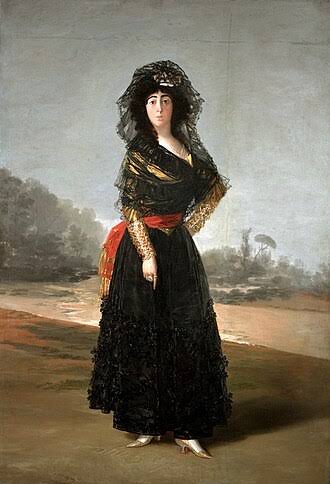
Goya, Portrait of the Duchess of Alba, 1797
Husband has died, in mourning
Covered in lace
Pointing down to words reading “only Goya”
Idea that she and Goya had love affair
She only wants him doing her portraits
Rings say “Alba” and “Goya”
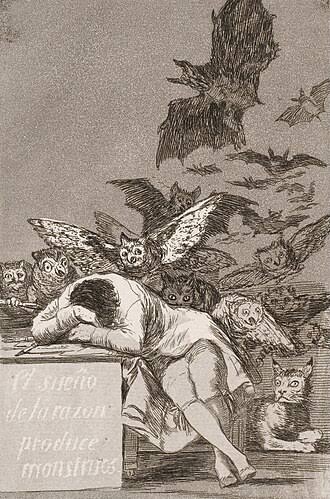
Goya, The Dream of Reason Produces Monsters, from Los Caprichos, 1797-98
Statement of artistic principles
Reason is counterbalance to imagination, stress of imagination looks forward to romantic era
Owls=foley, bats=ignorance, cats=witchcraft

Jacques-Louis David, The Sabine Women, 1799
Ends up becoming court painter to Napoleon
Women and babies in the middle of the battlefield
Women are trying to stop the war
This worked
Idea of pleading for people to reunite after revolution, love prevailing over conflict

Goya, Family of Carlos IV, 1800-01
Reached top of ladder of painter
Everyone sketched separately and then put together
Queen Maria Lousia seizes husbands power
Face turned away bc she hasn’t married into family yet
Poking fun at vs. being complicit to royal family
Includes himself in background

Jacques-Louis David, Napoleon Crossing the Alps at the St. Bernard Pass, 1800-01
Image of a contemporary scene, in contemporary dress
Napoleon going to the Battle of Marengo between France and Austria
Equates himself to Hannibal and Charlemagne
Heroic posing, used for propaganda

Antoine-Jean Gros, Bonaparte Visiting the Plague House at Jaffa, 1804
Show Napoleon as humane leader
Napoleon touches the sick, didn’t know how illness spread
Needed this because his men r*pe, pillage, steal, and k*ll thousands of civilians, Napoelon ordered slaughter of 3,000 surrendered Turkish soldiers
Left behind 50 of his sick men, ordered they should be poisoned
Makes him look compassionate, republican virtue (Horatii), channeling God like figure healing the sick (making himself semi-divine)

Jean-Auguste-Dominique Ingres, Portrait of Napoleon on his Imperial Throne, 1806
Commissioned by legislative body
Holding Charlemagne's scepter and Hand of Justice of French Kings in the other hand
Golden laurel wreath, coronation robes
Many people viewed this as a step too far
Alluded openly to the extent of his powers
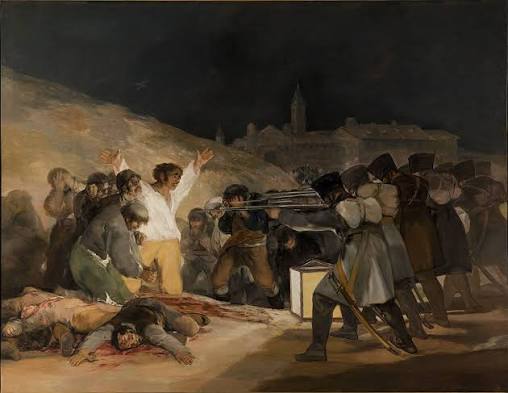
Goya, Execution of the Rebels on the Third of May 1808, 1814
Horrors of war had profound impression on Goya
French soldiers firing squad
People on right waiting to be shot
Central focus is man in white pose like crucified Christ, dying for his cause
Often considered first work of modern art

Caspar David Friedrich, Woman in Front of the Setting Sun, c. 1818-20
Feeling when we realize how small we are in front of nature
Half see has positive, communion with nature
Others see path as announcement of death and boulders are faith
Metaphorical communion with God

Thèodore Gèricualt, The Raft of the Medusa, 1819
Ship taking colonists to Senegal, ship runs aground, not enough lifeboats
Moment is when the remaining people on raft are found
Caused scandal bc people blame king for drunk aristocratic captain
Give us the moment of hope when they spot Argos, also fear they won’t be spotted
Diagonals
Black cabin boy given place of heroism in painting bc Géricault was an abolitionist
Naked instead of nude
Awesomeness of nature, wave/storm clouds
First time in modern history that contemporary subject was used to contest regime rather than propaganda for it

Eugène Delacroix, Scenes from the Massacres at Chios, 1824
Greek fight against Ottoman Turks
Ottoman Turks massacring Greeks on island of Chios
Those not killed were sold into slavery
More interested in color over line

Caspar David Friedrich, Hutten’s Grave, 1824
Imaginary monument of nationalist
Epithet of Patriotic movement, all hope completely abandoned
Gothic ruin with man (freedom righter) reflecting at monument
Names of fighters of 1813 inscribed on base
Broken statute of Hope

Jean-Auguste-Dominique Ingres, The Vow of Louis XIII, 1824
Broke through back in France, commissioned by Ministry of Interior
Louis XIII placing France under protection of Virgin of Assumption
First major public showing since Napoleon on imperial throne
Returned to super traditional representation of royalty and church
Based on Rafael’s Sistine Madonna
Spectacular success, propaganda, union of church and state
First critical accolades and election to academie
Expands historical painting to include French/European history not just classical history

Eugène Delacroix, The Death of Sardanapalus, 1824
Painted before Delacroix visits Morocco
Diplomatic party sent by France to Morocco, Delacroix goes to paint pictures (like photographic press)
Based on poem written by Byron of the same name written in 1821
Sardanapalus is king of Nineveh in Assyria (between Tigris and Euphrates)
Chaotic, strong diagonal and sharper focused middle
In poem S was harsh to everyone
As palace is besieged, S doesn't want others to get stuff (women, servants, animals) so he kills them
The bed he’s lounging on will become his pyre
Male fantasy of naked women, violence and sex
Lurid representations before Europeans came in contact
After visit Delacroix compared North African life to Ancient Romans

Eugène Delacroix, Liberty Leading the People: July 28, 1830, 1830
Woman is embodiment of France
Wearing cap associated with revolution
Carrying outlawed French flag from 1792

Thomas Cole, View from Mount Holyoke, Northampton, Massachusetts (The Oxbow), 1836
Reads left to right, storm to clear/peace
Oxbow is question mark, to Jewish people means touch of almighty
Cultivation would destroy natural wilderness

Louis Daguerre, Seashells, 1839
Photography as art, artistic side
How artists plays with light and more artistic styles
Play with light and shadow, rather than exact crispness
Workshop burned and all but 20 works were destroyed

David Octavius Hill & Robert Adamson, The Birdcage, 1843/48
Serious because people couldn’t smile for 2 minutes
Professional vs. candid
Adapt Fox Talbot to take photos of people
Changed understanding how world would translate into pictures
Bird is metaphor for caged heart, haven't found love yet
Posed like in a painting

Asher B. Durand, Landscape: Progress, 1853
Strand of art that say “mankind taking over nature for their own purposes” is a good thing, all about Manifest Destiny thought not out west
Left- wilderness, native people are “barbarians”
Right- has been “tamed” by Americans, work our way from horse and carriage to steam train
End up at factories
A story to read

Jean-Léon Gérôme, Snake Charmer, late 1860s
Focusing on accuracy of detail, not accuracy of culture
Instead of a cobra the boy is holding a python from the Americas
There is an Indian flute charmer
The boy is standing on an Afghani rug
Bedouins from Saudi Arabia
The blue wall is from Turkey
The Arabic at the top is gibberish, it’s what the artist thought Arabic looks like
What people expect Muslims to look like

Alexandre Cabanel, The Birth of Venus, 1863
Emptying out of meaningful content from classical subjects
Just a naked woman
Eroticism without offending public morality
Not a fight anymore between line and color

Timothy O’Sullivan, A Harvest of Death, Gettysburg, Pennsylvania, 1863
Wet plate photography, exposed, fixed, and developed while wet
Birth as photography as key documentary record
Medium came into its own during Civil War
Photography as transparent medium, what you see it what you get
Bring war into homes of people, make it real
Assumed bias in photos, printed in newspapers and put up in museum/galleries

Jean-Léon Gérôme, The Call to Prayer, 1865
Looks so realistic that you forget it is made up
Influenced by photography with focus and blurry background
Idea of orient to those who haven’t seen it
Idealized version of the call to prayer, all those buildings don’t exist in the same place

E. Carolus Duran, Mademoiselle de Lancey, c. 1876
One of great courtesan of Paris at this time
Wearing white satin ballgown, sitting suggestively
All about fabric and color
Ingres technique become standard for portraiture
Face tuned portraiture