CHE 4341 Exam 3
 Call Kai
 Learn
Learn Practice Test
 Spaced Repetition
 Match
Match Flashcards
 Knowt Play
1/43

There's no tags or description
Looks like no tags are added yet.
Name | Mastery | Learn | Test | Matching | Spaced | Call with Kai | Chat |
|---|
No analytics yet
Send a link to your students to track their progress
44 Terms
Carbohydrates (Sugars) are
Polyhydroxy Aldehydes and Ketones
Carbohydrates (Carbo-hydrates) b/c they have the
general formula (C●H2O)n. (= water + carbon), n ≥ 3
Classes of Carbohydrates
Monosaccharides, Oligosaccharides and Polysaccharides
Monosaccharides
single sugars freely soluble in water. Sweet taste.
Oligosaccharides
short chains of single sugars covalently linked
Polysaccharides
long chains (hundreds or thousands) of single sugars covalently linked.
All monosaccharides (except dihydroxyacetone) are
chiral (i.e. have 1 or more asymmetric carbon atoms )
Fisher notation determined to a standard reference compound = glyceraldehyde; most →Most naturally occurring carbohydrates are
D; although L- occur
Recognizing D vs L → Only mirror image isomer (enantiomer) gives exact opposite Fischer projection!
Look at first chiral carbon; if OH on left → L-glucose (Same applies for Haworth Projections)

Monosaccharides D-aldoses:
NEED TO KNOW BOXED STRUCTURES!

D-Glyceraldehyde

Aldose Structure Mnemonic

D-Glucose
Most important sugar in nature; blood sugar

D-Mannose

D-Galactose
Constituent of lactose

D-Lyxose
All in a row are diastereomers of each other
D-Ribose

D-Xylose
Plant Polysaccharides

D-Threose
All D sugars b/c OH on right for last chiral C

Epimers
A special subset of diastereoisomers when 2 sugars differ only in the configuration around one carbon.
eg of Epimer
D-mannose is a C-2 epimer of D-glucose; D-galactose is a C-4 epimer of D-glucose → D-galactose and D-mannose are NOT epimers

Monosaccharides General Structure:
Same as for aldoses
except switch C1 C=O and C2 OH
(results in one less chiral C)
Cyclization of Glucose and Fructose

Ring Structures- Anomers → isomers forned when
the ring forms: OH up = a & OH down = b; the new chiral hemiacetal/hemiketal C is referred to as the anomeric carbon
Anomers Example

In solution get equilibrium between anomers through
linear form (>C=O)
mutarotation (or anomerization) is the
interconversion in solution between a and b forms via the open-chain structure.
The predominant anomer of glucose in soln. is the
pyranose b form!
To modify sugars,
Just convert OH to H at specified position!

Reactions of Carbohydrates: Acetal (Glycosidic linkage) Formation
Condensation of two monosaccharides gives disaccharide

Glycosidic linkage naming is based on the anomeric carbon in the
1st sugar & C-OH position # of the 2nd sugar
Disaccharides consist of
two monosaccharides joined covalently by an O-glycosidic bond/linkage
Characteristics of Disaccharides
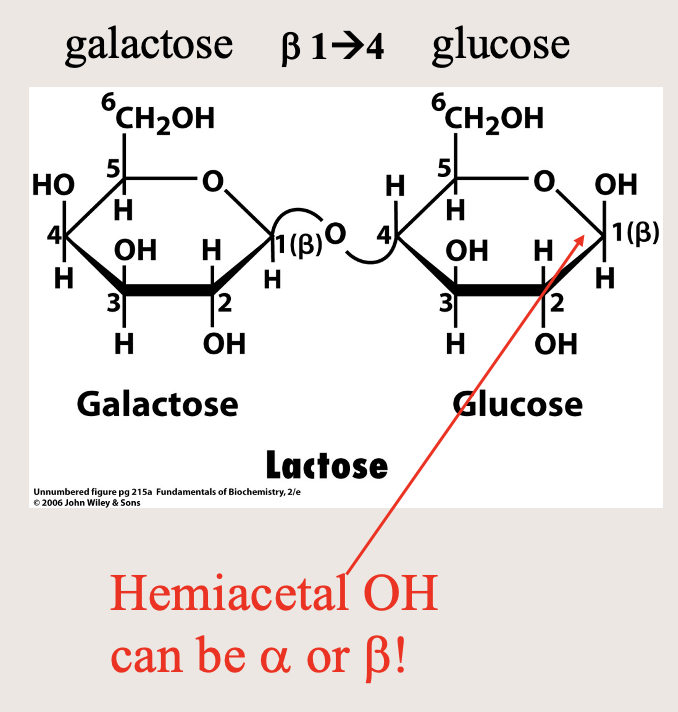
Hemiacetal OH can be a or b
Only glycosidic bond is different– but different shaped molecules w/ very different properties!
Maltose is made
breakdown of starch of germinated cereal grains (malt)
Maltose and Cellobiose

Cellobiose
Made from breakdown of cellulose
Lactose
Milk sugar
Sucrose (cane sugar, table sugar)
composed of a-glucose and b-fructose

Maltose Summary
Glca(1→ 4)Glc | reducing | maltase | Plants (starch) Animals (glycogen) |
Cellobiose Summary
Glcb(1→ 4)Glc | reducing | cellulase | Plants (cellulose dimer) |
Lactose Summary
Gal b(1 → 4)Glc | reducing | Lactase | Milk (major energy source) |
Sucrose Summary
Glca(1 → 2) bFru | non-reducing | Sucrase (invertase) | Fruits seeds roots and honey |
Anomeric bond, whether a or b, greatly influences the
shape of the molecule, which in turn influences enzyme activity on disaccharide
Mono/Disaccharides: Chemical & Physical Properties
Almost all monosaccharides and disaccharides taste sweet
undergo hydrogen bonding with themselves as well as with water
solids at room temperature and very soluble in water
Highly concentrated solutions of monosaccharides like honey, maple syrup and molasses are very viscous liquids.