MCB exam 3
0.0(0)
Studied by 2 people Call Kai
 Learn
Learn Practice Test
 Spaced Repetition
 Match
Match Flashcards
 Knowt Play
Card Sorting
1/65

Earn XP
Description and Tags
Last updated 3:39 PM on 11/5/22
Name | Mastery | Learn | Test | Matching | Spaced | Call with Kai | Chat |
|---|
No analytics yet
Send a link to your students to track their progress
66 Terms
1
New cards
DNA->RNA-> protein
central dogma
2
New cards
RNA->RNA->protein
central dogma in RNA base viruses
3
New cards
-single stranded
-uracil
- secondary (stem loops)
-tertiary (RNA folds on itself)
-uracil
- secondary (stem loops)
-tertiary (RNA folds on itself)
RNA structure
4
New cards
ribozyme
RNA enzyme catalyzing a chemical reaction
5
New cards
ribonuclease P (RNase P)
ribonucleoprotein endonuclease processing 5' end of pre-tRNA
6
New cards
hammerhead ribozyme
cleave RNA at NUH (N= any nucleotide, U= uracil, H = any nucleotide but guanidine) triplets 3' to the H
7
New cards
spliceosome
splice introns to join exons
8
New cards
ribosomes
peptide bond formation
9
New cards
1. RNA forms from inorganic sources
2. RNA self-replicates via ribozymes
3. RNA catalyzes protein synthesis
4. Membrane formation → New functionality
5. RNA codes for both DNA and protein
6. DNA becomes master template, Proteins catalyze cellular activities
2. RNA self-replicates via ribozymes
3. RNA catalyzes protein synthesis
4. Membrane formation → New functionality
5. RNA codes for both DNA and protein
6. DNA becomes master template, Proteins catalyze cellular activities
RNA world hypothesis
10
New cards
mRNA
- translation (protein synthesis) - regulatory
11
New cards
rRNA
- translation (protein synthesis) - catalytic
12
New cards
tRNA
-translation (protein synthesis)
13
New cards
hnRNA (heterogeneous nuclear)
precursors and intermediates of mature mRNAs and other RNAs
14
New cards
scRNA (small cytoplasmic)
-signal recognition particle (SRP)
- catalytic
- tRNA processing
- catalytic
- tRNA processing
15
New cards
snRNA(small nuclear) snoRNA (small nucleolar)
-mRNA processing
- polyA addition
-catalytic
- rRNA processing/maturation/methylation
- polyA addition
-catalytic
- rRNA processing/maturation/methylation
16
New cards
regulatory RNAs (siRNA, miRNA, etc.)
regulation of transcription and translation
17
New cards
80%
relative amount of rRNA
18
New cards
15%
relative amount of tRNA
19
New cards
5%
relative amount of mRNA
20
New cards
RNA polymerase
involved in elongation stage of transcription process (turning DNA into messenger RNA)
21
New cards
promotors
specific DNA sequences that direct RNA polymerase to initiation sites
22
New cards
consensus sequence
average sequence of the gene sequences given
23
New cards
termination
RNA polymerase stops the elongation process
24
New cards
UAA, UAG, UGA
what are the stop codons
25
New cards
rho-independent
hair pin with G:C base pairs and unpaired uracil residues
26
New cards
rho-dependent
ATP-dependent protein climbing up mRNA and yanking it out of polymerase
27
New cards
exons
coding regions
28
New cards
introns
noncoding regions
29
New cards
introns
there are no (introns/exons) in prokaryotes
30
New cards
-5' cap
-3' poly A tail
-3' poly A tail
pre-mRNA -> mature mRNA
31
New cards
translation: cytosol
transcription: nucleus
transcription: nucleus
where does transcription and translation occur in eukaryotes
32
New cards
simultaneously in the cytosol
where does transcription and translation occur in prokaryotes
33
New cards
top right- amino acid attachment site
top left- phorphoylated 5c terminus
bottom anticodon
top left- phorphoylated 5c terminus
bottom anticodon
label the tRNA structure

34
New cards
large subunit = 23S rRNA
small subunit = 16S rRNA
small subunit = 16S rRNA
rRNA structure
35
New cards
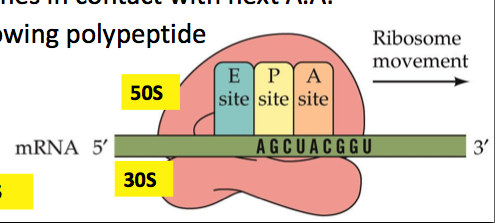
A = incoming tRNA
P= bind tRNA with growing peptide chain
E = tRNA exits
P= bind tRNA with growing peptide chain
E = tRNA exits
what is the function of the A, P, and E site
36
New cards
AUG
start codon
37
New cards
silent, nonsense, missense
point mutations
38
New cards
silent mutation
same amino acid
39
New cards
nonsense mutation
results in stop codon
40
New cards
missense mutation
-conservative = different amino acid, same charge/ property
- nonconservative = different amino acid, different charge/property
- nonconservative = different amino acid, different charge/property
41
New cards
insertion, deletion
frameshift mutation (both alter open reading frame)
42
New cards
- catalyzes the nucleophilic attack of the 3' hydroxyl group of the last nucleotide in the chain on the alpha (first) phosphoryl group of the incoming nucleoside triphosphate (causes pyro phosphate to be relased which drives the energy to form a new phosphodiester bond) - composed of multiple subunits (active site has metal ion in center)
RNA polymerase (an enzyme)
43
New cards
sigma subunit, core enzsyme, holoenzyme
how many subunits does prokaryotic RNA polymerase have?
44
New cards
-same thing as core enzyme but does contain sigma
- required for initiation but not for elongation
- required for initiation but not for elongation
holoenzyme
45
New cards
-catalytic moiety
- contains alpha, beta, beta 1, and omega
- does not contain sigma
- required for elongation
- contains alpha, beta, beta 1, and omega
- does not contain sigma
- required for elongation
core enzyme
46
New cards
- associates and dissociates as it pleases
- binds to the promotor and initiates transcription
- allows RNA polymerase to be directed to the promotor
- helps find the site where transcription begins
- participates in initiation of RNA synthesis
- dissociates from the rest of the enzyme after 9-10 BPs
- binds to the promotor and initiates transcription
- allows RNA polymerase to be directed to the promotor
- helps find the site where transcription begins
- participates in initiation of RNA synthesis
- dissociates from the rest of the enzyme after 9-10 BPs
sigma subunit
47
New cards
- can start without a primer (de novo)
- RNA polymerase searches and binds to the promotor sequences
- unwinds the DNA helix (short stretch)
- RNA polymerase searches and binds to the promotor sequences
- unwinds the DNA helix (short stretch)
RNA synthesis: initiation
48
New cards
-selects the ribonucleoside triphosphate that matches and catalyzes the formation of the phosphodiester linkage
RNA synthesis: elongation
49
New cards
keep going until termination signals are reached and that halts transcription
RNA synthesis: termination
50
New cards
bacterial promotor
core promotor upstream of the start sequence (same in prokaryotes and eukaryotes)
51
New cards
TTGACA
-35 core promotor
52
New cards
-10 core promotor
TATAAT
53
New cards
sigma factor
- part of the holoenzyme that binds to both core promotor units by decreasing the affinity RNA polymerase for general regions of DNA which allows for better recognition of the promotor site
54
New cards
will be further away from the consensus sequence
weak promotor
55
New cards
the closer the promotor is to the consensus sequence the stronger it is, almost identical to the consensus sequence
strong promotor
56
New cards
recA
example of a strong promotor
57
New cards
araBAD
example of a weak promotor
58
New cards
- going form a closed DNA complex to an open one (open complex is RNA polymerase with unwound helix inside of about 17 BPs)
- houses DNA-RNA hybrid
- houses DNA-RNA hybrid
transcription bubble
59
New cards
- first nucleotide is added while being catalyzed at the +1 site
- 5' end of the primary transcript is tagged with 3 phosphates and a purine
- nucleophilic attack removes phosphate and creates a phosphodiester bond
- 5' end of the primary transcript is tagged with 3 phosphates and a purine
- nucleophilic attack removes phosphate and creates a phosphodiester bond
nucleotide addition
60
New cards
- clearing the active site
- enzyme shifts the DNA over so new nucleotide can come in
- enzyme shifts the DNA over so new nucleotide can come in
translocation
61
New cards
- translocation in a backward direction
- hydrolyzes the nucleotide and brings a new one in
- hydrolyzes the nucleotide and brings a new one in
backtracking
62
New cards
- it doesnt need to be as fast
- it doesnt need to worry about mistakes as much (can just try again and dont become inherited traits)
- it doesnt need to worry about mistakes as much (can just try again and dont become inherited traits)
why is RNA synthesis slower and more error prone?
63
New cards
-uses rho and ATPase
-binds to rut (where rho can bind) and sends termination signal
- climbs up mRNA
- unwinds DNA-RNA hybrid using helicase activity
- competitive inhibitor of ribosomes so when it binds it kicks off ribosomes (uses ATP)
-binds to rut (where rho can bind) and sends termination signal
- climbs up mRNA
- unwinds DNA-RNA hybrid using helicase activity
- competitive inhibitor of ribosomes so when it binds it kicks off ribosomes (uses ATP)
rho-dependent
64
New cards
-hairpin/stem loop
-no use of rho
-hairpin yanks the RNA polymerase off RNA and it becomes detached
G-C followed by a lot of U
-no use of rho
-hairpin yanks the RNA polymerase off RNA and it becomes detached
G-C followed by a lot of U
rho-independent
65
New cards
actinomycin
-intercalates into DNA
-binds in between DNA bases
- blocks DNA from being a template for RNA synthesis
-prokaryotic and eukaryotic
-binds in between DNA bases
- blocks DNA from being a template for RNA synthesis
-prokaryotic and eukaryotic
66
New cards
rifampicin
- prokaryotic only
- binds in the site where DNA-RNA hybrid is made and prevents translocation of DNA
- blocks newly formed RNA
- binds in the site where DNA-RNA hybrid is made and prevents translocation of DNA
- blocks newly formed RNA