Psych unit 2.2
 Call Kai
 Learn
 Practice Test
 Spaced Repetition
 Match
 Flashcards
 Knowt Play
1/59

There's no tags or description
Looks like no tags are added yet.
60 Terms
Sensation
Process of attneding to and taking in stimuli from enviorment
Perception
Interpretation and organization of incoming sensory information
Psychphysics
Examination of the limits between physcial stimuli in the world ad psychological experience of those stimuli
Absolute Threshold
Minimum amonut of stimuli a person can detect at least 50% of the time
Difference Threshold
The smalles difference in stimuli someone can detect 50% of the time
Webers law
As the size of the stimulus increases, so must the size of the change in order to be detected
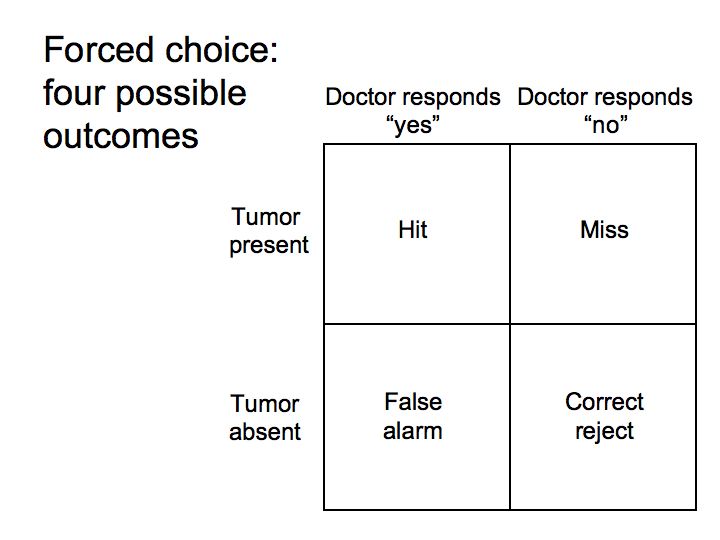
Signal detection theory
Sensory Adaptation
Receptors for any particular sense becomes less responsive in the presence of prolonged and continued stimulus
You get used to stimulus, so you can not notice it unless it increases
Habituation
We can gradually get used to a startling or sudden information in our enviorment, even if it isn’t consistent
Even when you gradually get used to it, it can still capture your attention
McGurk effect
Vision may trump other senses
Cornea
Where all incoming visual information must pass through
Protective bulge that covers front of eye
Works with eyelashes and blinking to keep enviormental debris out of eye
Think of a corn maze, and how it covers everything inside because its so tall
Pupil
Just behind cornea
A hole that allows light into eye
contracts and expands according to amount of light in enviorment
Pupil gets Petit in Photons
Iris
Colored portion of eye
muscle surrounding eye
allows pupil ot constrict or contract
Iris from cross country = strong = muscles = colored hair
Lens
Focusing info in the form of lifht to the retina, where the viusal receptors are located
Uses accomodation
When lens get thicker or thinner
Uses accomodation to focus incoming light rays into a sharp image on the retina
Retina
Light receptive surface lining in the back of the eye
Rods
Located in Retina
More numbers than cones
Specialized for black/white, light/dark vision
Think of how metal rods have no color
Cones
Specialized for color vision
Visual clarity or acuity in daylight hours
clustered in fovea
focal bullseye at center of retina
image must fall close to this for us to see color
behind the lens
Think of how colorful a traffic cone it
Nearsightedness
Focuses incoming message to quick before it reaches retina
Leads you to be able to see images nearby, but not far
Farsightedness
Lens may not be accomodatinf soon enough
It’s bending to send incoming visual messages onto retina
Can’t see near stuff
Transduction
Sensory receptor changes the energy of a physical stimulus into electrical information
electrical info is then interpredted by breain
completed in bipolar and ganglion cell
Electric info from transduction is sne to bipolar cells and the ganglion cell
Optic nerve
Made up of oxons of ganglion cells
Where newly tranduced message is carried to thalamus abd eventually visual cortex in occipital lobe
Blind spot
Point where optic nerve exits retina in order to carry messages to the brain
no rods or cones to process stimuli
Image in this area cannot be seen
Dark adaptation
Process by which our rods become fully functional in a dark room
takes 20 minutes
Only takes our cones a couple of minutes
Trichromatic theory of color
there are 3 different types of color regulators (cones)
each are specialized in either red, green, or blue
When these colors are combined, we can see all colors of light
Equal amounts of red, green, and blue create white
color is reflected
additive color mixing
Red, blue, and yellow make black/brown
subtractive color mixing
light is absorbed
Color blindness
Complete CB is rare
Color deficing is more accurate
see some colors, but struggle to differentiate between them
most common is red-green CB
red and green both look like brown
Opponent process theory
2 pairs of cones
1 responds to red and green while 1 responds to blue and yellow
each paur works opposite to other
when one is excited, the other is inhibited
Afterimage
Visual illusion or perspual experience that continues to appear in the eye or mind even after the original light or stimulus has been removed
What are the 3 major divisions of the ear
Outer ear
Middle Ear
Inner Ear
Outer Ear
Conatins auditory canal
Auditory Canal
Shaped like a cone
gathers sounds waves from the enviorment and sends them toward the middle ear
Eardrum
Division between outer and inner ear
tightly stretched across auditory canal
When it vibrates it activates ossicles
Ossicles
Middle ear
made up of 3 bones
Incus, stapes, malleus
The stapes vibrates against the oval window
this allows sound waves to enter the cochlea
Oval window
part of cochlea
membrane covered opening
recieves suond waves from ear drum and vibrate which causes fluid in the cochlea to move
Cochlea
Contains auditory recpetors called cillia/hair cells
embedded in basilar membrane
inside fluid filled cochlea
The inner ear
Cilia/Hair Cells
Transduces the physcial sound waves into electrical impulses
auditory nerves send electrical message to brain
eventually goes through thalamus and arrives in primary auditory cortex, in temporal lobe
Place Theory
Sound waves vibrate the hair cells
We identify the pitch of sounds according to the location of vibrations on the basilar membrane
Auditory receptors for high pitch on left and low pitch on right
How we sense high pitches
Frequency theory
Our brain identifies the pitch of sounds according to how repidly the nerve impulses fire
At high frequencies, neurones fire in teams because no single cell would fire quick enough to match the frequency
Volley Principal
When neurones fire in teams because no single cell would fire quick enough to match the frequency
Conduction Deafness
Occurs as individual ages
Ossicles in middle ear age and they become more brittle and may need mroe intense sound waves in order to vibrate
Sensorineural deafness
Nerve deafness
caused by famage to hair cells in basilar membrane or auditory nerve
Sensory receptors for hearing are not performing to fullest capacity
can be from birth
can be helped with cochlear implants
Sound Localization
Ability to determine the origin of a ssound in terms of distance and direction
Sound waves strike one ear sonner and more intensly than another
Olfaction
Sense of smell
Olfcation cells
Located along olfactory bulb in nasal cavity
The receptors are hair cells
When different sequences of odor receptors fire, we can identify smells
Ansomia
Loss of smell
Pappillae
Small bump on tongue where taste buds are located
Taste buds
Receptor cells for taste
Sensitivity declines with age
There is sweet, savory, sour, and umami
They die off which is why our taste evolves
Supertasters
25% of people
very sensitive to potent tastes
high # of tastebuds
Non-tasters
Fewer tastebuds
less sensitive to potent tatses
Synethesia
Interaction of different senses
Gustory sense
Tase
Gustory Cortex
in Parietal lobe
Basic tastes
Sweet
indicates energy source
Salty
indicates sodium essental to physiological processes
Sour
indicates potentially toxic acid
Bitter
indicates potential poisions
Umami
indicates proteins to grow and repair tissue
Touch receptors
Specific receptor cells involved with touch respond to pain, pressure, and temperature
Somatosensory cortex
In parietal lobe
Where messages carried by sensory neurons end up
The more sensitive areas of your body take up more space on the cortex
Homunculus
Diagram of how much surface area is on somatosenory cortex

Pain
2 distinct sets of nerve fibers that carry pain signals from skin to spine
Heavily myleniatyed and carries pain to brain
Gate control theory of pain
Theere is a neurological gate in the spinal cord that opens to allow pain messages through to the brain
It closes to stop messages
Gate is opened by small fibers to send pain signals
Gate can be closed by stimulating larger fibers around the injury
Phantom limb pain
Body part is gone but corresponding part in somasensory cortex is still intact
If areas on cortex is near where limb used to be and is stimulated, pain can be felt in the “limb”
Kinsethic sense
Helps to move particular body parts in a precise manner
Depends on proprioceptors
Propiceptors
Specialized sensory neurons in joints, tendons, an muscles
Give us information about position and movement of individual body parts
Vestibular sense
Sense of balance and whole body positoning
semicircular canals
controls vestibular sense
filled with fluid