DNA Replication
 Call Kai
 Learn
 Practice Test
 Spaced Repetition
 Match
 Flashcards
 Knowt Play
1/54

There's no tags or description
Looks like no tags are added yet.
55 Terms
In terms of DNA replication, what does it mean when we say its semi-conservative?
There is 1 template strand of DNA and 1 new strand of DNA
Who proposed that DNA replication is semi-conservative?
Meselson and Stahl
Who experimentally confirmed that DNA replication is semi-conservative?
Watson and Crick
Origin of Replication
Where DNA replication begins on a DNA strand
Prokaryotes vs Eukaryotes — origin of replication
Prokaryotes have a single origin; eukaryotes have multiple origins
Prokaryote’s replication bubble is (circular/linear)
Circular
Eukaroyote’s replication bubble is (circular/linear)
Linear
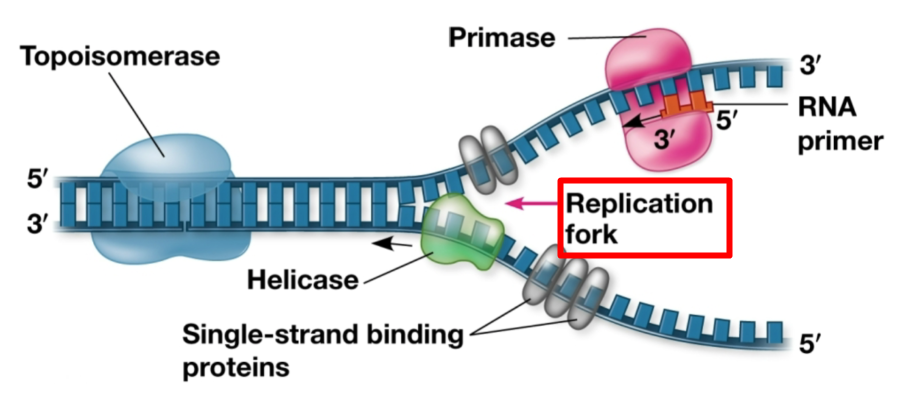
Replication Fork
Y-shaped region where the DNA double helix unwinds
When was DNA polymerase I discovered?
1956
Originally was simply termed “DNA polymerase” until others were found
When DNA polymerase I was first discovered, what was it thought to do?
Thought to be the only enzyme responsible for copying DNA
What is DNA polymerase I responsible for?
Removes RNA primers and replaces them with DNA
Responsible for DNA repair
When was DNA polymerase II discovered?
1970
What is DNA polymerase II responsible for?
Involved in backup repair where DNA Polymerase I may have failed
When was DNA polymerase III discovered?
1971
What is DNA polymerase III responsible for?
Responsible for leading/lagging strand synthesis
Sliding Clamp
Forms a complex with DNA polymerase 3
Primase
Adds RNA primers
RNA Primer
Must start with RNA, as RNA can be built with nothing
What does DNA require to build from?
A 3’ hydroxyl group
Helicase
Unwinds DNA strands
Singe-stranded Binding Protein (SSBP)
Prevent reannealing of DNA after helicase unwinds
Keeps original DNA strands from binding back together
Topoisomerase
Moves ahead of helicase to relieve pressure of unwinding
Where does synthesis of new DNA strands begin?
Origin of replication

DNA synthesis unwinds in what direction?
Both

Antiparallel Elongation in DNA strands
5’ —— 3’
3’ —— 5’
Regarding DNA polymerase III, what is the most important thing to note about its function?
It can only add nucleotides to the 3’ -OH end
Leading Strand Synthesis
Goes from the 5’ to 3’ direction
Moves toward the replication fork/helicase
Topoisomerase is ahead of the helicase to stabilize the helix
SSBPs prevent re-annealing of template strands
Primase adds the RNA primer on the leading strand for continuous synthesis
DNA polymerase III + Sliding Clamp form a complex
Adds nucleotides to the 3’ -OH end

Lagging Strand Synthesis
Moves away from the replication fork/helicase
SSBPs prevent re-annealing of template strands
Results in multiple RNA primers
DNA Polymerase III + Sliding Clamp form a complex
Adds nucleotides to the 3’ -OH end
Okazaki fragments created between RNA primers
DNA Polymerase I removes RNA primase and adds DNA to that spot
DNA Ligase seals the two fragments

Prokaryote mitosis
Essentially gives rise to a new organism that is an exact clone
Unicellular Eukaryote mitosis
Essentially gives rise to a new organism that is an exact clone
Multicellular Eukaryote mitosis
Supports renewal, repair, and embryonic development
Mitosis
Cell division
Chromosomes
Form of packaging of genetic material
(T/F) — All animals have the same number of chorosomes
False
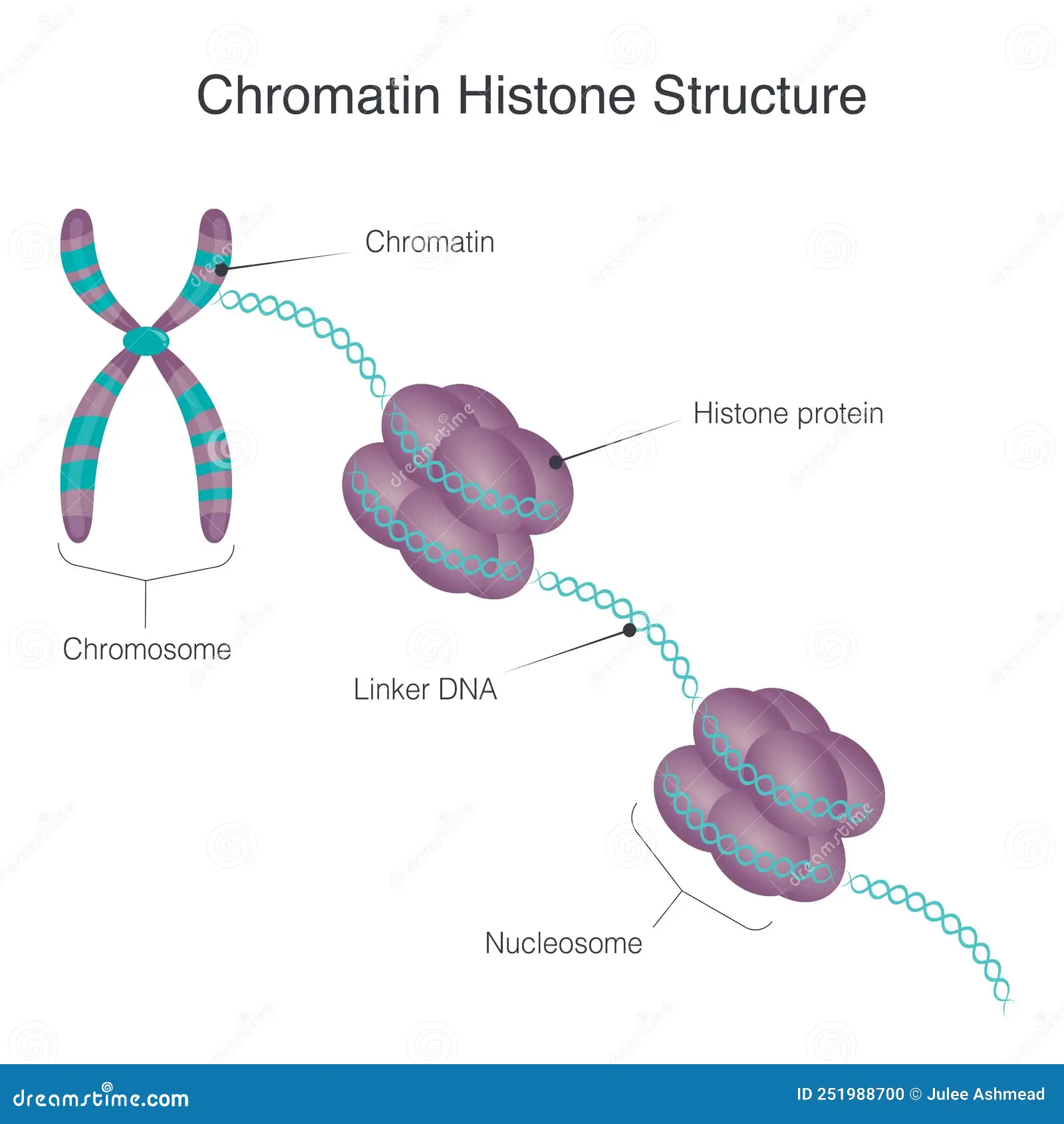
Chromatin
Packaging of complex DNA + histones
Makes up chromosomes
“Beads on a string” where each bead is called a nucleosome
Histones
Positively-charged proteins containing high amounts of lysine and arginine, allowing negatively-charged DNA to bind to them tightly
Octamer (8 subunits) with 2 DNA “winding” around each histone complex

Somatic Cells
All body cells except for reproductive cells
Each contains 46 chromosomes
22 autosomes (non-sex) + 1 sex chromosome
23 comes from each parent; n = 46
Gametes
Reproductive cells
Contains only 23 chromosomes
Derived from “germ cells”
Spermatogonia and oogonia
Germen
Latin for “seed”
During division, long, thing chromatin fibers are (condensed/uncondensed)
Uncondensed
After division, chromosomes start to (condense/uncondense)
Condense
Sister chromatids
Duplicated chromosomes consisting of two copies of the original chromosome
Held together via cohesins (proteins)
Greatest point of attachment is at the centromere
