biol-l112 multiple choice exam 3
 Call Kai
 Learn
 Practice Test
 Spaced Repetition
 Match
 Flashcards
 Knowt Play
1/195

There's no tags or description
Looks like no tags are added yet.
196 Terms
What is translation?
turning mRNA into proteins
translation is…
mRNA into proteins
transcription is…
DNA to RNA
Where does translation occur in both prokaryotes and eukaryotes?
In the cytoplasm on ribosomes.
What does rRNA stand for, and do cells have genes for it?
Ribosomal RNA; yes, cells have genes that provide instructions for making rRNA.
Where are rRNA genes expressed?
nucleolus.
How many subunits make up a ribosome, and what are they?
Two: a small subunit and a large subunit.
Where are ribosomal subunits exported after they are made?
into the cytoplasm.
When do the small and large ribosomal subunits assemble?
When mRNA binds the small subunit, the large subunit joins.
What types of proteins do free ribosomes and rough ER (rER) ribosomes synthesize?
Free ribosomes make intracellular proteins; rER ribosomes make extracellular proteins.
What is a codon?
A group of three nucleotides on mRNA.
Why is the genetic code described as redundant or degenerate?
Because multiple different codons can code for the same amino acid.
What is the function of tRNA?
bringing amino acids to the ribosome during translation.
What binds to the 3’ end of tRNA, and is this interaction specific?
An amino acid binds to the 3’ end, and the match is highly specific.
What is an anticodon, and what does it pair with?
the 3 tRNA nucleotides that pair with the 3 mRNA nucleotides
What enzyme attaches the correct amino acid to tRNA?
Aminoacyl-tRNA synthetase.
What is the universal START codon, and what amino acid does it encode?
AUG; it encodes methionine (M).
Do all newly synthesized polypeptides initially begin with methionine (M)?
Yes.
Why do not all mature, processed proteins begin with methionine (M)?
The first methionine may be removed methionine cleavage/excision.
Whatever amino acid occupies position 1 of a polypeptide, what terminus is it located at?
The N-terminus.
Does a STOP codon code for an amino acid?
No, it signals the end of translation.
What is the purpose of a signal peptide or signal sequence?
It tells the cell where the protein needs to go.
When and how do ribosomes associate with the rough ER?
when the protein they are making contains an ER-targeting signal peptide.
What are the three stages of translation?
Initiation, elongation, and termination
Initiation of translation
ribosome assembles to make a protein
Elongation of translation
amino acids are joined together to build the protein
termination of translation
the ribosome reaches a STOP codon and releases the protein.
What is glycosylation, and what is a protein with attached sugars called?
Glycosylation is adding sugars to a protein; the resulting protein is called a glycoprotein.
Where does glycosylation occur within the cell?
In the ER lumen or Golgi apparatus.
What post-translational process cuts a protein into multiple functional proteins?
Proteolysis.
What is alternative splicing?
One gene can produce different mRNA versions
What are the two mechanisms by which one gene can produce multiple proteins?
Alternative splicing and proteolysis.
What are chaperonins, and to what protein family do many of them belong?
Proteins that help other proteins fold properly and Heat Shock Protein (HSP) family.
How many protein-coding genes do humans have?
20,000
What percentage of the human genome is protein-coding DNA?
1.5%
What is noncoding DNA (ncDNA)?
DNA that does not code for proteins.
What are noncoding RNAs (ncRNAs)?
RNA molecules that do not code for proteins that mostly regulate gene expression.
What is the main function of ncRNAs?
Regulating the expression of other genes.
What is transcription and what enzyme carries it out?
turning DNA into RNA using RNA polymerase.
What are the three steps of transcription, in order?
Initiation, elongation, and termination.
What happens during initiation of transcription?
RNA polymerase attaches to the promoter region of DNA, where transcription begins.
What happens during elongation of transcription?
RNA polymerase reads the DNA template strand and builds an RNA molecule in the 5′→3′ direction.
What happens during termination of transcription?
RNA polymerase reaches the end of the gene, and transcription stops.
What is a promoter?
A region of DNA where RNA polymerase attaches to begin transcription.
What is a crucial element of the eukaryotic promoter?
The TATA box.
What is a primary transcript?
The RNA molecule made during transcription.
Are all primary transcripts used to make proteins?
No. Some transcripts produce noncoding RNAs that do not code for proteins.
What are introns?
Chunks that are removed during RNA splicing
What are exons?
Sequence chunks that are kept after RNA splicing
What happens to introns and exons during RNA splicing?
Introns are removed, and exons are joined together.
Where does RNA splicing occur?
In the nucleus of eukaryotic cells.
What are spliceosomes?
Structures that do RNA splicing.
How do spliceosomes perform RNA splicing?
They recognize splice sites, remove introns, and join exons together.
What is alternative splicing?
When some exons are also removed during splicing, allowing one gene to produce multiple different proteins.
How does alternative splicing allow one gene to produce multiple proteins?
Different combinations of exons can be kept or removed, producing different proteins.
What is an elegant experiment?
A simple, clear experiment that answers an important scientific question.
What does parsimony mean?
Using as few steps and assumptions as possible.
What is Ockham's razor?
Removing unnecessary steps and assumptions to keep an explanation simple.
Which experiment from lecture was an example of an elegant experiment?
The Hershey-Chase experiment

What are histones?
the dots that DNA wraps around
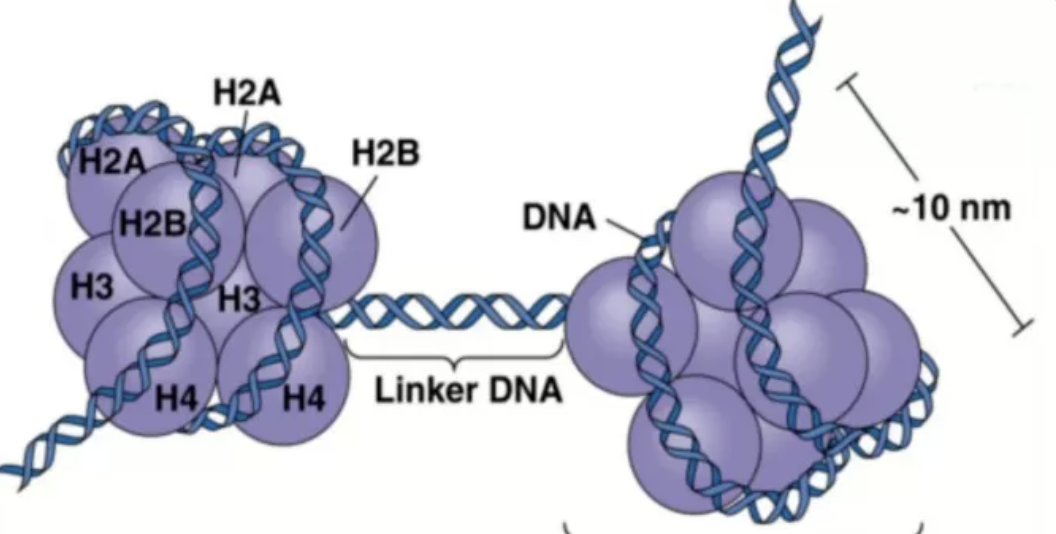

What is a nucleosome?
DNA wrapped around a group of histone proteins.
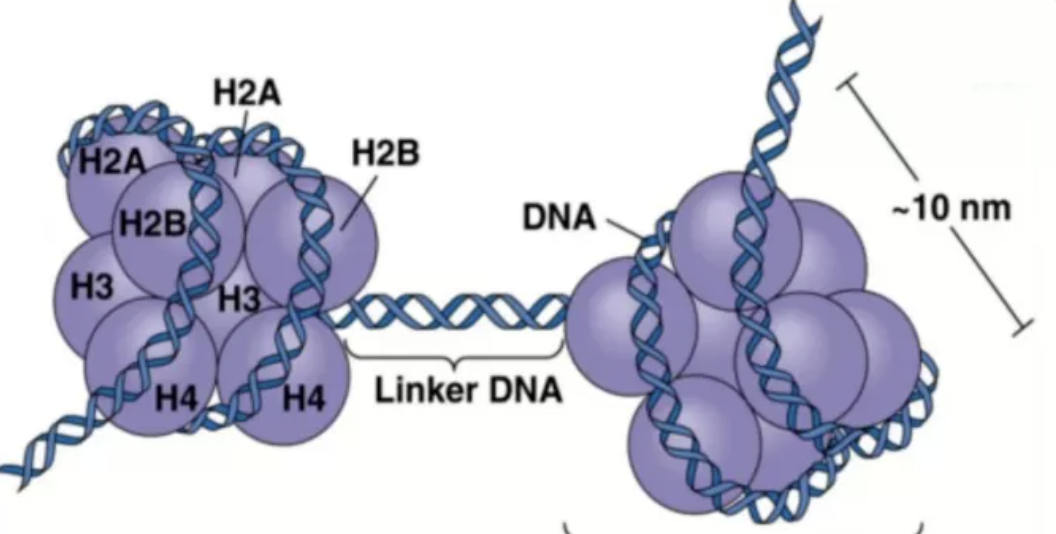
How many histone subunits make up one nucleosome?
8
What is the charge of histone tails?
Positive.
What is euchromatin?
Light colored losely packed DNA
Why is euchromatin significant?
It IS easily replicated and expressed.
What is heterochromatin?
Dark, densely packed DNA
Why is heterochromatin significant?
It is not easily replicated or expressed
How can you identify euchromatin in a TEM image?
light
How can you identify heterochromatin in a TEM image?
dark
In which type of chromatin is active replication and transcription more likely?
Euchromatin, because the DNA is more accessible.
What does semiconservative mean
Newly replicated DNA has one original strand and one newly strand
Where does DNA replication begin?
At the origin of replication (ORC).
In which direction does DNA replication proceed from the origin?
In both directions.
What does helicase do during DNA replication?
Unwinds and separates the two original DNA strands.
What does topoisomerase do during DNA replication?
Relieves twisting and tension
What does primase do?
Makes short RNA primers so DNA has somewhere to start
What is an RNA primer?
A short RNA sequence that provides a starting point for DNA
Why does DNA polymerase need an RNA primer?
DNA polymerase cannot start building a new DNA strand from scratch.
What does DNA polymerase do?
Builds new DNA strands
In which direction can DNA polymerase build a new DNA strand?
5 to 3
What is the leading strand?
The new DNA strand that is synthesized continuously
What is the lagging strand?
The new DNA strand that is synthesized in Okazaki fragments
What are Okazaki fragments?
Short pieces of DNA that make up the lagging strand.
Why is the lagging strand made in Okazaki fragments?
DNA polymerase can only build in the 5 to 3 direction, so the lagging strand must be made in separate pieces.
What does DNA polymerase I do?
Removes initial RNA primers and replaces them with DNA
What does DNA ligase do?
Joins Okazaki fragments and seals gaps
What are the final products of DNA replication?
Two identical daughter DNA strands
Describe the entire process of DNA replication in order.
Helicase separates DNA strands, topoisomerase relieves tension, primase adds RNA primers, DNA polymerase builds new DNA, DNA polymerase I replaces RNA primers, and DNA ligase joins okazaki fragments.
What are telomeres?
Protective tips at the ends of chromosomes
What happens to telomeres with each round of DNA replication?
They become shorter/snipped off
Why do telomeres shorten during DNA replication?
The RNA primer on the lagging strand is removed
What is the Hayflick limit?
cells can only divide 40-60 times
What happens when a cell reaches the Hayflick limit?
it stops dividing.
What type of cells does the Hayflick limit apply to?
Adult somatic cells.
Why are embryonic cells and stem cells exempt from the Hayflick limit?
They have telomerase
What does telomerase do?
Rebuilds telomere DNA and prevents it from shrinking too much
What does PCR stand for?
Polymerase Chain Reaction.
What is PCR used for?
making copies of a specific DNA sequence.
What are the three steps of PCR in order?
Denaturation, annealing, and extension.
What happens during denaturation?
Heat separates the two DNA strands by breaking their hydrogen bonds.