12: Life History Traits I
 Call Kai
 Learn
 Practice Test
 Spaced Repetition
 Match
 Flashcards
 Knowt Play
1/31

There's no tags or description
Looks like no tags are added yet.
32 Terms
reproduction incurs an increased risk of _______
predation
what are the advantages of early reproduction?
increased fecundity, hopefully b4 dying
what are the disadvantages of early reproduction?
decreased survivorship & decreased potential for later reproduction
what are the advantages of later reproduction?
increased growth & survivorship & potential fecundity
what are the disadvantages of later reproduction?
decreased fecundity if death occurs b4 sexual maturity
what is semelparity ?
example?
investing all energy into growth/maintenance, then expend 1 massive reproductive effort b4 dying
Ex// insects, salmon, annual plants, bamboos
what is iteroparity ?
example?
fewer young produced at 1 time, but production of young repeated throughout lifetime
ex// perennial plants, vertebrates, humans
True or false: Its costly to produce too few/ too many offspring OR too small/too large offspring?
TRUE
True or false? Small offspring more likely to survive.
FALSE, large offspring more likely to survive BUT small offspring can be produced in large numbers
what is altricial investment? What does this require?
example?
young are relatively helpless at birth
-requires less gestation time BUT greater parental care
ex// birds & mammals
What is precocial investment?
-what does this require?
examples?
young are relatively independent at birth
-greater gestation time BUT less parental care
ex// gallinaceous birds & ungulate mammals
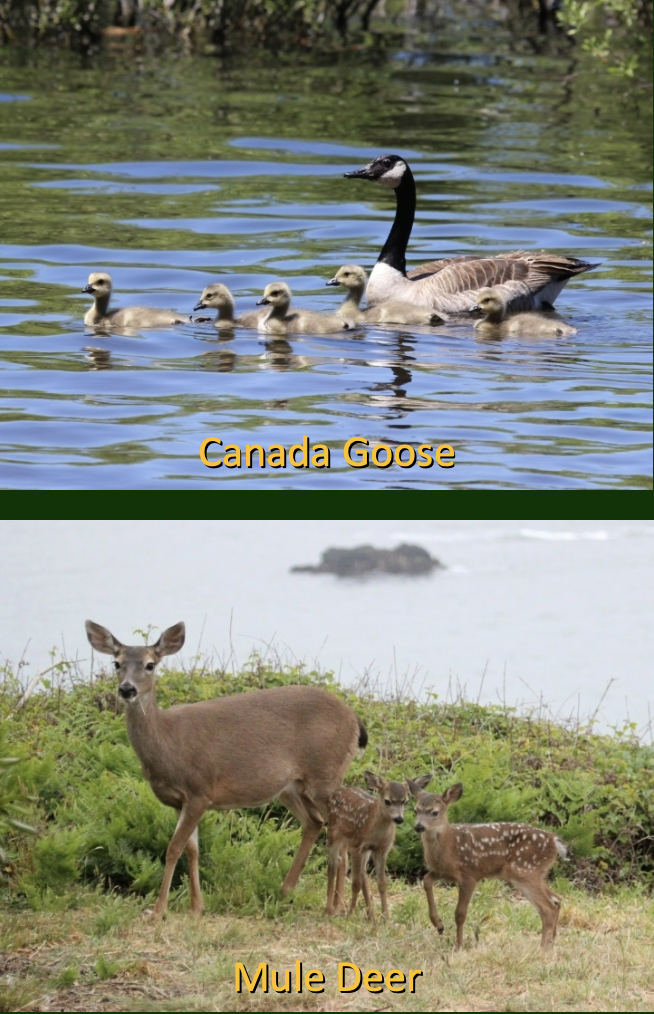
What are the characteristics of species most likely to produce precocial young?
lacking shelter from predators, thus increasing survivorship of young
annual plant characteristics?
example?
live for less than an year
-unstable, unpredictable environments
-produce an ABUNDANT number of small(windblown) seeds
example// weeds
perennial plants characteristics
example?
live for several or many years
-stable, predictable environments
-produce fewer, bigger seeds
example// nut trees
What is the tradeoff of some perennial plants having fruits?
fruits decrease parental fitness BUT increase offspring fitness
do temperate or tropical species have a larger litter size? Why?
temperate species have larger litter size BC temperate climates are more catastrophic & populations are usually below (K)
do high elevation or low elevation species have a larger litter size?
high elevation species
how is fecundity of plants & poikilotherms related to body size & age?
fecundity increases with size & age
How is age of reproduction related to population density?
example?
Age of 1st reproduction among trees increases as density increases
Ex// Virginia Pine
in open stands→produce seeds at 5-8 yeras
in dense stands→delays seed production up to 50 years
Why do smaller mammals have higher fecundity than large mammals?
higher predation & shorter lifespan requires them to produce more offspring to offset losses
Compare the climate in r-selection vs. K-selection species.
r-selection→harsh, unpredictable climate
K-selection→stable, predictable climate
Compare the Population Growth Rate & Population Density in r-selection vs. K-selection species.
r-selection→high population growth
K-selection→low population growth rate
r-selection→variable & low population density
K-selection→constant & high population density
Compare the Carrying Capacity in r-selection vs. K-selection species.
r-selection→seldom reached
K-selection→near K
Compare the Intraspecific Competition & Development in r-selection vs. K-selection species.
r-selection→low comp. & fast development
K-selection→high comp. & slow development
Compare the Energetics & Reproduction in r-selection vs. K-selection species.
r-selection→productivity & early reproduction, few events
K-selection→ efficiency & late reproduction, repeated events
Compare the body size & life expectancy in r-selection vs. K-selection species.
r-selection→small body size & short life expectancy
K-selection→large body size & long life expectancy
Compare the Survivorship & Mortality in r-selection vs. K-selection species.
r-selection→Type II & III ; density independent mortality
K-selection→ Type I ; density dependent mortality
Names for r-selection?
1) r-strategists
2) opportunists
3) generalists
names for K-selection
1)K-strategists
2) competitors
3) specialists
Examples of r-selection species
1) weeds
2) insects
3) mice
4) songbirds
examples of K-selection species
1) trees
2) eagles
3) elephants
4) humans
are all species ideal r-or K strategists
NO, there is a continuum