HD 2200 Prelim 2
 Call Kai
 Learn
 Practice Test
 Spaced Repetition
 Match
 Flashcards
 Knowt Play
1/43

There's no tags or description
Looks like no tags are added yet.
44 Terms
Week 7 - Are abstract concepts embodied?
Serious challenge to embodiment theory: if thinking involves perceptual-motor simulations, how _. Solution = metaphors
can we think about things we can never perceive w/senses or act w/muscles (abstract concepts)
Mental metaphors map _ domain to _ domain
source ; target

We know people talk about abstract ideas metaphorically but what are 2 studies to see if we really think about abstract ideas metaphorically?
Casasanto & Jasmin 2012: ppl may talk about time using language sagittally (front/back) but gesture laterally (left/right)
Casasanto & Dijkstra 2010: asked to recall ± emotional memory & faster when metaphor congruent action & memory (i.e. + & upward) ; asked neutral prompt & found motor action influence if we retrieve ± emotional memory
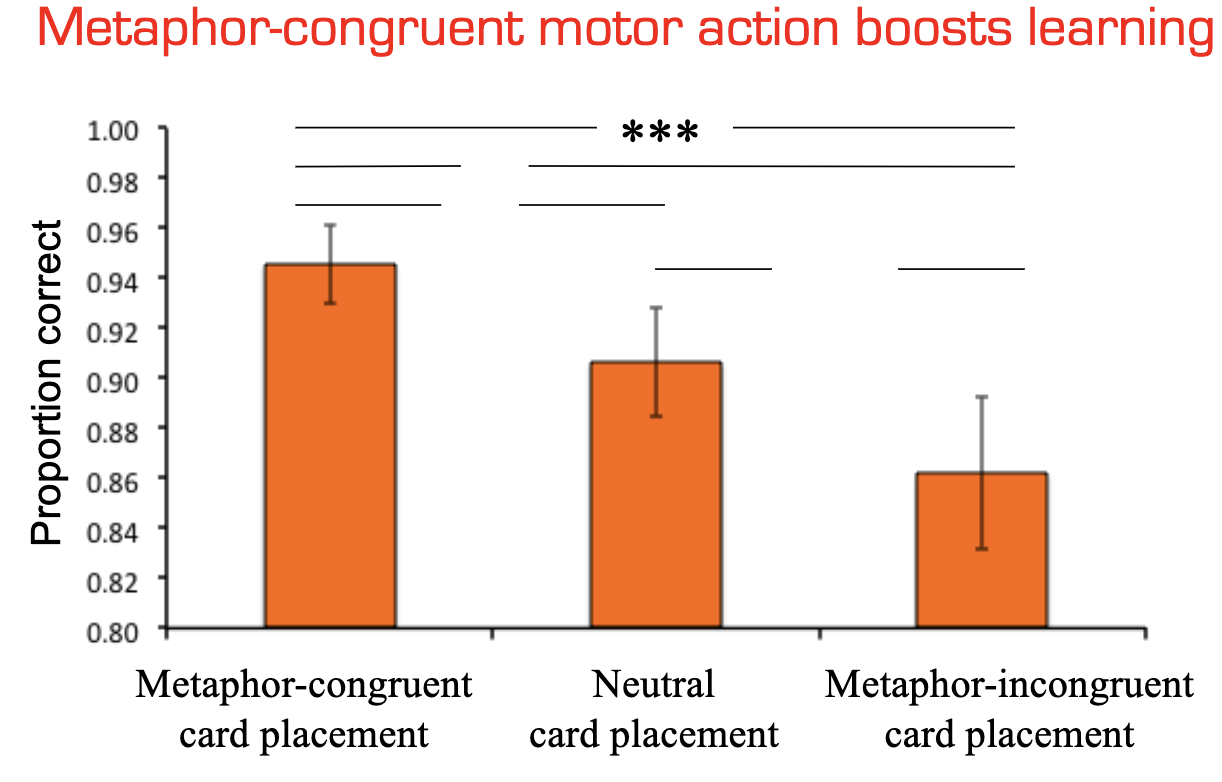
What did Casasanto & de Bruin 2019 find if mental metaphors help learning?
better accuracy when metaphor congruent card placement when learning unfamiliar words (blorf = love & had to sort into top/bottom box that was either ±)
Adults conceptualize pitches as high & low even when prevented from using _. Height-pitch mapping detectable in infants at 4 months.
language *associate pitch w/height w/o language
What are ANEW words?
Affective Norms for English Words (have valence: how ± word is)
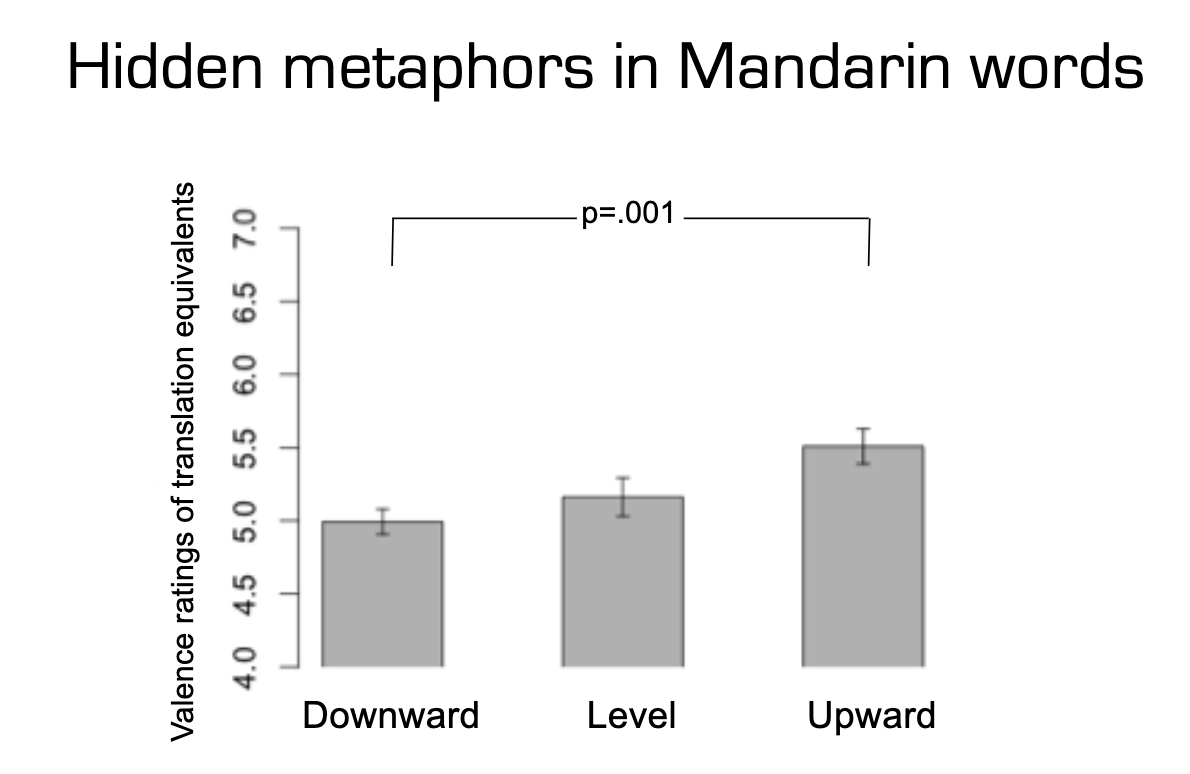
Explain Yap, Staum, & Casasanto 2014 to answer if space-valence metaphors influence forms of spoken words via pitch?
compare valence ratings of Mandarin words w/diff pitch mvt patterns & found that words w/upward pitch mvt more + meanings = evidence that spatial-valence associations reflected in forms of spoken words
Ok, ppl think about abstract ideas metaphorically but are they embodied in modality-specific simulations? 1 point + 3 studies.
sensory & motor homunculus where diff body parts correspond to diff cortical regions
Pulvermuller 2005: action words activate motor-related brain areas but NOT abstract metaphors
Aziz-Zadeh 2006: kick the ball = activation but kick the bucket = no
Quadfleig et al 2011: see if neural overlap for spatial & abstract judgments & found overlap ONLY in modality non-specific areas
Week 8 - Body-specificity of language & thought pt 1
Linguistic Relativity (Benjamin Whorf)
diff languages = think about time, space, & matter diff (language influences how we conceptualize world)
What are 3 experiences that shape brain & mind (lead to each relativity)?
linguistic
perceptuo-motor
cultural
Body-Specificity Hypothesis
ppl w/diff bodies interact w/env in diff ways = form diff concepts & word meanings
Previously Tettamanti et al 2005 found action words activate L-hemisphere circuits. What did Willems, Hagoort, Casasanto 2010 find about if word meaning left-lateralized or body-specific?
L-handers had greater % signal change in R-hemisphere & R-handers had greater % signal change in L-hemisphere = motor component of action verb understanding body-specific
What is in the 3-way interaction for body-specific prediction for WHC 2010?
word type (manual/non-manual)
hemisphere (left/right)
handedness (left/right)
Body-specificity of abstract concepts
What 3 exp do mental metaphors (i.e. GOOD=UP) come from?
bodily exp
linguisitc exp
cultural exp
In language & culture Right = Good & Left = Bad, so what would lefties & righties see as good based on linguistic/cultural exp or body-specific motor exp?
If explanation = linguistic/cultural exp both L & R see right as good
If explanation = body-specific motor exp L see left as good & R see right as good
What were results for Casasanto 2009 of asking L/R-handers to draw panda (good) or zebra (bad) in L/R box?
75% lefties respond left=good while 65% of righties respond right = good → support body-specific spatialization of good & bad
Body-specific judgments
What were results for Casasanto 2009 of asking ppts which Fribbles look more intelligent/happier/etc. in L/R positions based on their dominant hand?
lefties made more judgments that left = good & righties vice versa = body-specific spatial prefs influence judgments of unfamiliar objects
What were results for Casasanto 2009 of asking ppts to choose product descriptions/job applicants on L/R side?
lefties choose left more & righties vice versa = support body-specific judgments
Body-specificity in real world 3 ex
when choices similar/interchangeable (shopping shelves)
quick decisions like menu
voting
What did Kim, Krosnick, & Casasanto 2015 find if handedness influence voting pref in ballot position?
larger advantage for candidate on left of ballot among L-handed voters = handedness influence how we vote
What did Casasanto & Chrysikou 2011 find to see if motor exp cause preference judgments by placing glove on L/R hand to pick up dominoes & then make hands-free judgments if someone else would place panda/zebra as good/bad?
ppts w/glove on left trained to be righties more choose good = right while ppts w/glove on right trained to be raties more choose good = left → motor exp shape rep of good/bad
Motivation _ valence as valence can be ± (i.e. happy/angry) but motivation can both be to approach not avoid
does not equal
Hypothesis to if motor exp determine neural organization of motivation: motivation also depend on how we use our hands (dominant/non-dominant) not on _
motor fluency
Week 9 - Body-specificity of language & thought pt 2
Affective Motivation
drive to approach/avoid physical/social stimuli (i.e. approach = happiness, pride, anger vs. avoidance = fear, disgust, sad)
According to textbooks (Kinsbourne 1978 etc.) positive/approach = _ hemisphere while negative/avoidance = _ hemisphere & approach motivation lateralized to _ hemisphere in righties by EEG from Harmon-Jones & Allen 1998
left ; right ; left
3 points of Sword & Shield Hypothesis
ppl use dominant/non-dominant hand diff (dominant = approach-related actions = sword hand hand vs. non-dominant = avoidance = shield hand)
neural circuits for planning motivated actions functionally related to motiv. states
hemispheric specialization for motivation should vary w/specialization for dominant/ND hand motor control

Sutton & Davidson 1997 found that alpha-band asymmetries in EEG + correlate w/_
apporach motivation
Where do emotions come from?
SSH predicts that ppl who use their hands diff when performing approach/avoidance actions show corresponding diffs in _
cerebral laterality of motivation

Brookshire & Casasanto 2012 collected resting EEG for R/L handers & measured approach motivation via BAS questionnaire. What did they find about hands predicting laterality of approach motivation? What is is evidence for & challenge?
R-handers had higher BAS w/greater L-hemisphere bias & L-handers show opposite where they had higher approach motivation w/more R-hemisphere bias
evidence for body-specific of emotion in brain, challenge traditional model,

Inc neural activity in approach/avoidance? hemisphere to promote approach emotions, + mood as neural therapy for depression.
approach
What did Brookshire & Casasanto 2018 find about inc motivation using tDCS?
L excitatory simulation inc approach motivation in R-handed ppl & vice versa
motor-sys org predict approach motivation org, covariation is continuous, no 1 approach hemisphere but rather approach motivation lateralized to hemisphere that controls dominant hand

Treatments for mental disorders must be disordered to patients’ _
bodies

Readings
What are 3 major conclusions from Casasanto & Gijssels 2015 what makes a metaphor an embodied metaphor?
mental metaphors exist
embodied cognition has supporting evidence
but embodied metaphors have insufficient evidence

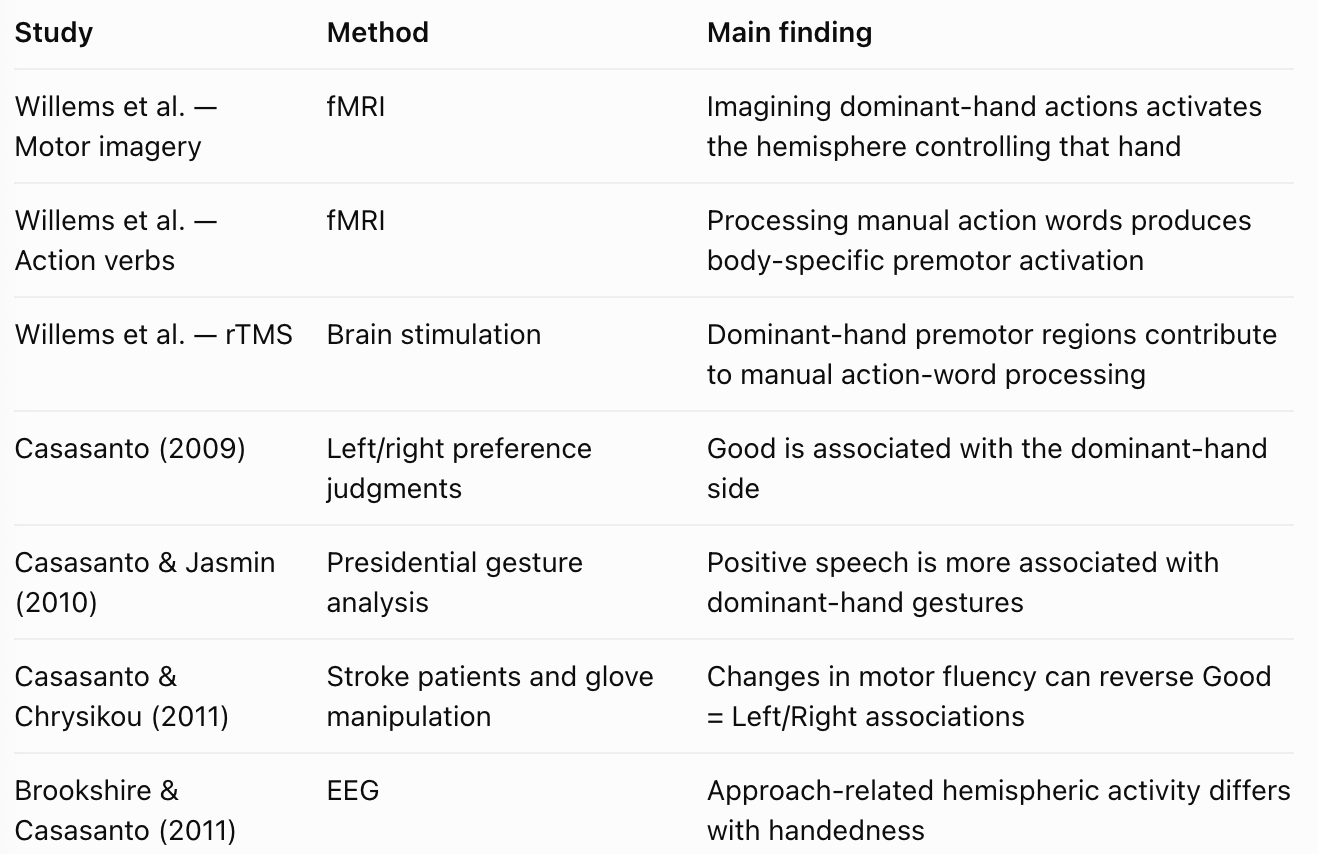
Casasanto 2011 covered multiple studies, what is the method and main finding?
According to Brookshire & Casasanto 2012 approach actions are performed with _ hand while avoidance actions by _ hand
dominant (sword) ; non-dominant (shield)
According to Brookshire & Casasanto 2012 what is Sword & Shield Hypothesis (SSH)?
approach motivation differently lateralized in right/left-handers’ brains consistent w/handedness diff
Brookshire & Casasanto 2012 results were that right-handers specialized approach motivation to _ hemisphere & opposite in left-handers.
left