Comparative politics
 Call Kai
 Learn
Learn Practice Test
 Spaced Repetition
 Match
Match Flashcards
 Knowt Play
1/66

There's no tags or description
Looks like no tags are added yet.
Name | Mastery | Learn | Test | Matching | Spaced | Call with Kai | Chat |
|---|
No analytics yet
Send a link to your students to track their progress
67 Terms
PROBLEM 1 Distortions between votes and power
Distortion
Situation in which an increase in votes for a candidate/party does not make it more likely to get into power.
Any level can be impacted (national, regional, local)
Can happen for both the legislature and the executive.
→ Why it matters?: When citizens sence their vote doesn’t make a difference they are angry.
Where does the distortion can come from?
Institutions and party strategies can interact → Reduce the votes-to-power link.
Example of distortion: AfD
Firewall strategy where all parties exclude AfD from negociations after the election → AfD excluded, which creates a distortion because they arrived second.
→ Can even be counterproductive because at the next election, anger about this process can backfire and even reinforce AfD. AND it also weakens the saying that the parties using the firewall are protecting the democracy (bc they ignore the result of the vote).
Where distortions arise?
Legislatures
Electoral-system distortions (including gerrymandering)
Malapportionment
Executives
Presidential systems
Parliamentary systems (coalition bargaining)
Proportional Representation (PR) vs Single Member District (SMD)
PR means that every vote has the same power (except if there is a threshold)
SMD means that the country is divided in many consituencies in which the First Past the Post (FPP) is used → So the candidate with the more vote wins
Legislatures: electoral-system distortions
Electoral formula: PR or SMD (+drawing of the constituency in the SMD system → gerrymandering)
District magnitude: Number of MPs per constituency (DEFINITION A CHECK DANS LE READING)
→ interact to distort the vote-to-power link.
Worse in SMD systems if there is a geographic concentration of votes for some parties.
Ex: Lib dem in 2019 UK elections got 11,6% nationawide but only 1,7% of the seats because they were second prefered candidates → So with SMD + FPP, they loose most districts even though at the national level they had more legitimacy.
Since SMD is very vulnerable with FPP, what is the risk?
Manipulation of district boundaries to change the electoral result. → Results in distortion between:
Party preferences of the electorate in the country as a whole
Seats awarded to parties in the legislatures.
In most countries, to avoid this, ‘France, Canada, Uk, australia), there is an independent commission or extra parliamenaary body that draws the districts.
Gerrymandering
Process of drawing districts for the purpose of granting an electoral advantage to a particular group. (Legally easier in the US)
How is gerrymandering possible in the US?
Every 10 years → Census → Leads to a REAPPORTIONMENT of the number of MPs each state has → the state legislatures need to redraw the congressional map if the number is changed.
Only 7 + 2 states have truly independent commissions
Only TWO RULES:
Districts have to be contiguous and have roughly equal populations (US constitution)
Districts cannot be drawn purely on the grounds of privileging one racial group avoer another (“racial gerrymandering” → Equal protection in the US constitution, some Acts and various SCOTUS decisions)
Ex: Taxes redisticting for the 2026 midterms
Gerrymandering strategies
Cracking: splitting supporters of the opposing paty across many districts so that they are a majority in a very few (or none) of them
Packing: Concentrating supportes of the opposing party in very few districts (or even on district) sot hat many of their voters unnecessarily “waste” their votes.
→ Goal: DILUTION of the opposing party’s voting power.

Legislatures: Malapportionment
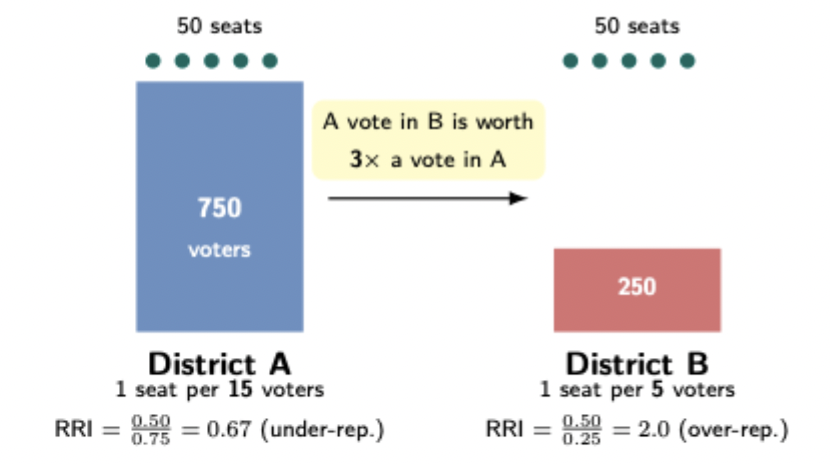
Seat shares across districts are not proportional to population shares.
→ Violates the “one person, one vote” principle
ATTENZIONE - Ne pas confondre gerrymandering and malapportionment
Malapportionment is about HOW MANY seats a district gets, not WHERE the lines are drawn.
Mechanisms of malapportionment
Fixed seat minima
Federal overrepresentation of subnational units
Delayed reapportionment
RRI calculation
RRI = District shares of seat / This district share of the population
If RRI = 1, it is a good proportion
If RRI < 1, the population is underrepresented
If RRI > 1, the population is overrepresented.
Ex: Senate of the US → 2 senators, no matter how many ppl in the constituency.
Why malapportionment matters?
It distorts the mapping from citizen prefences to legislative seats → then to policy
Can advantage particular territories or party families or ideologies
Executives: Two types of distortions (depending on the politcal system)
Presidential systems: SMD by definition (=The country is a single district), producing typical distortion (Worse in the US because the Electoral college combines SMD distortions with malapportionment).
Parliamentary systems: Combine with PR, between election and government formation, there is typically PARTY BARGAINING, which can break the link between votes and power.
PARTY BARGAINING is the less straightforward → we focus on it as of nowin the Martin and Vanberg reading.
Normative premise for evaluating executive distortions
Better electoral performanc should (weakly) increase a party’s likelihood of entering government
Weaker electoral performance should (weakly) decrease a party’s likelyhood of entering govermnent.
EN GROS: Does electoral performance systematically shape government formation in multiparty parliamentary systems?
What could be the distortion in “Executives: Parliamentary systems”
Coalition bargaining happens BETWEEN the electoral outcomes and the government formation → Can lead to a situation where strong parties are don’t govern because the rest of the parties ally to form a coalition.
2 channels affecting the Vote-to-power in “Executives: Parliamentary systems”
Structural channel: Votes → seats → New bargaining environemnt (new feasible coalitions, pivotality, median status)
Perceptual channel: Gains and losses are public “verdicts” that shape how parties see themselves and each other.
2 channels affecting the Vote-to-power in “Executives: Parliamentary systems”: Structural channel
Unreliable channel alone → BEcause the Seats → Power is NON-MONOTONIC
PROBLEM 2 - Institutions are failing citizens: When democracies erode form within: fragility, pahtways, and resistance → BACKSLIDING
Democratic backsliding
Incremental erosion of democratic norms and institutions.
Determining a democracy VS no longer a democracy → Not easy, many criteria can be used. Since you start from a democracy, you use the channels of democracy so it needs a lot of qualitative analysis.
Universe of case (time & geography)
Which data/indicattor (v-dem liberal democracy index
Democracy thershold: waht counts as a democracy to begin with?
Decline threshold: How much drop =”backsliding”?
When do episodes start/end
What about recovery afterward
Do we exclude extraordinary things (coups)
Why is backsliding worth studying?
Endogenous phenomenon → It comes from the politicians elected.
Old worry was: will ne democracies consolidate?
New worry is now: will establish democracies erode?
Ex: Poland, Hungary, US…
Global concern (affects both new and old democracies
Winner's’ dilemma (Rield et al.)
Will election winners resist the temptation to tiult the field and lock in power?
(before it was the losers’ dilemma)
How to resist backsliding
Sources: Proportional rules, strong veto players, independent courts, vibrant civil society
Strategies: Broad opposition coalitions, depolarizing narratives, early coordinated action.
Pathways of backsliding
4th step is that the resilience and recovery (but it happens rarely lol)
They are not mutually exclusive, several

Executive agrandizement
Elected leaders use formally democratic procedures (legislative majorities, constitutitonal amendments, referneda) to centralize power and weaken checks and balances.
≠ coup: Changes are incremental, legalistics, and framed as majoritarian democracy (not an open break with the constitution)
Ex:
Poland: PiS alters judicial appointment rules, sidelining constitutional checks by legislation
India: Hindu nationalist appeals delegitimize critics whole power centralizes
Venezuela: Chavez uses referenda to expend presidential power
Common tactics of executive agrandizzement
Identify activation (often ethnonationalist): delegitimize courtsn media, oppoistion as “anti-national” or captured by hostile elites
Ex: India (Hindu nationalism), Poland (courts cast as post-communist holdovers), Serbia
Plebiscitary override: Appeal directly to “the people” via referenda to by pass or discipline other institutionss
Ex: Venezuela (Chavez), Ecuador
Consequences of executive aggrandizement
checks are hollowed out while institutions remain on paper
Incumbent advantage entrenched; opposition access narrowed
Democratics procedures retaines- but repurposed to reduce accountability
Courts, parliaments, elections still work on paper → but for the incumbent. → that’s why it’s hard to call it “the end of democracy”
Elite collusion
Incumbents entrench power by co-opting other eleites (business owners, media owners, civil society figures, rival politicians) into a pro-incumbent coalition.
Ex:
Hungary (Fidesz gather oligarchs who own media and capture EU funds),
TUrkey (AKP takes over newspapers through rich people pro-AKP buyuing via state-brokered sales),
Russia (oligarchs can thrive economically onyl if they stay politically loyal)
Difference between agrandizement and collusion
Collusion is about concentrating power via BARGAINS and ALLIANCES among elites.
Aggrandizement: power concentrates wia FORMAL RULE CHANGES driven by the executive.
Tactics for elite collusion
Patronage & corruption: contrcts, jobs, resources, exchanged for loyalty
Legal takeovers: regulation, licensing, state brokered slaes to capture media/CSOs
Threats & intimidation: Selective prosecutions, tax audits, investigations
Consequence of elite collusion
Media, business, civil soceity lose independent; oversign becomes performative
Opposition co-opted for marginalized; contestation narrows
An oligarchic cartel concrols policy and access behind intact institutions.
Self-coup (autogolpe)
Democratically elected leader dimanstles or disables existing institutions to conslidate power. It is rapid, and visible (not incremental) because channels of contestation (parliament, courts, electoral bodies) are bypasses/closed outright.
→ SUDDEN RUPTURE (rules are swept aside in one stroke).
It is an OPEN dismantling (the two others keep fake institutitons for la facade)
Ex:
Peru: Fujimori dissolves congress and the courts to rule by decree
Tunisia: President Saied suspends parliament and rewrites consitution.
Self-coup: Tactics
Declare state of emergency; rule by decree
Suspend or dissolve the legislature and/or courts
Cancel, suspend or rig elections
impose a new consituttion ending checks & terms limit
Self-coup: consequences
Immediate collapse of horizontal accountability
Opposition sidelined in one decisive move
Rapid transition toward authoritarian rule
Svolik’s argument
Backsliding comes from citizens because they accept undermocratic behavior if it comes from their party (bc of polarization).
How do voters’ respond to norm violation
3 mechanisms:
backlash
vote switching
disengagement
→
Citizens weight policy/partisan closeness against the cost of a democratic violation
The more polarized (the more you love your side) the narrower the “vote-switching” zone (fewer are willing to cross over

Natural experiment of istambul (→ READING FICHE)
Magic ingredient allowing for abcksliding
Polarization → 3 pathways through hcih polarization acts
- Executive aggrandizement: Voters forgive institutional capture if their side wins
- Elite collusion: partisan loyalty blunts outrage over corruption and patronage
- Self-coup: polarization discourages the broad, cross-party coalition needed to defend deocracy.
Sources of democratic resilience (Capacity to withstand, adapt, recover, from shocks without losing democratic quality).
Highly proportional electoral systems (many veto points)
Federalism and indepdendent state/local governments
RUles that protect judicial independence
Vibrant opposition parties, independen tmedia, active civil society.
A legacy of pasy reversals of authoritarian to draw on.
Strategies of resistance (and coordination trap)
Choices facing the opposition and pro-democrayc civil soceity
Institutional (courts, elections) vs extra sinsitution (protest, boycott)
compete separately vs. build a broad multiparty coalition?
Highlight the democracy cleavage vs run on performance
Use polarizing vs depolarizing appeals
Timing problem
Backsliding is incremental, so opposition often recognizes the thrat too late, after 10 years) → making resistence not successful.
Takeaway backsliding
Backsliding today is incremental, legal and endogenous → the winners’ dilemma not the losers’
It runs on “ pathways (aggrandizement, collusion, self-coup) that blend in practice
Elites supply the tactics; polarized publics supply the permission (Svolik)
Yet outcomes are not predetermined: institutions and politicla agency creates sites of contestation that can hold or recover (South korea, modova, malawi)
→ wealth is not a firewall. Insituttions and coordinated, early resistance are.
PROBLEM 3 - Institutions are failing citizens: Populism, technocracy and institutional trust
Basis of democracy
Trust in institutions and representation through parties and elections.
Visions criticizing these bases of democracy
Populism
Technocracy
→ RIVAL VISIONS
Populism
Legitimacy comes from the UNMEDIATED WILL of the people.
Technocracy
Legitimacy from reason, expertise, competence.
Commonalities between populism and democracy
Anti-pluralism → Both think that there is a single “common good” and thus reject standing opposition → Rejecting party democracy. (Party democracy sees legitimate disagreement, whereas populism and technocracy think there is a single good answer.)
Both bypass “politics as usual”
Both delegitimize representative institutions (as corrupt for populism, or incompetent from technocracy)
Same casualty as a consequence of technocracy and populism
Different diagnoses but the same victim → the MEDIATING institutions of party democracy AND the citizens’ trust in these institutions.
Triangular challenge
Representative democracy bridges inclusion (popular will) and competence (expertise). Populism keeps the will but drops mediation; technocracy keeps competence but drops the will. + both populism and technocry remove the pluarlist middle.

Technocratic citizen
Citizens can also have technocratic inclinement (=20% in greece and itlay)
3 pillars of attitude:
Expertise: Knowledge can identify the objectively “best” solution
elitism: The competent, not the many, should decide
Anti-politics: Party competition is divisive and self-serving.
Technocratic citizens attacking democracy
Anti-politics pillar → Directl attacks representative democracy because the technocratic thinks that parties
Represent particular interests, not the common good
Electoral cycles reward short-termism
Over responsiveness to shifting moods; media driven pressure for instant reesults
Deliberation, parliamentary proceduure, elections = slow, inefficient friction.
→ How is this possible: If there is an objective CORRECT policy → then opposittion is illegitimate because it cannot vote against the trust. PArty democracy’s premise that disgagreement is legitimate → Here, technocrats believe only one answer is possible.
Technopopulism
Fusion of populist appeal to the people with technocratic appeal to expertise.
consequnce: Blurs the lines of legitimacy, further hollowing party competition and accountability.
Ex:
Emmanuel Macron (LREM): anti-establishment outsider and evidence-based, expert-led, “neither left nor right”.
Five Star Movement (Italy): “Pure people vs corrupt elites” and digital-platform, technical-competence claims.
What is the consequence of both populism and technocratic
Domestic sytemic corrosion → Both logics erode trust in parties and representative institutions, normalize non-majoritrain alternatives (experts, strong leaders)
→ GRowing support for governance that is less pluralist and less contestable
→ RISK OF DEMOCRATIC BACKSLIDING: not bu coup but by hollowing out the mediating institutions citizens rely on.
Conclusions
Clear systematic threat on party democracy (Caramani 2017, Bertsou et al 2025)
Both populism and technocracy reject its founding premise (legitimate disagreement, mediated by parties).
Technocrats do that via anti-politics and populist do it via pure-people/corrupt elite frame
No clear systematic pattern for international organizations (van der Veer and Meibauer)
Populists don’t reliably tear IOs down
Technocrats don’t reliably prop them up
IO (de)legitimation is issue-specific, reactive, and probably domestically strategic, not bound by ideological camps.
Normative implications
neither vision supplises stable democratic legitimacy; both erode pluralism, contestation and compromise
Rebuilding trust at home:
Transparent, accountable institutions
Expertise inside democratic input (not above it)
Reinvigorated, repsonsive party competition
For IOs: if contestation is not ideologically fixed, their authority is more brittle, but also more reformable. Defense and attack are both up for graps.
PROBLEM 4 - Citizens are failing themselves: Voter knowledge deficits and consequences for responsiveness
What’s the requirement for citizens to be considered informed
Know what they think are going to get
VS
What they actually get
→ The comparison of the two is a prerequisite to any accountability and information.
Limitations to access information for citizens
Cost of information gathering (increasing with complexity)
Cognitive resources for processing and storing information.
→ voter behavior models assume voters have wealth of information at their disposal.
consequence of these barriers to information access?
resort to HEURISTICS when making choices
Heuristics
“Rule of thumb”/mental shortcut strategy that allows us to solve problems and make decisions quickly without sacrificing signficant resources.
Good heuristics is
Fast and frugal
Accurate.
→ All heuristics are not good: It can include some mistakes, stereotypes, prejudices.
LEft-right metaphor as heuristic (Fortunato, Stevenson and Vonnahme)
Left-right scale and labels can serve as a heuristic
(Fortunato, Stevenson and Vonnahme → studied this)
Political awareness
The extent to which an individual pays attention to current political events and understands what they have encounterered. (Zaller’s definition)I
Ideological awareness
Extent to which an individual pays attention to, and understands, the issue priorities and policy positions of the political parties that compete in elections and subsequently engage in legislative bargaining.