Topic A - Functions of Management
 Call Kai
 Learn
 Practice Test
 Spaced Repetition
 Match
 Flashcards
 Knowt Play
1/43

There's no tags or description
Looks like no tags are added yet.
44 Terms
scalar principle
authority and responsibility flow in a direct line vertically from the highest to lowest echelons: clear and unbroken lines
unity of command
each is accountable to only one supervisor
six functions of management
Planning
Organizing
Staffing
Controlling
Directing
Planning
involves determining what the organization or unit should accomplish and how to accomplish it
it includes establishing goals, priorities, strategies, and performance targets.
Organizing
arranging the unit’s structure and resources to carry out plans
it includes identifying needed positions and assignments and defining relationships among authority, responsibility, and reporting lines.
Staffing
involves obtaining and maintaining the personnel needed to perform organizational work
Activities include recruiting, selecting, orienting, scheduling, developing, and retaining employees.
Controlling
monitoring actual performance, comparing it with established standards or targets, and taking corrective action when needed
it helps ensure that organizational plans and goals are achieved.
Directing
Delegation is the directing function of assigning a task or responsibility to a qualified subordinate while granting enough authority to complete it. The manager remains ultimately accountable for the outcome.
motivational theories and strategies
supply a personal incentive for the worker
Maslow’s Hierarchy of Needs
determinants of behavior, motivated by the desire to satisfy specific needs

Existence, Relatedness, Growth Theory (ERG)
simplistic model of human needs that influence work behavior
Existence: basic needs to exist (water, shelter)
Relatedness: interpersonal, social aspects
Growth: productive meaningful tasks
Herzberg’s two-factor theory
motivation and maintenance approach
Maintenance (Hygiene) factors (satisfiers, dissatisfiers)
if present and perceived as good…satisfiers
if lacking or perceived as negative, dissatisfiers will interfere with work
do not produce motivation, but can prevent motivation from occurring
fair wage, insurance, retirement benefit, supervision, schedule, working conditions, interpersonal relationships on the job
Motivators - call forth energy and enthusiasm, job enrichment
achievement, personal accomplishment, recognition, responsibility, participation in decision-making, opportunity to growth and advance
McClelland’s theory
suggests that all people have THREE needs:
the need to achieve
the achievement motive is a desire to do something better or more efficiently
people with this need tend to gravitate towards sales and management positions
They are task-oriented and can manage themselves
the need for power
the need for power enjoy competition and seek confrontation
the need for affiliation
the need for affiliation is the desire to be liked by others, join groups
Mintzberg’s role theory of management
A framework that groups a manager’s 10 roles into 3 categories:
Interpersonal (about relationships/status):
Figurehead
Leader
Liaison
Informational (about handling information):
Monitor
Disseminator
Spokesperson
Decisional (about making choices/taking action):
Entrepreneur
Disturbance Handler
Resource Allocator
Negotiator
MacGregor
attitude of the manager toward employees has an impact on job performance (based on manager’s assumptions as to how employees view work)
Theory X (BAD!) - people inherently dislike work and will avoid it if possible; authoritarian, work-centered; workers prefer to be controlled and directed by pressure; motivation through fear; negative, autocratic
Theory Y (GOOD!!) - work is as natural as play or rest; management should arrange conditions so workers can achieve goals by directing own efforts; positive participative
Theory Z (Ouchi)
the value of the company is the people
everyone who will be affected by a decision is involved in making the decision (consensus decision-making
scientific management - Taylor
work-centered - workers must work at fastest pace possible and at maximum efficiency; systematic approach to improving worker efficiency
structure work situation to minimize motivation needed by supervisor
find best way of performing tasks
focus on physical aspects of the job (assembly line, manufacturing)
Management By Objectives (MBO) - Drucker
type of democratic management that provides control from within
establish performance goals and objectives with employees
gives higher incentive value
overall control achieved through self-control by employees
management stresses accomplishments and results
participative leadership
Hawthorne studies
Western Electric - Elton Mayo
If you involve people in the the process, they become more productive
productivity due to: employees were given special attention, were involved in an interesting experience, and were well-treated by supervisors
work breaks increased productivity
placebo effect (special attention improves behavior)
Expectancy theory
Beer, Vroom
rewards serve as motivators only under certain circumstances
employees must believe that effective performance leads to certain rewards
employees must feel that rewards offered are attractive
Path-Goal Theory focuses on leader’s effect on employee’s motiavtion to a behavior will result in a particular goal and how strongly a person desired the goal. Do they value the reward offered.
Most to least order of control (leadership styles)
Autocratic
Consultative
Bureaucratic
Participative
Democratic
Free Rein (Lassez-faire)
Autocratic leadership
demands obedience, most control, full responsibility, crisis control
Consultative leadership
asks for input, but makes major decisions alone
Bureaucratic leadership
by the book, follows procedures to the letter
Participative leadership
emerging trend in management
Encourage workers to participate in decision-making
Uses quality circles: small groups of employees who meet regularly to identify and solve problems
Democratic leadership
guides and encourages the group to make decisions
Laissez-faire leadership
least control, allows groups to make decisions
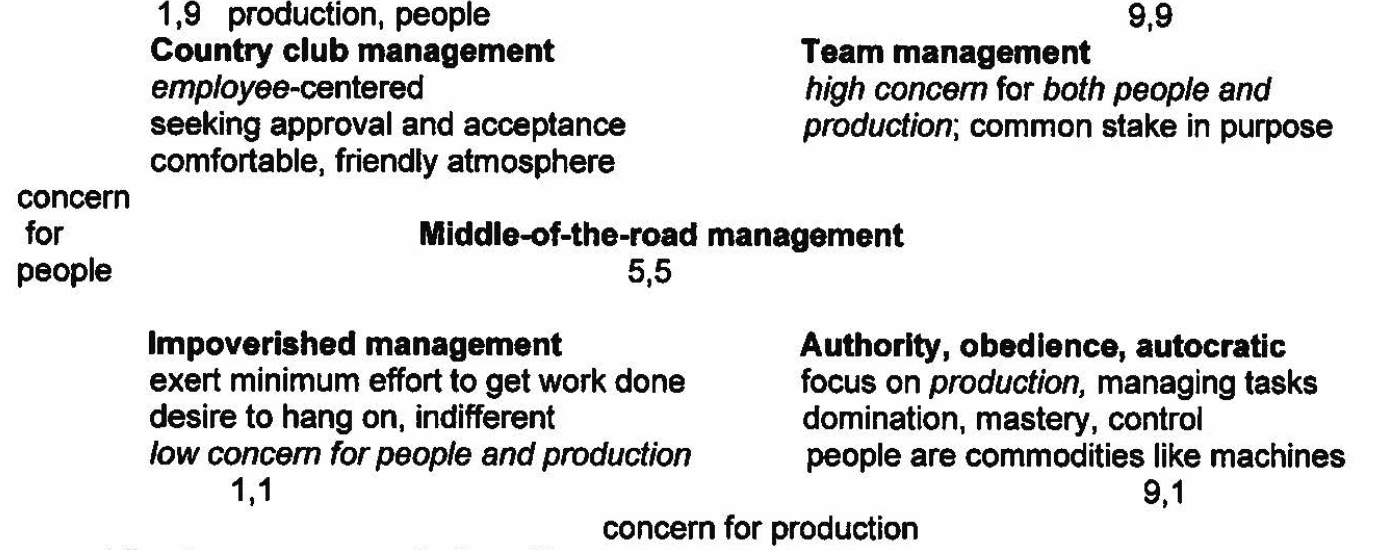
Leadership Grid
Blake, Mouton
plots leader’s concern for people (employees) vs their concern for production
scale of 1-9, 1 is low concern, 9 is high concern
Country club management (1,9 - production, people)
employee-centered; seeking approval and acceptance
comfortable, friendly atmosphere
Impoverished management (1,1)
exert minimum effort to get work done
desire to hang on, indifferent
low concern for people AND production
Team management (9,9)
high concern for BOTH people and production
common stake in purpose
Authority, obedience, autocratic (9,1)
focus on production, managing tasks
domination, mastery, control
people are commodities like machines
Leadership continuum - Tanenbaum and Schmidt
Develop continuum or range of possible leadership behaviors
Each type of behavior is related to the degree of authority used by the manager and the amount of freedom available to subordinates in reaching decisions
Tells decision → Sells decision → Discusses decision → Asks for input on decision → Collaborates on decision → Delegates responsibility for decision
Contingency approach: Fiedler
In both highly favorable and unfavorable situations, a task-oriented leader is more effective (the group is ready to be lad)
In moderately favorable situations, a relationship-oriented leader tends to be more effective because cooperation is more successful than task-oriented leadership
technical skills (techniques, procedures)
understanding of and proficiency in a specific kind of activity.
*Most important at lower levels of management
human skills
ability to work effectively as a group member, interpersonal
important at all levels but imperative at lower levels of management
conceptual skills
ability to see organization as a whole
importance increases at higher ranks of management
hard skills
specific, measurable technical abilities learned through education or training
can be taught
soft skills
transferable interpersonal and behavioral traits that shape how you work with others
must be developed and nurtured
nominal group technique
Delbecq (generate innovative, creative ideas)
more structured and controlled than an ordinary brainstorming group
has authoritative leader, controlled interactions, closely focused goals, rigid enforced procedures, responses strictly controlled by leader
often sit in horseshoe formation; silent generation of ideas by participants
round robin reporting - leader record ideas
group RANKS items in priority order; vote for final decision
Delphi technique (consensus of experts)
designed to probe expert minds in a series of written interviews from which some consensus is sought
participants do not meet
Pareto analysis, bar chart
illustrates the relative importance of problems
work on the tallest bar or problem that occurs most frequently; correcting the “vital few” problems will have the greatest impact on quality
most effects have relatively few causes
80-20 rule: 80% of a given outcome results from 20% of an input
(80% of sales come from 20% of customers)
Queue - queuing theory
develops the relationships involved in waiting in line
used in analyzing flow of customers in a cafeteria - balance cost of waiting lines with the cost of preventing waiting lines through increased service
reward power
ability to reward another for carrying out an order, give incentives, praise to reinforce certain behaviors
coercive power
negative side of reward power, ineffective in motivating behavior change, may create resistance
ability to punish another for not carrying out requirements
used to maintain minimum standard of performance
position (legitimate) power
subordinate acknowledges that the influencer has the right to exert influence due to position (job title/rank)
expert power
belief that influencer has some relevant expertise that the subordinate does not; provides credibility; viewed as competent
referent power (personality, charisma)
based on desire to identify with or imitate the influencer, how well you are liked