Biochem Exam #2
 Call Kai
 Learn
 Practice Test
 Spaced Repetition
 Match
 Flashcards
 Knowt Play
1/137

There's no tags or description
Looks like no tags are added yet.
138 Terms
study of enzyme kinetics begin in —- when —- studied —-
1902 when Adrian Brown was studying sucrose hydrolysis
Adrian Brown enzyme kinetics info
rxn: sucrose + water (enzyme of B-fructofuranosidase/invertsase) yeileds glucose + fructose
when [sucrose] > > than [enzyme] the reaction rate is independent of [sucrose], ie the rxn is zero-order with respect to sucrose
so he proposed a two step rxn mechanism in which the substrate forms a complex with the enzyme that then decomposed to produces P and free energy
the complex with the enzyme (ES) is not the same as the transition state
when substrate concentration is much greater than enzyme conc then the enzyme is saturated so that all the enzyme is in ES form
under this condition then the second step of the rxn is rate limiting as more substrate does nothing to the overall reaction rate
michaelis and menton general
used the knowledge from brown’s experiments to mathematically describe rxn rate of the scheme E + S yields ES yields P + E
when S conc is sig. greater than E conc then the rxn rate of product formation from ES is a first order process
-however, this expression does not completley describe catalyzed rxns as all enzymes are not always saturated. Rather, the change in the concentration of the ES complex is the rate that it is formed minus the rate that it breaks down.
Assumption 1:
Pre-Equilibrium
assume that k-1 >> k2 so that the first step reaches equilibrium
Ks is a dissociation constant for the first step
This is why ES is known as the Michaelis complex
PROBLEM: this assumption is not often correct (but it is reasonable for most cases according to prof)
Assumption #2
Steady State
under physiological conditions, common for [S] > > [E], the [ES] remains nearly constant until substrate is consumed… in other words ES maintains a steady state
note that a rxn at steady state is not a equilibrium as conc. S and conc P are rapidly changing when conc ES and conc E are constant
total concentration of an Enzyme equation
[E]t = [E] + [ES]
unfort for all the equations and stuff… i have no idea so go read the slides ok
ok
what is initial velocity
experiemtnally: velocity measured before more than ~10% of substrate has been converted to product
The [S] that gives 50% Vmax yields the Km
okay so basically small km means the enzyme achieves maximal catalytic efficiency at low [S]
Km depends on
identity of enzyme, substrate, pH, and temperature
when [S] < < Km then
rxn rate varies linearly [S]
when [S] > > Km then
enzyme is saturated so that Vo=Vmax
when k2 < k-1 then….
Km represents Kd
lineweaver-burk plot
plots of 1/V0 vs 1/[S] will be linear, with slope = Km/Vmax and y intercept equal to 1/vmax and x intercept = -1/Km
usually you collect data from 0.5-5 Km
kcat
is always a first-order rate constant, so units of s-1
it is also referred to as the turnover number, which represents the number of reactions per second under fully saturating conditions
under physiological conditions the [S]/Km ratio is usually 0.01-1 thus
kcat/Km is the apparent second-order rate constant
Kcat/Km is a measurement of
catalytic efficiency (or specificity constant) fan an enzyme for a particular substrate
the higher the ratio, the more efficient that enzyme is with that substrate
it is a metric to compare different substrates for teh same enzyme or different enzymes with the same substrate
note that km is = to the substrate dissociation constant (Kd) only if k-1 > > k2
okay
since overall catalysis can be no faster than the rate constant k1 for substrate binding…
catalysis happesn as fast as the enzyme and substrate collide into eachother
the upper limit for any 2nd order rate constant in biochem is the
diffusion-controlled limit 10^8 - 10^9 M-1s-1 … simply how fast two things can collide into each other in water
under steady state conditions…
mechanistic details of a reaction cannot be determined
aka steady state conditions cannot determine microscopic rate constants or the number of intermediates by examining only the concentrations of substrate and/or products
competitive inhibition - reversible
prevents/weakens substrate binding without affecting catalytic activitiy
molecule binds to teh active site… can be overcome by adding more substrate
uncompetitive inhibition - reversible
reduces catalytic rate without weakening substrate binding affinity
molecule only binds to an ES complex. only binds to the union of E and S
mixed inhibition - reversible
elements of both, affects substrate binding and catalytic activity
molecule binds to the enzyme at allosteric site either in the presence or the absence of the substrate and reduces enzyme efficiency
irreversible competitive inhibitors
form a covalent bond with an active-site residue to irreversibly inactivate enzyme
methods of enzyme regulation: control of localization
sequester enzyme away from substrate until the time is right
methods of enzyme regulation: allosteric modulation
just like allosteric modulators for binding affinity
enzyme has at least 2 binding sites, conformational change from allosteric modulator changes enzyme activity
often used as mechanism of positive or negative feedback
methods of enzyme regulation: covalent modification
may enhance or reduce enzyme activity
can be reversible or irreversible
may have multiple sites
this is a way to integrate multiple signals
creates a gradient of signals, not just binary on/off
focus on phosphorylation: the most abundant, common, and important type of covalent modification to regulate enzymes
-kinases: add phosphate group
-phosphatase: remove phospahte group
technically cutting up a protein is also considered a covalent modifiaction, called proteolysis
zymogen
an inactive molecule that is converted into an zyme when activated by another enzyme
Alexander Todd
hydrolyzed precipitates and found nucleotides
-proposed major components of nucleic acids were base, sugar, phosphates
Franklin
-isolated a small piece of nucleic acid
-crystallized it and discovered that there was symmetry in DNA
-she gave a lecture and Francis + Crick were in the audience
Francis + Crick
-build cardboard model of DNA… double helix
DNA and RNA are polymers comprised of
nucleotides
-there is a ton of non coding dna that we do not know what it does but its probably involved witth regulation
nucleotide vs nucleoside
The fundamental difference between a nucleoside and a nucleotide is the presence of a phosphate group.
Nucleoside = Nitrogenous Base + Pentose Sugar
Nucleotide = Nitrogenous Base + Pentose Sugar + Phosphate Group (a nucleoside with one or more phosphate groups attached)
3 groups of nucelotide
nitrogenous base, pentose sugar, phospate
Nitrogenous Bases
either purine or pyrimidine
purine = 2 fused rings
pyrimidine = 1 ring
bases are planar, aromatic, heterocyclic molecules
each atom is identtified by a number
purine and pyrimide iupac number system
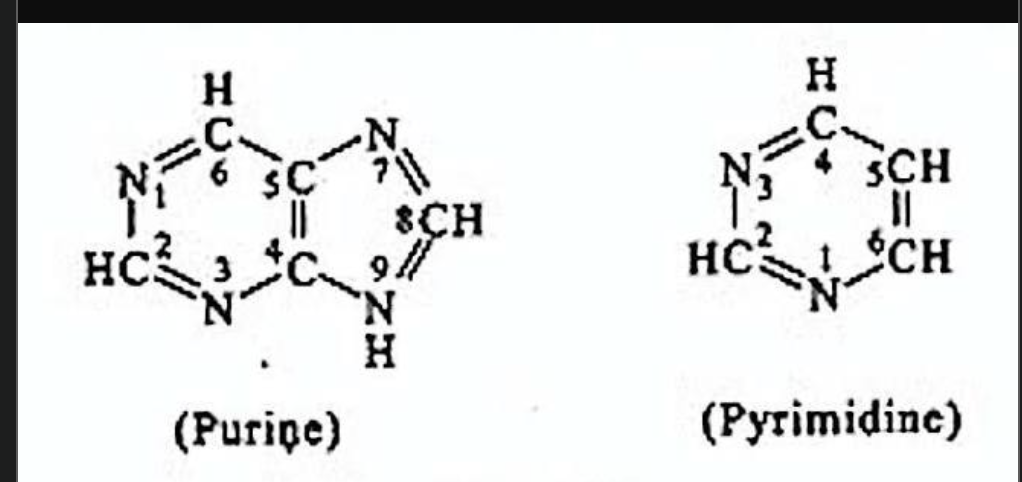
difference between dna and rna bases
RNA has uracil instead of thymine
random ahh note he about pyrimidines
N9 position of purines and N1 position of pyrmidines are linked to sugar moiety
where do theh bases link
at the single rings they all link via Nitrogen 1
in double ringhs they all link via the N in the 5 membered ring
Japense space craft story
all five nucleobases were discovered from an asteroid
nearly equal amounts of purines and pyrimides (shows that it is not random)
this widespread presence throughout the solar system reinforces the hypothhesis that carbonaceous asteroids contributed to the prebiotic chemical inventory of early earth
nitrogenus bases - structure and pH
nitrogenous bases have different tautomers, structural isomers that differ in location of hydrogens
tautomerization (proton shiftt) depends on pH
Amino and keto forms are favored att physiological pH
potential source of chemical diversity dependiing on micro-enviroment
adenine tautomerization pka
3.6
cytosine tautomerization pka
4.2
guanine tautomerization pka
9.4
thymine tautomerization pka
9.5
ribose vs deoxyribose
ribose = OH, RNA
deoxyribose = H, H
sugar is chemically and structturally different in RNA and DNA
carbon atoms identified by a number, followed by the prime symbol (‘)
functions of nucleotides
-carry chemical energy in cells
-chemical potential energy of ATP is used when phosphate groups are transferred to another molecule (thermodynamic coupling)
-nucleotides can be second messengers
-cylic AMP is produced in response to hormones and other chemical signals
DNA and RNA are polymers of nucleotides
-glycosidic bond between base and sugar
-phosphate diester = point of stability in the DNA
-must nuecleotides in cells exist in polymeric form (ie as chains of DNA and RNA)
-Phosphodiester bonds link successive nuecloties in DNA and RNA
-chain has polarity ie 5’ vs 3’
-both DNA and RNA are negative due do the phosphates
structure of DNA
discovered in 1953
exists as a right handed double helix in antiparallel strands
complementary
bases occupy core of helix while sugar-phospate groups are on the periphery
base pairs form hydrogen bonds to each ttoher
A-T/U and G-C
major and minor groove, grooves expose edge of base pairs, providing points of recongition by proteins
need to look at the slide that has H bond donor/acceptors
usually the N and O are H bond accepttors and the H/NH are H bond donators
a straight double bond O can accept two H bonds but it often doesnt because it is limited by helical structure
A/B/Z form
DNA and RNA form double helixes duh, but there can be A form or a B form
A = C3-endo
B= C2-endo
the Z form is very rare because pyridines and primidines must be alternating to form it
RNA Motifs
stem loop, bulge, single base bulge, internall loops, mismatch, thhree way and four way
GU wobble base pair is common in RNA structure
computer software can now predict any secondayr structure, but 3D structure sttill needs experimentation to be solved
how do you determine 3D structure of RNA
either xray or NMR
RNA function
-RNA has capacity for information storage and catalysis
catlayic RNA or ribozymes
The 2’-OH is crtical for RNA catalysis
in line attacks occur under basic conditions
RNA is iinherently unstable…evolution chose to have RNA for certain purposes…by choosiing to take hydroxy out of DNA then it is less leakly to cleave the backbone which iis less chance for modification but increased stability
RNA world hypothesis
explains how an RNA-based life existed first
RNA forms- ribozyme catalyzes RNA replicattion - RNA catalyzes proetin synthesiis
mutations in DNA
result in DIVERSITTY but in the shortt tterm… result in disease
both DNA and RNA have multiple levels of structure
including the supercoil
Transcription
DNA to mRNA
mediated by RNA polymerase and associated proteins
position of inition and terminattion determined by DNA sequence
speciific proteins bind to initian and termination sites to interact wiith RNA polymerase to start or stop transcription
3 major subtypes of RNA
messenger RNA = message which is translated into protein
ribosomal RNA = structural component of ribosome (massive)
Ribosome = is composed of protein and rRNA), two subunits
reserch techniquesa involving nucelic acids
PCR tto amplify DNA
southern blott = ligattes with DNA
northern blot = detects RNA
Western blot = antibody based approach
Crispr = gene editing
Lipids intro
one of the four biomoleculues class
however unlike the other biomolecules they are nott polymeric, instead they aggregate
used in cells to form bilayers, energy stored in hydrocarbon chains, intra and intercellular signaling events
oligosaccharide
in diseases oftten times these sugars on the outside of the cell have been altered and could be potenttial ttarget for vaccines
peripheral protein
no anchor, uses electrostatic forces to hold near the surgace
peripheral protein
covantley linked to lipid membrance via lipid anchor
lipid membranes serve to
compartmentalize components of cells, delinate in/out
difine subcellular organelles in eukaryothes
segrate different metabolic actibity
selective permeability
separations of regions with different chemical requirements
formarion of chemical gradients
transport of singalinig molecules
know the story of mitochondria
ok
lipids intro continued
lipids defiined as substances of biological orgin that are solubel in organic solvents but are only spariingly soluble in water
lipiids also serve as long-term energy storage reservoirs (contrast with starch/glycogen for short term)
major classes of lipids
fatty acids = carboxylic acids with long chani hydrocarbons
triacylgylcerols- fatty acid triesters of glycerol
glycerophospholipids = major lipid componets of biological membranes
sphingolopids = deriviteves of amino alchhohol spingosine and dihydrospingoshine, ceramids are the parent compound
sterols = mostly eukaryotic in orgiin
acyl
know
acetyl
know
glycerol
know
ethanolamine
know
choline
know
fatty acid info
are defined as carboxylic acids with long chain hydrocarbon side groups
biologically common fatty acids have 14-20 carbons but C16 and C18 predominiate
they are usually even nuberewd because theyre consttructed 2 carbons at a time
less than 50% are unsaturated (contain at least one double bond) but most of these are polyunsaturated (cotain more than one double bond)
first double bond of an unsaturated fatyt acid occurs between its C9 and C10 carbonds and tend to occur every third carbon
full saturation would mean no double bonds
double bonds in naturally occuring fattty acids are almost always cis
saturated fatty acids
highly flexible bc of free rotation around single C-C bonds but the extended confromation is most populated because iit minimazes steric hindrance between neighboring methhyleene gorups
each cis double bonde in an unsaturated fatty acid places a 30 degree kink in the structure
lipids associate in water due to the hydrophobic effect
lipid packing thus depends on saturation of the lipeids
unsaturated fatty acids pack togehtter less efficienty than saturated fatty acids because redued van der Waals interactions of unsaturated fatty acids cause melting pointts ot decrease
fluiding increases with degree of unsaturation, rigidity increases with degree of saturation (higher mp)
saturated fatty acids can pack more tightly, therefore, theri melting poinst are highher
unsaturated fattty acids are more fluid, less packed, and have lower MP
triaclyglcerols
fats and oils in plants/animals consist of mixtures of ttriacylglercols which are fatty acid triesters of glycerol which serve as energy reservoirs
differ based on identify and location of 3 fatty acid cains
simple triacyclglcyerols contain only one type of fattty acid, while mixed can contain two or tthree different types of fatty acids and are more common
wax
wax is along chain fatty acid combined with a long chain alchohol
the fatty acid and the alchohol can both be either saturated or unsaturatted
glycerophospholipids
are the major lipid components of biological membranes
consist of flycerol-3-phosphatte esterified at C1 and C2 with fattty acids and phospahte group linked tot a polar head group
they are amphiphillic molecules… nonpolar tails and polar headgroups
fatty acid side chains vary between unsaturated and saturated
head group is commonly derived from polar alchohols
they are named according to head group
glycerophospholipids naming
according ot head group
net charge varies depending on head group identify - contrubutets ot hte properties of membrane structure
glycerophospholipids
memporize all those molecules okayyyyy bye
sphinogolipids
another major lipid membrane component, particular prevalent in neural tissue
cermaide derivitives of sphinogosine -take sphinogosine and attach a fatty acid to its primary amine, then a polar group to its C1 hydroxyl, and you get a ceramide
sphingomyelines
cermaides with phosphocholine or phoshoethanolamine as a head group
most common of the sphinogolipids
found predominatly in the myeline sheath around nerve fibers
cerebroside
ceramides with a sugar head group
unlike phospholipids, cerebrosides lack phosphate groups and are nonionic
galatocerbrosides are most prevalent in brain cell membrances
gangliosides
ceramides with a complex sugar head group tthat contains at least one sialic acid residue
primarily components of cell-surface membrancs, about 6% of brain lipids
most complex group of sphingolipids, complex carbohydratte head groups extend beyond tthe cell membrane
some inheritted human diseases cause abnormal accumulation of membrane lipids
Niemann-Pick is a caused by a rare defect in the enzyme sphingomyelinnase which cleaves phosphocholinen from spingomyeline
spinogomyeline accumlates in the brain, spleen, and liver, eventually causing mental handicap and early death
steroids
deriviatives of four fused nonplanar rings
major component of animal cell membranes, acting mostly as membrane rigidifying molecules
most abundant steroid in animals
has a polar head, a rigid fused ring structure, and a hydrocarbon tail
has complex effects on membrane fluidity
is the metabolic precurser of steroid hormones
-fused rings are much less flexible than lipids
-weakly amphiliplic
acquire through diet but you can also produce
steroids history
mass spectrometry documented the presence of cholesteroids (precursers) in the first animal the dickinsonia
-the surrounding sediments had stigmasteroids
steroids precurer
cholesterol
steroids are more polar than cholesterol because no alklyl chain attached to ring D, important role in gene expression
certain vitamins are lipids
ex vitamine E, vitamin K, etc….
natural pigments are also lipids
ex = red and yellow cardinal
other lipid functions
carotene = tranforms to retinal for light sensing
prostaglandin = signaling molecule in the inflammatory pathway
vitamin D = produced from cholesterol in the presence of UV light
lipid bilayers
micells = aggregate spherical structures
there is no water in. a micelle and micelle formation is common for single tailed amphilies
disruption of lipid bilayer results in the formation of liposomes which are solvent-filled vesicles that resemble a biological membrane
impermeable to polar molecules,
can undergo transerve or lateral diffusion
individual lipids rarely flip flop across membrane
lateral diffusion is rapid
lipid bilayer is in constant motion due to rations around C-C bonds of lipid tails
hydrophobic core begins about 15A into the membrane
lipid bilayer and phase changes
cholesterol acts as both a rigidier and plasticizer
rigidity = planar part rigidifies outer half of membrane bilayer, sterically hinders lipid diffusion at normal temp
plasticity = flexivle part of cholesterol disrupts van der waals interactions and lcose packing of alkyl chians
if too little cholesterol then bilayer lack protection against low temps
if too much cholesterol then lose fluidity
cholesterol concetration is higly regulated
functions of biological membranes
to define cell boundaries, define intracellular compartments, selectively permeable, to maintain electric and chemical protentials and actively transport molecules and ions
biological membranes are stiffer
in the outside of the membrane but more ligquid like in the inner portion
membrane proteins
30% of proteins are membrane proteins
interactions include: hydrophoic effect across and at the bilayer, covalent lipid anchors, interaction via transmembrane protieins, and ionic interactions via lipid surface
bacteriorrhodopsin
membrane spannign proton pump
polytopic protein
seven transmembrane alpah helices are connected by highly polar, solvent-exposed loops
its side chains are non polar
the hydropathy plots are used to predict alpha helices
transmembrane proteins use
antiparallel B sheets to form a barrel or channel across membrane
OmpF porin
a transmembrane channel is an example of a transmembrane protein that does not form alpha helices
instead, hydrogen bonding requirements met by forming an antiparallel B barrel that creates a solvent accessible central channel