Y9 Chem: Unit 1.1: Atomic Structure
 Call Kai
 Learn
Learn Practice Test
 Spaced Repetition
 Match
Match Flashcards
 Knowt Play
1/26

There's no tags or description
Looks like no tags are added yet.
Name | Mastery | Learn | Test | Matching | Spaced | Call with Kai | Chat |
|---|
No analytics yet
Send a link to your students to track their progress
27 Terms
three types of subatomic particle, their relative charge, relative mass and symbol.
protons, +1, 1, p
neutron, 0, 1, n
electron, 1/1840, -1, e-
atom
smallest unit of matter that has the chemical properties of an element
subatomic particles
units of matter that are smaller than an atom
mass number
total number of protons and neutrons in an atom
atomic number
number of protons / electrons in an atom, unique for each element
where are the subatomic particles located?
protons and neutrons in the nucleus
electrons in shells around the nucleus
why are no. of p and no. of e- equal for atoms?
to keep the charge of the atom neutral overall
most of an atom is (1)
most of an atom’s mass is in the (2)
an atom is (3)m large in terms of radius and the (2 again) is (4)m large in terms of radius.
air
nucleus
1×10⁻¹⁰
1×10-14
isotopes
atoms of the same element with the same number of protons (atomic number) that have a different number of neutrons and mass (mass number).
Why is the mass number usually whole but the relative atomic mass decimal?
Because the mass number shows the number of protons + neutrons and you have to have a whole number of atoms.
Whereas relative atomic mass being the weighted average of all isotopes and their abundances which could be made a decimal based on the numbers you are working with.
A weighted average of an element's isotopes.
when referring to isotopes to differentiate them you…
add their mass at the end
isotopes have the same (1) properties but not the same (2) properties.
chemical
physical
relative atomic mass definition
the average mass of an element’s atom relative to 1/12 of the mass of an atom of carbon-12
we express mass of atoms in (1) also known as (2).
one of these units is more simply the mass of a (3) or (4) with a relative mass of 1.
atomic mass units
amu
proton
neutron
How do you calculate relative atomic mass? (isotopic abundance)
Multiply each isotope's mass by its abundance, add them together, then divide by 100

these are symbols for (1).
the one on the left shows rubidium with an atomic number of (2) and a mass number of (3).
the one on the right shows rubidium with an atomic number of (3) and a mass number of (4).
this means they are (5), because… (6 - explain)
Rubidium
37
85
37
87
isotopes
they have the same atomic number but different mass number
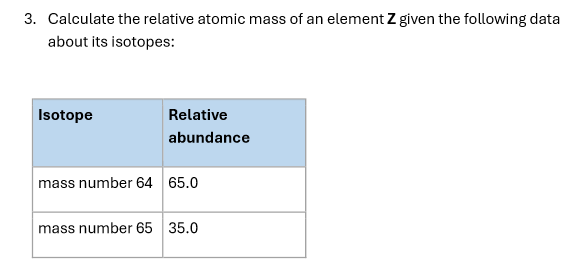
form the equation.
64 × 65 + 65 × 35 / 100
What did Democritus suggest about matter?
What did Dalton's early atomic model perceive atoms as?
What did Thomson discover?
What was Thomson's atomic model?
Matter was made from tiny particles called atoms
tiny solid spheres with different types for elements
electrons
the plum pudding model
What did Rutherford conclude?
What problem did Rutherford's model have?
What did Bohr propose?
Atoms have a tiny dense positive nucleus and are mostly empty space
Electrons should be attracted towards the positive nucleus.
Electrons occupy shells around the nucleus.
describe how the dalton model of an atom has changed over time because of the discovery of subatomic particles
Dalton’s solid sphere model changed as electrons, protons and neutrons were discovered, and also electron shells, showing atoms are made of smaller subatomic particles with each one being in a different place.
how does the existence of isotopes result in relative atomic masses not being whole numbers.
Elements contain different isotopes in different relative abundances, so with their relative atomic mass being a weighted average doesn’t always mean a whole number answer due to no need for rounding for precision.
An element has two isotopes:
X-63
X-65
Its relative atomic mass is 63.6.
Calculate the percentage abundance of X-63.
Form the equation solving for the % abundance of X-63 representing that as x.
63x + 65(100-x) / 100 = 63.6
This is the equation to solve the question below:
63x + 65(100-x) / 100 = 63.6
An element has two isotopes:
X-63
X-65
Its relative atomic mass is 63.6.
Calculate the percentage abundance of X-63.
Explain how the following numbers got into the equation:
63
65
x
100-x
/100
63 is the mass of isotope 1
65 is the mass of isotope 2
x is the abundance of isotope X-63
100-x is the abundance of isotope X-65 because the relative abundance of all the isotopes will add to 100
/100 is the calculation to get the weighted average
difference between relative atomic mass and mass number.
mass number = no of protons + neutrons
relative atomic mass = average mass of all isotopic atoms of an element relative to 1/12 of one atom of carbon-12
rutherford’s gold experiment
method
discovery
conclusion
Method: Fired positive alpha particles at a thin sheet of gold foil and detected where they went.
Discovery: Most passed straight through, but some were deflected and a few bounced back.
Conclusion: Atoms are mostly empty space with a tiny, dense, positively charged nucleus containing most of the mass where the rays deflected.