Emotion and Biological Psychology
 Call Kai
 Learn
Learn Practice Test
 Spaced Repetition
 Match
Match Flashcards
 Knowt Play
1/113

There's no tags or description
Looks like no tags are added yet.
Name | Mastery | Learn | Test | Matching | Spaced | Call with Kai | Chat |
|---|
No analytics yet
Send a link to your students to track their progress
114 Terms
epistemic emotions
curiosity, confusion, surprise, interest, wonder
closely tied to knowledge, learning, and cognitive processes
arise in response to situations involving uncertainty, curiosity, insight, or the pursuit of understanding
crucial in motivation for learning, problem-solving, and critical thinking – signal that something needs to be understood or resolved, prompting further cognitive effort
doubt-certainty cycle (KOLLA UPP?)
curiosity
the desire to acquire new knowledge
epistemic emotion
confusion
a reaction to conflicting or unclear information
epistemic emotion
surprise
a response to unexpected information
epistemic emotion
interest
engagement with novel or complex stimuli
epistemic emotion
wonder
a deep sense of awe or fascination, often about something vast or mysterious
epistemic emotion
definition of emotional episode
an event-focused, two-step, fast process consisting of
a) elicitation mechanisms that
b) shape multiple responses (e.g. behavioral, physiological, and subjective feeling)
provides us with information about the environment and prepare us to handle it and reach our goals

components of an emotional response

action tendency as emotional response component
approach – avoid
subjective experience as emotional response component
conscious experience of feeling
physiology and somatic respons as emotional respons component
autonomic nervous system
endocrine systems
expression as emotional response component
facial expression
posture
movement
cognitive as emotional response component
attention
cognitions
decision-making
volitional control as emotional respons component
the conscious capacity to regulate actions, emotions, and impulses to align with personal goals or values
KOLLA UPP
functions/adaptive purposes of emotions
inform us about the environment and prepare us to handle it and reach our goals, e.g. increasing survival (although is gets out of hand sometimes…) and well-being
guide behavior
facilitate decision-making
prioritize attention and memory
regulate physiological states
support social communication
emotions as functional states
Adolphs & Anderson’s idea that defines emotions by what they do, rather than how they are implemented
illustration: a clock is defined as something that shows the time, rather than by the multiple implementations it can have
brain state
an instance of an emotion
not all instances of the same emotion have an identical such state
properties of emotion states
scalability: emotion intensity (roughly like arousal)
valence: evaluation, good/bad
persistence: lasts longer than stimuli
generalization: over stimuli and behavior
global coordination: engages the whole organism
automaticity: greater priority over behavior than volitional actions
social communication: signals to other organisms
can be used to separate instances of emotion states!
necessity of emotion causation theories
should explain:
elicitation: why a given event evokes an emotion
differentiation: why the evoked emotion is of a specific kind
and the psychological mechanism, i.e. the process through which this is achieved
evolutionary origin of emotions
originally served to guide action
all living organisms share some fundamental characteristics:
the are autonomous systems
they can produce self-initiated movements
their movements show direction: they move towards some things and away from other
→ to determine the direction, some type of evaluative process is needed → the forerunner of our emotions
emerging consensus among emotion researches
emotions…
are complex phenomena
have evolutionary origins, but are shaped by cultural factors
serve as an “interface” between the organism and its environment
are elicited by some type of “information processing”
have a number of important functions (usually of social nature)
include several components (e.g. expression, physiology, action tendencies)
involve changes in mental and bodily components that are centrally represented as feelings (which can be labeled)
dominant approaches in emotion theory
categorical
basic emotion theories
cognitive appraisal theories
associative theories
dimensional
unidimensional models
multidimensional models
hybrid
constructionist theories
multilevel theories
categorical approaches
theories that assume that people experience emotions as categories, which are distinct from each other
agrees on that learning is involved to some extent
basic emotion theories (BET)
categorical approach, assumes that there are a limited number of innate and universal emotion categories
there’s a set of survival problems that most living organisms have in common → these problems require adaptive responses → these responses are seen as the “prototypes” of human emotion
some say that basic emotions may combine with other emotions or cognitive contents to create more complex emotions
have their roots in Darwin’s work on emotional expression
examples of adaptive responses in basic emotion theories (BET)
fear, to avoid danger
interest, to search for food
joy, to cooperate with others
anger, to compete for resources
desire, to procreate
disgust, to avoid toxic substances
tender love, to care for offspring
possible support for basic emotion theories (BET)
early development
phylogenetic continuity
cross-cultural consistency in the antecedent conditions
cross-cultural accuracy in facial and vocal expression
categorical perception of emotional expressions
distinct patterns of psychophysiological changes
distinct brain networks
Panksepp’s seven emotional systems
well-known model in basic emotion theories (BET), that defines emotions as fixed biological building blocks, not psychological constructions
argues that we are born with seven fixed, subcortical circuits:
SEEKING: generalized motivational arousal
RAGE: affective attech
FEAR
LUST: sexuality
CARE: nurturance/maternal
PANIC: separation distress, social bonding
PLAY: social joy and affection
learning only conditions what triggers them and how we regulate the behavioral output

criticism against basic emotion theories (BET)
little agreement about how many emotions are basic, which emotions are basic, and why they are basic – if there really are basic emotions, how can there be so much disagreement?
can’t explain the variety of emotions people experience in life
not that much distinct patterns in expressions, physiology, or neural activity
cognitive appraisal theories (CAT)
categorical theories, focus on how specific profiles of appraisal outcomes determine the emotion
says that emotions are elicited and differentiated on the basis of a person’s subjective evaluation, of the personal significance (usually related to goals, motives, and plans) of a situation, object, or event on a number of dimensions or criteria
assume “emotion specificity” in the response

comparison of basic emotion theories (BET) and cognitive appraisal theories (CAT)
similarities:
assume “emotion specificity” in the response
categorical approaches
differences:
(most) CAT assume that emotions will reflect the outcomes of individual criteria in even more specific ways
CAT often postulate a much larger number (even infinite) of emotions
criticism against cognitive appraisal theories (CAT)
disagreement among researchers about the exact number and identity of the criteria required to account for emotions
also disagreement about the appraisal profile for each emotion: even if they agree on the criteria, they may not predict the same pattern for the emotion
appraisals have mainly been studied with verbal self-reports (recalled emotional episodes) – critics argue that this is studying what people think causes their emotions rather than the actual causes
inconsistent in the view of subconsciousness: responds with “appraisals may occur subconsciously” when accused of being too cognitive, but at the same time assuming that subjects can report upon their appraisal processes (which is not possible if it’s outside consciousness)
appraisal may not be the only mechanism! when trying to predict specific emotions based on ratings of criteria, only 40-50% of episodes are classified correctly
associative theories (AT)
categorical approaches, range from simple condition theories to complex semantic networks
emotions are recorded in memory → activation of these memories is the most frequent cause of emotions in daily life
claim that most stimuli evoke emotions as a result of learning and emotional conditioning
not all of them are focusing on how emotions are caused. some just investigate the link to memory
neo-behavioristic
emotional conditioning
learning processes in LeDoux’s Higher-Order Theory of Emotional Consciousness (associative theory, AT)
a new neutral stimulus acquires “emotional power” via repeated pairings with another stimulus that is already stored in memory as part of an “emotion schema” → previously neutral stimulus will eventually evoke that emotion on its own
very similar to classical conditioning
Rolls’ emotion classification scheme
associative theory (AT), similar to operant conditioning/instrumental learning
we are born with primary reinforcers (e.g. pain), and learn secondary reinforcers (e.g. money) by associations throughout life
emotions = states elicited by rewards and punishments (reinforcers), and by the omission or termination of such reinforcers
categorizes emotion in terms of:
a. whether the reinforcer is positive (reward) or negative (punishment)
b. by the contingency relationship between the response and the reinforcer

criticism against associative theories (AT)
not very informative about what stimuli will tend to evoke what emotions
underestimates innately prepared responses: any stimulus should be capable of eliciting any emotion, but this is not really true – we learn some associations easier than others, e.g. easier to develop a phobia of snakes than lightbulbs
circular reasoning: the emotion (e.g. joy) could be the reward and the elicited emotion
sneaks in some cognitive interpretation elements: acknowledgement that associations alone can’t explain the full range of emotions experienced by people
neglect evidence of multiple emotion systems within the brain
little effort to analyze cultural differences in emotions (probably because mostly animal studies)
primary reinforcers kinda similar to affect programs in BET
dimensional approaches
conceptualize emotions based on their placement along broad and continuous dimensions
not usually regarded as theories of emotion causation – the goal is rather to describe the structure of emotional experience (feelings) – but often part of hybrid theories
come in many different forms: one-dimensional, two-dimensional, three-dimensional
circumplex model of emotions/core affect
two-dimensional model that illustrates that emotions vary in their similarity to each other
says that we are always experiencing some core affect – at a given moment, the conscious experience is a single integral blend of two dimensions
economic way of representing affective responses

criticism against the circumplex model/core affect
blurs important psychological distinctions: emotions placed roughly at the same position can be quite different (e.g. angry and afraid are both high in arousal and unpleasantness, but very different in terms of their implications for the individual, such as different action tendencies)
people actually don’t seem to experience a feeling all of the time, in fact maybe only 25% of the time
confuse emotions (intense, short-lived responses to events) with moods (weaker, more floating, without a specific object)
methodological problems: the model might just be random from the factor analyses
we can experience opposite emotions at the same time, this model doesn’t acknowledge that
there might be two arousal dimensions reflecting different physiological systems
dimensions may not be superior to categories
emotions might manifest earlier than valence and arousal
hybrid approached
combine categorical and dimensional aspects
come in different forms: constructionist and multilevel
theory of constructed emotion (TCE) (Feldman Barrett)
hybrid approach constructionism theory, says that emotions aren’t in principle distinct from cognitions and perceptions – no brain systems dedicated/unique to emotions at all
emotions are “created on the fly” every time. the brain uses concepts (required: without a concept for fear, you can’t experience fear) to give meaning to both internal and external sensations – if the concept happens to be about emotion, the brain is constructing an emotion
social construction: empasizes the importance of culture and language-based concepts
psychological construction: argues that emotions are constructed from various mental elements that are not specific to emotions
hybrid model: interpretative layer for emotion categories/concepts, affect layer with biological dimensions/core affect

criticism against theory of constructed emotion (TCE)
doesn’t escape the problems with core affect – if all mental states are conceptualizations, core affect should be too, but it’s seen as a biological primitive
emotions feel very different from other mental states, which contradicts the idea of the same domain-general core systems for all mental states
the focus on language forces an awkward position: it there’s no swedish word for an english term of emotion X, do swedes not experience emotion X?
difficult to test: no clear hypotheses on how the brain relates to emotions, unclear distinction between emotions being triggered vs created, “predicts variability” but there’s always variability (i.e. impossible to falsify)
if concepts are absolutely necessary, how can we create the concept of fear without experiencing fear? no infant or animal could never have emotions – fails to explain how emotions evolved
not realising that we can experience multiple emotions (e.g. anger and happiness) at the same time
doesn’t differentiate feelings from emotions – emotions are labeled feelings
multilevel theories (MLT)
many different causes of human behavior and emotions, i.e. emotions are multiply determined – a single emotion mechanism is unable to account for all emotions
these theories can resolve some of the problems associated with other theories
reflect both universal and culture-specific aspects
accounts for variability and individual differences
can explain that more than one emotion can occur at the same time (occurance of mixed emotions)
cover emotions not addressed by traditional theories
more consistent with neuropsychological findings
incorporates both dimensional and categorical aspects
different events may activate different mechanism, and different mechanisms have different emotions related to them (?)
the BRECVEMAC theory
different types of emotions are aroused by different types of mechanisms at different levels of the brain. the lowest levels may involve mainly the arousal dimension and proto-emotions (e.g. surprise), whereas the highest levels may involve more complex and even aestethic emotions
features nine mechanisms, which involve more or less distinct brain networks, thought to have evolved sequentially/gradually through evolution
Brain stem reflex
Rhythmic entrainment
Evaluative conditioning
Contagion
Visual imagery
Episodic memory
Musical expectancy
Aesthetic judgment
Cognitive appraisal
main problems for emotion theories
emotions are a less perfectly homogenous class of phenomena
instead of agreeing on criteria distinguishing different emotions from each other, it might be easier to converge on a set of criteria that distinguish emotions from non-emotional phenomena
disconnection between psychological emotion theories and empirical studies in neuroscience
no shortage of either one, but they aren’t exactly working toghether
few neuropsycholocigal studies try to test theories of emotion, although there are a lot of neuroscience data on emotions
emotional perception vs emotional induction
observing and understanding vs internally experiencing
cognitive and sensory ability to detect and decode emotional signals in others or environment (e.g., looking at a sad face or listening to sad music and logically realizing it represents sadness)
vs
actual activation of your own subcortical circuits and autonomic nervous system, causing you to genuinely experience the emotion yourself (e.g., crying and feeling sad while listening to that music)
components of the central nervous system (CNS)
brain
spinal cord
afferent signals
goes to the brain (or intended brain region)
efferent signals
goes from the brain (or intended brain region)
gross division of the nervous system
central nervous system (CNS)
peripheral nervous system
components of the peripheral nervous system
networks of nerves and ganglia outside the brain and the spinal cord
divides into somatic and autonomic nervous system
neuron
nerve cells that handle/process/transfer information in the nervous system
consists of a cell body with a nucleus, dendrites, and an axon (surrounded by myelin sheath) ending in an axon terminal
glial cells
non-neuronal helper sells in the nervous system
don’t carry nerve impulses (action potential), but help with e.g. cleaning waste, digest parts of dead neurons, provide insulation (i.e. myelin) to the neurons’ axons, and regulate synaptic transmission
several different types, for example: astrocytes, schwann cells, and oligodendrocyte
autonomic nervous system
part of the peripheral nervous system that controls and regulates internal organs without us consciously recognising it
both reflexes and central regulation
divides into two major divisions that act complementary: the sympathetic and parasympathetic nervous system, sometimes also enteric and intrinsic cardiac nervous system
visceral nervous system
sometimes used as a synonym to the autonomic nervous system
sometimes seen as a system specifically for the afferents (input) from the viscera (internal organs), i.e. for interoception. the autonomic nervous system is then seen as the motor (efferent) component
insula
brain structure very important for the autonomic nervous system
primary interoceptive cortex that integrates bodily signals, tracking the state of the body
sympathetic nervous system
quick and mobilizing part of the autonomic nervous system that controls our “fight or flight” response
regulates vital organ functions
activates in “times of need”, especially under stress or danger
increases heart rate/blood flow, releases glucose to give us a quick burst of energy, and slows down enteric activity to save energy for immediate physical action, among other things
parasympathetic nervous system
slower and dampening part of the autonomic nervous system that controls “rest and digest”
helps to control body responses during times of rest
increases digestion rate, lowers heart rate, and calls for insulin release, among other things
ways of dividing the brain
gross anatomy
hemispheres
lobes
structures/regions
cytoarchitecture

cerebrum

cerebellum

brain stem

1
frontal lobe

2
temporal lobe

3
brain stem

4
cerebellum

5
occipital lobe
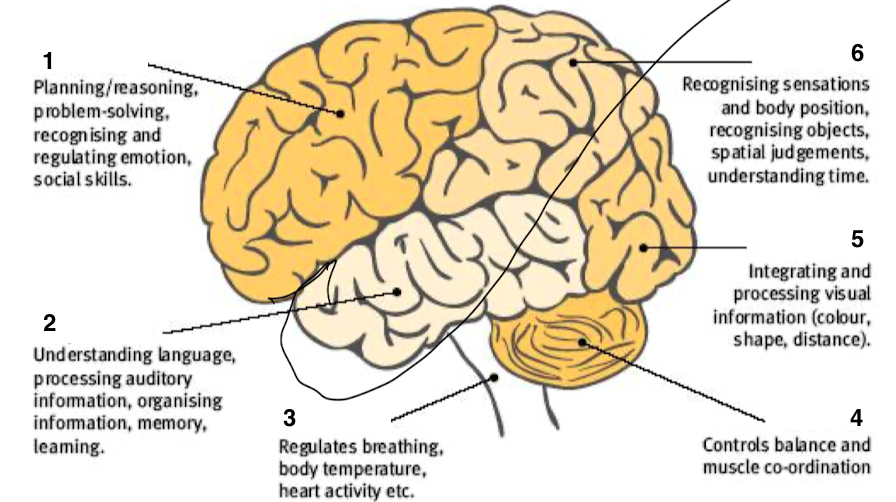
6
parietal lobe
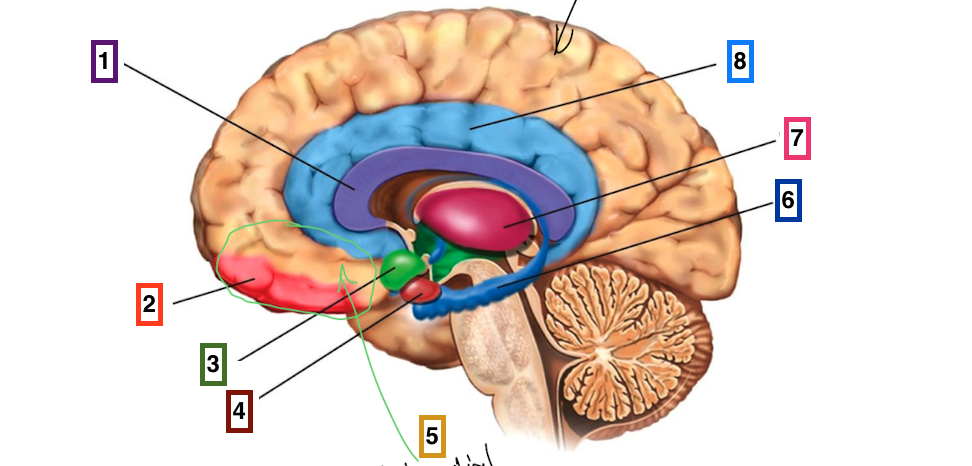
1
corpus callosum

2
orbitofrontal cortex

3
hypothalamus

4
amygdala

5
ventral-medial prefrontal cortex (important for emotion regulation)

6
hippocampus

7
thalamus
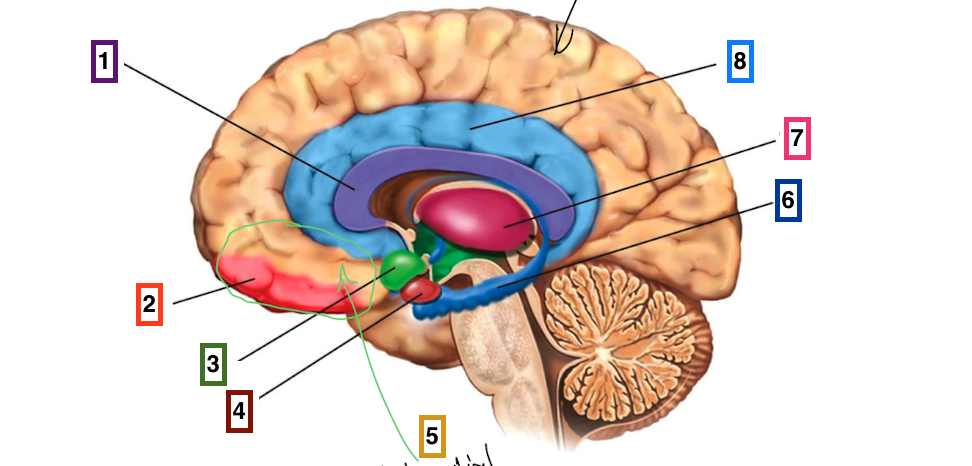
8
cingulate gyrus
frontal lobe tasks
planning/reasoning
problem-solving
recognising and regulating emotion
social skills
temporal lobe tasks
understanding language
processing auditory information
organising information
memory
learning
brain stem tasks
regulate breathing, body temperature, heart activity etcc
cerebellum tasks
control balance and muscle co-ordination
occipital lobe tasks
integrating and processing visual information (colour, shape, distance)
parietal lobe tasks
recognising sensations and body position
recognising objects
spatial judgments
understanding time
amygdala tasks
integrate information from different parts of the brain
salience detection
essential for the processing of emotional responses
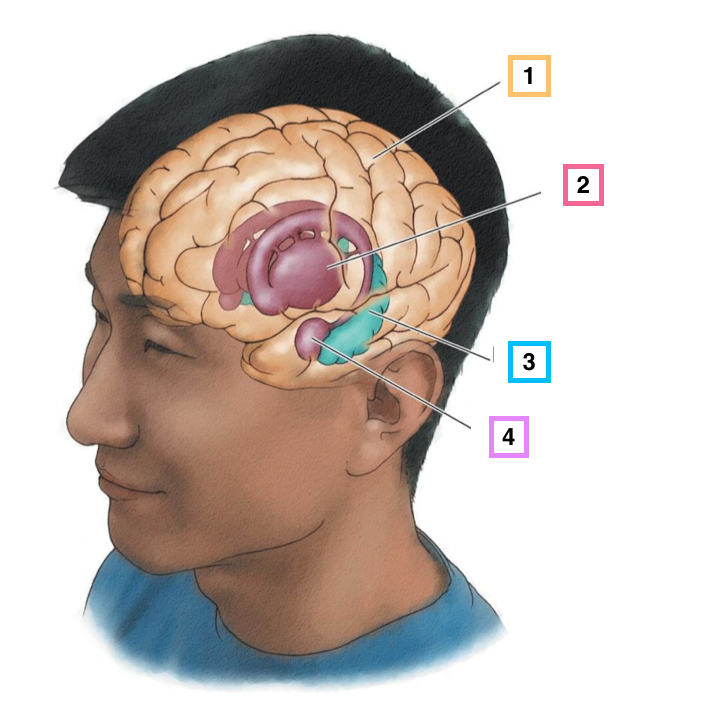
1
cerebral cortex

2
basal ganglia

3
hippocampus

4
amygdala
brief history of (thought) localisation of psychological functions
the brain was not originally seen as responsible, instead the heart, liver, blood, pineal gland, and humidity (among other things)
phrenology
idea that the mind is based in the brain, that is not seen as a unity but as distinct organs with distinct functions
the brain was said to be composed of different muscles – the bigger ones are those we use the most.
belied that personality traits can be predicted by measuring contours of the brain
discredited pseudoscience

division of the brain in functional areas

holistic view of the brain (Flourens, Lashley)
early form of distributed processing saying that the whole cerebrum contributes to higher functions
no specific place has a specific function → the location of brain damage doesn’t matter, only the size of the injury
equipotentiality: intact parts of the brain can take over functions from damaged areas
ideas of early connectionism/interactionism
Forms of distributed processing
Wernicke: basic functions localized to specific brain regions – complex cognitive functions involve connections between regions
Luria: block model where localized functions work in functional systems across three blocks
block 1: basal parts of the brain. wakefulness, basal attention, and affect
block 2: posterior cortex. receive, analyze, store information from the outside
block 3: frontal lobe. motor function, planning, executive functions
modern distributed processing in networks
networks are the basic building blocks for brain functions. they operate within the connectome (the brain's functional network)
it processes information by combining local specialization, where specialized functions are handled within network modules (functional segregation), and global coordination, where network hubs integrate that information across the brain (functional integration)
this topology is dynamic and meta-stable, meaning the networks can reorganize fast depending on the functional requirements
which parts are communicating at a timepoint changes → the network also changes over time


default mode network (DMN)
resting network of the triple network model
deals with self-reflection, memories, planning, inner focus
medial prefrontal cortex, posterior cingulate cortex, lateral and medial paretial lobe

salience network (SN)
network in the triple network model that deals with bahavioral relevance
detects what is important in the flow of information and deals with switches between default mode network and central executive network
anterior insula and cingulate cortex
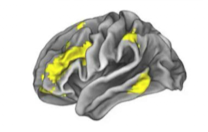
central executive network (CEN)
network in the triple network model that deals with goal oriented behavior, working memory, problem-solving, outer focus
dorsolateral prefrontal cortex, posterior paretial cortex
triple network model
model illustrating how distributed processing operates through three different networks

contents of networks
circuits, which consist of cells (neuron and glia) that communicate mostly through chemical processes at synapses, but sometimes also electrochemical
electrochemical neural communication
how a signal travels from one end of a neuron to the other (i.e. communication within cells)
resting potential → reaching threshold due to stimulation from another neuron → depolarization → action potential → repolarization → hyperpolarization → signal to next neuron
action potential
at rest, the inside of the neuron is more negatively charged (i.e. the resting potential is negative) because of an imbalance in the concentrations of ions – mostly in natrium (Na+) and potassium (K+) – and proteins
when a neuron receives signals from another neuron, the membrane potential is no longer in rest and gets less negative. when the charge reach the threshold (often -55 mV), action potential begins. the neuron is depolarised by Na+ entering through ion channels opened due to the action potential, making the charge inside the neuron positive. the Na+ channels are then closed and K+ channels opened, causing K+ to exit the neuron. these channels are a bit slow, so “too much” K+ exits. this makes the neuron hyperpolarized with an extremely negative charge, which makes it impossible for the potential to travel in any other direction than “forward”. when it reaches the axon terminal (the end of the neuron) the voltage change opens calcium channels
effects of the action potential on the presynaptic site
potential reaches voltage-sensitive terminal → opens calcium channels → calcium ions enter and bind to the protein calmodulin, forming a complex → the complex binds to vesicles → releases some of the vesicles and induces vesicles to bind to the presynaptic membrane and to empty their contents exocytosis