Food Safety Management Systems
 Call Kai
 Learn
 Practice Test
 Spaced Repetition
 Match
 Flashcards
 Knowt Play
1/14

There's no tags or description
Looks like no tags are added yet.
15 Terms
What role do veterinarians play in food safety?
• Primary production
Prevention and control of food safety hazards at the farm
• Slaughter, processing and distribution
Technical management and official controls
• International trade
Certification of compliance with animal health and food safety standards
What does food safety mean?
• Food safety: the guarantee that foods will not cause harm to the health of those who consume them, and it is a fundamental property of food quality
QUALITY
What does food security mean?
• Food security: the ability to obtain and/or to store basic food products to guarantee that food is available for consumption
AVAILABILITY
What does hazard mean, what does risk mean?
Ensure to clearly differentiate the two with examples.
• Hazard
• a biological, chemical or physical agent in, or condition of, food or feed with the potential to cause an adverse health effect
• Risk
• a function of the probability of an adverse health effect and the severity of that effect, consequential to a hazard

How did organizations transition to risk-based food safety approaches?
Transition to risk-based food safety approaches promoted by:
• World Trade Organisation (WTO)
Defined concept: of appropriate level of risk for a specific food type
• Organisation for Economic Co-operation and Development (OECD)
• Codex Alimentarius Commission (FAO and WHO)
• European Union (EU)
Food law based of food-risk analysis
What regulations lay down principles of food law?
Assimilated Regulation (EC) 178/2002:
• Lays down the general principles and requirements of food law
• Covers all stages of food and feed production, processing and distribution, 'from farm to fork'
• Established the European Food Safety Authority (EFSA)
EFSA is responsible for independent scientific advice and support
• Created systems to manage food safety incidents, e.g.:
Rapid Alert System for Food and Feed (RASFF)
What regulations lay down principles of hygiene?
Assimilated Regulation (EC) 852/2004, on the hygiene of foodstuffs:
• Lays down the general rules and principles on the hygiene of foodstuffs:
• Primary responsibility for food safety rests with the food business operator (article 1)
• Good hygiene practices
Annex I: primary production (i.e. farming, hunting or fishing), transport, storage and handling of primary products, and transport of live animals
Annex II: after primary production (i.e. slaughterhouses, processing plants, retailers)
• Procedures based on the hazard analysis and critical control point (HACCP) principles (article 5)
Assimilated Regulation (EC) 853/2004, on the hygiene rules for food of animal origin:
• Lays down the specific hygiene rules for food of animal origin:
• Products of animal origin can only be placed on the market if
prepared and handled in registered/approved establishments (article 4)
they have a health mark or identification mark (article 5)
Health mark (Indicates it is fit for human consumption and passed AMI and PMI at the abattoir) is applied by regulatory authority, FBO applies identification mark to the packaging
• Annex II, section II: objectives of HACCP-based procedures
• Annex III, Specific requirements for specific products:
meat (sections I:VI)
bivalve molluscs (section VII)
fishery products (section VIII)
dairy (section (X)
eggs (section X) ...
What regulation controls or lays down how verification of compliance to food standards is met?
Assimilated Regulation (EU) 2017/625 on official controls and other official activities to verify compliance with rules on food and feed law, animal health and welfare, plant health, and animal by-products:
• risk-based approaches
• 'farm to fork'
• assessment of procedures based on
good hygiene practices
principles of hazard analysis critical control points (HACCP)
staff performing official controls must be trained on the application of HACCP procedures
What is a food safety management system?
What are the key elements of FSMS? (The two main pillars + central pillars)
What is a food safety management system (FSMS)?
A food safety management system is a set of interacting elements forming a network to ensure that food presents a minimal risk to consumers...
What are the key elements of a FSMS?
Prerequisite programs (PRPs)
Good hygiene practices (GHPs)
Other (traceability, recall/withdrawal, training)
Operational prerequisite programs (oPRPs)
Procedures based on the hazard analysis and critical control point (HACCP) principles
Definitions:
PRP (Prerequisite Program): Baseline conditions and general good manufacturing practices (like handwashing, pest control, or general facility cleaning) that support a safe environment overall.
OPRP (Operational Prerequisite Program): Specific, measurable, and monitored control measures for identified significant hazards that do not rise to the level of a Critical Control Point (CCP).
CCP (Critical Control Point): A final, essential "kill step" (such as high-temperature cooking or pasteurization) where loss of control directly results in an unsafe product.
Define recall and withdrawal?
Recall
Recalled back when it has reached the market or consumers via retail
Withdrawal
If withdrawn from the supply or production chain, it has yet to reach the market yet
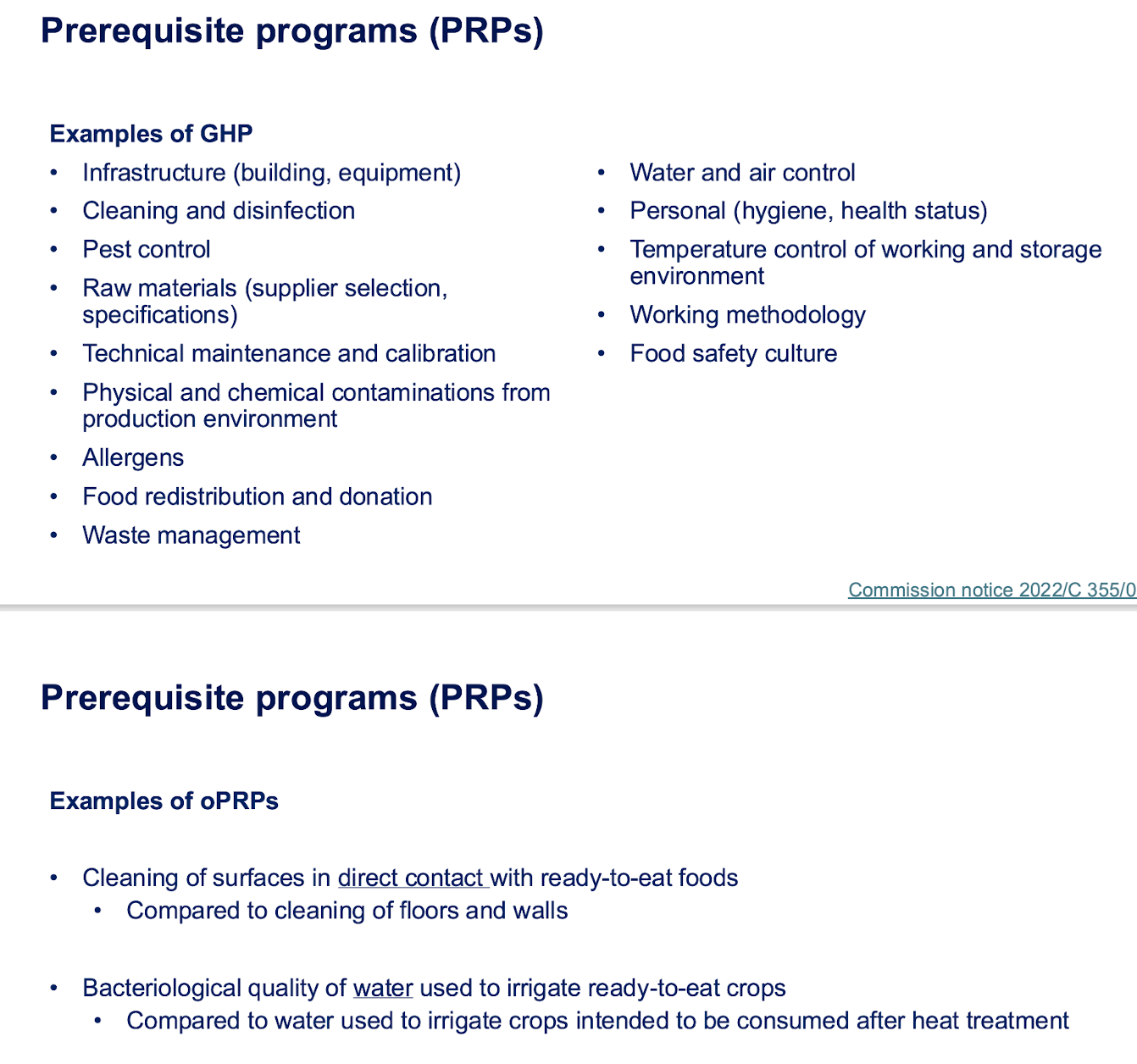
What are some examples of Prerequisite programs?
Includes GHPs and oPRPs
What are the seven key principles of HACCP?
Principle 1: Conduct a hazard analysis and identify control measures
Principle 2: Determine the critical control points (CCPs)
Principle 3: Establish critical limits
Principle 4: Establish a system to monitor control of CCPs
Principle 5: Establish corrective actions to be taken when monitoring indicates a deviation
Principle 6: Validate the HACCP plan and establish verification procedures
Principle 7: Establish documentation and record keeping
Describe the process of assembling a HACCP plan.
12 STEPS TOTAL.
1. Assemble a HACCP team
• The HACCP team is responsible for developing and maintaining a HACCP plan.
• HACCP team members are people who know the production processes well and understand hazards associated with the product
2. Describe the end product
• Raw materials/ingredients
• Production processes involved
• Packaging
• Distribution and storage conditions
• Other (e.g. shelf life, microbiological criteria applicable)
3. Define intended use
• Define the intended use of the product by the consumer
• Consider suitability to specific consumer groups
4. Construct a flow diagram
• Present all production processes in a flow diagram.
5. On-site confirmation of flow diagram
• The HACCP team needs to confirm during operational hours that the flow diagram reflects the production processes.
6. Conduct a hazard analysis and identify control measures (principle 1)
• Hazards that can occur at each step of the process are analysed:
• Probability of occurrence and severity ('risk')
• Acceptable/tolerable levels of the hazard in the product
• Potential for survival and multiplication of biological hazards
• Other factors (e.g. intended use)
7. Determine the critical control points (CCPs) (principle 2)
Critical control point (CCP): A step at which a control measure or control measures, essential to control a significant hazard, is/are applied in a HACCP system (The CCP is always a defined step in the flow chart produced)
8. Establish critical limits (principle 3)
• Critical limits separate acceptable (likely safe) from unacceptable (likely unsafe) products
• Critical limits must be objective, based on scientific evidence, and measurable or observable, e.g.
Milk pasteurisation (Reg. (EC) 853/2004):
a high temperature for a short time: at least 72 °C for 15 seconds
a low temperature for a long time: at least 63 °C for 30 minutes
• Acidification of raw egg products (pH ≤ 4.2 for mayonnaise)
9. Establish a system to monitor control of CCPs (principle 4)
• CCPs must be monitored by measurement or observation
• Monitoring should enable timely detection of deviations and prompt corrective action
• For each CCP, the HACCP plan should indicate:
• What should be monitored e.g. pasteurisation temperature and time
• Who should perform the monitoring e.g. person 'X'
• When should CCPs be monitored e.g. every batch
• How should CCPs be monitored e.g. by checking the instrument display
10. Establish corrective actions (principle 5)
• When CCPs are not under control, there is a need to consider
• The safety of the product since the last check (past)
• How to re-establish control (present)
• Root cause analyses to avoid recurrence (future)
• For each CCP, the HACCP plan should indicate:
• What corrective action(s) should be implemented
• Who is responsible for implementing corrective action(s)
• When should corrective action be implemented (usually immediately)
• How corrective action(s) should be implemented
11. Validate the HACCP plan and establish verification procedures (principle 6)
• Validation (Done BEFORE production): obtaining evidence that a control measure or combination of control measures, if properly implemented in the HACCP-based procedures and by the OPRP, is capable of controlling the hazard to a specified outcome
e.g. experimental evidence that the process will eliminate the hazard
• Verification (Done DURING production): the application of methods, procedures, tests and other evaluations, in addition to monitoring, to determine whether a control measure is or has been operating as intended
e.g. regular laboratory tests on the end product indicating absence of the hazard
12. Establish documentation and record keeping (principle 7)
• Documents and records that verify and demonstrate compliance with the HACCP plan:
• HACCP team composition
• Hazards analyses outcomes and justification
• Justification for establishment of CCPs, control measures and critical limits
• CCP monitoring activities
• Corrective actions taken following identified deviations
• Outcomes of verification procedures
• Updates to the HACCP plan
What is the objective of an audit for a food safety management system?
What are the key audit requirements?
The auditor must uphold what code or aspects of ethics?
Audit objective: to verify compliance with food safety and animal health and welfare standards
Key audit requirements
• Risk-based (Commission Implementing Regulation (EU) 2019/627)
• Informative to both FBO and Competent Authority
• Consistent
• Accurate
Auditor’s code of ethics
• Integrity
• Objectivity
• Competency
• Confidentiality
What are the compliance ratings that the auditor uses to judge a food safety management system?
• Good
• No issues of significance for public health, animal health or animal welfare
• Generally satisfactory
• No immediate issues of significance for public health, animal health or animal welfare identified on the day of the audit. Any NCs identified during the audit period corrected promptly
• Improvement Necessary
• Major NCs identified at audit and/or NCs during the audit period not always responded to and corrected promptly
• Urgent improvement necessary
• Multiple major NCs or critical NC identified during audit visit or interim audit period. Official intervention required to ensure public health safeguards.
**Ratings are published, abattoir desires a good audit, as also judges whether they get a follow up and how frequently the full audit occurs
