ECON TEST 2 - Chapters 4, 5 and 6
 Call Kai
 Learn
 Practice Test
 Spaced Repetition
 Match
 Flashcards
 Knowt Play
1/19

There's no tags or description
Looks like no tags are added yet.
20 Terms
Consider a demand curve that has a constant elasticity value of 0. What happens to quantity demanded and total revenue when price increases?
The quantity demanded does not change, but total revenue increases

Refer to Figure 5.8. Suppose the market is initially in equilibrium at price P1 and now the government imposes a tax on every unit sold. Which of the following statements best describes the impact of the tax? For demand curve D1, ___________
the producer bears a greater share of the tax burden if the supply curve is S2
If tolls on a toll road can be raised significantly before commuters will consider using a free alternative, demand for using the toll road must be _____
inelastic

Refer to Figure 5.9. Suppose the market is intially in equilibrium at price P1, and then the government imposes a tax on every unit sold. Which of the following statements best describes the impact of the tax?
The consumer will bear a smaller share of the tax burden if the demand curve is D1

Figure 5.7 shows the market for beer. The government plans to impose a unit tax in this market. Refer to Figure 5.7. What is the size of the unit tax?
$7
Suppose when Nablom’s Bakery raised the price of its breads by 10 per cent, the quantity demanded fell by 15 per cent. What was the effect on sales revenue?
Sales revenue decreased.

Figure 5.7 shows the market for beer. The government plans to impose a unit tax in this market. Refer to Figure 5.7. For each unit sold, the price sellers receive after the tax (net of tax) is ______
$20
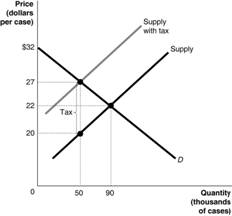
Figure 5.7 shows the market for beer. The government plans to impose a unit tax in this market. Refer to Figure 5.7 How much of the tax is paid by producers?
$2
To what is total revenue equal?
The price of a product multipled by the number of units of the product sold
If demand is perfectly inelastic, what is the absolute value of the price elasticity coefficient?
Zero

Figure 5.7 shows the market for beer. The government plans to impose a unit tax in this market. Refer to Figure 5.7. For each unit sold, the price sellers receive after the tax (net of tax) is _________.
$20
Which of the following correctly comments on the following statement? ‘The only way to increase the revenue from selling a product is to increase the product’s price’.
This statement is not true. Revenue will increase as the price of the product increases only if demand is inelastic.

Figure 5.7 shows the market for beer. The government plans to impose a unit tax in this market. Refer to Figure 5.7. How much of the tax is paid by producers?
$2
A private school is considering increasing its tuition to raise revenue. If the school believes that raising tuition will increase revenue, _________.
it is assuming that the demand for attending the school is inelastic
When demand is unit-elastic, a change in price causes total revenue to stay the same because ______.
the percentage change in quantity demanded exactly offsets the percentage change in price
Suppose a decrease in the supply of bottled water results in a decrease in revenue. What does this indicate?
That the demand for bottled water is elastic in the price range considered
Suppose an excise tax of $1 is imposed on every case of beer sold, and sellers are responsible for paying this tax. How would the imposition of the tax be illustrated in a graph?
The supply curve for cases of beer would shift to the left by $1.
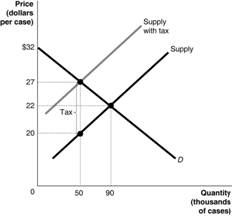
Figure 5.7 shows the market for beer. The government plans to impose a unit tax in this market. Refer to Figure 5.7. The price buyers pay after the tax is ______.
$27
The price elasticity of demand for canned soup is estimated at -1.62. If the price of canned soup rises, sales revenue ___________.
falls