CFS Flashcards
 Call Kai
 Learn
 Practice Test
 Spaced Repetition
 Match
 Flashcards
 Knowt Play
1/19

There's no tags or description
Looks like no tags are added yet.
20 Terms
Discuss the merits of short term and long term debt sources for the finances of working capital

Explain the difference between hard and soft capital rationing
Hard - external, business cannot raise enough debt or equity finance to fund the investment.
Soft - internal, the business has sufficient access to funds but chooses to limit investment for strategic reasons.
Give examples (at least three) of different dividend policies
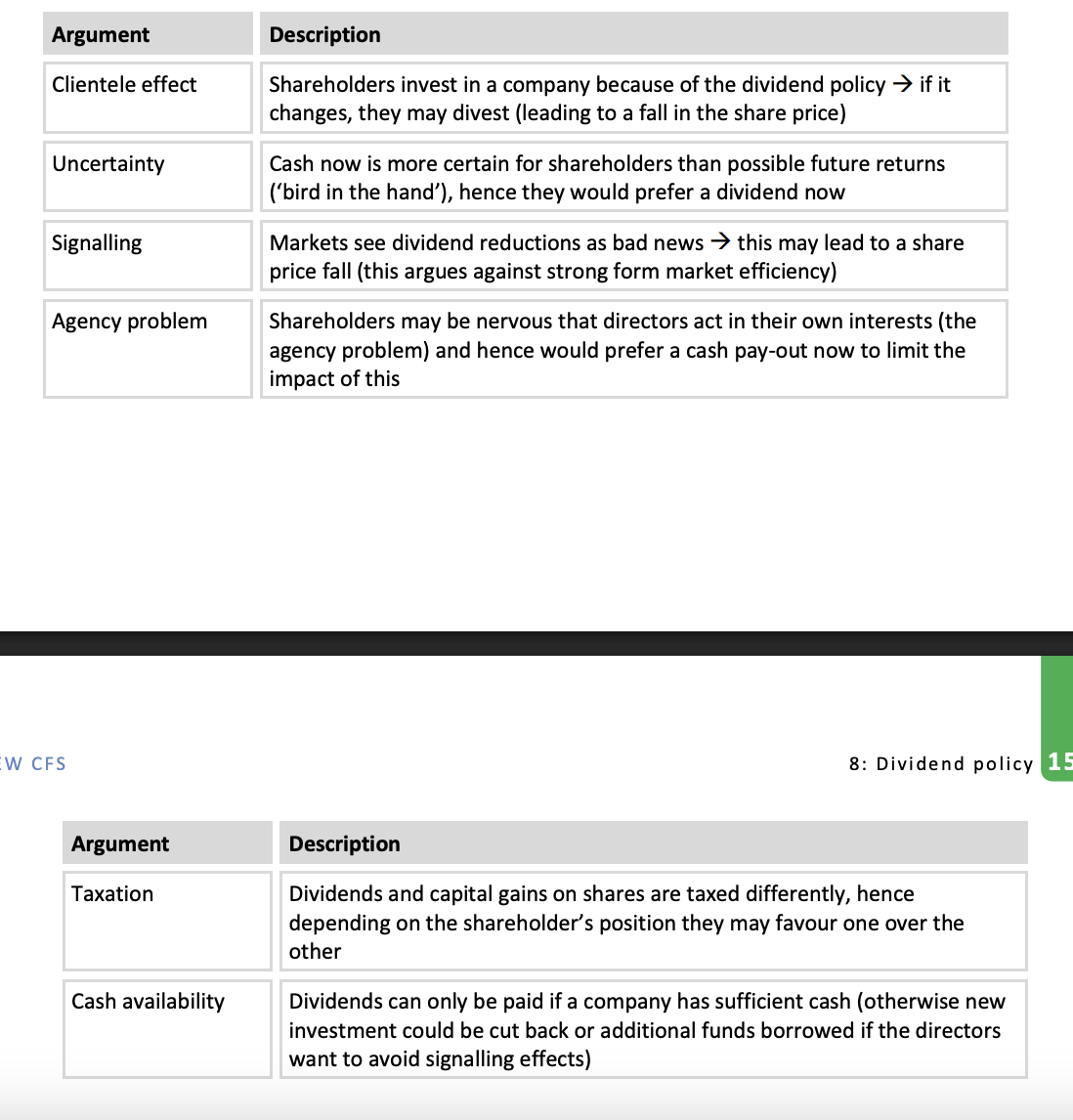
What is the dividend irrelevance theory by Modigliani and Miller?

What are “real options”?
Traditional NPV analysis only considers cash flows related directly to the project, however, there are options (such as strategic choices) associated with a particular project which add value to the conventionally calculated NPV. These include:
Follow-on options: Ability to launch future products off the back of this one, or extend the life of this project. This is especially relevant if the project has a negative NPV.
Abandonment options: The ability to exit the project early and sell the assets. Potentially a market relevant option if there is uncertainty regarding the sales demand
Timing options: The ability to delay the start of the project to wait for favourable market conditions
Growth options: The ability to ‘dip your toe in the water’ with a small initial investment and then grow (ie. by launching in additional locations).
Flexibility options: The ability to change suppliers/materials/locations in the future if a cheaper option becomes available.
How do you calculate the interest cover for a company and what does it mean?
Divide profit before interest and tax (PBIT) by interest. A higher interest cover ratio indicates a company's ability to meet its interest obligations, while a lower ratio suggests potential financial difficulty. Industry minimum is 4.
What is the theoretical ex-rights price (TERP)?
TERP is the theoretical share price immediately after a rights issue. The formula is:

Explain the dividend growth model formula along with its limitations
The DVM is a method which calculates the current price of an ordinary share as the present value of a stream of constantly growing dividends.
P0 is the current ex div share price
D0 is the current dividend
G is the constant growth on dividends (can be calculated using the historical growth method (=POWER(most recent value/oldest value, 1/n)-1, or using the gordon growth model (less common)
Ke is the cost of equity

How do you calculate the growth figure in the DVM using POWER
=POWER(most recent value/oldest value, 1/n)-1. You dont need to find the exact price per share as you do for D0 for example, because the growth is about the relationship between the most recent and oldest value, so it doesn’t matter if you use the per share divi, or total divis in the formula
What are the inputs for the RATE function to calculate the cost of debt for redeemable debentures
The rate function tells you what return the investor is actually earning from buying this bond today.
The inputs are:
NPER: Number of years until redemption (for semi-annual, you have to multiply by 2)
PMT: The annual coupon payment (again, divide by 2 for semi-annual)
PV (Present value): This is today’s ex-interest market value, entered as a negative number
FV (Future value): This is the redemption amount that the investor receives at maturity. This is normally 100 if redeemed at par, but sometimes it can be with a premium so keep an eye out.
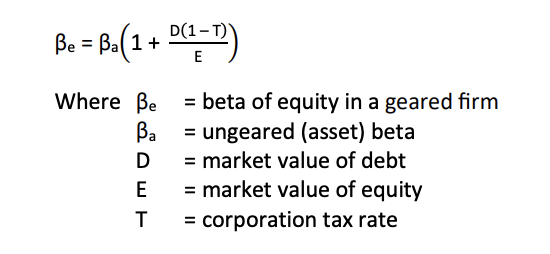
Explain the steps to find a risk adjusted WACC - ie what happens when a company enters into a new field and they need to find a new cost of capital using a proxy company's equity beta
you need to ungear the proxy company’s equity beta. You get given the formula to find a company’s equity beta, so all you have to do is move the formula around so you are looking for an asset beta. So put in the equity beta of the proxy company, along with the company’s debt and equity and you get the asset beta
Using the asset beta from part 1, find the re-geared equity beta of your own company by putting it into the formula (given in exam). Remember to use your own debt/equity for this one.
The equity beta from part 2 can be used to calculate a WACC using CAPM.
Explain what is revenue based finance and how is it calculated
Revenue-Based Finance is a method of raising finance where a business receives money from an investor or lender and agrees to repay it using a percentage of its future revenue.
In the exam, you will be given a pre-populated spreadsheet of the worst case, the medium case and the best case scenarios (monthly revenue figures). You will make another table showing a percentage of these figures (how much the investor is getting back). The question will tell u until what point the investor wants to get money so if say investor invests 50k and wants 60k back, you have to find which month they will get 60k back.
Following this, use IRR formula on all inputs (including the original -50k invested). this will give u the monthly cost. Then you have to compound this monthly cost using the formula ((1+IRR)^12)-1. Finally, you have to multiply by (1-Tax rate) to get the post tax cost.
What is replacement analysis and how do you calculate it.
Sometimes an investment decision will involve choosing between two alternatives where the benefits are unequal e.g. comparing renting one property for five years and an alternative for seven years. In such situations comparing the NPVs would not necessarily give the correct decision, so an alternative appraisal technique is required.
You first do a mini NPV of each cycle, so lets say u are trying to figure out when to replace a van, you do an npv for each cycle. U will get a negative NPV for each because you are only looking at costs. Then you line up the NPV and you find the relevant annuity factor for each cycle from the annuity table provided in the exam. You divide each NPV by the relevant annuity factor to get the equivalent annual cost (EAC). The option with the lowest EAC should be chosen.
What is the profitability index?
The profitability is used to value the net present value generated from the each £1 of the initial investment in a capital rationing question. The formula is NPV divided by initial investment. The projects with the highest profitability indexes should be invested into first in a capital rationing question where the project is divisible. In a question where the project is indivisible, you shouldn’t rely on this method, instead you should just manually find out what combination of projects gives you the highest NPV.
Explain the adjusted present value method
The adjusted present value method is used when a project has an unusual financing structure, such as when a company finances something entirely with debt.
First discount the free cash flows, dont include the first year.
Then, find the terminal value by multiplying the final free cash flow by the percentage divided by the discount rate minus the percentage.
Then, multiply the terminal value by the discount rate to the power of how many years there are
Deduct any cash and long term loans to get equity
Explain the three forms of market efficiency

What is shareholder value analysis?
Shareholder Value Analysis (SVA) is the process of analysing a business's activities to identify how they can increase shareholder wealth. A business's value is determined by the present value of its projected future cash flows and is influenced by seven key value drivers: sales growth rate (increase sales through marketing and new products), operating profit margin (increase prices or reduce costs), corporation tax rate (reduce the effective tax rate), investment in non-current assets (reduce unnecessary investment), investment in working capital (manage stock and working capital efficiently), cost of capital (find cheaper sources of finance) and life of projected cash flows (extend the period of cash generation). Improving one or more of these seven drivers in a favourable direction will increase business value and shareholder wealth. use SLOWCAT method to remember the drivers.
Explain what is interest rate parity and how to calculate it
Interest Rate Parity (IRP) says that differences in interest rates between two countries should be reflected in their forward exchange rate. The currency with the higher interest rate should trade at a forward discount, while the currency with the lower interest rate should trade at a forward premium. This prevents investors from making a risk-free profit simply by borrowing in the low-interest-rate currency, converting it, and investing in the high-interest-rate currency.
How to calculate:
Find average spot rate, find average between depositing and borrowing rates for both home and foreign country. Multiply the average spot rate by (1+foreign rate/1+home rate). Make sure to add two decimal places when writing the rates. For example, 0.75 should be written as 0.0075 in the formula. The formula will give you the IRP. If you look at the difference between the IRP and the average spot rate, you should get the forward discount or premium that is given in the question. Compare to see if they match, if they do, u got it correct.
List and explain the different types of valuations
Net assets (historical):
the balance sheet value of equity (total assets less total liabilities)
Net assets (revalued)
the question will give you revalued NCA or u will have to revalue NCA, and same as above
Advantages/disadvantages
Useful for asset strippers, assets are more certain than income
Useless method for service businesses, ignores goodwill, and lots of other costs
P/E multiple
Take P/E of proxy company and multiply with your own PAT. If P/E is not given, calculate by dividing share price by EPS
Advantages/disadvantages
Useful for growth companies, shows industry sentiment regarding a particular sector.
Requires proxy company which may be skewed, and accounting policies may be used to manipulate earnings figures in PAT
Enterprise value
Take EV multiple of proxy company and multiply it by your EBITDA. For EBITDA, remember to start with PBIT and add back depreciation/amortisation. For EV, its either given or calculate by adding market value of debt with market value of net debt.
Advantages/disadvantages
Same as P/E, but ignores financing and accounting decisions so more reliable
Also same as P/E, needs proxy company, and can still be skewed
Dividend yield
Divide dividend by the dividend yield. If not given in question, find dividend by multiplying PAT and divi payout ratio and find divi yield by dividing divi per share by share price
Advantages/disadvantages
Based on current market valuations (share prices), which can be useful
Needs proxy company for dividend yield, its also based on historical dividends which are not always reflective
Shareholder value analysis
Discount future free cash flows (SLOWCAT).