Lecture 6: Beyond Medelian Genetics (how progress in med gen expands our understanding of genetic diseases)
 Call Kai
 Learn
 Practice Test
 Spaced Repetition
 Match
 Flashcards
 Knowt Play
1/30

There's no tags or description
Looks like no tags are added yet.
Name | Mastery | Learn | Test | Matching | Spaced | Call with Kai | Chat |
|---|
No analytics yet
Send a link to your students to track their progress
31 Terms


What are the interacting factors in health and disease
11 factors split into 2 groups
Environmental
Environment
Education
Access to health care
Exposure
Socioeconomic status
Stress
Genetic:
Ancestral geographic origins
Genome variation
Variants in disease genes
Epigenetic modifications

Why is it important to study polygenic or multifactorial diseases?
MOST COMMON cause of DEATH = multifactorial disease
majority have an inherited component
Genetics is recognized as a key determinant of health

Genetics is recognized as a key determinant of health
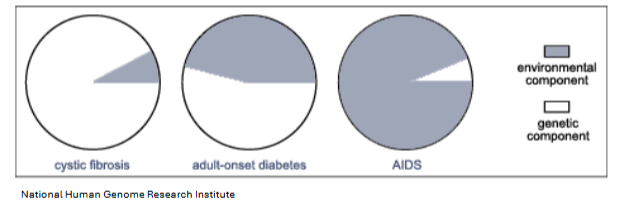
What % of health outcomes are attributable to genetics?
30%
*****To study the genetics of complex disorders what are 3 things we need to keep in mind/ recognize/ understand?
Understand the dynamics of variation in human populations and to have as complete an inventory of that variation in human populations
Recognize a Temporal Bias (eg. Right now its European centric) in what we consider to be medically good or bad
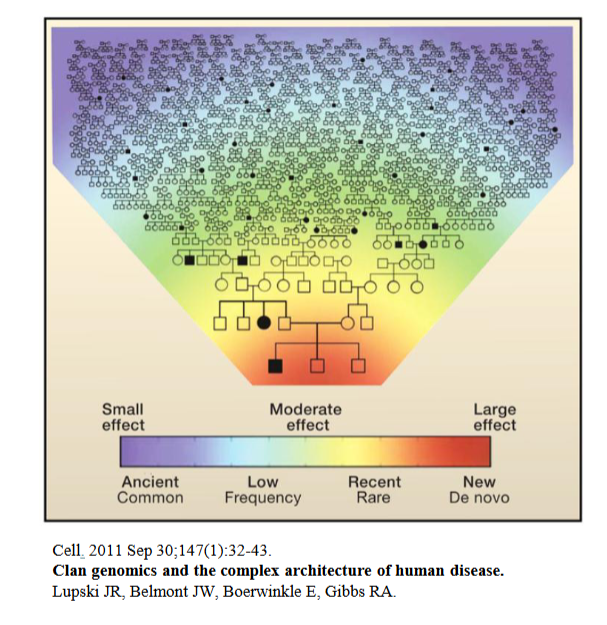
Recognize that to date finding rare mendelian causes of some complex disorders for eg. Parkinson’s, provided insight on mechanisms and cellular pathways involved in more common forms. Newer genomic tech are contributing further to the understanding of complex disorders
Human pop and genetics
what does the relatedness amongst groups mimic?
Local adaptions occur to what things? (3)
Admixture with extinct hominid groups (Neanderthals, Denisovans etc.) can affect what?
Each human is what % reltated to each other
Genomic databases are _____Centric, balancing input is being worked on
Relatedness amongst groups mimic? = Geography
Local adaptions occur to what things? (3) = altitude, diet, microbial pathogens
Admixture with extinct hominid groups (Neanderthals, Denisovans etc.) can affect what? = Disease risk eg. depression, severe covid etc.
Each human is what % related to each other = 99.9%
Genomic databases are EUROPEAN Centric, balancing input is being worked on

*****What are the 2 main strategies to Identify multiple interacting genes, the Biological pathways involved and the relative impact (Weak vs. strong)on the trait being studied
GWAS = Genome-wide association studies
PheWAS = phenome-wide association studies
******Compare/define GWAS vs. PheWAS
GWAS = associations between specific phenotypes and variants across the genome. Phenotype-to-genotype (starts with a disease or trait and looks across the whole genome for genetic variants).
PheWAS = examines associations between specific genetic variants and a large number of different phenotypes (phenome). Genotype-to-phenotype (Takes a single genetic variant (or a set of variants/polygenic score) and tests its association against a broad array of medical conditions and traits.).

****What are the REQUIREMENTS for GWAS + PheWAS
Need access to genetic/genomic info, consistent measures and descriptions of health related or biometric info on a LARGE # of individuals (1000’s to 100 000)
****Why do you need so many people for GWAS and PheWAS?
Variants in genes may exert effects from less than 1% on the expression of a trait up to the strength of impacts observed in mendelian disorders
aka. there are so many variants between people on how the disease manifests
GWAS vs. PheWAS again
GWAS = look at many people with and without a phenotype
PheWAS = Can find multiple phenotypes or cellular pathways associated with a variant

******Advantage of PheWAS over GWAS in terms of application
PheWAS offers distinct practical and clinical advantages due to its "one-to-many" approach
Discovering Drug Repurposing Opportunities
Can find multiple phenotypes or cellular pathways associated with a variant
Diff phenotype with same underlying genetic target/ cellular pathway = can use same med
eg. Metformin can be applied to other diseases
True or false there is a continuous range of genetic conditions from simple mendelian to highly polygenic?
TRUE
****Give an example of a trait that is….
Complex/ HIGHLY POLYGENETIC
Kinda Polygenetic
Kinda monogenetic
Simple/ Monogenic

What is the trend on a genes effect size in relation to the traits complexity/polygenetic-ness
More complex/ polygenic = Less effect a given gene has on the trait
Monogenic = Greater effect a given gene has on the trait (b/c there is only 1 gene that creates the trait)
****HUMAN HEIGHT GWAS study
WHAT WAS THE RESULT
How many people was asses?
What % of height is associated with genetic background?
What % of height is associated with common variants in human populations?
how big of an effect did these common variants have
Height related loci occupy about what percent of the genome?
5 million people asses, 1.3 mil SNPs in meta study of 280 studies
80% of height = associated with genetics
40-50% = height associated with common variants in human pop
Each with a VERY SMALL EFFECT collectively in all human populations
Loci occupy 20% of the human genome
Why does the Human height Loci occupy 20% of the human genome? (honestly I dont really get it)
Functional impact and associations
****HUMAN miRNA PheWAS study
What are miRNA
What was tested/what was the goal of the study (+ why)
RESULTS
MicroRNAs are small, highly conserved non-coding RNA molecules involved in the regulation of gene expression and therefore may play a role in disease and health outcomes\
Tested whether changes in blood miRNA expression levels could affect disease risk through colocalization and Mendelian randomization analysis (measure to assign causality of the miRNA to the trait vs some other linked variant)
miRNAs can bind to target mRNAs to suppress translation.
More than 2000 miRNA’s are known, specific functions in cell function still to be established
Genetic variants in miRNA-related sequences could affect their biogenesis or functionality and ultimately affect disease risk. May be targetable for treatment.
Their implications and pleiotropic effects on many clinical conditions is unknown
Need a comprehensive method to assess potential impact on health. To link individual miRNA’s to one or more phenotypes
RESULTS
A disease (phenotype) association has been discovered for some of the miRNA variants studied.
Since miRNAs have specific targets, those target genes were studied also found to be associated with the disease diagnosis via a GWAS analysis (reverse study)
Those target genes and the cellular pathways they are involved with can be further studied for their role in disease.
A lot of information was whittled down to find a few significant associations

******When analyzing a source with so many individuals it is important to rule out what? and why?
ruling out/ removing RELATED individuals is important
ruling out family relationships among participants is crucial to prevent a major scientific error known as confounding by cryptic relatedness.
*****HYPERTENSION is classic example of a POLYGENIC or MONOGENIC disorder?
is a diagnostic genetic test for the most common forms useful? why or why not?
Hypertension, aside from a few inherited forms is the classic polygenic disorder
Large number of loci with VERY small effects on blood pressure
Large influence of lifestyle on genetic traits.
Lifestyle interventions can have a large impact.
A diagnostic genetic test for the most common forms has no clinical utility at present as the predictive value is poor.
*****Will understanding the genome be enough to explain multigenic disorders or any disorder in general?
Why or why not? What is it missing?
What else is needed to supplement?
No
It can tell you what has happened, what may happen. BUT
It isn’t dynamic enough to say what is happening exactly at the CELLULAR level
To provide guidance on the functional impact of variants and what action may help may require other “OMIC” strategies
*****What are the 3 other OMICS?
Transcriptomics, Proteomics, Metabolomics
*****What additional information do other “OMICS” provide?
Genomics = Variants
Transcriptomic = Altered splicing, Location, timing or amount
Proteomics = Abnormal protein Expression, location timing or amount
Metabolomics = Absence, presence or altered relative amounts of metabolites

*****What are 4 Transcriptomic Techniques
Bulk RNA seq
scRNA seq
snRNA seq
Spatial transcriptomics

Example of trancriptomics in a rare genetic disorder.
A novel, de novo synonymous CASK variant (NM_001367721.1: c.1737G>A,
p.(Glu579=)) was discovered via exome sequencing in a male patient diagnosed with
MICPCH, characterized by microcephaly, developmental delay, visual impairment,
and myoclonic seizures.
Pathogenic variants of CASK are known to cause several neurodevelopmental disorders
The variant disrupts a donor splice site at the end of exon 18. It is in the coding region flanking the splice site, so does it disrupt splicing and could that explain the phenotype in the patient?
What did transcriptomics reveal?
Transcriptomic analysis showed that compared to healthy controls in the patient exon 18 was missing in all transcripts
Abnormal versions produced either an in-frame deletion of a portion of the protein in an area critical for function, or a frameshift causing a truncated protein.
Result: Apparently neutral variant, classified as pathogenic


PROTEOMICS + METABOLOMICS
what needs to be done/ what is the process?
WHO does these tests?
PROCESS: requires separation of components in a sample by spectroscopy, chromatography or IHC studies so they can be identified and quantified.
WHO:
Chemists, biochemists, and biochemical geneticists
Their known interactions and pathways can also be assessed for significance

STUDY: Can metabolomics and proteomics provide better risk profiling or cause and effect for complex disorders than a genetic analysis?
What did the OUTOCME SUGGEST?
What did Metabolomics + Proteomics bring to the table
YES: Metabolic and proteomics can define specific food preference (dietary profiles) to better understand and map the downstream risk of complex, chronic disorders
found that Differences in disease risk Correlated with diet type
Health conscious = less risk for disease than sweet tooth
Metabolomics and proteomics seems to provide insight into socioeconomic impacts on health more so than genomics
Can shape education, healthcare policy, translates into tangible impact on costs and quality of life

Social/Ethical Challenges With multigene disorders and GWAS/PheWAS studies?
Fine structure of human populations needed. Lack of representation in genetic
databases by all populations will hamper broad application of findings to other
populations
Shift in approach from being dominated by the “Global North” or “HIC” (high income
countries) ownership and pursuit from within each continent including “LMIC”, and
collation on a global scale.
Traditionally, massive scientific endeavors (like the original Human Genome Project) were heavily dominated by High-Income Countries (HICs)—primarily located in Western Europe and North America (often referred to as the "Global North").
These wealthy nations owned the data, decided the research priorities, held the patents, and provided the vast majority of the genetic or medical samples, which usually left out minority populations.
Desire to meld with history and culture of a population, to promote education and social engagement locally (cannot gate keep the info obtained from an area, should share it)
Importance of community-centered research. It emphasizes that for global health or genetic studies to succeed and be ethically sound, they cannot just treat people as data points. Instead, researchers must actively intertwine their scientific work with the unique history, cultural values, and local needs of the community they are studying.
Social/Ethical Challenges
How can this be applied to address broad social issues such as access to education, healthcare, wealth disparities
Questions about use of knowledge beyond medical benefits.
For eg, use of knowledge of genetics of physical traits, hair, eye colour in forensic profiling
Use for discrimination in employment, eg environmental susceptibilities
Equitable access to benefits, such as treatments which may be very expensive.