COMM1000 M7: Communication in Relationships
 Call Kai
 Learn
 Practice Test
 Spaced Repetition
 Match
 Flashcards
 Knowt Play
1/13

There's no tags or description
Looks like no tags are added yet.
Name | Mastery | Learn | Test | Matching | Spaced | Call with Kai | Chat |
|---|
No analytics yet
Send a link to your students to track their progress
14 Terms
Human attraction
Human attraction = force that brings people together
Friendships, work dynamics, romantic attraction, social attraction, task attraction

What are the 5 forces of attraction?
Appearance
Proximity = same jobs, classes,
Similarity = reduces uncertainty, easier to bond
Complementarity = people who fit together well
Reciprocity = do you try to interact with someone who is interested in you?

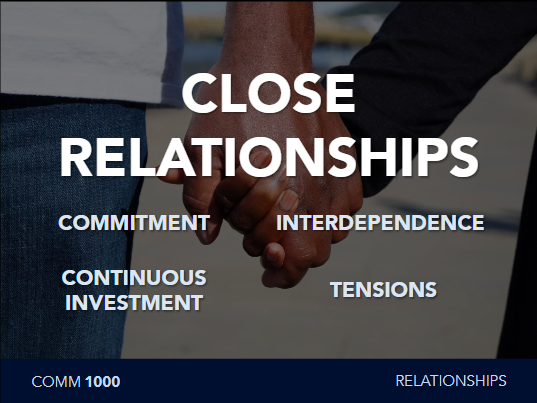
What are 4 components of close relationships?
Close relationships = relationships with intimacy or significant closeness
Commitment = you will help them, they will help you
Interdependence = increased closeness → greater dependence on e/o
Continuous investment = continued effort put into relationship
Tensions = dialectical tensions = conflicting needs as a person
Independence
Change vs. predictability
What are 6 components of communicating in relationships?
Content & Relational Message Dimensions
Content = what is being said
Relational Message Dimensions = understand partner’s communication style and what it means to relationship
Confirming vs. Disconfirming messages
Perception check to see if they’re fully invested
Confirming → “We are going to figure out”
Disconfirming → “I have to do what’s best for me”
Supportive vs. Defensive Communication
Supportive = ways we can be kind + supportive
Defensive = ways to defend themselves
Handling Issues of Privacy
Some couples = open books
Other couples = more secretive, private
Emotional Communication
Feelings intertwined with close relationships
Instrumental Communication
task-focused interaction to “get things done”
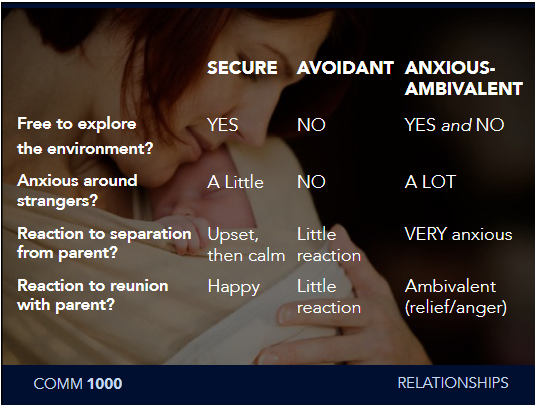
What is attachment theory? What are the 3 different attachment styles?
Attachment theory = care @ an early age can impact our relational behaviors later in our lives
Secure = 70% of children, positive model of themselves & others
Caregiver signals that they care about child
Avoidant = 20% of children, negative model of others
Caregiver overstimulated or understimulated child
Helicopter parent
Neglect
Anxious-ambivalent = 10% of children, negative model of themselves
Caregivers inconsistent, preoccupied, or stressed
Working 2 jobs
Mental health issues
Substance abuse issues
What is attachment in adults?
Attachment styles cannot change over time: (True/False)
Secure adults → warm relationships
Easy to get to know
Good relationships w/ parents
Avoidant adults → closeness = uncomfortable
Afraid of intimacy
Hard to depend on others
Romantic partners = not worth it (eventually leave)
Anxious-ambivalent adults → yearn for close relationships
Afraid of abandonment and being unloved
Cyclical process of hoping they never leave
FALSE → Attachment styles can change & often do
Relationship development
Relationships move through stages/phases
What is Knapp and Vangelisti’s stages of relational development?
5 Steps to commitment
Initiating = introduction, first conversation
Experimenting = spending time together, exchanging numbers = attempt towards relationship
Intensifying = endorphins, dopamine, feeling rush, spending more time together
Applies to people around them as well
Integrating = outwardly signal commitment = begin acting like a couple
Places for people to stay
Let other borrow keys
Bonding = pinnacle of love, long-term close connection
Marriage
5 steps to termination
Differentiating = taking time away from partner
Normal in healthy relationships
Can progress
Circumscribing = avoiding conversations for fear of worsening relationships
Stagnating = relationship feels it’s staying the same, does not see the purpose of relationship
Avoiding = do things to avoid interacting with them to reduce anxiety
Admitting relationship is harder to have
Terminating = ending relationship
Do NOT need to hit every step; Do NOT need to go to top

Social exchange theory
Social exchange theory = people tend to try to maintain relationship when benefits outweigh the cost
Comparison level = baseline expectations for relationships
Comparison alternative = picturing life w/ another person
If comparison alternative is better than current person → many make the jump

What are 6 styles of love?
Eros = passionate love
Ludus = game-playing love
Storge = friendship-based love
Pragma = practical love
Mania = possessive, dependent love
Agape = selfless, all-giving love

What is relational maintenance?
What are 5 behaviors?
Relational maintenance = effort put into relationship
Positivity
Openness
Assurances
Social Networks
Sharing Tasks
What is the proposed number of positive interactions for every negative interaction? (ratio)
5 positive: 1 negative

What are 5 relationship termination strategies?
Negative identify management: intentional sabotage
De-escalation: “Let’ just be friends”
Justification: Rationalizing the end
Positive-tone strategies: “You deserve better”
Behavioral de-escalation: Avoiding your partner

What are 3 friendship/casual termination strategies?
Withdrawal/avoidance: Ghosting
Machiavellian tactics: Using others to end it
Openness: Coming right out with it
