accounting exam 3 - flashcards
 Call Kai
 Learn
 Practice Test
 Spaced Repetition
 Match
 Flashcards
 Knowt Play
1/141

Earn XP
Description and Tags
13A, 13, 14, 16
142 Terms
ch 13 starts here
okay
differential analysis and decision making
relevant vs irrelevant costs
relevant = differes between alternatives and should be considered
irrelevant = does not differ between altenratives and should not be considered
two questions to ask about any cost
is it in the future? And is it different depending on what I choose?
It has to be both to be relevant.
past costs can help you guess what future costs will be, but the past cost itself never matters for the,,,
decision.
what does differential analyses focus on
future costs and benefits that differ among alternatives (relevant).
differential benefit/cost
Differential benefit: future benefit that differs
Differential cost: future cost that differs
incremental cost
Incremental cost: increase in cost between two alternatives
avoidable cost
Avoidable cost: cost that can be eliminated by choosing one alternative over anothe

if there’s a cost NOT in these four categories, what should you do?
Everything else is irrelevant and should be ignored.
is depreciation relevant or irrelevant
usually irrelevant
Depreciation is usually irrelevant because the money for the equipment was already spent. The exception is if you could sell the equipment.
add or dropping a segment shortcut. if you drop a segment, you lose its ____. but you stop paying the _____ that go away with it. only drop it if you ____ more than you _____.
If you drop a segment, you lose its contribution margin, but you get to stop paying the fixed costs that go away with it. Only drop it if what you save is more than what you lose.
if a company is involved in more than one activity in its value chain , what does that mean + imply?
it’s VERTICALLY integrated —> less outsourcing
make or buy decision:
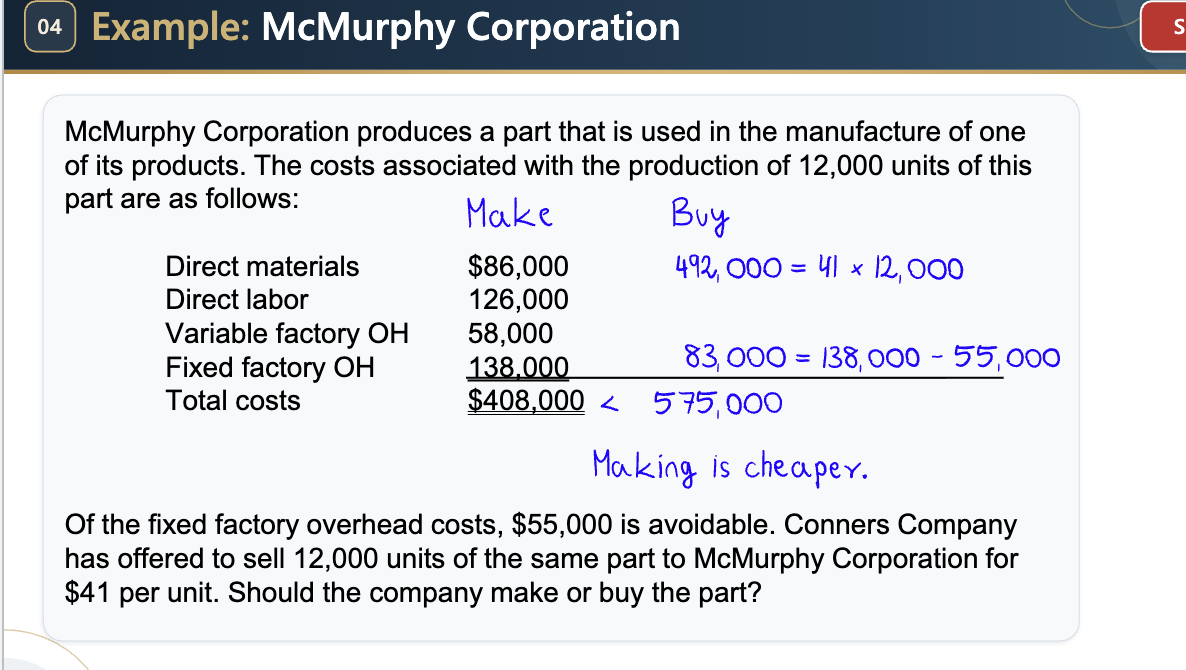
Pick the lowest relevant cost: variable costs + avoidable fixed costs + opportunity cost of freed-up facilities
when are fixed costs relevant?
when the fixed costs differ between two alternatives
what should you always do before calcs with fixed cost
convert fixed costs/unit to TOTAL FIXED COSTS before performing calculations
learning objectives of ch 13
• Identify relevant and irrelevant costs and benefits in a
decision.
• Prepare an analysis showing whether to keep or drop a
product line or segment.
• Prepare a make or buy analysis.
• Prepare an analysis showing whether to accept a special
order.
• Determine the most profitable use of a constrained resource.
• Determine the value of obtaining more of the constrained
resource.
• Prepare an analysis showing whether joint products should
be sold at the split-off point or processed further
relevant costs
future costs and benefits that differ between alternatives
sunk costs vs opportunity costs
sunk costs = always irrelevant
opportunity costs = always count
add or drop a segment - when do you drop?
drop only if avoidable FC exceed the CM lost
add or drop a segment - what do you ignore?
allocated common fixed costs reamin, so you just ignore them
regular selling price?
NOT a relevant cost. this is the selling price is the same no matter what, there’s no difference.
incremental costs
those are releavnt
make or buy - what alternative do you choose?
choose the alternative with the lower releavnt costs
what types of fixed costs and opportunity costs count?
count: avoidable fuxed costs + opportunity costs of released facilities
special orders when do you accept them?
if incremental rev > incremental cost
for special orders, which costs are USUALLy irrelevant
fixed costs
constrained resources - how do you rank products?
rank products by the CM per unit of the constrained resource
constrained resources - extra capacity is worth up to …
that CM per unit of constraint
sell or process further - when do you process further?
if the incremental rev > incremental cost
sell or process further - what do you do with joint costs
joint costs are sunk at the split off point, so you ignore them
fixed costs are not always irrelevant.
fixed costs can CHANGE. even if they’re fixed. incremental costs, if they change, make it RELEVANT. variable costs are relevant if they change incrementally (?)
what is the first step in decision making
to define the alternatives being considered
what do you do once you’ve defined the altneratives, you need to…
identify the criteria for choosing among them
the criteria for choosing among alternatives
relevant costs + benefits = should be considered
irrelevant costs + benefits = should be ignored
differential analysis is the KEY to making decisiosn. what is it?
focusing on future costs and benefits that DIFFER between the alternatives. everything else is reelevant and should be ignored.
differential revenue/cost
future revenue/cost that differs between any two alternatives
incremental cost
an increase in cost between two alternatives
avoidable costs
a cost that can be eliminated by choosing one alternative over another
sunk costs - what to do with them?
always irrelavant when choosing among alternatives.
A sunk cost is a cost that has already been incurred and cannot be changed
regardless of what a manager decides to do
opportunity costs - what do to with them?
they need to BE CONSIDERED.
n opportunity cost is the potential benefit that is given up when one
alternative is selected over another
sunk cost fallacy
occurs when costs that cannot be recovered are still factored into a
business decision making process
A rational decision maker is interested only in the future consequences of current investments.
Throwing good money after bad rather than facing the humiliation

i think it’s adam

differential approach vs total cost approach
Differential Approach: identifies the relevant costs and
benefits of each alternative.
• Total Cost Approach: includes all costs and benefits
(relevant and irrelevant).
differences between answers of differnetial approach and total cost approach
they give the same answer, BUT there are
Advantages of differential:
difficult to include all costs and
including relevant and irrelevant costs can be confusing.

what do you look for in this
you look for the DIFFERENCES in the numbers for the same line items. so, the differences here are the DL expense, and then the new machine rental

decision rule for adding or dropping product line segments
does adding/discontinuing a branch or segment add OPERATING INCOME TO THE FIRM?
yes - add/don’t discount
no - dont add/discontinue
for segment dropping/adding ,what is the decision based off of?
the profitability of the branch/segment, not how much rev the branch or segment generates
consider traceable FC and common FC
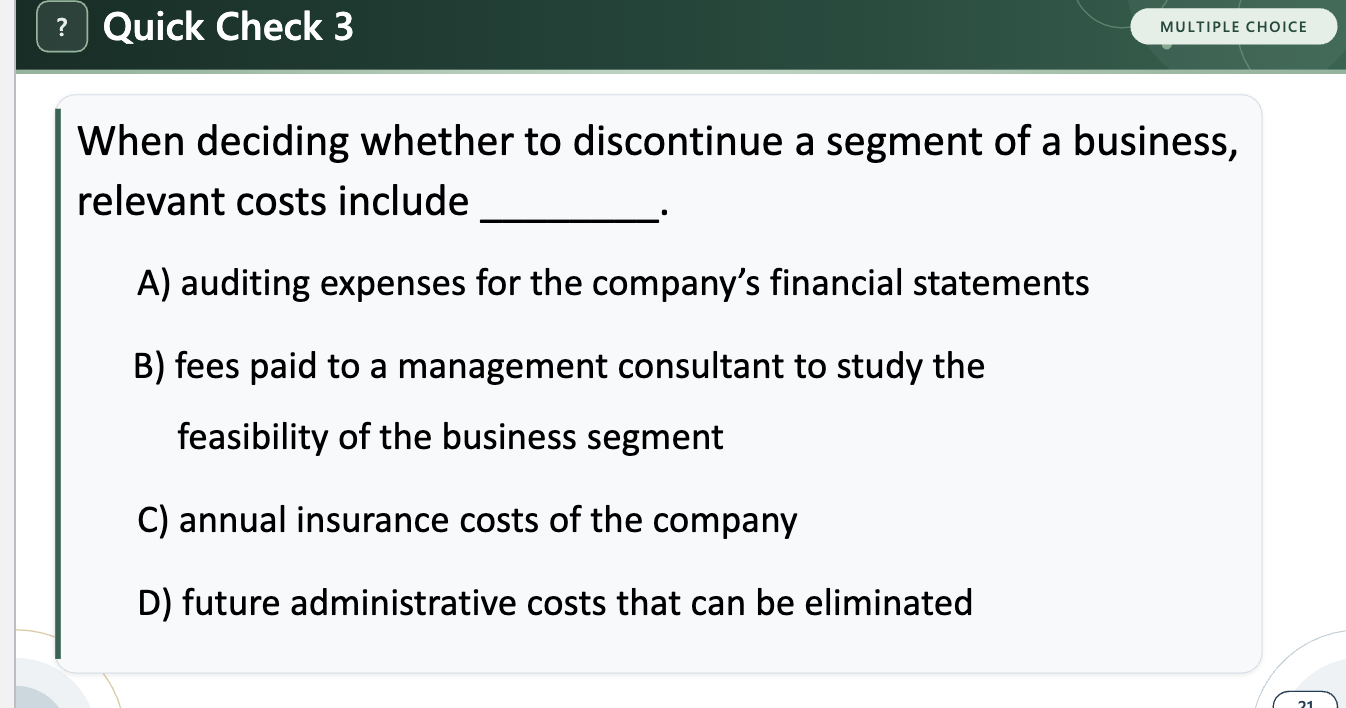
A: this is a common cost, does not matter to the specific segment
B: this is a sunk cost
C: this is a common fixed cost - irrelevant
D ; this a future admin cost (so directly affects OI), and it’s in the FUTURE, and it’s AVOIDABLE

identify which ones are relevant or irrelevant
relevat:
salaries (employees)
advertising
insurance
irrelevant:
utilities
depreciation
rent
admin
so how do you figure out if the product line should be dropped
find the CM lost by dropping it
add back the amount of relevant FC that you would avoid
find the NI change if it’s dropped (subtract the two). If the NI drops, then you keep the housewares line
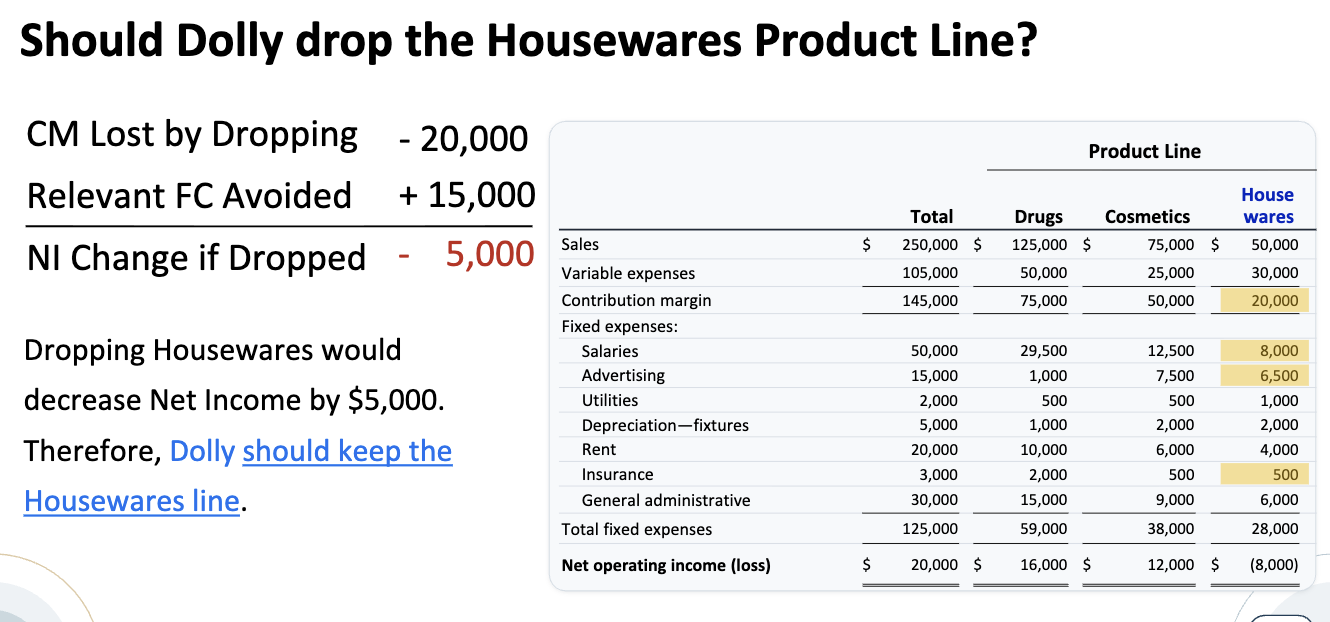
but! the NI in the previous slide is still (8000)!!! Why would you keep that?
because you have to realize that the COMMON FIXED COSTS (of the whole company) are also being allocated to products
By including unavoidable common fixed costs, it makes the product line SEEM unprofitable. However, dropping the product line would actually decrease the NI of the company.
product-line segment margin: how do you find it? what does it show you?
CM - Total Traceable Fixed Expenses = Product Line Segment Margin.
product-line segment margin: do you want it to be positive or negative
you want it to be positive.
what does the segment margin NOT include? what do you do?
the segment margin does NOT include the depreciation. Meaning, the number you get for the segment margin already has the depreciation subtracted from it. So, to see how much TRUE loss comes with the segment, you have to add back the depreication.
Deprecciation is a sunk cost, the company does not actually save that when it drop the segment line.

find the OVERALL NOI with both segments (add the NOI sections together) = -42100
find the LOSS/GAIN FROM DROPPING THE WEST SEGMENT (use the cm - traceable fixed costs) = -16,000
Combine the OVERALL NOI + the loss of the west segment = 58100 = B

vertically integrated
when a company is involved in more than one activity in the entire value chain
"make or buy” decision
a decision to carry out an activity in the value chain internally, rather than to buy externally from a suppliers
insourcing and outsourcing
insourcing — producing goods or services within an organization
Outsourcing – purchasing goods or services from outside vendors
make or buy decision rule
Select the option that will provide the firm with the lowest
cost, and therefore the highest profit
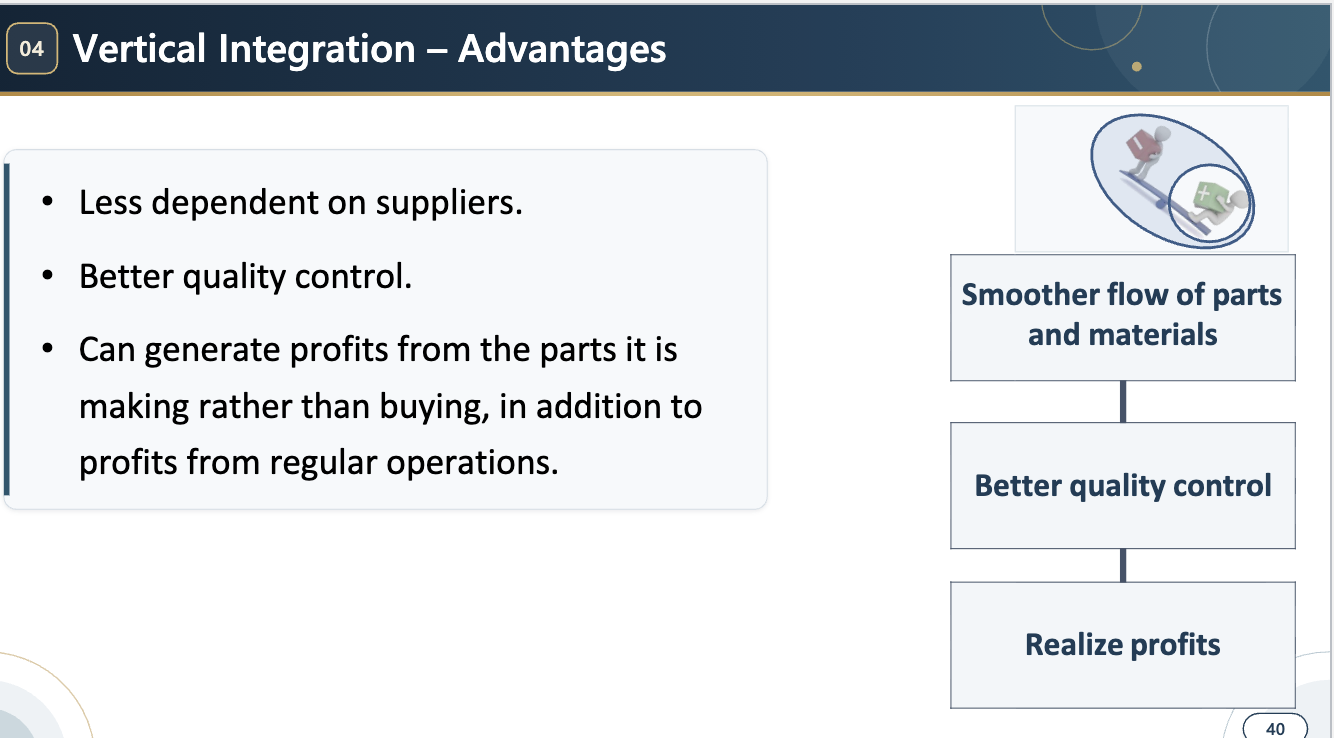
vertical integration advantages
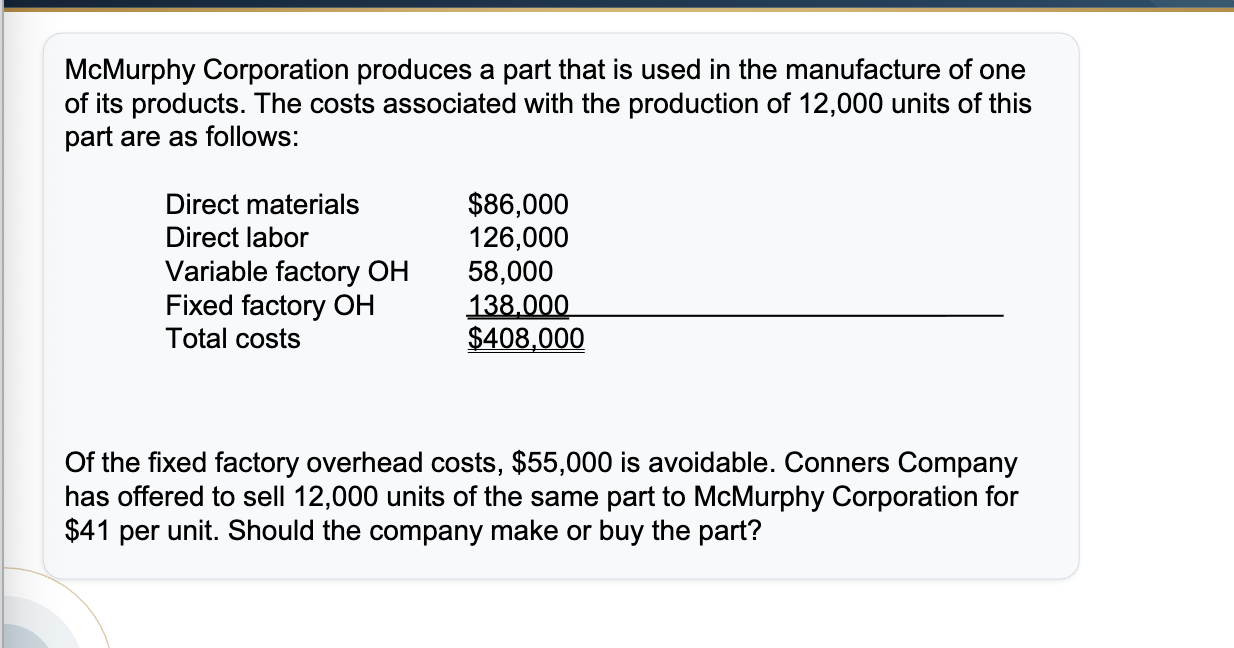
vertical integration disadvantages

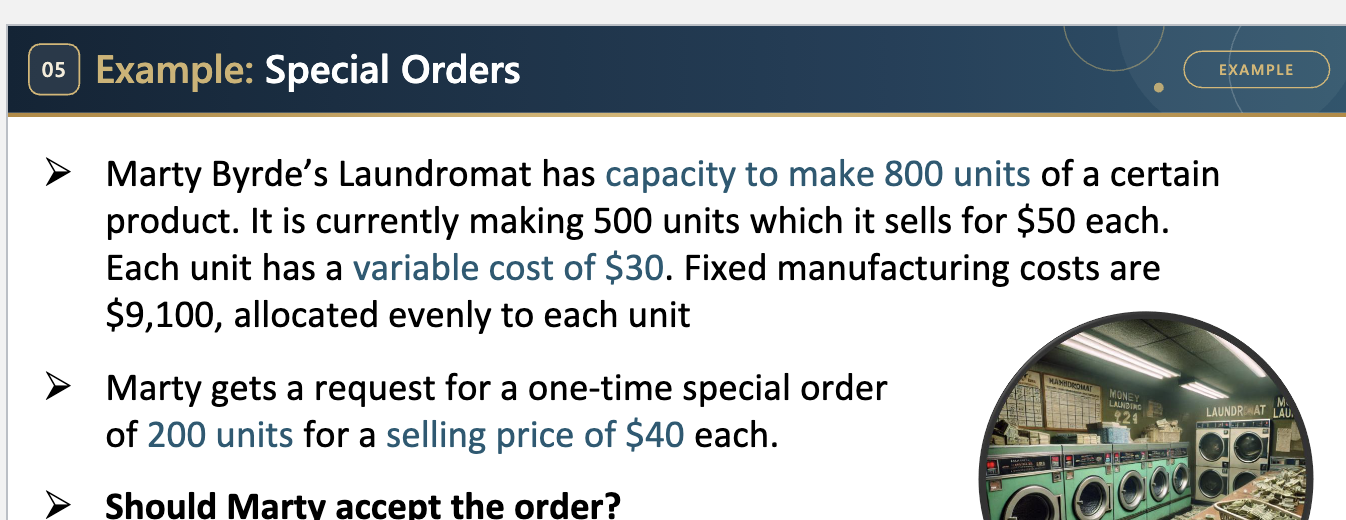
Special Orders - what are the two criteria, and what impact does it have?
accepting/rejecting special orders when there is idle production capacity and the special order ==> has no long-run implications
special order decision rule
does it generate additional OI?
yes - accept
what does special orders compare for the decision rule?
compares relevant revs and relevant costs to determine profitability
what are the relevant revs and relevant costs for SPECIAL ORDERS
incremental costs and revenues
3 parts of a special order: decision, focus, is it apart of operations
one time decision
short run focus
not part of the ongoing operations
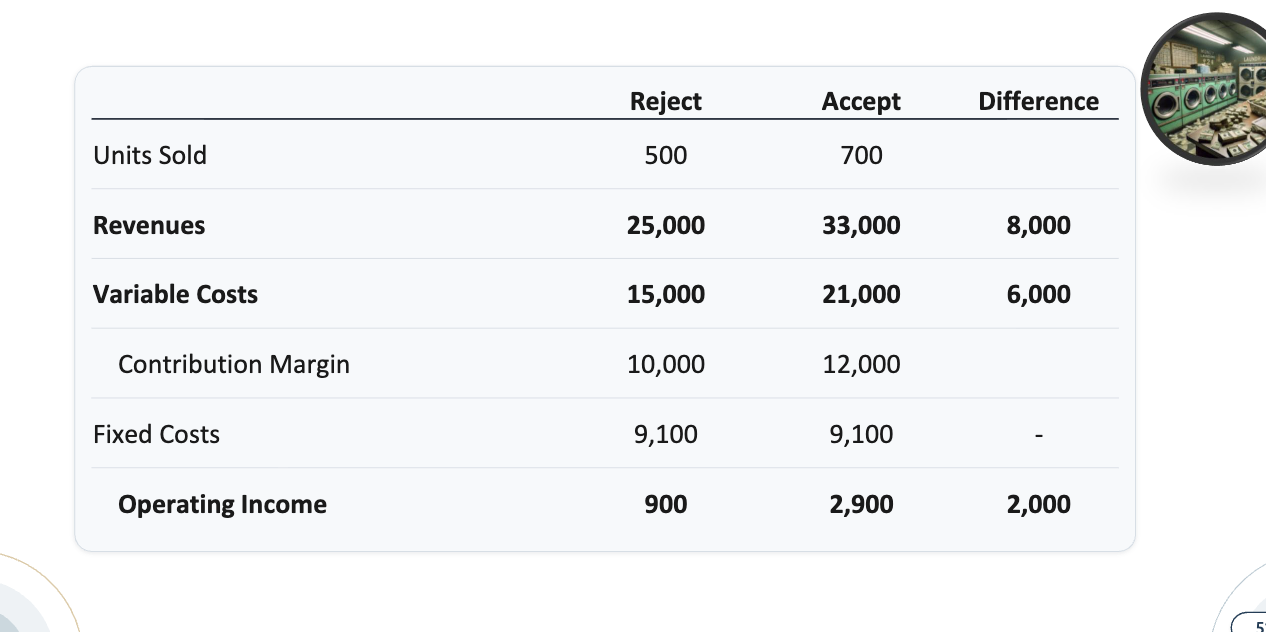
operating income =
rev - costs (VC and FC)
first step for this:
make a TABLE, and compare the OI (rev - costs) for both options.
remember that only RELEVANT costs are considered. what are relevant costs?
meaning costs that will actually change or be incurred because you accepted the order.

what are the relevant costs here?
variable production costs
imprinting machine costs
Why the $18 fixed production cost is excluded: Fixed costs (like factory rent, equipment depreciation, or salaried supervisors) stay the exact same in total whether Northern Optical accepts this special order or not.
Why the $1 variable selling cost is excluded: The problem explicitly states that "this special order would not involve any selling costs" (for example, no sales commissions or standard shipping/marketing fees apply to this direct deal). Since they won't have to pay that $1 per unit on this specific order, it isn't part of their cost to fulfill it.

steps for completeing this problem
figure out if it’s able to fufill the request with the given capacity. if it’s ABLE TO, that means there is no opportunity cost (no lost regular sales)
separate the relevant and irrelevant costs
relevant = special order rev and variable landscaping hours
irrelevant = fixed land costs, var marketing costs, fixed marketing costs, regular selling price
Compare the relevant revenue against the relevant costs for the 1,000-hour order.
YES IT SHOULD ACCEPT THE ORDER, BECAUSE IT WILL ADD $10K TO REVENUE


why is the bolded text at the bottom of the problem A TRICK?
because the fixed costs are included in that calculation.
for this part, though, it inludes varibale costs. it's not only unitizing the fixed costs. does that change things, and why not?
Fixed Landscaping Costs ($108,000): Fixed costs stay the same regardless of whether Rainier works 9,000 hours or 10,000 hours. Note that the problem tries to trick you by unitizing this fixed cost into the "$62 per hour" figure ($50 variable + $12 fixed). Never use unitized fixed costs for special order decisions.
still not relevant because it INCLUDES AN IRRELEVANT COST IN THE TOTAL NUMBER:
It does not change things because you simply need to separate the two pieces bundled inside that $62/hour figure:
The $50 variable piece is relevant because you will actually incur an extra $50 for every new hour worked.
The $12 fixed piece ($108,000 ÷ 9,000 hours) is irrelevant because your total fixed costs stay at $108,000 whether you take the order or not.
Bundling them into a single $62/hour rate creates the illusion that fixed costs increase with every hour worked—which isn't true. As long as the $60/hour offer clears the $50/hour variable cost, the remaining $10/hour is pure profit.
incorrect general assumptions:
such as all variable costs are relevant and all fixed costs are irrelevant
when is FMOH relevant? (Example)
variable marketing costs may be irrelevant, fixed manufacturing costs
may be relevant if special order shifts the output level out of the relevant range

unit-fixed costs given in a problem (like the rainer co example). what is the caveat for that?
check for these!!

volume trade-off decisions - when are they made, and what is the main question asked?
forced to make these deiciosn when they do not have enough capacity to produce all the products and sales volumes demanded by their customers?
question: which products to sell and in what quantities?
what do companies do in volume trade off decisiosn
companies must trade off/sacrficie production of some products in favor of others in an effort to max profits
a company has a constraint
when a limited resource of some type RESTRICTS THE COMPANY’S ABILITY TO SATISIFY A DEMAND
what is a bottleneck?
the machine or process that is limiting overall output. its a type of constraint.
relaxing the constraint
manager can icnrease the capacity of a bottle neck, which is called relaxing the constraint
how do you increase bottleneck capacity (4 ways)
working overtime/shifting workers to the bottleneck
subcontracting some of the processing
investing in additional machines or process improvement
reducing defective units processed through the bottleneck
decision rule of the volume trade off situations / for constrainted resources
fixed costs are usually unaffected
what should be selected: the product mix that MAXIMIZES the company’s total contribution margin
“the product mix that MAXIMIZES the company’s total contribution margin”
what is the nuance to this?
the company should nott just promote products that have the highest CM
instead, the that CM will be maxed by promoting those products OR accepting those orders that provide the HIGHEST CM in relation to the constraining resource

a bigger CM is better or worse?
it’s BETTER, because CM = sales - VC. Having a bigger value means that there’s smaller VC, meaning you keep more of your sales.

key aspect of the constrained source stuff
the CM per unit of the constrained resource!
once you figure out what product you’re focusing on for your constrained resource (if you’re debating between two)
you have to:
fufill the demand of the product you’re focusing on
subtract that number (in relation to the constrained resource) from the total amount of constrained resource you have
and then, find how much of the OTHER product you can make given the amount of the constrained resource you have left AFTER focusing on the first product
this is based on example 06 in the CH13 post class slides
increaseing the capacity of a constrained resource should also lead to
increased production and sales
how to find the VALUE of a constrained resource?
if it’s going towards making more of product 1 (for example), then the constrained resource should cost NO MORE than the CM of making more that product
what do you find the CM in terms of
you always find the CM in terms of the units of the contrained resource. and remember, any additional units of the contrained resources would be going towards the product you DIDNT focus on
sell vs process further: the two “points” that should be considered
joint products:
split off point
joint products
produced from a single raw material input
split off point
the process where joint products cn be recognized as separate
decisions question of sell vs process further:
should a joint product be sold at the split off point, or processed further?
3 critieria of the sell vs process decision
question: should a joint product be sold at the split off point, or processed further?
ignore joint costs (they are sunk)
detemrine the incremental revenue from further processing vs incremental revenue from selling
subtract incremental cost from incremental rev
3 steps of the sell vs process decisions
incremental revenue: calc (the sales value if processed further — the salves value at the split off point) = the incremental value
incremental cost: determine the cost of further processing
subtract the two (the incremental rev - the incremental cost of furtehr processing) to find the financial advantage / disadvantage of further processing
decision: if the incremental rev from further processing is higher than the incremental cost, then process further.
are joint costs relevant or irrelevant, and how are they incurred?
joint costs are IRRELEVANT in the sell vs process deicison
they are incurred UP TO THE SPLIT OFF POINT

where are joint costs allocated to?
to the END PRODUCTS to value inventory
what is the joint costs allocation based on?
the relative sales value of the products at split off.