4. Nutrition Behavior Development of food preferences
 Call Kai
 Learn
 Practice Test
 Spaced Repetition
 Match
 Flashcards
 Knowt Play
1/12

There's no tags or description
Looks like no tags are added yet.
13 Terms
How are food preferences established?
Majority are learned?
What are inborn preferences and aversions?
Preference for sweetness = inborn
Aversion to strong bitter and sour = inborn
Preference for salt is learned in the first year of life
What compounds are responsble for the different flavors?
Sweet = CHO
Umami = protein
Fat = fat
Salt = fluid balance
Sour and bitter = danger
How does preferences for taste change in babies?
Preference for sweet is inborn, increases first year, decreases at 12 months
Preference for salt not present at the start, developing with six months and increases until twelve months
For bitter & sour no differences in intake at 3, 6 and 12 months, differences present with facial expression (neg)
For umami no differences in intake and no reaction on facial expression at 3, 6 and 12 months
Development neophobia in relation to age

Mechanisms to learning to like taste/flavors

Exposure/familiarization to learn new foods
▪ Repeated exposure (how many times is needed)
▪ Exposure to variety and neophobia/tasting new foods
▪ Critical periods, when & what
▪ Change in optimal levels of sweet, sour, salt
(reformulation)
Effect of prenatal and postnatal exposure
Mothers who consumed carrot juice daily for 4 days per week for three weeks had children that liked carrots more than mothers who did not do it
Also children who had mothers who consumed carrot juice during lactation had the same effect .
Is exposure effect stable?
Studies found that when exposing child (6-12 months) to disliked vegetable consistently eight times then they will like it more.
This effect remained the same after 9 months, they still liked this initially disliked vegetable.
Further studies showed that effect lasts up to a year but not at 1.5 years of age.
Children eating in absence of hunger
Children as young as ~ 18 months eat in the absence of hunger
Flavor-flavor learning and its effectiveness as compared to exposure
Pairing of an initial neutral stimulus (e.g. odor) with a positive or negative stimulus (e.g. sweet or bitter taste)
Change in valence/liking
Vegetable with apple sauce; tomato ketchup (apple sauc, tomato ketchup is not only taste, also energy)
Flavor-flavor learning is not necessarily better than exposure, results are very similar.
Flavor nutrient learning
Effect in humans is present, although difficult to reproduce earlier results
Why difficult? Large offer of food, not hungry?
In baby’s toddlers flavor-nutrient learning is not more effective than repeated exposure
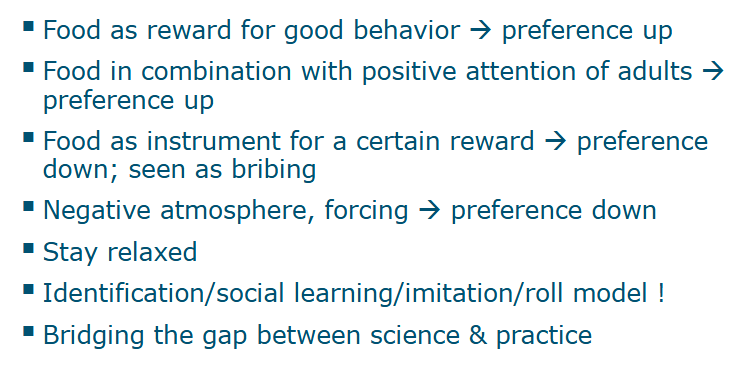
Food and social reinforcement