Lecture 8 - Dividend Policy
 Call Kai
 Learn
 Practice Test
 Spaced Repetition
 Match
 Flashcards
 Knowt Play
1/37

There's no tags or description
Looks like no tags are added yet.
38 Terms
What is payout policy for a firm?
The way a firm chooses to distribute surplus cash to shareholders
How much cash should be distributed?
How should it be distributed? - dividends or share repurchases
What are some key dates involved when firms pay dividends?
Declaration date: When the board of directors authorises the payment of a dividend
Ex-dividend date: For ordinary UK dividends, shares typically trade ex-dividend one business day before the record date
Record date: When a firm pays a dividend, only shareholders on record on this date receive the dividend
Payable (or distribution) date: A date generally within a month after the record date, on which a firm mails dividend checks to its registered shareholders
What were the key dates when Pfizer paid their first-quarter dividend in 2021?

How do firms pay dividends?
Cash dividend: Payment of cash by the firm to its shareholders
Stock split or stock dividend: A company issues a dividend in shares of stock rather than cash to its shareholders
Describe stock dividends
With a stock dividend, a firm doesn’t pay out any cash to the shareholders
As a result, the total market value of the firm’s equity is unchanged
The stock price will therefore fall because the same total equity value is now divided over a larger number of shares
Stock dividends are not taxed, so from both the firm’s and shareholders’ perspective, there is no real consequence to a stock dividend
The number of shares is proportionally increased, and the price per share is proportionally reduced so that there is no change in value
What is the motivation for a stock split?
The typical motivation for a stock split is to keep the share price in a range thought to be attractive to small investors
Give an example of a stock dividend and split (50% stock dividend, 3:2 stock split)

Describe share repurchases
An alternative way to pay cash to investors - the firm uses cash to buy shares of its own outstanding stock
These shares are retired or transferred to a ‘treasury stock’ account and removed from the issued capital of the company
They can be resold if the company needs to raise money in the future
What are the three reasons why firms undertake share repurchases?
As a return of excess cash flow in a form other than paying a dividend
As a form of capital management to increase the debt/equity ratio
To obtain common stock to use when options issued to employees are exercised
What are the main types of share repurchases?
Open market repurchase
Tender offer
Dutch auction
Targeted repurchase
Greenmail
What is an open market repurchase and a tender offer?
Open Market Repurchase
When a firm repurchases shares by buying shares in the open market
95% of all repurchase transactions
Tender Offer
A public announcement of an offer to buy back a specified amount of outstanding securities at a fixed price
What is a Dutch auction and a targeted repurchase?
Dutch Auction
The firm lists different prices to buy shares
Shareholders indicate how many shares they are willing to sell at each price
The firm then pays the lowest price
Targeted Repurchase
When a firm purchases shares directly from a specified shareholder
What is a greenmail?
When a firm avoids a threat of takeover and removal of its management by a major shareholder by buying out the shareholder, often at a larger premium over the current market price




How much would Mr Hauptmann receive?

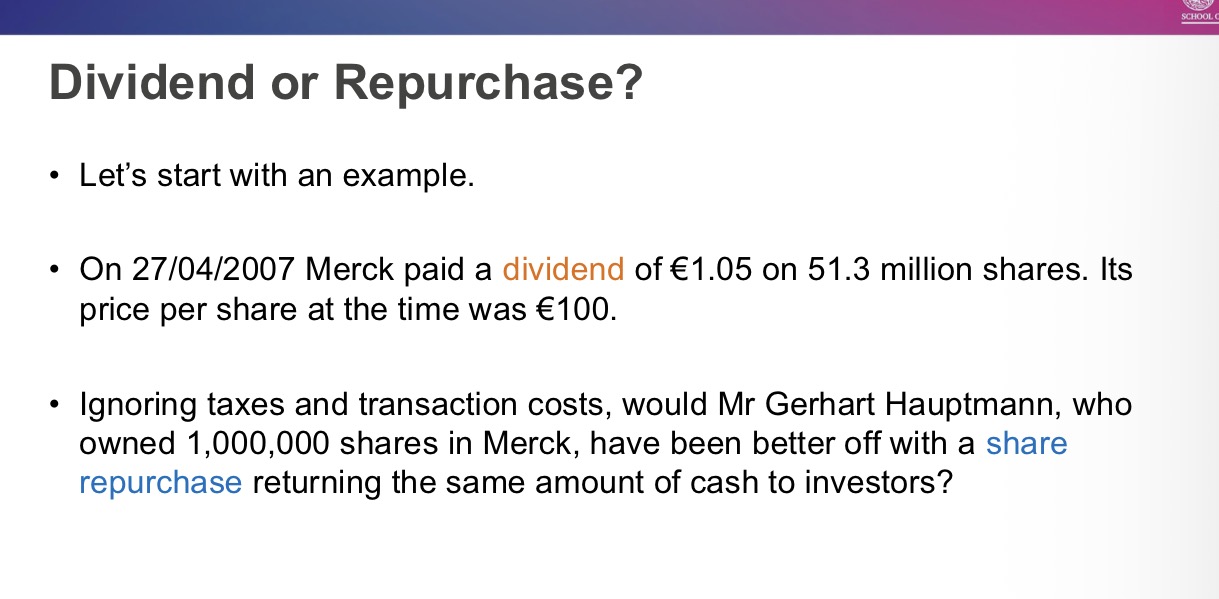
What about the firm?

What is the M&M dividend irrelevance proposition?
In perfect capital markets, holding fixed the investment policy of a firm, the firm’s choice of dividend policy is irrelevant and doesn’t affect the initial share price
If a firm increases its dividend, it undertakes a share issue. If it decreases its dividend, it undertakes a share repurchase
How do taxes work on dividends?
Shareholders must pay taxes on the dividends they receive, and they must also pay capital gains tax when they sell their shares
Dividends are typically taxed at a higher rate than capital gains
It is therefore argued that companies should pay the lowest dividend
How do US taxes work on dividends? Give a diagram of an IS to show it
About 1/5 of US financial managers cite investor taxes as an important influence on dividend decisions
In the US returns to shareholders are taxed twice. This example assumes that all income after corporate taxes is paid out as cash dividends

Show the value of share repurchases (as a % of total payouts) in the US from 1975 to 2020

How does the tax on dividends work in Australia with an IS to show it?
Under imputation systems such as Australia’s, shareholders can receive credits for corporate income tax already paid. The UK abolished its dividend tax credit in 2016

What are the current UK rules for investors’ taxes for dividends?

Show the share repurchase as a % of market capitalisation for the US, UK, Australia, Germany and Canada


Work out the total PV of taxes if BG pays immediate dividends to shareholders


Work out the total PV of taxes if BG repurchases the shares from shareholders

What are some additional notes about taxes?
The immediate tax liability is higher with a dividend
Future tax liability when shares are sold is higher with a share repurchase
PV of the total amount paid in taxes is still considerably lower with the repurchase alternative
Taxation is important but cannot be the whole story of payout
Show a graph of the percentage of firms either paying dividends or repurchasing shares from 1975 to 2020

What is the ‘Bird-in-the-hand’ theory of dividend payout?
Lintner (1962) and Gordon (1963) argue that most shareholders are risk adverse, and prefer a higher dividend payout as dividends are perceived as less risky than uncertain future capital gains
Shares of companies with higher dividend payout ratios or dividend yields should have higher prices (or lower required returns) than shares paying lower dividend yields
Describe how clientele effects relate to this theory, with different investor groups’ dividend policy preferences and the proportion
When a firm’s dividend policy reflects the tax preference of its investor clientele, individual in the highest tax brackets have a preference for stocks that pay no or low dividends, whereas tax-free investors and corporations have a preference for stocks with higher dividends

What is a dividend reinvestment plan (DRIP) and when is it attractive to shareholders and firms? What does the demand of a DRIP tell the firm?

Describe signalling effects and examples of signals
Under information asymmetry investors assume that significant dividend changes represent anticipated future earnings (dividend changes are “signals”)
Examples of signals:
Reported earnings announcements backed up by dividends give investors greater confidence
Target dividend payout ratios based on long-term earnings trend
Smooth dividend payouts
To return one-off cash, consider special dividend or share repurchase
Where cuts are necessary, publish adequate information
What did Lintner say in 1956 about dividend payout?
Firms have long run payout ratios
Managers focus on dividend changes rather than absolute levels
Dividends follow shifts in long run sustainable levels of earnings rather than short run earnings changes
Managers are reluctant to make dividend changes which have to be reversed, eg. rescinding a dividend increase
Give a summary of payout policy, including when firms favour low or high dividends, or that payout policy is irrelevant

Give the background behind Intel and what 2 decisions did it make about dividend payout in 2023 and 2024
Intel is a major US semiconductor producer. Developing new chip technologies and manufacturing facilities requires substantial long-term investment
In Feb 2023, Intel reduced its quarterly dividend from $0.365 to $0.125 per share to improve its financial flexibility
On Aug 2024, Intel announced that it would suspend its dividend from Q4 2024, while continuing its business restructuring and investment programme
Work out the dividend cut in 2023 and what other announcement did they make in the August 2024 announcement?

What then did management announce and what happened to Intel’s share price?
Management also announced a workforce reduction of more than 15% and a plan to reduce costs by more than $10bn in 2025
Intel’s share price fell approximately by 26% on 2 Aug 2024, the trading day after the announcements
This reaction cannot be attributed to dividend suspension alone: disappointing earnings, weaker guidance and restructuring plans were announced at the same time
Apply the dividend policy theories to Intel (signalling effects, investment and payout, and dividend clientele)
Signalling effect: A dividend suspension can signal weaker expected cash flows. However, the market also observed poor earnings and weaker guidance
Investment and payout: Investment needs and liquidity constraints made retained cash more valuable for Intel’s turnaround than regular dividends
Dividend clientele: Income-oriented shareholders may dislike the suspension, while investors prioritising the long run recovery may accept it