Lecture 12 (Super Resolution Microscopy)
 Call Kai
 Learn
 Practice Test
 Spaced Repetition
 Match
 Flashcards
 Knowt Play
1/27

There's no tags or description
Looks like no tags are added yet.
28 Terms
Light is a wave so it is
subject to diffraction
Numerical aperture lens can only
focus the light into a “point cloud”, but not a single point
Dimension of XY
200-300nm in super resolution microscopy
Dimension of Z
500-800nm in super resolution microscopy
Abbe’s Diffraction Limit is?

Diffraction limits what
the resolution of light microscopy
point spread function (PSF)
describes the response of a focused optical imaging system to a point source or point object

Is this resolvable?
Yes
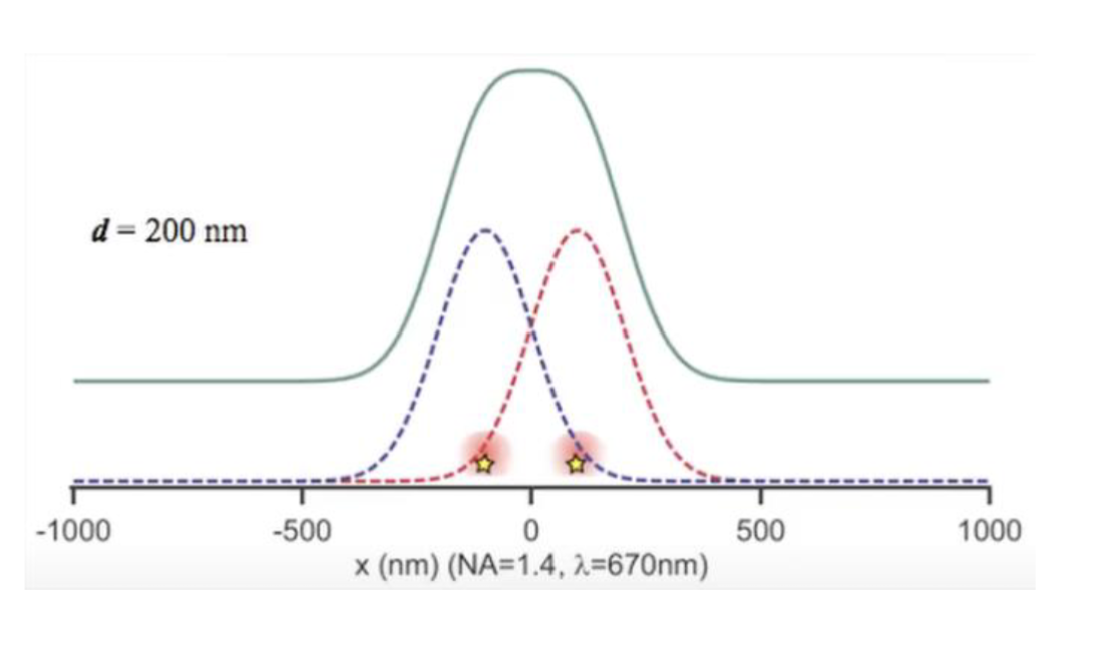
Is this resolvable?
No
What does single molecule microscopy require?
Well isolated molecules before imaging
Single Molecule Microscopy limit
Who was awarded the 2014 Nobel Prize in Chemistry for Super Resolution Microscopy
Eric Betzig, Stefan W. Hell, and William E. Moerner
What is PALM
Photoactivated Localization Microscopy
Principle of PALM
location of each molecule is first determined by fitting the expected molecular image given by the PSF of the microscope [(G), center] to the actual molecular image [(G), left], the molecule can be plotted [(G), right] as a Gaussian that has a standard deviation equal to the uncertainty σx,y in the fitted position.
What does STORM stand for?
Stochastic Optical Reconstruction Microscopy
What is STORM (Explanation)
STORM is a super-resolution microscopy technique that utilizes the stochastic switching of fluorescent molecules to achieve high-resolution imaging, allowing for precise localization of individual molecules in biological samples.
STED definition
STED (Stimulated Emission Depletion) is a super-resolution microscopy technique that uses a pair of laser beams to achieve resolution beyond the diffraction limit of 0.2um by selectively depleting the fluorescence of molecules in specific regions, thereby allowing for high-resolution imaging of biological samples.
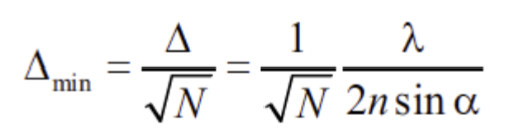
Abbe’s Equation modified for fluorescence

STED did what?
reduced the PSF to break diffraction limit
n is
the refractive index of the medium, which affects the resolution in microscopy
Alpha is
the half-angle of the cone of light entering the objective lens, impacting the numerical aperture and resolution
n sin alpha is
the numerical aperture of a microscope, influencing its resolution capabilities
Higher NA equals
smaller diffraction limit and better resolution
How does STED work?
by using a focused laser beam to excite fluorescence in a sample while a second, donut-shaped laser beam depletes the fluorescence surrounding the focal point, narrowing the observation area and enhancing resolution.
STED Diffraction Limit

STED what does l (x) stand for?
Local intensity of the STED depletion laser at position x
STED what does lsat stand for?
Saturation intensity, the STED intensity at which fluorescence is reduced to half its depleted value under a simplified steady-state model
STED what does S= l/lsat stand for?
Saturation factor, a dimensionless measure of how strongly the STED beam suppresses fluorescence