Renaissance Review
 Call Kai
 Learn
 Practice Test
 Spaced Repetition
 Match
 Flashcards
 Knowt Play
1/85

There's no tags or description
Looks like no tags are added yet.
86 Terms
What does Renaissance mean?
"Rebirth" in French.
What was the Renaissance?
A period from the 1400s–1600s marked by a revival of art, architecture, and literature inspired by ancient Greece and Rome.
Where did the Renaissance begin?
Italy.
What did the Renaissance promote?
Education and humanism.
What is a patron?
A wealthy or powerful person who pays for and commissions works of art, architecture, or literature.
What is patronage?
Financial support for creating art, architecture, and literature.
What is humanism?
A movement focused on human potential, individual dignity, and the revival of ancient Greek and Roman ideas.
What was humanism based on?
The study of classical Greek and Roman literature.
What subjects did humanists study?
Grammar, rhetoric, poetry, moral philosophy, and history.
What is classicism?
Respect for ancient Greek and Roman art, literature, architecture, and philosophy.
What is an example of classicism?
Michelangelo's David.
What is secularism?
A focus on worldly ideas and topics rather than just religion.
Which Renaissance focused more on secularism?
The Northern Renaissance.
What is an example of secularism?
Pieter Brueghel's Hunters in the Snow.
What is scholarship?
The use of reason, curiosity, and experimentation.
What is an example of scholarship?
Raphael's The School of Athens.
What is individualism?
Showing the dignity and worth of individuals.
What is an example of individualism?
Da Vinci's Mona Lisa.
What were the main causes of the Renaissance?
Rediscovery of classical knowledge, rise of humanism, economic prosperity, technological innovation, and social and cultural changes.
How did classical knowledge contribute to the Renaissance?
People rediscovered ancient Greek and Roman literature, philosophy, and science.
How did economics contribute to the Renaissance?
Trade created wealth, allowing wealthy patrons to fund art and learning.
What technological innovation helped spread Renaissance ideas?
The printing press.
What events caused social and cultural changes during the Renaissance?
The Crusades and the Black Death.
Who was Desiderius Erasmus, and what did he believe about Christianity?
A leading Christian humanist who believed in a pure, simple Christian life without unnecessary rituals or politics. His works were censored and condemned by the Church.
What did Erasmus believe about education?
He believed in the importance of educating children.
Who was Christine de Pisan, and what topics did she write about?
A writer who focused on the role of women in society, equality, and women's education.
What was The City of Women about?
A book discussing different views of women and their roles in society.
Why did Christine de Pisan turn to writing?
She became widowed and turned to writing to support her family.
Who was William Shakespeare?
The most famous English playwright of all time.
What topics did Shakespeare explore in his plays?
Natural science, humanist ideas, and human nature.
How did Shakespeare make his plays relatable?
He used language and themes that everyone could understand and relate to.
How did Shakespeare spread Renaissance ideas?
Through realistic, nonreligious plays that brought Renaissance ideas to the masses.
What famous book did Sir Thomas More write?
Utopia.
What did Utopia criticize?
The English government and society as a whole.
What does the word utopia mean, and how did it become popular?
An ideal society. The title of More's widely read book became a common word for an ideal society.
What famous book did Niccolo Machiavelli write?
The Prince.
What did Machiavelli believe about rulers being feared or loved?
He believed it was better for a ruler to be feared than loved.
What was Machiavelli's view of human nature?
He described men as ungrateful, fickle, and liars.
What did Machiavelli believe was more useful to rulers than idealism?
Power and ruthlessness.
What influenced Machiavelli's political beliefs?
His experiences with violent politics as a political philosopher and statesman.
Who was Baldassare Castiglione?
An Italian diplomat and humanist.
What book did Castiglione write, and when?
The Courtier (1528).
What did The Courtier discuss?
How the perfect gentleman and lady should act.
Who was Jan van Eyck?
A Northern Renaissance painter known for extremely detailed artwork.
What famous painting did Jan van Eyck create?
The Arnolfini Wedding Portrait.
How did Jan van Eyck incorporate religion into everyday life?
Through the use of symbolism in his paintings.
Who was Pieter Brueghel?
A Northern Renaissance painter known for painting scenes of everyday peasant life.
What are two famous paintings by Pieter Brueghel?
Hunters in the Snow and Peasant Wedding.
What famous paintings did Leonardo da Vinci create?
The Last Supper and the Mona Lisa.
What other skills did Leonardo da Vinci have besides painting?
He advised dukes on architecture and weaponry.
How skilled was Leonardo da Vinci as an artist?
He surpassed the level of his masters.
What famous works did Michelangelo create?
Sculpted David (marble), painted The Creation of Adam, and painted the Sistine Chapel ceiling.
What moment does Michelangelo's David represent?
David right before his battle with Goliath.
Why was Michelangelo considered a true Renaissance artist?
He was a master sculptor and painter.
How did Michelangelo learn about human anatomy?
He dissected corpses to better understand anatomy and make his artwork more realistic.
What famous sculpture did Donatello create?
David (bronze).
Why was Donatello's David controversial?
It was the first free-standing male nude sculpture since ancient times.
What moment does Donatello's David represent?
David after he had defeated Goliath.
What famous painting did Raphael create?
The School of Athens, a fresco.
What did Raphael use as models for the ancient philosophers in The School of Athens?
His own friends.
Who was Filippo Brunelleschi?
An architect and engineer who designed the dome of Florence's greatest cathedral.
How did Brunelleschi solve the problems involved in constructing the dome?
He used his knowledge of ancient architecture.
Who were Brunelleschi's patrons?
The Medici family, with whom he had a close relationship.
What is a fresco?
A painting made on fresh, wet plaster using water-based paints.
Where were frescoes most common?
The Italian Renaissance.
What were the main characteristics of Italian Renaissance art?
Realism, perspective, classical inspiration, religious subjects, focus on wealthy society, and frescoes.
What were the main characteristics of Northern Renaissance art?
Oil painting, detailed artwork, landscapes, everyday life, symbolism, realistic people, and peasant life.
What painting technique was popular in the Northern Renaissance?
Oil painting.
What painting technique was dominant in the Italian Renaissance?
Fresco painting.
What were the main subjects of Medieval art?
Religious figures and portraits, usually of wealthy or religious people.
Why was Medieval art considered unscientific?
It lacked shadows and depth and often showed unrealistic figures.
What types of sculptures were absent in Medieval art?
Freestanding sculptures.
Did Medieval art commonly include nudes?
No.
What were the main subjects of Renaissance art?
A variety of subjects, including human life, not just religion or portraits.
Why was Renaissance art considered scientific?
It used 3D figures, perspective, depth, and shading.
How were people depicted in Renaissance art?
Realistically and expressively.
What types of sculptures became popular during the Renaissance?
Freestanding sculptures inspired by ancient Greece and Rome.
Did Renaissance art include nudes?
Yes.
What is one major difference between Medieval and Renaissance art?
Medieval art focused mainly on religion, while Renaissance art explored a wider variety of subjects.
What is one major artistic improvement during the Renaissance?
More realistic figures, depth, shading, and perspective.

What is the name of this painting called and who is its painter?
The Last Supper by Leonardo Da Vinci
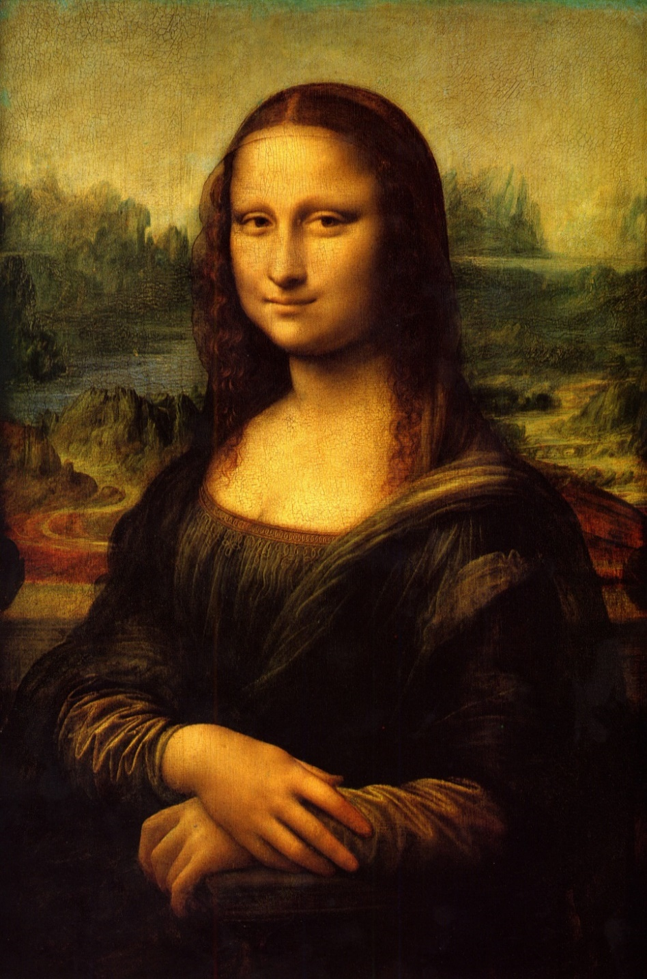
What is the name of this painting called and who is its painter?
Mona Lisa by Leonardo Da Vinci
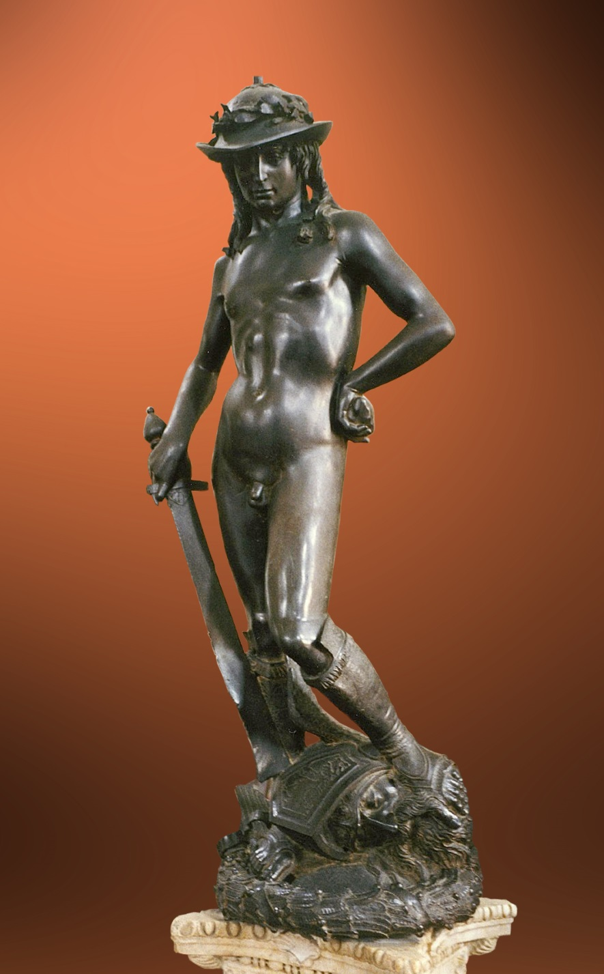
What is the name of this sculpture called and who is its sculptor?
David by Donatello

What is the name of this sculpture called and who is its sculptor?
David by Michelangelo

What is the name of this fresco called and who is its painter?
Creation of Adam by Michelangelo