magnetism
 Call Kai
 Learn
 Practice Test
 Spaced Repetition
 Match
 Flashcards
 Knowt Play
1/43

There's no tags or description
Looks like no tags are added yet.
44 Terms
any ______ ______ in motion creates a magnetic field these magnetic fields interact with each other
charged particle
imaginary lines of a magnetic field are always _____ _____
closed loops
with an electron circling a nucleus the magnetic field lines will always be _____ to the plane of motion
perpendicular
protons and electrons are charged particles when they move they generate a _____ ____
magnetic field
electrons behave as if they rotate on an axis clockwise or counterclockwise this rotation causes property known as _____ _____. this also induces a magnetic field
electron spin
magnetic fields are ______ meaning there is a north and south pole
dipolar
small magnet created by electron is called _____ ______
magnetic dipole

an accumulation of many dipoles aligned creates a _____ _____ when this happens it acts like a magnet
magnetic domain
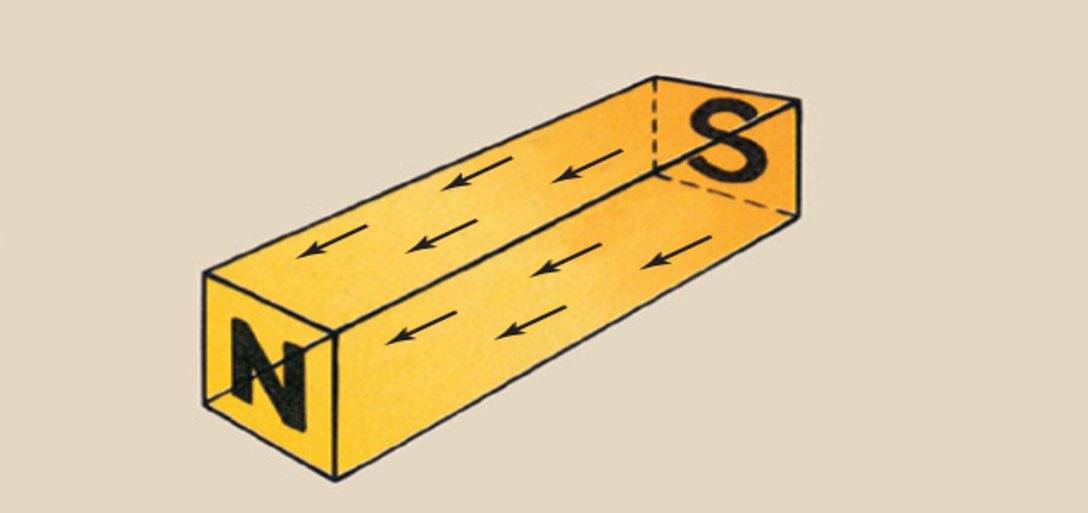
when acted on by an external source or artificially induced magnetism randomly oriented dipoles will _____ with the magnetic field. this is basis for MRI
align
when an external source like a strong magnet is applied the dipoles will line up with that external magnetic field. when enough align the material gets a north and south pole and behaves as a magnet this is known as ______ ________
induced magnetism
three principle types of magnets
-naturally occurring magnets
-artificially induced permanent magnets
-electromagnets
this is the best example of a naturally occurring magnet. it has a magnetic field because it spins on its axis. (also has a molten iron core which moves with the spinning)
earth
this is a natural magnet. it is naturally magnetized pieces of magnetite. found in the earth and have strong magnetic properties due to being within the earth’s magnetic field for a long time becoming permanently magnetized.
Lodestones
this type of magnet is available in many sizes and shapes but principally as bar or horseshoe shaped magnets that are usually made of IRON
artificially produced magnets
this is an example of an artificial permanent magnet
compass
what makes magnet a ____ ______ is that their dipoles (domains) were forced to become aligned by exposing the material to strong external magnetic field.
permanent magnet
permanent magnets magnetic property can be destroyed by _______ the magnet or _____ it with a hammer. this causes magnetic domains to be jarred from alignment
heating the magnet (heat causes atoms to vibrate)
hitting it with a hammer
can all metals become a permanent magnet?
no.
this type of magnet can be turned on or off via electricity. it consists of a wire wrapped around an iron core. The electric current runs through the wire and a magnetic field is created. the magnetic field intensity it proportional to the current
electromagnet
matter can be classified by four interactions or states of matter with an external magnetic field
-non magnetic
-diamagnetic
-paramagnetic
-ferromagnetic
this applies to many materials. it is when they are unaffected when brought into a magnetic field.
non-magnetic

name two nonmagnetic materials
wood, and glass
these materials are weakly repelled by either magnetic pole when brought into magnetic field. cannot be artificially magnetized.
diamagnetic
name three diamagnetic materials
plastic and water and copper
these materials are strongly attracted to a magnetic field and can usually be permanently magnetized.
ferromagnetic

name three ferromagnetic materials
iron, cobalt, nickel
this alloy is one of the more useful magnets produced from ferromagnetic material. made of aluminum and nickel. retains magnetism even when heated.
alnico
these materials are somewhere between ferromagnetic and non magnetic. they are slightly attracted to a magnet and loosely influenced by an external magnetic field (only lasts when external magnetic field is present, loses magnetism when it is gone)
paramagnetism
name one material that is paramagnetic
gadolinium used in mri
this is the degree to which a material can be magnetized. (iron would be high) (wood low)
magnetic susceptibility
when iron is placed in magnetic field it increases the strength of the field so it has high _____ _____ wood does not increase the strength of the field so it has low _____ _____
magnetic susceptibility
there is a smallest unit of magnetism true or false?
false. when you divide a magnet you just make a smaller magnet. there is no separating the north and south pole.
every magnet has a north and south pole this is analogous to ____ and _____ electrostatic charges
positive and negative
like magnetic poles _____ unlike magnetic poles _____
repel, attract (just like positive and negative electrostatic charges)
these are the imaginary lines of the magnetic field they leave the north pole of the magnet and return to the south.
lines of induction (or flux lines)

the intensity of flux lines are ____ to the intensity of the magnetic field. more lines that are packed together= ____ magnetic field
proportional, more lines packed together means stronger field.

what is the SI unit of the magnetic field
Tesla. one Tesla= 10,000 Gauss
earth at the surface is ____ Tesla. Mri is ___-___ tesla
.0005 tesla. MRI 1.5-3 Tesla
like electrostatic charges some materials can be made magnetic via _______. ex if you have soft iron and bring it near magnetic field the lines of induction are altered, attracted to the soft iron and the iron is made temporarily magnetic
induction

most ferromagnetic material when removed form magnetic field does or does not? retain its strong magnetic property
does not
this is a good temporary magnet since it will become a magnet during induction as long as magnetic field is in vicinity
soft iron
if copper was brought into a magnetic field would it become magnetic by induction?
no. copper would not it is diamagnetic

what are two things that can be done to have ferromagnetic materials retain their magnetism when removed from external magnetic field to become permanent magnets?
properly temper the material with heat
leave it exposed to external magnetic field for a long time
intensity of magnetic force is ______ to product of the magnetic divided by the square of distance between them
proportional